
Test 2 of 10 · 20 questions · Free 2026
SD Permit Practice Test 2
Jump to the test ↓A fixed 20 question set from the South Dakota bank with answers and plain English explanations.
Question 1 of 20 · 0 right so far
All 20 questions in test 2
Every question below comes from the South Dakota question bank on this page. Open a question to see the correct answer and the explanation. Nothing here is hidden behind a signup.
1. In which months does the South Dakota manual say to be especially alert for deer?
- October and November
- June and July
- January and February
- March and April
Show answer
October and November. The manual singles out October and November as the months to be especially alert for deer, because those are the months with the highest number of car and deer crashes. Deer are the second most commonly struck object in the state. Deer are most active at dusk and dawn, so scan the roadsides then, slow down when you see eyes reflecting in your headlights, blow the horn, and be ready to stop. Always watch for more than one deer.
Study this in the handbook: Night, winter, deer and work zones
2. What does a red arrow signal mean?
- You may turn after yielding to pedestrians
- The arrow direction has priority over other lanes
- You may proceed if there is no oncoming traffic
- You must stop and may not go in the arrow's direction
Show answer
You must stop and may not go in the arrow's direction. A red arrow means stop, and you cannot move in the direction shown by the arrow until the signal changes. It is stricter than a permissive turn movement because the arrow specifically controls that direction. The yield and turn choice is wrong because it treats a red arrow like a right turn on a circular red light. The cue is the arrow shape: it applies to the indicated turn lane or movement, not every direction at the intersection.
Study this in the handbook: Traffic signals and arrows
3. When passing horseback riders or animal-drawn vehicles, what should you avoid?
- Avoid leaving extra space
- Avoid slowing before you pass
- Avoid using the horn or revving the engine
- Avoid looking for driveway turns
Show answer
Avoid using the horn or revving the engine. Horses can be frightened by sudden noise, so South Dakota tells drivers not to honk or rev the engine near animal-drawn vehicles or riders. Avoiding extra space is the opposite of a cautious pass. Look for rural warning signs, fields, and driveways, then pass slowly and expect an animal-drawn vehicle to turn left. Extra patience is important because riders and animals can react unpredictably to sound, speed, or tight clearance.
Study this in the handbook: Pedestrians, bicyclists, motorcyclists and school buses
4. At a crash scene with wrecked vehicles, what should be done about ignition and smoking?
- Turn off ignitions and do not smoke around wrecked vehicles
- Keep engines running so emergency lights stay bright
- Smoke only if no flame is visible
- Restart damaged vehicles to move debris faster
Show answer
Turn off ignitions and do not smoke around wrecked vehicles. South Dakota warns that spilled fuel can make fire a real danger after a crash. Turning off ignitions and avoiding smoking lowers that risk. Keeping engines running goes against the manual's direct instruction to turn off the ignition of every wrecked vehicle. The cue is any wrecked vehicle, especially where you smell fuel or see fluid on the pavement. After reducing fire risk, keep people out of traffic lanes and call for police or medical help when needed.
Study this in the handbook: Crashes, emergency vehicles and traffic stops
5. In rainy, snowy, or foggy weather, what lighting habit does South Dakota recommend?
- Use parking lights instead of headlights
- Keep lights off until sunset
- Use high beams continuously in fog
- Turn on headlights whenever you use the wipers
Show answer
Turn on headlights whenever you use the wipers. South Dakota gives an easy visibility rule: if you turn on the wipers, turn on the headlights. Rain, snow, and fog make it harder for other drivers to see your vehicle, even during daylight. The parking lights choice is wrong because parking lights are for parked vehicles only, not for driving in low visibility. The cue is your wiper switch: once it is needed for weather, your headlights should help others find you.
6. How does the South Dakota manual define a truck's No-Zone?
- The lane reserved for trucks on hills
- The 100 feet directly in front of a truck only
- Any area where trucks are prohibited
- The areas around trucks and buses where cars disappear into blind spots or are so close they restrict the driver's ability to stop or maneuver
Show answer
The areas around trucks and buses where cars disappear into blind spots or are so close they restrict the driver's ability to stop or maneuver. Trucks and buses have blind spots called No-Zones. The manual defines them as the areas around trucks and buses where cars disappear into blind spots or are so close that they restrict the truck or bus driver's ability to stop or maneuver safely. Both kinds greatly increase the potential for a crash. The No-Zone surrounds the vehicle on the sides, front and rear, not just ahead, and it has nothing to do with truck restrictions or hill lanes.
Study this in the handbook: Following distance, passing and large vehicles
7. From 10 p.m. to 6 a.m., when may a South Dakota Restricted Minor’s Permit holder drive under the basic restriction?
- Whenever the trip is less than 5 miles
- When any licensed friend rides in the back seat
- When accompanied by a parent or legal guardian seated beside the driver
- Only if the vehicle has daytime running lamps
Show answer
When accompanied by a parent or legal guardian seated beside the driver. The basic nighttime restriction for a Restricted Minor’s Permit requires a parent or legal guardian in the seat beside the driver from 10 p.m. to 6 a.m. A licensed friend in the back seat does not meet that requirement because the adult must be the parent or guardian and must occupy the adjacent seat. The cue is clock time: after 10 p.m., check whether the listed exception applies or whether the parent or guardian is seated beside the minor.
Study this in the handbook: Instruction and Restricted Minor's Permits
8. What is the minimum age for a South Dakota under-18 Instruction Permit?
- 15 years old
- 14 years old
- 15 years and 6 months old
- 16 years old
Show answer
14 years old. South Dakota allows an under-18 Instruction Permit at age 14 after the applicant passes the required vision and knowledge tests. The 16-year choice is misleading because 16 is tied to an Operator’s License, not the initial under-18 permit. A useful cue is the graduated sequence: at 14 a minor may begin supervised instruction, then must hold the permit for the required period before moving to a restricted permit or license.
Study this in the handbook: Instruction and Restricted Minor's Permits
9. What condition does this skidding-car sign warn about?

- Only vehicles with chains may enter
- The road may be slippery when wet
- The lane is closed to passenger cars
- A sharp drop-off begins at the shoulder
Show answer
The road may be slippery when wet. South Dakota's common warning signs include Slippery When Wet. That differs from a tire-chain requirement, which would be a separate control rather than a general hazard warning. The skidding-car symbol is the cue to reduce speed before the slick area, avoid sudden steering or braking, and leave more following distance if rain, ice, or standing water is present. South Dakota groups this sign with other warnings that tell drivers to slow down and be prepared for a hazard ahead.
Study this in the handbook: Warning, railroad and work zone signs
10. Under South Dakota law, how may a child under five who weighs at least 40 pounds be secured?
- The child may be secured in a seatbelt
- The child must ride in a rear-facing seat
- The child may ride on an adult's lap
- The child needs no restraint
Show answer
The child may be secured in a seatbelt. South Dakota requires a child under five to be secured in an approved child passenger restraint system. The requirement is met for a child under five who weighs at least forty pounds by securing the child in a seatbelt. Rear-facing seats are for infants, and a lap is never safe, since the child would be torn away or crushed in a collision. Violating the rule is a petty offense for the operator.
Study this in the handbook: Seat belts, child seats and driving position
11. What does a yellow right-curve sign warn you to expect?

- A right turn is required now
- A curve to the right ahead
- A one-way street begins to the right
- A no-passing zone ends after the sign
Show answer
A curve to the right ahead. The manual's warning sign examples include Right Curve, which warns of roadway alignment rather than a required turn. The required-turn choice would be regulatory and would tell you what movement to make, not warn about the shape of the road. Use the curved arrow as the cue to manage speed before the bend and keep steady lane position through it.
Study this in the handbook: Warning, railroad and work zone signs
12. What kind of sign is this red circle and slash over the letter P?
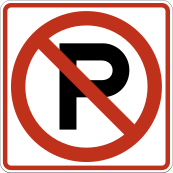
- A service sign showing nearby parking help
- A regulatory sign stating a law you must obey
- A warning sign for a hazard ahead
- A destination sign giving distance to cities
Show answer
A regulatory sign stating a law you must obey. South Dakota lists No Parking among its common regulatory signs. Regulatory signs talk about specific laws that you must obey, including rules for parking, and some use a red circle with a red slash over a symbol to prohibit an action. Here the slash over the letter P means parking is prohibited where the sign is posted. It is not a service, warning, or destination sign, which give help, hazard, or route information instead.
Study this in the handbook: Regulatory, stop, yield and guide signs
13. Which violation does NOT add points to a South Dakota driving record?
- Reckless driving
- Failure to yield right-of-way
- Speeding
- A stop sign violation
Show answer
Speeding. South Dakota's point system states that no points are assessed for speeding, standing, parking, equipment, size, or weight violations. That makes speeding the exception among the choices here. Reckless driving, failure to yield, and stop sign or light violations are all on the point schedule. Speeding is still a violation; it simply does not count toward the 15 point and 22 point suspension thresholds.
Study this in the handbook: License rules, insurance and the point system
14. After a DWI conviction in South Dakota, what insurance filing is required?
- No filing, only a fine
- Proof of insurance for 30 days
- A one-time letter from the insurer
- An SR22 filing maintained for 3 years from the eligibility date
Show answer
An SR22 filing maintained for 3 years from the eligibility date. Upon conviction of DWI, the driver must present an SR22 insurance filing to the Department of Public Safety and maintain it for 3 years from the eligibility date. A one-time letter or 30 days of proof does not satisfy the requirement. The same 3 year SR22 rule applies after a conviction for failing to maintain proof of insurance. SR22 forms go to the central office, not a local exam station.
Study this in the handbook: Alcohol, zero tolerance and implied consent
15. A South Dakota driver sits in a parked car with the engine running after drinking. Can the driver be arrested for DWI?
- Yes, having physical control is enough if BAC is over the limit
- Only if the driver is under 21
- No, because the car is not moving
- Only if the car is on an interstate
Show answer
Yes, having physical control is enough if BAC is over the limit. South Dakota says that if you have physical control of a vehicle, you do not have to be driving to be arrested when your BAC is over the legal limit. A parked car with the engine running and the driver behind the wheel can meet that test. The rule is not limited to drivers under 21 or to interstates. Drivers under 21 face the lower Zero Tolerance range starting at 0.02%.
Study this in the handbook: Alcohol, zero tolerance and implied consent
16. What do blue service signs show?
- Places where passing is prohibited
- The maximum safe speed for ideal conditions
- Locations of services such as rest areas, gas stations, campgrounds, or hospitals
- A railroad crossing with more than one track
Show answer
Locations of services such as rest areas, gas stations, campgrounds, or hospitals. Blue service signs point drivers toward services such as rest areas, gas, camping, or hospitals. A maximum safe speed is posted on a speed limit sign, which is black and white. The cue is a blue square or rectangle with white letters or symbols for traveler services near an exit or roadway. These signs help with trip decisions, but they do not change right-of-way or speed obligations by themselves.
Study this in the handbook: Regulatory, stop, yield and guide signs
17. At a South Dakota intersection, who must be yielded to if they are still in the intersection?
- No one after your signal turns green
- Only motor vehicles larger than yours
- Only pedestrians inside painted crosswalk lines
- Pedestrians, bicyclists, and other drivers
Show answer
Pedestrians, bicyclists, and other drivers. South Dakota includes pedestrians, bicyclists, and other drivers in its yield rule for anyone still occupying the intersection. A green signal or an opening does not erase the need to let the intersection clear. The painted-crosswalk choice is too narrow because the manual phrase includes more than pedestrians and does not limit the duty to marked lines. The cue is occupancy: before moving, scan the whole intersection for people or vehicles that have not cleared.
Study this in the handbook: Right of way, funerals and intersections
18. What offense can result if a driver violates South Dakota’s stopped-vehicle warning-light law and causes a crash?
- A parking infraction
- A Class 1 misdemeanor
- A registration-only penalty
- A warning unless someone is injured
Show answer
A Class 1 misdemeanor. South Dakota treats a crash caused while violating the stopped-vehicle warning-light law as a Class 1 misdemeanor when the crash involves a qualifying emergency vehicle or stopped vehicle with amber, yellow, or blue lights. A warning is not the listed consequence, and the rule does not depend only on whether someone is injured. The cue is the combination of violation plus crash: failing to stop, move over, or slow can escalate the offense classification.
19. What should you do first if your vehicle begins to skid?
- Turn the ignition to lock
- Set the parking brake firmly
- Release pressure from the brake or accelerator
- Accelerate hard toward the shoulder
Show answer
Release pressure from the brake or accelerator. When a skid begins, release pressure from the brake or accelerator and look where you want the vehicle to go. Adding abrupt braking or power can make the tires lose more grip, which leaves you with even less control. The parking brake choice is especially risky because locking wheels can deepen the skid. Your cue is the first slide or sideways pull: get off the pedal causing the skid and aim your eyes down the intended path.
Study this in the handbook: Skids, brake failure and other vehicle emergencies
20. What does a flashing yellow traffic light mean in South Dakota?
- Slow down and proceed with caution
- Stop completely and wait for a green signal
- Traffic from every direction must stop
- The signal is reserved for emergency vehicles
Show answer
Slow down and proceed with caution. A flashing yellow signal means slow down and proceed with caution. It is not the same as a flashing red, which South Dakota treats like a stop sign. Use the flashing yellow lamp as the cue to reduce speed, scan the intersection or hazard area, and continue only with enough control to respond if another road user enters. A steady yellow is different: it means the light is about to turn red and you must stop if it is safe.
Study this in the handbook: Traffic signals and arrows
QualitySpace is expanding to South Dakota
We are a California-based independent insurance brokerage working on licensing in more states. We cannot help with South Dakota insurance yet. Leave your email and we will let you know when we can.
Every question is written from the official South Dakota Driver License Manual. Need paper? Printable SD practice test with answer key.
Last verified 2026-10-05. How we check every question · Study all 202 as flashcards
Frequently asked questions
How many questions are on this South Dakota practice test?
This fixed set has 20 questions. It is test 2 of 10 from the 202 question South Dakota bank.
How does this fixed test relate to the full South Dakota bank?
Each numbered test is a fixed set of questions in a fixed order, so you can retake the same test later and compare. Every test mixes road signs and the other topics in about the same proportion as the full bank. Tests 1 to 10 together cover 200 of the 202 questions in the South Dakota bank, each once. The full practice page mixes the whole bank at random.
Last verified 2026-10-05. See the South Dakota DMV facts page for sourced state details.
Return to the full South Dakota practice test · Study road signs