
Test 6 of 10 · 20 questions · Free 2026
SD Permit Practice Test 6
Jump to the test ↓A fixed 20 question set from the South Dakota bank with answers and plain English explanations.
Question 1 of 20 · 0 right so far
All 20 questions in test 6
Every question below comes from the South Dakota question bank on this page. Open a question to see the correct answer and the explanation. Nothing here is hidden behind a signup.
1. Your vehicle has trouble and you must stop on a South Dakota highway. What should you try to do first?
- Get your vehicle off the road and away from traffic if possible
- Stop in the travel lane and wait for help
- Turn off all lights so other drivers are not distracted
- Stand near the center line to warn traffic
Show answer
Get your vehicle off the road and away from traffic if possible. South Dakota's breakdown guidance starts with getting the vehicle off the road and away from traffic when that is possible. Next, turn on the 4-way emergency flashers to show you are having trouble. If you cannot get completely off the road, stop where other drivers have a clear view of the vehicle, not just over a hill or just around a curve. Stand off the road where you are safe from traffic, and never stand in the roadway.
Study this in the handbook: Night, winter, deer and work zones
2. In a South Dakota funeral procession, which vehicle must obey traffic signs and signals?
- Only the hearse
- Only the first vehicle
- Every third vehicle
- Only vehicles without headlights on
Show answer
Only the first vehicle. South Dakota assigns the traffic-control duty to the first vehicle in a funeral procession. The vehicles behind it are identified by headlights and should not be cut off or interfered with as the group proceeds. The hearse choice is too narrow because the rule says first vehicle, which may or may not be the hearse in every arrangement. Your cue is position in the procession: lead vehicle obeys the signal, following marked vehicles stay together.
Study this in the handbook: Right of way, funerals and intersections
3. Which debt can cost a South Dakota driver the license?
- Any unpaid parking meter
- A credit card balance over $500
- Owing $1,000 or more to a South Dakota government agency
- A $100 library fine
Show answer
Owing $1,000 or more to a South Dakota government agency. The manual lists owing debt to a South Dakota government agency totaling $1,000 or more as a reason to lose the license, along with failing to pay a fine from a traffic conviction. Private debts such as a credit card balance are not on the list, and a small library fine or parking meter does not meet the threshold. Child support arrearages of $1,000 or more can also block a license.
Study this in the handbook: License rules, insurance and the point system
4. How does South Dakota classify a third DWI offense in the manual?
- Class 6 felony
- Class 2 misdemeanor
- Petty offense
- Civil insurance violation
Show answer
Class 6 felony. The third DWI listed in the manual is no longer treated as the same misdemeanor level as earlier offenses. It is a Class 6 felony, with possible imprisonment and license loss for no less than one year after release from incarceration. The Class 2 misdemeanor option belongs to different violations, including underage Zero Tolerance and some traffic offenses, not a third DWI. The cue is count escalation: third offense means felony treatment in this penalty list.
Study this in the handbook: DWI and zero tolerance penalties
5. What does South Dakota say may happen to speeding fines in a work zone?
- They are waived if workers are absent
- They may be doubled
- They are always reduced for first offenses
- They become parking violations
Show answer
They may be doubled. Work zones require lower speeds and closer attention because workers, lane shifts, equipment, and rough surfaces may be present. South Dakota warns that fines for speeding in a work zone may be doubled. The waived-if-absent choice has no support: the manual simply says to reduce your speed in work zones, be prepared to stop suddenly, and avoid tailgating there. The cue is work-zone signing: once you see orange signs, reduced limits, or lane changes, slow early and expect stronger penalties.
Study this in the handbook: Warning, railroad and work zone signs
6. At a steady green light, what must you do before moving from a stop?
- Enter immediately before cross traffic reacts
- Allow crossing traffic to clear the intersection
- Wait until the light turns yellow
- Turn left without yielding to oncoming traffic
Show answer
Allow crossing traffic to clear the intersection. A green light allows movement, but South Dakota requires a stopped driver to let crossing traffic clear before proceeding. Entering immediately can trap you in conflict with a late vehicle or pedestrian. The cue is a fresh green after you have been stopped; pause long enough to confirm the intersection is open. This small pause is most important just after a signal change, when cross traffic may still be finishing.
Study this in the handbook: Traffic signals and arrows
7. What should you do if your vehicle breaks down on a highway?
- Stop just past a hill so approaching traffic slows
- Leave the vehicle in the lane with headlights off
- Get off the road and turn on emergency flashers
- Stand behind the vehicle to direct traffic around it
Show answer
Get off the road and turn on emergency flashers. For a highway breakdown, get the vehicle off the road and away from traffic, then turn on emergency flashers so other drivers can see the problem. Standing behind the vehicle or stopping where sight distance is poor increases the chance of being struck. The hill choice is wrong because the manual warns against stopping just over a hill or around a curve. Use the cue of disabled movement: move out of the travel lane before anything else if possible.
Study this in the handbook: Skids, brake failure and other vehicle emergencies
8. What following distance should you normally keep behind the vehicle ahead?
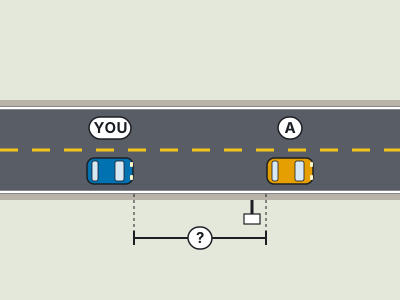
- One car length for every 20 mph of speed
- A minimum of 4 seconds
- At least 2 seconds in town and 3 seconds on highways
- Close enough to read the rear license plate
Show answer
A minimum of 4 seconds. South Dakota teaches a minimum 4 second following distance for ordinary driving. That time gap gives you room to notice a problem, react, and brake without relying on the driver ahead to keep moving. The 2 or 3 choice “At least 2 seconds in town and 3 seconds on highways” is tempting, but those gaps are shorter than the 4 second minimum this manual sets. Pick a roadside object, start counting when the rear of the lead vehicle passes it, and stay back until your count reaches four.
Study this in the handbook: Following distance, passing and large vehicles
9. What does a yield sign tell a South Dakota driver to do?
- Slow down and give right of way to traffic in or entering the conflict area
- Stop every time before the sign
- Proceed first if driving on the wider street
- Turn only in the direction shown by an arrow
Show answer
Slow down and give right of way to traffic in or entering the conflict area. A yield sign means slow down and be ready to let other traffic go first in the intersection or roadway you are entering. It differs from a stop sign, where the manual demands a stop behind the line or crosswalk; the yield duty is to slow and let others go first, stopping when they are in your way. The stop every time choice changes the control from yield to stop. The visual cue is the red and white downward triangle, which warns you to check gaps before entering.
Study this in the handbook: Regulatory, stop, yield and guide signs
10. If a tire blows out or suddenly goes flat, what should you avoid doing?
- Holding the steering wheel firmly
- Taking your foot off the accelerator
- Pulling off at a safe place
- Braking hard right away
Show answer
Braking hard right away. During a blowout, grip the wheel, keep the vehicle straight, and slow gradually. South Dakota tells drivers not to brake because a sudden brake application can upset the vehicle while the tire is already pulling or wobbling. Taking your foot off the accelerator is part of the recommended response, not the mistake. The cue is the bang, pull, or shake from the tire: stabilize first, let speed bleed off, and leave the road when safe.
Study this in the handbook: Skids, brake failure and other vehicle emergencies
11. When may a driver under 18 with a restricted minor's permit drive alone after 10 p.m.?
- Whenever the trip is inside the driver's home county
- When taking the most direct route to or from school, church, work, or farm related work
- Only when carrying no passengers and staying under 35 mph
- Any time after completing one month on the restricted permit
Show answer
When taking the most direct route to or from school, church, work, or farm related work. A restricted minor's permit normally limits unsupervised driving after 10 p.m., but South Dakota lists specific direct route exceptions. School, church, work, and farm related work can qualify when the driver takes the most direct route. The no passengers and 35 mph choice sounds cautious, yet it adds conditions that do not create a late night privilege. The cue is trip purpose: if it is not one of the listed purposes, a parent or legal guardian must be beside the driver.
Study this in the handbook: Instruction and Restricted Minor's Permits
12. How many supervised driving hours must a South Dakota minor complete on an Instruction Permit?
- 50 hours, including 10 in inclement weather and 10 after dark
- 25 hours, all during daylight
- 40 hours, with no weather or night requirement
- 100 hours, including 20 on interstate highways
Show answer
50 hours, including 10 in inclement weather and 10 after dark. For an under-18 Instruction Permit holder, South Dakota requires 50 hours of supervised driving. The total must include both difficult-weather practice and after-dark practice, with 10 hours in each category. The 40-hour choice is wrong because it omits the manual’s larger total and the specific conditions. A concrete cue for families is the logbook: count the overall hours, then separately verify that bad-weather and night entries each reach 10 before seeking the next credential.
Study this in the handbook: Instruction and Restricted Minor's Permits
13. What must you do when facing a completely unlighted traffic signal in South Dakota?
- Keep moving if cross traffic appears light
- Treat it as a yield sign until power returns
- Stop as though you were at a stop sign
- Follow the last color you saw before it went dark
Show answer
Stop as though you were at a stop sign. South Dakota gives a specific rule for a dark signal: a red or completely unlighted signal requires the same stop you would make at a stop sign. Treating it as a yield sign is too loose because yielding can allow a rolling entry. Your cue is the absence of a working lamp facing you; make a full stop, check each approach, and proceed only when safe.
Study this in the handbook: Traffic signals and arrows
14. What does this curvy road warning sign mean?

- The shoulder is open for passing
- A single stop sign is hidden ahead
- Traffic must move only one way
- Several curves are ahead
Show answer
Several curves are ahead. South Dakota's warning sign group includes Curvy Road, which alerts drivers to a series of alignment changes. Warning signs are usually yellow diamonds that tell you of possible danger ahead. A one-way message would come from a regulatory sign with a directional arrow, not a yellow curvy road warning. Use the repeated curve symbol as the cue to reduce speed, keep both hands steady, and avoid starting a pass where sight distance changes quickly.
Study this in the handbook: Warning, railroad and work zone signs
15. What roadway condition does this merge sign warn about?

- A required stop at every lane line
- A railroad crossing with several tracks
- A road closed by construction barriers
- Traffic entering or joining your roadway
Show answer
Traffic entering or joining your roadway. South Dakota lists Merging Traffic as one of the common warning signs. The railroad option belongs to RXR and crossbuck signs, not a merge symbol. When you see the merging arrow, expect another traffic stream to join yours, check mirrors and side space, and adjust speed or position so vehicles can enter without forcing a sudden stop. The manual lists this sign among warnings about a hazard or special situation on the roadway ahead.
Study this in the handbook: Warning, railroad and work zone signs
16. A driver licensed in a state without implied consent is arrested for DWI in South Dakota. Whose implied consent law applies?
- The home state's law
- Neither state's law
- South Dakota's law, because it is the state of arrest
- Only federal law
Show answer
South Dakota's law, because it is the state of arrest. The manual explains that implied consent law applies to the state where you were arrested, not the state that issued your license. A driver from a state with no implied consent law who is arrested in South Dakota is subject to South Dakota's law, including the possible one year license loss for refusing a BAC test. The home state rule, the no law choice, and federal law are all wrong.
Study this in the handbook: Alcohol, zero tolerance and implied consent
17. Under SDCL 32-37-1.2, which operators must wear a seatbelt, with a violation treated as a petty offense?
- Only operators on interstates
- Only operators over 21
- Operators at least fourteen and under eighteen
- Operators under 12
Show answer
Operators at least fourteen and under eighteen. South Dakota Codified Law 32-37-1.2 requires any operator of a passenger vehicle on a public street or highway who is at least fourteen and under eighteen to wear a properly adjusted and fastened seatbelt whenever the vehicle is moving, and a violation is a petty offense. Separately, every operator and front seat passenger must belt up under 32-38-1. Over 21 only, interstate only, and under 12 do not describe this statute.
Study this in the handbook: Seat belts, child seats and driving position
18. What do green or brown destination signs show?
- Directions and distance to locations such as cities or special areas
- That a vehicle is traveling less than 25 mph
- Where drivers must stop for a school bus
- That passing is permitted in both directions
Show answer
Directions and distance to locations such as cities or special areas. Destination signs use green or brown backgrounds with white lettering to show directions and distances to places, airports, state lines, parks, museums, or other special areas. The slow-moving vehicle triangle is a different sign entirely. The cue is route or destination information rather than a command to stop, yield, or change speed. Read these signs early enough to choose the proper lane without a sudden last-minute movement.
Study this in the handbook: Warning, railroad and work zone signs
19. What is the fee for a new or renewed regular South Dakota driver license or instruction permit?
- $20.00
- $10.00
- $50.00
- $38.00
Show answer
$38.00. The fee schedule lists a regular driver license or instruction permit, whether an upgrade, new issue, renewal or transfer from out of state, at $38.00, and the same $38.00 applies to an identification card. An address change, name change, or replacement license or ID card costs $20.00. The manual notes the amounts are subject to change, so treat them as the current published figures rather than permanent numbers.
20. What is hydroplaning?
- The vehicle drifting because of strong wind
- A tire losing air suddenly after a puncture
- A normal ABS vibration during hard braking
- The steering tires riding up on pooled water
Show answer
The steering tires riding up on pooled water. Hydroplaning begins when steering tires ride on water instead of gripping the road. A sudden loss of tire air is a blowout, not hydroplaning. Watch for pooled water or puddles during rain, slow before reaching them, and avoid sharp steering or hard braking because the tires have less contact with the pavement. The safer response is speed control before the water, because steering and braking choices shrink once traction is gone.
Study this in the handbook: Controlling speed
QualitySpace is expanding to South Dakota
We are a California-based independent insurance brokerage working on licensing in more states. We cannot help with South Dakota insurance yet. Leave your email and we will let you know when we can.
Every question is written from the official South Dakota Driver License Manual. Need paper? Printable SD practice test with answer key.
Last verified 2026-10-05. How we check every question · Study all 202 as flashcards
Frequently asked questions
How many questions are on this South Dakota practice test?
This fixed set has 20 questions. It is test 6 of 10 from the 202 question South Dakota bank.
How does this fixed test relate to the full South Dakota bank?
Each numbered test is a fixed set of questions in a fixed order, so you can retake the same test later and compare. Every test mixes road signs and the other topics in about the same proportion as the full bank. Tests 1 to 10 together cover 200 of the 202 questions in the South Dakota bank, each once. The full practice page mixes the whole bank at random.
Last verified 2026-10-05. See the South Dakota DMV facts page for sourced state details.
Return to the full South Dakota practice test · Study road signs