
Test 9 of 10 · 20 questions · Free 2026
SD Permit Practice Test 9
Jump to the test ↓A fixed 20 question set from the South Dakota bank with answers and plain English explanations.
Question 1 of 20 · 0 right so far
All 20 questions in test 9
Every question below comes from the South Dakota question bank on this page. Open a question to see the correct answer and the explanation. Nothing here is hidden behind a signup.
1. A 19-year-old South Dakotan renews a license. When will a license issued to someone under 21 with five years or less until age 21 expire?
- On the 21st birthday
- 30 days after the 21st birthday
- Five years from issue no matter what
- On the 25th birthday
Show answer
30 days after the 21st birthday. Any South Dakota driver license or ID issued to someone under 21 with five years or less remaining until the 21st birthday expires 30 days after the 21st birthday. Such a license may be renewed only on or within the 30 days immediately following that birthday. A regular license runs 5 years and expires on the birthday, which is why the five year choice is a trap for younger drivers. The 25th birthday is not part of the rule. Other licenses may be renewed up to 180 days before they expire.
2. What penalties can follow a South Dakota conviction for failing to maintain proof of financial responsibility (insurance)?
- A Class 2 misdemeanor plus a driver license suspension
- A $25 fine only
- A warning on the first offense
- Loss of license until age 21
Show answer
A Class 2 misdemeanor plus a driver license suspension. Failure to maintain proof of financial responsibility is a Class 2 misdemeanor in South Dakota, which can bring time in county jail, a fine, or both. It also brings a driver license suspension of not less than 30 days or more than one year, and SR22 proof of insurance must be filed for 3 years from the date of eligibility. A small fine alone or a warning understates it, and a suspension lasting until age 21 belongs to no insurance rule.
Study this in the handbook: License rules, insurance and the point system
3. What are shared center lanes reserved for?
- Passing slow traffic in either direction
- Driving straight during rush hour only
- Stopping for loading and unloading passengers
- Making left turns or permitted U-turns from either direction
Show answer
Making left turns or permitted U-turns from either direction. Shared center lanes are for left turns, and for U-turns only where U-turns are allowed, by traffic traveling in either direction. They are not passing lanes, so using one to go around slower traffic creates a head on conflict with drivers preparing to turn from the opposite direction. The cue is the lane's marking pattern and arrows: enter only for the turn movement, check both directions, and avoid using it as a through lane.
Study this in the handbook: Pavement markings and signaling
4. When using ABS in an emergency stop, how should you press the brake pedal?
- Press as hard as you can and keep pressure applied
- Pump the brake pedal rapidly until the vibration stops
- Brake lightly and steer only after the vehicle stops
- Use the parking brake before touching the pedal
Show answer
Press as hard as you can and keep pressure applied. With ABS, press the brake pedal as hard as you can and keep steady pressure on it. The system can prevent wheel lock only while you continue pressing the pedal, and vibration or clicking can be normal. Pumping the brakes is the tempting older habit, but it defeats the instruction for ABS-equipped vehicles. The cue is an emergency stop in a modern vehicle: press firmly, hold, and continue steering around danger if needed.
Study this in the handbook: Skids, brake failure and other vehicle emergencies
5. Before a lane change or turn, what does the South Dakota manual say to do about blind spots?
- Rely on properly adjusted mirrors alone
- Quickly turn your head to look for hidden pedestrians or vehicles
- Sound the horn to clear the blind spot
- Slow to a stop before moving over
Show answer
Quickly turn your head to look for hidden pedestrians or vehicles. Mirrors leave blind spots, so before making lane changes or turns the manual says to quickly turn your head to look for any hidden pedestrians or vehicles. It also advises avoiding driving in other drivers' blind spots and being particularly conscious of blind spots near commercial vehicles, since the manual calls the truck and bus blind spots No-Zones. A horn does not reveal what is beside you, and stopping in a travel lane creates a new hazard.
Study this in the handbook: Controlling speed
6. On a two lane highway, how should you approach a stopped vehicle using amber, yellow, or blue warning lights?
- Keep the posted speed and move only if signaled
- Stop beside the vehicle until the warning lights shut off
- Slow at least 20 mph below the limit, or to 5 mph when the limit is 20 mph or less
- Move into the oncoming lane within 50 feet of the vehicle
Show answer
Slow at least 20 mph below the limit, or to 5 mph when the limit is 20 mph or less. On a two lane highway, South Dakota requires a substantial speed reduction before you reach a stopped vehicle using amber, yellow, or blue warning lights. The rule is at least 20 mph below the posted limit, with a 5 mph speed when the posted limit is 20 mph or less. The keep speed choice is unsafe because it ignores the reduced speed requirement. Look for warning lights on shoulders or lanes and finish that slowing at least 300 feet before the vehicle, as the law states.
7. What does a reflective orange triangle on the rear of a vehicle mean in South Dakota?
- The vehicle is leading a funeral procession
- The vehicle is carrying explosive cargo
- The vehicle is required to stop at all railroad crossings
- The vehicle is traveling less than 25 mph
Show answer
The vehicle is traveling less than 25 mph. A reflective orange triangle is the slow-moving vehicle marker. South Dakota says it means the vehicle is traveling less than 25 mph, often in rural or construction settings. The funeral-procession choice is tempting only because both topics use visual cues, but processions are identified by headlights, not this triangle. The road cue is the emblem on the rear of equipment, farm vehicles, or horse-drawn wagons; slow early and plan any pass carefully.
Study this in the handbook: Warning, railroad and work zone signs
8. A South Dakota minor under 16 gets a second traffic violation on an Instruction Permit. What suspension period is listed?
- 180 days or the driver’s 16th birthday, whichever is longer
- 7 days or until court costs are paid
- 30 days with no exceptions
- Until age 18 in every case
Show answer
180 days or the driver’s 16th birthday, whichever is longer. For a second traffic violation on an Instruction or Restricted Minor’s Permit, South Dakota lists a suspension of 180 days or until the driver’s 16th birthday, whichever is longer. The 30-day option is a trap because it fits a first traffic violation under the preceding paragraph. The cue is violation count: first violation points to 30 days, while second violation, restricted-permit violation, or felony/Class 1 misdemeanor language points to the longer period.
Study this in the handbook: Instruction and Restricted Minor's Permits
9. Why are speed limit signs posted according to the South Dakota manual?
- They are there for safety
- They mark suggested fuel-saving speeds only
- They show the speed police prefer in heavy traffic
- They apply only when pavement is dry
Show answer
They are there for safety. The manual’s speed discussion ties posted limits to safety, not convenience or fuel economy. A sign gives the lawful maximum or minimum for suitable conditions, and drivers still need to adjust downward when conditions are poor. The dry-pavement choice is misleading because signs still apply in rain or snow, but bad conditions may require less than the posted number. The cue is that a speed sign is a safety boundary, not a target to reach regardless of weather.
Study this in the handbook: Seat belts, child seats and driving position
10. What kind of windshield or mirror clutter should a South Dakota driver avoid?
- Sun visors that remain above the windshield line
- Any factory rearview mirror adjustment
- Clean paper towels kept inside the vehicle
- Objects that block the driver's view
Show answer
Objects that block the driver's view. South Dakota's visibility advice is direct: do not hang items from the mirror or crowd the windshield with decals when they can block your view. A factory mirror adjustment is not the problem; the issue is extra material in the sight line. Before driving, use the cue of your forward view through the glass and remove anything that hides pedestrians, signals, or the edge of the road.
Study this in the handbook: Vision, fatigue, distraction and aggressive driving
11. What happens for pedestrians after they push the button for a pedestrian hybrid beacon?
- The beacon stays dark and pedestrians cross without a signal
- The beacon starts a yellow to red sequence and then shows WALK to pedestrians
- Drivers receive a green arrow while pedestrians wait
- Only a railroad bell sounds at the crossing
Show answer
The beacon starts a yellow to red sequence and then shows WALK to pedestrians. A pedestrian hybrid beacon activates only after a pedestrian pushes the call button. It then gives drivers yellow and red indications and gives the pedestrian a WALK display. Saying the beacon stays dark describes its idle state, not the crossing sequence. The cue is the special beacon with two red lenses above one yellow lens. Pedestrians should still look for traffic because the beacon controls drivers through a sequence, not by a physical barrier.
Study this in the handbook: Right of way, funerals and intersections
12. What maneuver is barred by this red-slashed left-turn sign?
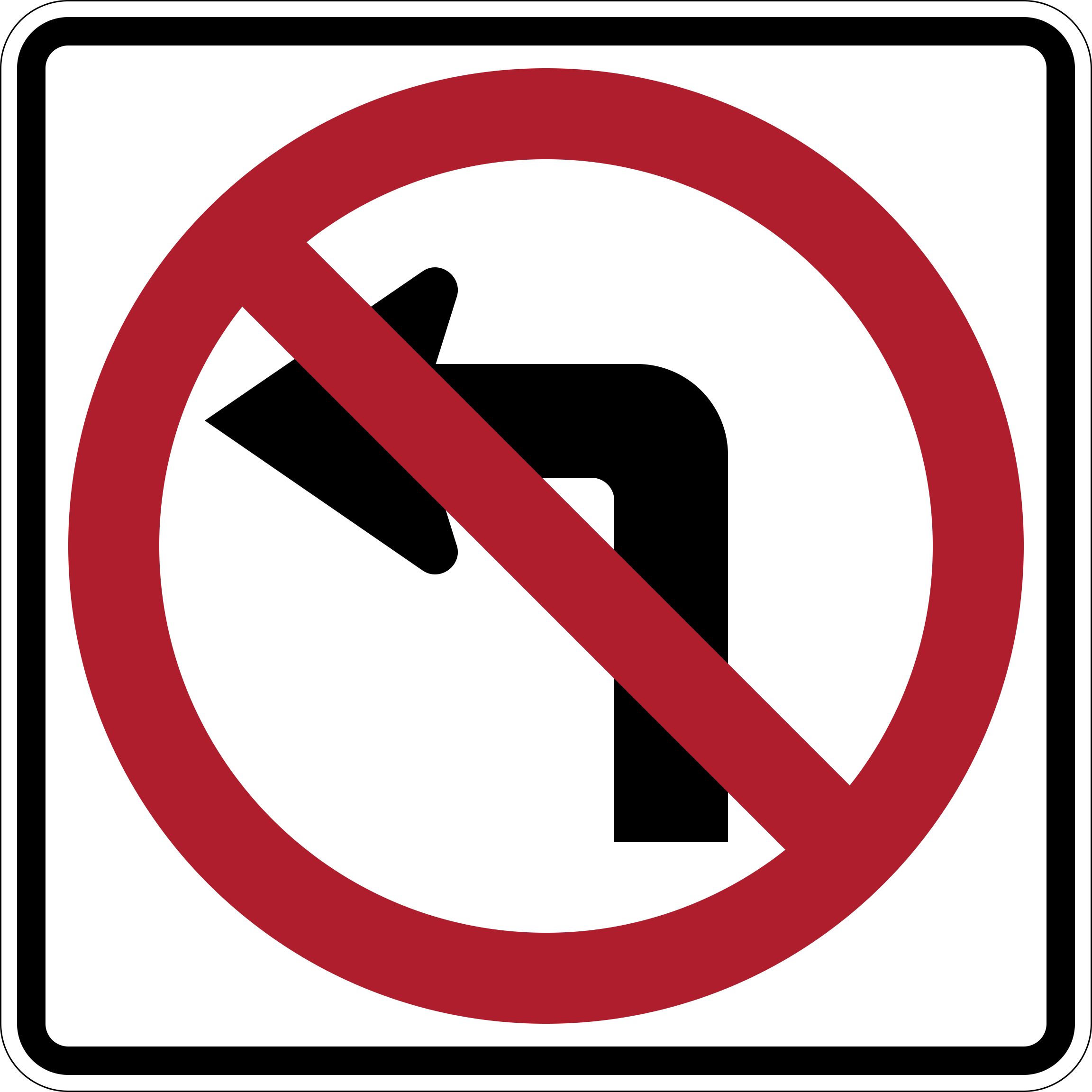
- Going straight through the intersection
- Turning right after stopping
- Turning left at that location
- Changing lanes before the intersection
Show answer
Turning left at that location. South Dakota places No Left Turn in its group of regulatory signs, and regulatory signs state laws drivers must obey. The straight-through choice confuses the sign with a lane-use command; this symbol is aimed at the left-turn movement. When the left arrow is crossed out, keep your vehicle on a permitted path and find another legal route for the turn.
Study this in the handbook: Traffic signals and arrows
13. When approaching a South Dakota roundabout with two or more lanes, what does the manual say is very important to do before entering?
- Stop completely at the entrance
- Move to the inside lane in every case
- Observe the signs and arrows to determine which lane to use
- Turn on the hazard lights
Show answer
Observe the signs and arrows to determine which lane to use. As you get closer to a multi-lane roundabout entrance, the manual says it is very important to observe the signs and arrows to determine which lane to use before entering. Lane choice depends on your exit, so the inside lane is not always right. Entry is a yield, not a mandatory stop, and hazard lights have no role. Once inside, keep your lane, and if an emergency vehicle approaches, continue to your exit and then pull over.
Study this in the handbook: Turns, U turns and roundabouts
14. What should you do when an emergency vehicle with lights and siren approaches?
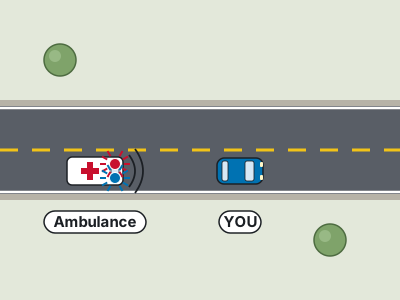
- Yield the right-of-way and pull over to the edge of the road so it may pass
- Stop immediately in your lane wherever you are
- Speed up until you reach the next intersection
- Follow the emergency vehicle through traffic
Show answer
Yield the right-of-way and pull over to the edge of the road so it may pass. South Dakota tells drivers to yield the right-of-way to an emergency vehicle when its flashing lights and sirens are on by pulling over to the edge of the road so the emergency vehicle may pass, and to avoid blocking intersections. Stopping in your lane can block the response route, and following the vehicle through traffic puts you in the path of the next responder. The cue is a siren, flashing emergency lights, or both; signal, move to the edge carefully, and remain stopped until the vehicle has passed.
Study this in the handbook: Crashes, emergency vehicles and traffic stops
15. You have a green light, but pedestrians are still in the intersection. What should you do?
- Drive through because green gives priority over pedestrians
- Yield until the pedestrians are clear
- Honk once and steer around them
- Enter the crosswalk and wait there
Show answer
Yield until the pedestrians are clear. A green signal does not erase the duty to yield to pedestrians who are in the intersection. Driving through because the light is green ignores the pedestrian rule. Use the visual cue of people still crossing your path, especially near the far side of the crosswalk, and wait until your lane is clear before moving. This includes pedestrians who are finishing after your light changes, since they may still legally occupy the crossing space.
Study this in the handbook: Controlling speed
16. At a school crossing with a traffic patrol signal to stop, what should you do?
- Proceed if no adult is in your lane
- Stop and yield as signaled
- Wave children across while rolling forward
- Use the horn and continue slowly
Show answer
Stop and yield as signaled. A school crossing patrol signal controls your movement at that crossing. Stop and yield when directed, even if you do not immediately see a child in the lane. Proceeding because no adult is standing in your lane ignores the patrol's function. The cue is a patrol member or school crossing control giving a stop signal. Do not restart until the patrol signal and the crossing area both show that movement can resume without crowding students.
Study this in the handbook: Controlling speed
17. When does a South Dakota driver give consent to a chemical test for blood alcohol concentration?
- Only if the driver has a prior DWI conviction
- Only after signing a consent form at the police station
- Only when a judge issues a warrant
- Whenever the driver drives on a public highway
Show answer
Whenever the driver drives on a public highway. South Dakota treats driving on a public highway as consent to a chemical test for BAC. If you are placed under arrest for DWI, or for Zero Tolerance if under 21, the police may ask you to take the test, and that consent was already given the moment you drove on the highway. The manual ties that consent to the act of driving itself, not to a prior conviction or a form signed later. A BAC of 0.08%, or 0.02% if under 21, or more is evidence of driving under the influence. Refusing has its own consequences, so understand the rule before you drive.
Study this in the handbook: Alcohol, zero tolerance and implied consent
18. According to the South Dakota manual, what is the second most commonly struck object in the state?
- Parked cars
- Utility poles
- Deer
- Bridge abutments
Show answer
Deer. Collisions between motor vehicles and deer keep increasing in number and severity, and the manual says deer are the second most commonly struck object in South Dakota, with intersection crashes topping the list and lane departures coming in third. Be especially alert for deer in October and November, and when headlights reflect in deer eyes beside the road, slow down, blow the horn and be ready to stop, and keep an eye out for a second animal, as the manual advises watching for more than one.
Study this in the handbook: Night, winter, deer and work zones
19. This sign is posted at a street you plan to turn onto. Which turn does the South Dakota manual tell you not to make?
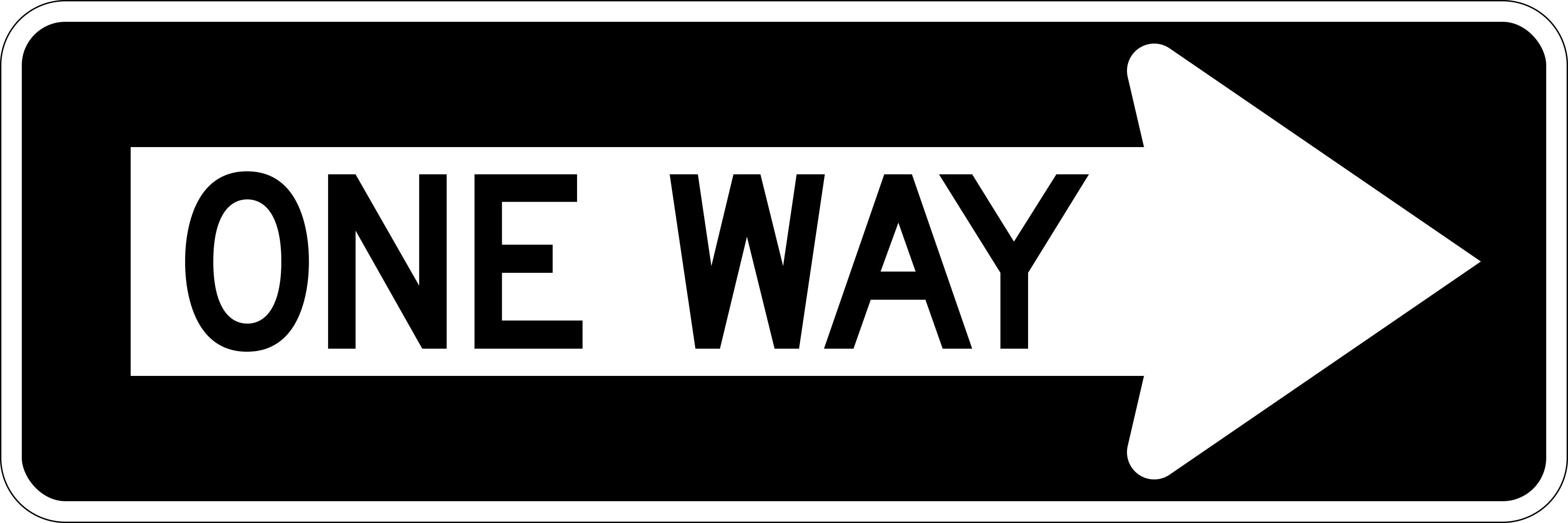
- A turn in the direction the arrow points
- Any turn made after a complete stop
- A turn in the opposite direction of the arrow
- Any turn while other vehicles are on the street
Show answer
A turn in the opposite direction of the arrow. A ONE WAY sign tells you that traffic on that street flows only in the direction of the arrow. South Dakota says not to turn in the opposite direction of the arrow and never to drive the wrong way on a one-way street. Turning with the arrow is the permitted movement, and a prior stop or the presence of other traffic does not change which way the street runs. Check the arrow before you begin the turn and line up to move with it.
Study this in the handbook: Regulatory, stop, yield and guide signs
20. Which permit holders are barred from using any wireless communication device while operating a motor vehicle?
- Only drivers carrying passengers
- Only drivers over 18
- Only motorcycle operators on interstates
- Instruction and Restricted permit holders
Show answer
Instruction and Restricted permit holders. South Dakota places a special wireless-device ban on Instruction Permit and Restricted Permit holders while they operate a motor vehicle. The over-18 answer reverses the likely concern because the restriction is tied to permit status, not adult age. Passenger status also does not define this rule. The cue is the credential in the driver’s wallet: if it is an instruction or restricted permit, no wireless communication device use while driving on public roadways.
Study this in the handbook: Instruction and Restricted Minor's Permits
QualitySpace is expanding to South Dakota
We are a California-based independent insurance brokerage working on licensing in more states. We cannot help with South Dakota insurance yet. Leave your email and we will let you know when we can.
Every question is written from the official South Dakota Driver License Manual. Need paper? Printable SD practice test with answer key.
Last verified 2026-10-05. How we check every question · Study all 202 as flashcards
Frequently asked questions
How many questions are on this South Dakota practice test?
This fixed set has 20 questions. It is test 9 of 10 from the 202 question South Dakota bank.
How does this fixed test relate to the full South Dakota bank?
Each numbered test is a fixed set of questions in a fixed order, so you can retake the same test later and compare. Every test mixes road signs and the other topics in about the same proportion as the full bank. Tests 1 to 10 together cover 200 of the 202 questions in the South Dakota bank, each once. The full practice page mixes the whole bank at random.
Last verified 2026-10-05. See the South Dakota DMV facts page for sourced state details.
Return to the full South Dakota practice test · Study road signs