
Test 3 of 10 · 20 questions · Free 2026
SD Permit Practice Test 3
Jump to the test ↓A fixed 20 question set from the South Dakota bank with answers and plain English explanations.
Question 1 of 20 · 0 right so far
All 20 questions in test 3
Every question below comes from the South Dakota question bank on this page. Open a question to see the correct answer and the explanation. Nothing here is hidden behind a signup.
1. A South Dakota Instruction Permit holder under 16 is convicted of a first traffic violation. How long is the suspension?
- Seven days
- Until age 18
- A full year
- Thirty days
Show answer
Thirty days. For a minor under 16, a conviction for a traffic violation or a violation of the permit or license restrictions suspends driving privileges for thirty days, or as otherwise required by law. A second violation, a restricted permit violation, or a felony or Class 1 misdemeanor raises the suspension to 180 days or the 16th birthday, whichever is longer. Seven days, one year, and until 18 are not the first offense rule.
Study this in the handbook: Instruction and Restricted Minor's Permits
2. For a second DWI in South Dakota, what minimum license loss does the manual list?
- At least 60 days
- At least 30 days
- At least one year
- Until the driver turns 21
Show answer
At least one year. A second DWI has a much tougher license consequence than a first DWI. South Dakota lists loss of the driver license for a minimum of one year. The 30-day answer repeats the first-offense minimum, which is why it is a tempting but wrong choice. Use the cue of repeat conviction: once the DWI is a second offense, think one-year minimum license loss before considering any added jail risk for driving during that period.
Study this in the handbook: DWI and zero tolerance penalties
3. Under South Dakota implied consent, what have you agreed to when you get a driver license?
- Automatic guilt for any crash after drinking
- A search of your vehicle at every traffic stop
- A lawfully requested alcohol or drug content test when suspected of impaired driving
- A yearly medical exam by law enforcement
Show answer
A lawfully requested alcohol or drug content test when suspected of impaired driving. South Dakota describes implied consent as an agreement connected to licensing and driving: if an officer lawfully requests a test because impaired driving is suspected, you have already consented to testing of blood, breath, urine, or another bodily substance. The vehicle-search choice overstates the rule and changes it into a general search permission. The cue is suspicion of impaired driving plus a requested chemical test; that is when implied consent applies.
Study this in the handbook: Alcohol, zero tolerance and implied consent
4. If a posted minimum speed is too fast for your vehicle or conditions, what does the South Dakota manual advise?
- Ignore the minimum speed sign
- Stay in the left lane with hazard flashers
- Stop on the shoulder until traffic clears
- Use another road
Show answer
Use another road. Minimum speed signs are used so slow vehicles do not become hazards on high-speed roads. If that posted minimum is too fast for you, the manual says to take another road. The hazard-flasher choice might seem cautious, but it still leaves you traveling below the required speed in traffic that expects a faster pace. The cue is inability to keep up: when you cannot meet the posted minimum without risk, choose a route with slower traffic.
Study this in the handbook: Regulatory, stop, yield and guide signs
5. Which listed option may satisfy South Dakota financial responsibility without buying a standard owner liability policy?
- A vehicle title kept in the glove box
- A notarized promise to pay future crash costs
- A $50,000 certificate of deposit or securities with the State Treasurer
- A receipt for the last fuel purchase
Show answer
A $50,000 certificate of deposit or securities with the State Treasurer. South Dakota lists several ways to maintain financial responsibility, and one non-policy method is a $50,000 certificate of deposit or securities placed with the State Treasurer. The notarized promise may sound official, but the manual names formal financial instruments, not private assurances. When checking compliance, look for proof issued by an insurer, surety, State Treasurer, or self-insurance authority, because casual paperwork will not show the required ability to cover losses.
Study this in the handbook: Instruction and Restricted Minor's Permits
6. During the first 6 months on a South Dakota Restricted Permit, which passengers are allowed?
- Immediate family or household members only
- One unrelated passenger of any age
- Any passengers if all wear seatbelts
- No passengers, including family
Show answer
Immediate family or household members only. For the first 6 months on the Restricted Permit, South Dakota limits passengers to immediate family or household members. The unrelated-passenger option is wrong for that initial period, even if the rider is responsible or belted. The all-seatbelts option also misses the passenger-category restriction. The cue is how long the minor has held the restricted permit: during the first 6 months, keep the passenger list within family or household unless another rule clearly changes the situation.
Study this in the handbook: Instruction and Restricted Minor's Permits
7. If a power line is down in or on the road after a crash, what should you do?
- Drive over it slowly if it is not sparking
- Move it with a dry wooden object
- Keep away from it
- Stand near it to warn other drivers
Show answer
Keep away from it. At a crash scene, South Dakota says that if power lines are down with wires in or on the road, do not go near them. Driving over the wire, moving it, or standing beside it to warn others all bring you close to the hazard. Other scene steps still apply: do not stand or walk in traffic lanes, turn off the ignition of wrecked vehicles, and use flares or other warning devices to alert traffic of the accident.
Study this in the handbook: Crashes, emergency vehicles and traffic stops
8. When a vehicle behind you wants to pass, what should you do to increase space in front?
- Slow down so the pass can be completed sooner
- Move left to block the passing lane
- Speed up until the driver drops back
- Tap the brakes repeatedly to warn the driver away
Show answer
Slow down so the pass can be completed sooner. The South Dakota manual lists situations that call for more space in front of your vehicle. One is when the driver behind wants to pass: slow down to allow room in front of the vehicle, and slowing will also allow the pass to be completed sooner. Speeding up, moving left to block the passing lane, or tapping the brakes as a warning all work against the passing driver instead of giving the room the manual asks for.
Study this in the handbook: Following distance, passing and large vehicles
9. Why does the South Dakota manual say to lower your speed in places where people gather or traffic is heavy?
- Room to move is limited, and you need time to react in a crowded space
- Pedestrians there always have the right of way
- Speed limits are always 15 mph in those places
- Police enforce speed more strictly there
Show answer
Room to move is limited, and you need time to react in a crowded space. The manual's trouble spots are places like shopping centers, parking lots, downtown areas, and anywhere people gather or traffic is heavy. Room to move is limited there, and you need to lower your speed to have time to react in a crowded space. No universal 15 mph limit is stated, and the reason given here is about your own reaction time rather than a separate pedestrian rule. The point is reaction time, not enforcement.
Study this in the handbook: Crashes, emergency vehicles and traffic stops
10. You are driving past a crash scene and you are not involved. What does the South Dakota manual tell you to do?
- Drive to the scene and park where you can see
- Keep moving unless emergency help has not yet arrived
- Stop in the nearest lane until responders direct traffic
- Block the shoulder so other drivers slow down
Show answer
Keep moving unless emergency help has not yet arrived. South Dakota warns drivers not to become spectators at emergency scenes. Unless you are involved or emergency help has not arrived, keep attention on driving and continue past safely. Stopping simply to look can block responders, so the parking choice creates the problem the manual warns about. Scan for people near the roadway as you pass. Keep lanes and shoulders available for police, firefighters, ambulances, tow trucks, and other rescue vehicles working there.
Study this in the handbook: Crashes, emergency vehicles and traffic stops
11. A South Dakota driver is convicted of two offenses from the same incident. How are points assessed?
- Points for both offenses are added together
- Only the offense with the highest point value counts
- No points are assessed when there are two offenses
- Only the first offense written on the ticket counts
Show answer
Only the offense with the highest point value counts. When multiple offenses arise out of a single incident, South Dakota assesses points only on the offense carrying the highest point value. The points are not added together, and the order on the ticket does not matter. Two offenses do not cancel each other out either. Keep in mind that points are also assessed on out-of-state convictions just as if they were committed in South Dakota.
Study this in the handbook: License rules, insurance and the point system
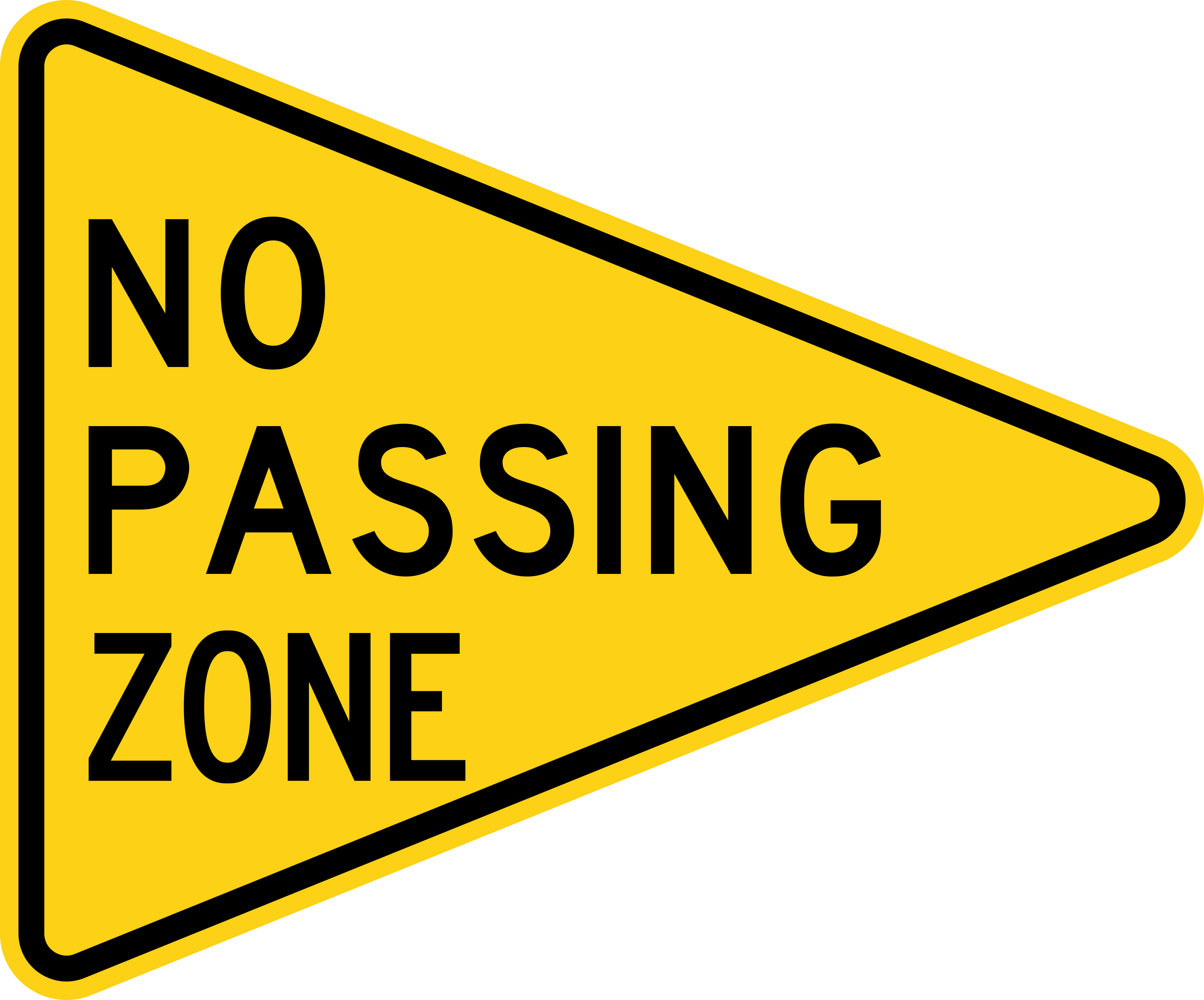
12. What does a pennant-shaped NO PASSING ZONE sign mark?
- A road segment for bicycles only
- A lane where passing is required
- A shoulder where slow vehicles must drive
- A place where passing is not permitted
Show answer
A place where passing is not permitted. South Dakota says no-passing signs tell drivers where passing is not permitted. The idea that passing is required reverses the message and could put a driver into oncoming traffic near hills, curves, intersections, or other hazards. Treat the pennant as an early cue to stay in your lane and wait for markings or signs that show passing is again allowed.
Study this in the handbook: Regulatory, stop, yield and guide signs
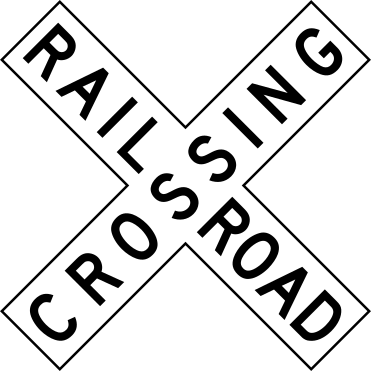
13. Where is this X-shaped RAILROAD CROSSING sign located?
- At the end of a passing zone
- One mile before every railroad yard
- Only beside tracks with automatic gates
- At the highway-railroad grade crossing
Show answer
At the highway-railroad grade crossing. South Dakota identifies the white X-shaped crossbuck as the sign located at the highway-railroad grade crossing. Saying it appears only where gates are installed is too narrow because crossings can have different controls. The cue is the crossbuck itself at the tracks; look and listen there, and stop behind the proper line when a train or railroad vehicle is approaching.
Study this in the handbook: Warning, railroad and work zone signs
14. What does this round yellow RXR sign warn you to do?

- Slow down, look, listen, and be ready to stop for a train
- Speed up to clear the tracks before a gate lowers
- Stop only after your front bumper reaches the rails
- Use the shoulder until the crossing ends
Show answer
Slow down, look, listen, and be ready to stop for a train. The round yellow railroad warning sign is placed before a grade crossing and tells drivers to slow, look, listen, and prepare to stop if a train is coming. Waiting until the bumper reaches the rails is dangerous and contrary to the warning's purpose. Treat the RXR symbol as an advance cue to check sight lines, lower speed, and be ready before the tracks.
Study this in the handbook: Warning, railroad and work zone signs
15. Your vehicle has broken down on a South Dakota highway. Why does the manual say to place flares or triangles behind it?
- So other drivers can see the vehicle and change lanes if necessary
- So the towing company can find the vehicle faster
- Because the law requires three devices for every stop
- So you can wait inside the vehicle without using flashers
Show answer
So other drivers can see the vehicle and change lanes if necessary. After a breakdown, the manual's concern is that other road users see the disabled vehicle in time. Crashes happen because drivers did not notice a stalled vehicle until it was too late to stop. Placing emergency flares or triangles behind the vehicle warns approaching traffic and gives drivers room to change lanes if necessary. The devices are about visibility, not about towing or a fixed count. Use the flashers as well, and if you have a phone, notify authorities that the vehicle is disabled.
Study this in the handbook: Night, winter, deer and work zones
16. In which direction does traffic move through a South Dakota roundabout?
- One-way clockwise
- One-way counterclockwise
- Two-way around the center island
- Any direction marked by the nearest driver
Show answer
One-way counterclockwise. South Dakota describes roundabout traffic as moving one way in a counterclockwise direction. Calling it two-way misunderstands the design and would place vehicles into conflict points. The cue is the central island and yield-at-entry pattern; enter to the right, circulate counterclockwise, then signal right as you approach your exit. Lane arrows before the circle help you choose the proper lane for your exit before you enter.
Study this in the handbook: Turns, U turns and roundabouts
17. Which action is one of the three crash avoidance options listed by South Dakota?
- Honking, parking, or idling
- Braking, steering, or accelerating
- Texting, signaling, or coasting
- Stopping, reversing, or opening a door
Show answer
Braking, steering, or accelerating. South Dakota frames emergency avoidance around three active vehicle-control choices: braking, steering, and accelerating. Parking or idling does not match that emergency response set and may leave the vehicle in the hazard. The cue is an immediate crash threat; choose the control action that creates space or reduces the impact. Braking is not always the answer; steering or accelerating may be safer when stopping would leave you in the impact path.
Study this in the handbook: Skids, brake failure and other vehicle emergencies
18. Where does the South Dakota manual say to find the recommended tire pressure for your vehicle?
- On the tire sidewall only
- At any gas station pump
- On the registration card
- In the owner's manual or on the driver side door jamb
Show answer
In the owner's manual or on the driver side door jamb. Before entering a vehicle, check tire pressures using the recommended PSI located in the vehicle owner's manual or on the driver side door jamb. Use a tire pressure gauge; if the PSI is above the listed number let air out, and if it is below add air or have a tire professional help. The manual points to those two places, not to markings on the tire itself. The manual adds that worn tires can cause hydroplaning and increase the chance of a flat tire.
19. What may a driver do at a flashing yellow left-turn arrow?
- Turn immediately because oncoming traffic has a red light
- Turn cautiously after yielding to oncoming traffic and pedestrians
- Stop and remain stopped until a green arrow appears
- Proceed straight only and cancel the turn
Show answer
Turn cautiously after yielding to oncoming traffic and pedestrians. A flashing yellow arrow allows the indicated left turn only when it is safe after yielding to oncoming traffic and pedestrians. The choice saying oncoming traffic has a red light is wrong; South Dakota says oncoming traffic will have green. The cue is the flashing yellow arrow rather than a green arrow, so check the gap carefully before entering the intersection.
Study this in the handbook: Traffic signals and arrows
20. What is the purpose of regulatory signs such as stop, yield, and turn-control signs?
- They point out scenic and service destinations
- They warn only of temporary work zones
- They state traffic laws drivers must obey
- They mark pavement edges during fog
Show answer
They state traffic laws drivers must obey. Regulatory signs tell drivers about specific laws, including traffic direction, lane use, turning, speed, parking, and other special situations. A service-destination answer belongs to guide or service signs, not regulatory signs. The cue is a white, red, black, or special-shaped command sign; read it as an enforceable instruction and adjust before reaching the intersection or lane control. Some regulatory signs use a red circle with a slash over a symbol to prohibit an action.
Study this in the handbook: Regulatory, stop, yield and guide signs
QualitySpace is expanding to South Dakota
We are a California-based independent insurance brokerage working on licensing in more states. We cannot help with South Dakota insurance yet. Leave your email and we will let you know when we can.
Every question is written from the official South Dakota Driver License Manual. Need paper? Printable SD practice test with answer key.
Last verified 2026-10-05. How we check every question · Study all 202 as flashcards
Frequently asked questions
How many questions are on this South Dakota practice test?
This fixed set has 20 questions. It is test 3 of 10 from the 202 question South Dakota bank.
How does this fixed test relate to the full South Dakota bank?
Each numbered test is a fixed set of questions in a fixed order, so you can retake the same test later and compare. Every test mixes road signs and the other topics in about the same proportion as the full bank. Tests 1 to 10 together cover 200 of the 202 questions in the South Dakota bank, each once. The full practice page mixes the whole bank at random.
Last verified 2026-10-05. See the South Dakota DMV facts page for sourced state details.
Return to the full South Dakota practice test · Study road signs