
Test 5 of 10 · 20 questions · Free 2026
SD Permit Practice Test 5
Jump to the test ↓A fixed 20 question set from the South Dakota bank with answers and plain English explanations.
Question 1 of 20 · 0 right so far
All 20 questions in test 5
Every question below comes from the South Dakota question bank on this page. Open a question to see the correct answer and the explanation. Nothing here is hidden behind a signup.
1. You want to pass a slow-moving vehicle but are not sure there is enough space to complete the pass. What does the South Dakota manual advise?
- Pass on the right before it reaches the next driveway
- Honk steadily so the driver holds a straight path
- Wait until you are sure there is enough space
- Move beside it and check for a hand signal
Show answer
Wait until you are sure there is enough space. South Dakota tells drivers to wait when they are unsure there is enough room to pass. Passing on the right is especially wrong near slow farm equipment because the manual separately says never to do that. Use practical cues before committing: a left edge movement, a driveway, oncoming traffic, or blocked sight distance all mean staying back until the pass is clearly open.
Study this in the handbook: Following distance, passing and large vehicles
2. A dashed yellow line is on your side of a two-direction roadway. What does it mean?
- Traffic in your direction may not cross it
- Passing is prohibited for both directions
- The lane is reserved for emergency vehicles
- Passing is permitted on your side when safe
Show answer
Passing is permitted on your side when safe. A dashed yellow line on your side marks a passing area, but only when the maneuver can be completed safely. Saying passing is prohibited for both directions describes a different marking, such as double solid yellow. Check sight distance, oncoming traffic, intersections, and the space needed to return before crossing the line. Do not begin if you cannot see far enough ahead to complete the pass and return calmly.
Study this in the handbook: Pavement markings and signaling
3. What should you do when rain, snow, ice, or fog makes the posted maximum speed unsafe?
- Use the minimum speed sign as your target
- Drive exactly the posted maximum to avoid surprising others
- Reduce speed below the posted maximum
- Speed up until visibility improves
Show answer
Reduce speed below the posted maximum. A posted maximum assumes ideal driving conditions. South Dakota tells drivers to reduce speed when weather or roadway conditions make that maximum unsafe, including slippery surfaces or poor visibility. Driving exactly the sign number may look lawful, but it can still be too fast when traction or sight distance is reduced. Your cue is conditions, not just the number on the sign: if tires grip poorly or you cannot see clearly, slow before the vehicle needs sudden braking.
Study this in the handbook: Controlling speed
4. What does the South Dakota manual say about assuming you have the right-of-way at an intersection?
- It always belongs to the vehicle that is moving faster
- The driver on the larger road always has it
- No one should assume they automatically have it; consider the situation and circumstances
- A driver who signals first has it
Show answer
No one should assume they automatically have it; consider the situation and circumstances. The yielding rules are a guide to who should give way, but the manual adds that no one should assume he or she automatically has the right-of-way. The situation and circumstances at the intersection must always be considered, because another driver may not know or follow the rule. Road size, speed, and who signals first do not settle priority. Slow, look, and be prepared to yield even when the rule seems to favor you; being right is no help in a crash.
Study this in the handbook: Right of way, funerals and intersections
5. What does South Dakota tell drivers not to do around a funeral procession?
- Pass the first vehicle on the left
- Cut into or interfere with it
- Turn on headlights while waiting
- Stop before the procession reaches an intersection
Show answer
Cut into or interfere with it. South Dakota protects the continuity of a funeral procession by telling other drivers not to cut into or interfere with it. Passing the first vehicle is not the rule stated in this section, and turning on headlights while waiting does not solve the right-of-way issue. The cue is a marked line of vehicles traveling together, usually with headlights on. Let the procession remain intact instead of entering a gap that belongs to the group.
Study this in the handbook: Right of way, funerals and intersections
6. When should you signal before an intended turn in South Dakota?
- Only after entering the intersection
- Exactly 25 feet before the turn
- At least 100 feet before the turn
- Only when another vehicle is visible
Show answer
At least 100 feet before the turn. Signal 100 feet before the intended turn so people behind, beside, and approaching you have time to understand your plan. Signaling only when another vehicle is visible is a poor habit because motorcycles, pedestrians, and vehicles in blind spots are easy to miss. The 25 foot choice gives too little notice at normal traffic speeds. Watch for driveways or streets before your turn, because signaling too early can make another driver think you are turning sooner.
Study this in the handbook: Pavement markings and signaling
7. A South Dakota driver with a second DWI is caught driving without a license during the revocation. What jail sentence does the manual require?
- None, only a fine
- At least three days in county jail, which may not be suspended
- At least ten days
- Exactly 30 days
Show answer
At least three days in county jail, which may not be suspended. After a second DWI, the license is lost for a minimum of one year. If that person is convicted of driving without a license during that period, the sentence is not less than three days in county jail, and it may not be suspended. The ten day minimum applies to a person caught driving without a license after a third DWI. A fine-only outcome and a fixed 30 days are not in the rule.
Study this in the handbook: Alcohol, zero tolerance and implied consent
8. Under South Dakota's Zero Tolerance law, what BAC range can lead to an arrest for a driver under 21?
- Any measurable amount above 0.00%
- 0.05% to 0.10%
- Only 0.08% or higher, the same as adults
- 0.02% to 0.08%
Show answer
0.02% to 0.08%. South Dakota applies Zero Tolerance to drivers under 21 at a BAC of 0.02% to 0.08%, a band well below the adult DWI level. Choosing the adult figure misses the point of the law, which is that a young driver can be arrested long before reaching 0.08%. The band the manual prints begins at 0.02%, so a trace just above zero is not the figure it gives. Once arrested, the driver may be asked to take a chemical test, and consent to that test was given by driving on a public highway.
Study this in the handbook: Alcohol, zero tolerance and implied consent
9. If you are involved in a crash where someone is injured or killed, who must be notified?
- Only your insurance company
- The nearest vehicle repair shop
- The police
- A driver licensing examiner
Show answer
The police. When a crash injures or kills someone, the police must be notified. Insurance contact is important later, but it does not replace the legal duty to report the crash and give police the needed information. The repair shop choice is unrelated to the immediate crash requirement. A concrete cue is any injury complaint, visible injury, or fatality at the scene: stop, call for police and medical help, and do not leave before required information is handled.
Study this in the handbook: Crashes, emergency vehicles and traffic stops
10. If a stuck accelerator makes your vehicle accelerate out of control, what should you do?
- Turn off the engine, shift to neutral, steer smoothly, and brake gently
- Shift into a lower gear and continue to the nearest mechanic
- Press the accelerator harder to free the pedal
- Use the horn while staying in the travel lane
Show answer
Turn off the engine, shift to neutral, steer smoothly, and brake gently. With a stuck accelerator, turn off the engine, shift to neutral, search for an escape path, steer smoothly, and brake gently. The goal is to remove engine power and guide the vehicle out of traffic without adding abrupt steering. Pressing the accelerator harder is wrong because it can keep or increase the unwanted acceleration. The cue is speed building without your command: separate power from the wheels, then move to a safe stopping place.
Study this in the handbook: Skids, brake failure and other vehicle emergencies
11. How many points trigger a possible license suspension under South Dakota's point system?
- 15 points in any 12 consecutive months, or 22 points in any 24 consecutive months
- 8 points in any 12 months
- 12 points in any 24 months
- 30 points in any 36 months
Show answer
15 points in any 12 consecutive months, or 22 points in any 24 consecutive months. South Dakota subjects an operator to suspension after accumulating 15 points in any 12 consecutive months or 22 points in any 24 consecutive months. The 8 point, 12 point, and 30 point choices are not South Dakota thresholds and do not appear in the point system. A hearing is available before suspension if the operator requests one. Points are also assessed on out-of-state convictions just as if they happened in South Dakota.
Study this in the handbook: License rules, insurance and the point system
12. What should you do before entering an intersection after stopping?
- Check only for pedestrians on your side
- Watch only the signal facing you
- Enter immediately when the vehicle ahead moves
- Look left, right, and left again
Show answer
Look left, right, and left again. After stopping at an intersection, take the extra moment to look left, right, and left again before entering. A fresh green light or another driver's movement cannot prove the cross path is clear. The signal only choice fails because some road users run lights or stop signs. Use the cue of your final glance: left again catches traffic nearest your lane before your vehicle moves into the crossing area.
Study this in the handbook: Right of way, funerals and intersections
13. How long is a South Dakota Instruction Permit valid?
- Five years, or until the lawful presence document expires if sooner
- Two years from issue
- One year from issue
- Until the holder turns 18
Show answer
Five years, or until the lawful presence document expires if sooner. A South Dakota Instruction Permit, for minors and adults alike, is valid for five years or until the expiration date on the documents authorizing the applicant's presence in the U.S., whichever occurs first. One and two years are shorter than the five year term this manual gives. The permit does not end at 18; instead a Restricted Minor's Permit converts to an Operator's License at 18. The Motorcycle Instruction Permit is the one valid for one year.
Study this in the handbook: Instruction and Restricted Minor's Permits
14. Before starting through a South Dakota intersection, what does the manual say to do besides looking left and right?
- Look across the intersection to make sure the path is clear all the way through and you will not block it
- Sound the horn
- Wait for the vehicle behind to honk
- Turn on the hazard lights
Show answer
Look across the intersection to make sure the path is clear all the way through and you will not block it. Before entering an intersection, look to both the left and right for approaching vehicles and crossing pedestrians, and if stopped, look left and right again just before moving. The manual adds a step drivers skip: look across the intersection before you start to move to make sure the path is clear all the way through and that you will not block it if traffic ahead stops. Entering a blocked intersection leaves you stranded in cross traffic.
15. What hazard does this walking-person warning sign point out?

- The road surface becomes gravel
- Parking is reserved for buses
- Drivers must enter a one-way street
- Pedestrians may be crossing ahead
Show answer
Pedestrians may be crossing ahead. The manual includes Pedestrian Crossing among common warning signs. That makes the walking-person sign a warning that people may cross the roadway ahead, not a parking or lane-direction control. The cue is the pedestrian symbol on a yellow warning face; reduce speed, search both sides of the road, and be ready to yield even if the crosswalk markings are hard to see.
Study this in the handbook: Warning, railroad and work zone signs
16. What do regulatory signs usually tell drivers?
- Weather forecasts for the next highway segment
- Only the distance to cities and airports
- Only scenic points of interest
- Specific laws about traffic direction, lane use, turning, speed, or parking
Show answer
Specific laws about traffic direction, lane use, turning, speed, or parking. Regulatory signs communicate laws a driver must obey, including direction, lane use, turning, speed, parking, and other special rules. Distances to cities belong to destination or guide signs. The cue is a white, red, black, or green regulatory sign telling you what is required, prohibited, or limited at that place. Because these signs state law, missing one can produce an illegal turn, speed, parking choice, or lane movement.
Study this in the handbook: Regulatory, stop, yield and guide signs
17. What does the red slash on this U-turn symbol mean?
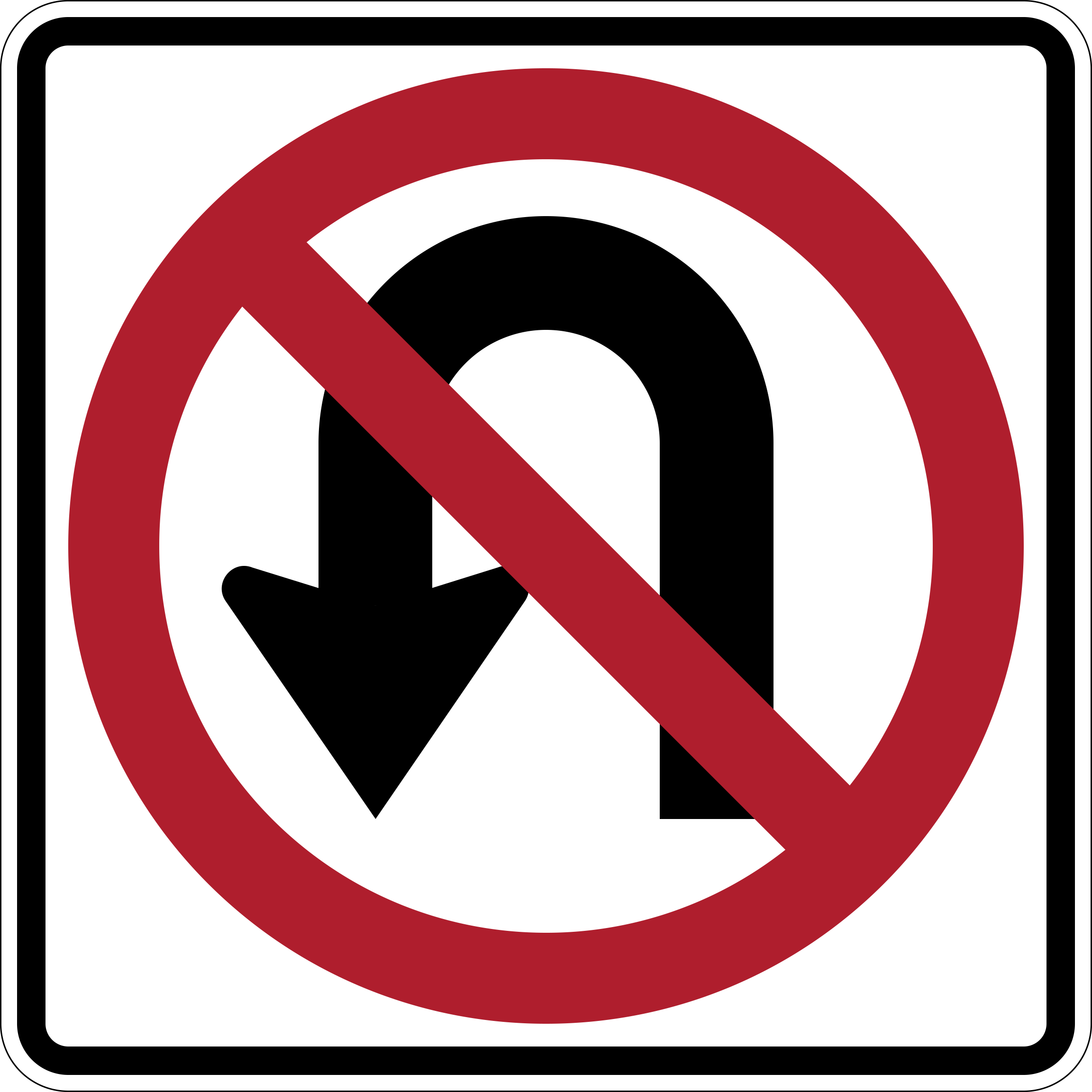
- U-turns are required for through traffic
- U-turns are prohibited at that location
- Only commercial vehicles may make a U-turn
- U-turns are allowed after yielding to pedestrians
Show answer
U-turns are prohibited at that location. South Dakota explains that regulatory signs may use a red circle and slash to prohibit an action, and it lists No U-Turn as a common regulatory sign. The answer allowing the turn after yielding changes the meaning of the slash. Use the cue of the red slash over the turning arrow: continue to a legal turnabout location instead of trying the maneuver there.
Study this in the handbook: Regulatory, stop, yield and guide signs
18. According to the South Dakota manual, what happens if you give false information when applying for a driver license or ID?
- Your driving privilege can be suspended, revoked, or cancelled
- You must pay a $20 correction fee
- Nothing, if the error is fixed within 30 days
- You must retake the vision test
Show answer
Your driving privilege can be suspended, revoked, or cancelled. Giving false information when you apply for a driver license or a non-driver ID is one of the listed grounds for losing your driving privilege in South Dakota, along with attempting to alter the information on a license, using someone else's license, and failing to appear for a re-examination when requested. The consequence is action against the license itself, not a small fee or a retest. Apply with accurate documents and correct any error with South Dakota Driver Licensing.
Study this in the handbook: License rules, insurance and the point system
19. What is prohibited by this red-slashed right-turn sign?
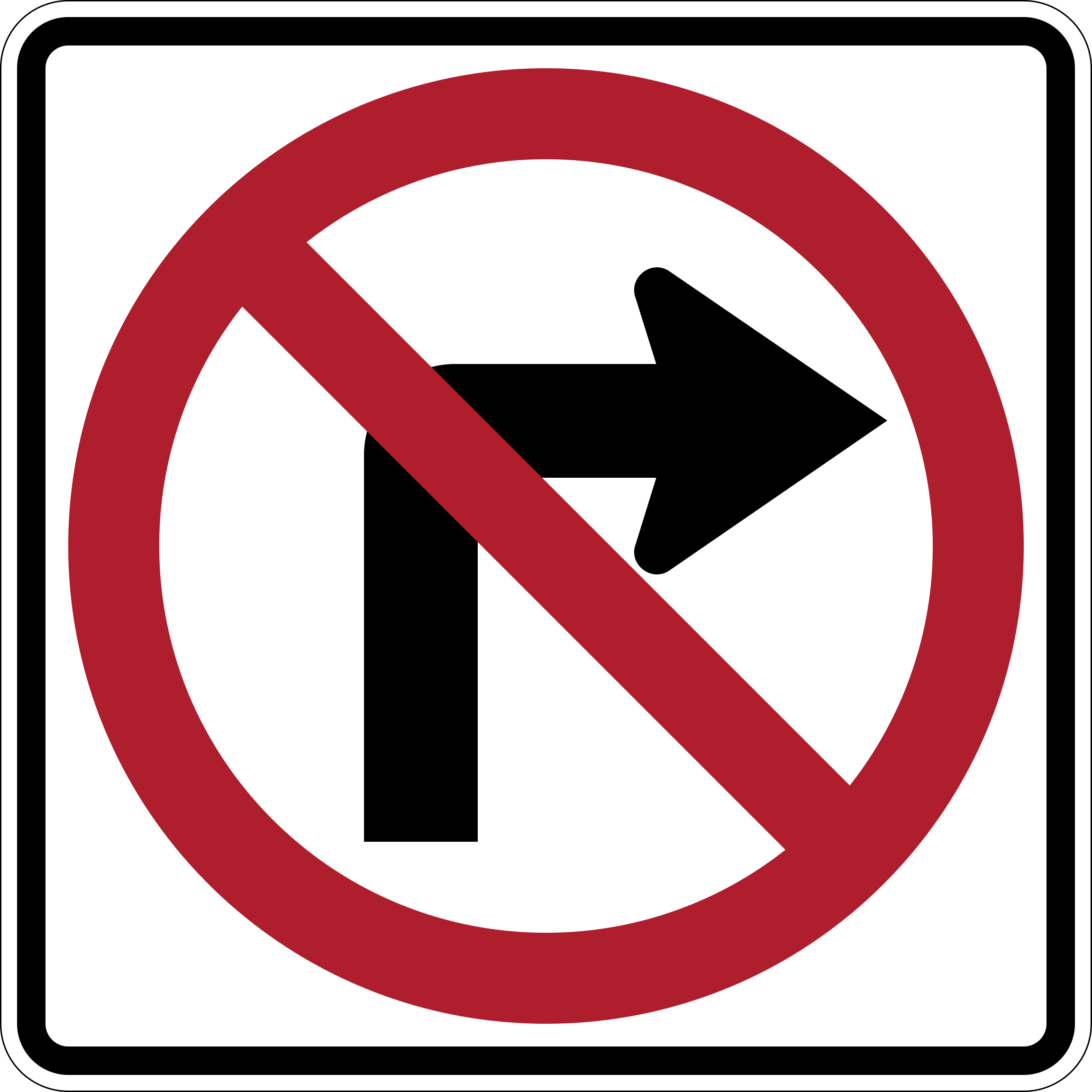
- Stopping before entering the intersection
- A left turn from the nearest lane
- A right turn where the sign is posted
- Proceeding straight after checking traffic
Show answer
A right turn where the sign is posted. The South Dakota manual lists No Right Turn among common regulatory signs. A regulatory sign is not merely advisory; it gives a rule that must be obeyed. The left-turn choice names the wrong movement and would leave the posted right-turn ban unanswered. Use the crossed right arrow as the cue to continue on an allowed movement until another route is available.
Study this in the handbook: Regulatory, stop, yield and guide signs
20. When a bicycle path or bike lane intersects a road, what should a South Dakota driver do?
- Stop and park in the bike lane to check traffic
- Yield the right-of-way
- Drive in the bike lane until the intersection clears
- Sound the horn and keep speed
Show answer
Yield the right-of-way. South Dakota tells motorists to yield where a bicycle path or bike lane intersects a road. The parking or driving-in-the-bike-lane choices conflict with the same bicycle guidance, which says not to stop, park, or drive there except for narrow exceptions such as entering a driveway or obeying an officer. The cue is a bike lane crossing your path: slow, scan for bicyclists, and let them clear before turning or crossing.
Study this in the handbook: Controlling speed
QualitySpace is expanding to South Dakota
We are a California-based independent insurance brokerage working on licensing in more states. We cannot help with South Dakota insurance yet. Leave your email and we will let you know when we can.
Every question is written from the official South Dakota Driver License Manual. Need paper? Printable SD practice test with answer key.
Last verified 2026-10-05. How we check every question · Study all 202 as flashcards
Frequently asked questions
How many questions are on this South Dakota practice test?
This fixed set has 20 questions. It is test 5 of 10 from the 202 question South Dakota bank.
How does this fixed test relate to the full South Dakota bank?
Each numbered test is a fixed set of questions in a fixed order, so you can retake the same test later and compare. Every test mixes road signs and the other topics in about the same proportion as the full bank. Tests 1 to 10 together cover 200 of the 202 questions in the South Dakota bank, each once. The full practice page mixes the whole bank at random.
Last verified 2026-10-05. See the South Dakota DMV facts page for sourced state details.
Return to the full South Dakota practice test · Study road signs