
Test 7 of 10 · 20 questions · Free 2026
SD Permit Practice Test 7
Jump to the test ↓A fixed 20 question set from the South Dakota bank with answers and plain English explanations.
Question 1 of 20 · 0 right so far
All 20 questions in test 7
Every question below comes from the South Dakota question bank on this page. Open a question to see the correct answer and the explanation. Nothing here is hidden behind a signup.
1. What color and shape are most South Dakota warning signs?
- White with black, red, or green letters and square shaped
- Blue with white lettering and square shaped
- Green or brown with white lettering and rectangular shaped
- Yellow with black lettering or symbols and diamond shaped
Show answer
Yellow with black lettering or symbols and diamond shaped. Most warning signs in South Dakota are yellow with black symbols or lettering and have a diamond shape. Blue square signs point to services, so that choice names a different category. The cue is a yellow diamond before a condition such as a curve, side road, slippery road, merging traffic, or animal crossing. The sign gives advance notice, so begin adjusting speed before reaching the curve, crossing, or other condition.
Study this in the handbook: Warning, railroad and work zone signs
2. Where should both hands usually be placed on the steering wheel for best control?
- At the 2 and 10 o'clock positions
- At the 3 and 9 o'clock positions
- Together at the bottom of the wheel
- One hand inside the rim and one on top
Show answer
At the 3 and 9 o'clock positions. South Dakota recommends both hands on opposite sides of the wheel at 3 and 9 o'clock. That position gives control while reducing the air bag risk associated with the older 2 and 10 placement. The 2 and 10 choice is familiar, but the manual specifically says it is no longer recommended in vehicles with air bags. Use the cue of a clock face: hands level across the center of the wheel.
Study this in the handbook: Seat belts, child seats and driving position
3. A South Dakota driver under 21 is convicted of a second Zero Tolerance offense (BAC 0.02% or more). What license loss applies?
- A 180 day loss
- A 30 day loss
- A one year loss
- Loss until age 21
Show answer
A 180 day loss. Under Zero Tolerance, a first offense is a Class 2 misdemeanor with a fine and a 30-day loss of license. A second or subsequent offense is also a Class 2 misdemeanor, with a fine and a 180-day loss of license. Thirty days is the first offense period. One year is the minimum for a second adult DWI, and revocation until 21 is not in the South Dakota Zero Tolerance rule.
Study this in the handbook: Alcohol, zero tolerance and implied consent
4. To cut South Dakota's required Instruction Permit holding time from 275 to 180 days, what driver education result is needed?
- Attendance at any one-day safety class
- Completing a course with a score of 80% or better on both written and driving portions
- Passing the DMV knowledge test twice
- 50 logged hours with a parent
Show answer
Completing a course with a score of 80% or better on both written and driving portions. Minors must hold the Instruction Permit continuously for 275 days, or 180 days with successful completion of an approved Department of Education driver education course. Successful means a score of 80% or better on both the written and driving portions. A one-day safety class, retaking the knowledge test, or the 50 hour supervised log (which is required anyway) does not shorten the holding period.
Study this in the handbook: Instruction and Restricted Minor's Permits
5. What should a driver do if the vehicle's headlights suddenly go out at night?
- Turn off all exterior lights so other drivers are not confused
- Continue at the same speed until reaching a lighted business
- Try the switch, use other lights if possible, and pull off the road promptly
- Brake hard in the travel lane and wait for traffic to clear
Show answer
Try the switch, use other lights if possible, and pull off the road promptly. If headlights fail, first try the switch several times because the failure may be temporary. If the headlights stay out, use emergency flashers, turn signals, or fog lights if they work, then get off the road as soon as possible. Continuing at speed toward a lighted area leaves you nearly invisible and unable to see hazards. A practical cue is simple: no headlights means leave the traffic stream immediately, using any legal light that still works.
Study this in the handbook: Skids, brake failure and other vehicle emergencies
6. What is the minimum age for a South Dakota Operator's License?
- 14
- 15
- 16
- 18
Show answer
16. An Operator's License requires the applicant to be at least 16 and to pass the vision, knowledge, and driving tests. Fourteen is the minimum age for the Instruction Permit and the Restricted Minor's Permit, not the Operator's License. A minor from 16 to under 18 must also complete the permit requirements and have no traffic conviction in the past six months. At 18 a Restricted Minor's Permit converts automatically to an Operator's License.
Study this in the handbook: Instruction and Restricted Minor's Permits
7. What happens to a South Dakota Restricted Minor’s Permit when the holder reaches age 18?
- It automatically converts to an Operator’s License
- It expires immediately and must be retested
- It becomes a commercial permit
- It remains restricted until age 21
Show answer
It automatically converts to an Operator’s License. South Dakota states that a Restricted Minor’s Permit automatically becomes an Operator’s License when the holder reaches age 18. The retesting answer is not what this passage says, although other licensing events can require tests in different contexts. The commercial-permit option is unrelated to the noncommercial graduated license described here. The cue is the birthday: when the restricted-permit holder reaches 18, the credential changes status automatically under this manual section.
Study this in the handbook: Instruction and Restricted Minor's Permits
8. A South Dakota traffic signal is not functioning properly and you face a green signal. What may you do?
- Wait until the signal is repaired
- Stop as if at a stop sign, then wait for a police officer
- Turn right only
- Proceed with caution
Show answer
Proceed with caution. South Dakota law spells out what to do at a malfunctioning signal by the color you face. A green signal may proceed with caution, a yellow signal may also proceed with caution, and a red or completely unlighted signal must stop in the same manner as at a stop sign. Treating a green signal as a stop sign is not required, and waiting for repairs is not the rule. Because other drivers may be unsure what the signal means, slow down, look in every direction, and be ready to yield.
Study this in the handbook: Traffic signals and arrows
9. In South Dakota, what must you do when approaching a stopped authorized emergency vehicle using red lights?
- Honk and pass quickly
- Slow to 20 mph under the limit and continue
- Change lanes only if traffic is light
- Come to a complete stop before reaching it, then proceed with caution when safe
Show answer
Come to a complete stop before reaching it, then proceed with caution when safe. South Dakota law requires motorists from any direction approaching an authorized emergency vehicle using red visual signals to come to a complete stop before reaching it. They may then proceed with caution only after making sure it is safe, unless directed otherwise. Slowing by 20 mph and moving over are the rules for stopped vehicles with amber, yellow, or blue lights, not red. Honking and passing quickly is never the rule.
10. On pavement markings, when is passing permitted on your side of a two-direction roadway?
- When the solid yellow line is on your side
- When a double yellow line separates traffic
- When the dashed yellow line is on your side
- Whenever the shoulder is paved
Show answer
When the dashed yellow line is on your side. South Dakota’s pavement-marking diagram says passing on a two-direction roadway is allowed when the dashed yellow line is on your side, assuming the maneuver is otherwise safe. A double yellow line means passing is prohibited in both directions, so it is the opposite of permission. A paved shoulder is not a passing lane. The cue is the line nearest your vehicle: dashed yellow on your side permits consideration of passing; solid or double yellow tells you not to start.
Study this in the handbook: Warning, railroad and work zone signs
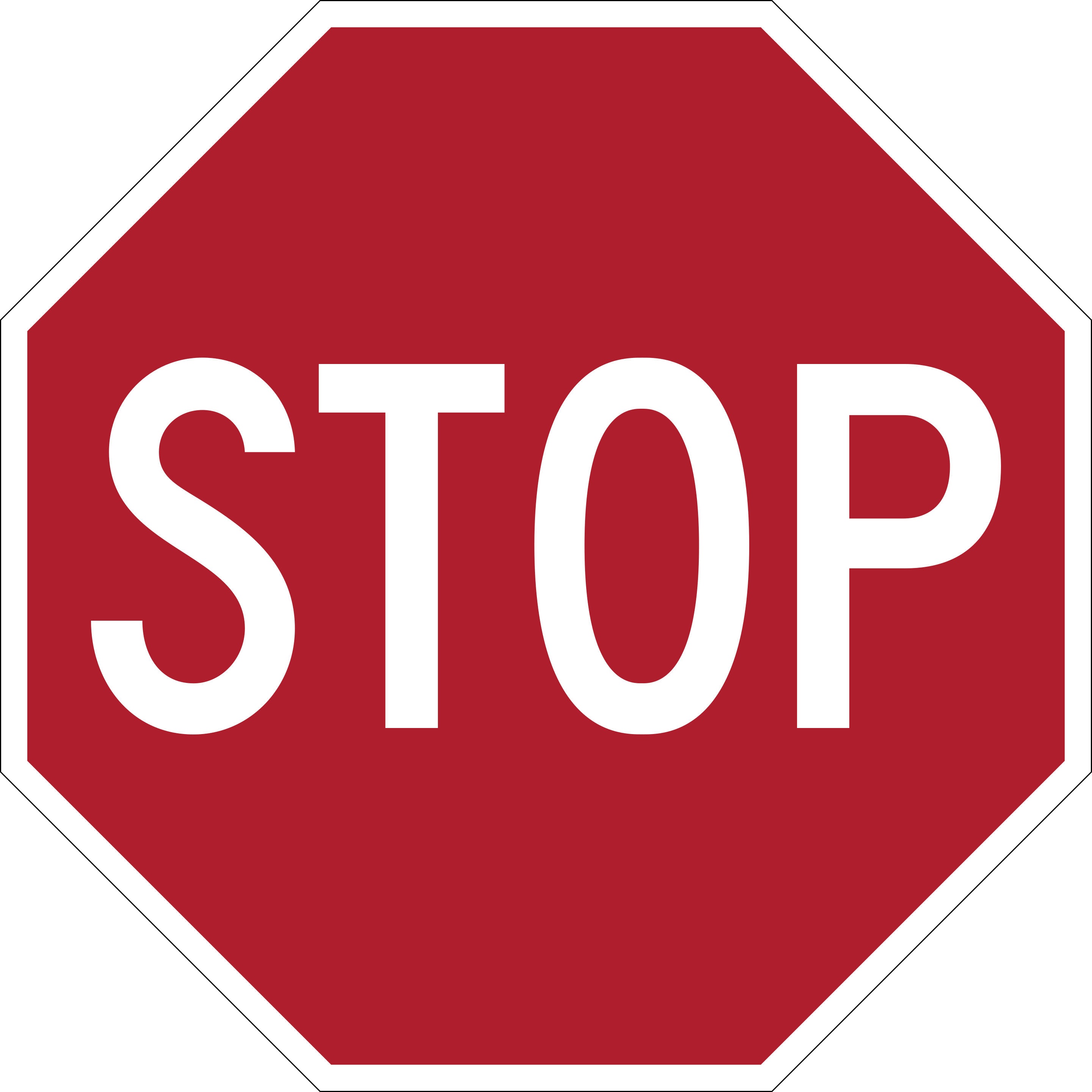
11. At this red eight-sided sign, where should you stop if a stop line or crosswalk is present?
- Past the crosswalk where you can see better
- Beside the sign after yielding
- Only before the sign post itself
- Behind the stop line or crosswalk
Show answer
Behind the stop line or crosswalk. A stop sign requires a full stop, and South Dakota tells drivers to stop behind the stop line or crosswalk when one is present. Stopping past the crosswalk is wrong because it can place the vehicle in the pedestrian area before yielding. Watch for the painted stop line first, then the crosswalk, and then crossing traffic and pedestrians before you move again.
Study this in the handbook: Regulatory, stop, yield and guide signs
12. A school crossing guard tells you to stop. What does South Dakota require?
- Stop only if the guard is holding a red sign
- Continue slowly unless children are already in the crosswalk
- Obey only traffic lights and posted signs
- Follow the guard's direction to stop
Show answer
Follow the guard's direction to stop. School crossing guards are included in South Dakota's traffic control devices, along with law enforcement and highway personnel. Their directions are not optional suggestions. The choice about continuing until children are already in the crosswalk reacts too late and ignores the guard's authority. When a person directing traffic faces your lane and signals stop, brake before the crossing and wait for a clear release.
Study this in the handbook: Pedestrians, bicyclists, motorcyclists and school buses
13. When turning left in South Dakota, which traffic must you yield to?
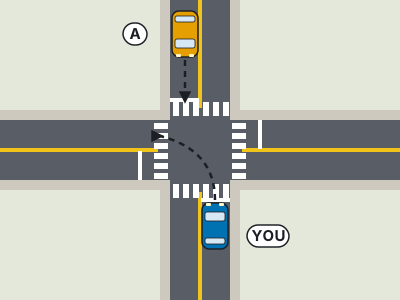
- Drivers in the opposing traffic lane
- Drivers behind you in your lane
- Parked vehicles on the far curb
- Only vehicles with flashing headlights
Show answer
Drivers in the opposing traffic lane. A left turn crosses the path of vehicles coming from the opposite direction, so South Dakota directs the turning driver to yield to opposing traffic. The driver-behind-you option confuses signaling and rear awareness with right-of-way; you still check mirrors, but the conflict point is ahead across oncoming lanes. A useful road cue is the gap in oncoming traffic: wait until approaching vehicles are far enough away before you turn across their lane.
Study this in the handbook: Right of way, funerals and intersections
14. Why does the South Dakota manual tell drivers to be especially watchful for bicyclists at night?
- Bicyclists are required to ride on the sidewalk after dark
- Some bikes may not have the reflectors or lights they should have
- Bicycles are not allowed on roads at night
- Bicycle lights are always bright enough to be seen
Show answer
Some bikes may not have the reflectors or lights they should have. Bicyclists should have reflectors or lights on their bikes, but the manual warns that some bikes may not have this equipment, so drivers must be especially careful and watchful for bikes and bicyclists. A rider with no lights can be invisible until the last moment. Slow down when approaching, pass with room, and remember that bicyclists have the same rights on the roadway as other vehicles. They are not required to leave the road at night.
Study this in the handbook: Controlling speed
15. What information is shown on an Emergency Notification System sign at a railroad crossing?
- The engineer's radio channel and train schedule
- A dispatch phone number and DOT crossing number
- The nearest highway speed limit and mile marker
- A detour map for oversized vehicles
Show answer
A dispatch phone number and DOT crossing number. The ENS sign gives drivers a direct emergency dispatch number and a DOT number that identifies the exact crossing. That lets railroad personnel locate a blocked or damaged crossing quickly and warn trains. The train schedule choice is wrong because the sign is for reporting problems, not predicting arrivals. A useful cue is the blue sign near the crossing: use both numbers if a vehicle is stuck, gates malfunction, or tracks are blocked.
Study this in the handbook: Warning, railroad and work zone signs
16. When must you stop for a South Dakota school bus?
- Whenever its red lights flash or stop arm is extended unless a physical barrier separates the roadway
- Only when you are behind it on a two-lane road
- Only during posted school hours
- Only if children have already stepped into your lane
Show answer
Whenever its red lights flash or stop arm is extended unless a physical barrier separates the roadway. South Dakota requires stopping for a school bus with flashing red lights or an extended stop arm at all times unless a physical barrier separates the roadway. Limiting the rule to drivers behind the bus, to school hours, or to children already in your lane misses that it applies whenever the red lights flash or the arm is out. After the red lights stop flashing and the stop arm is no longer visible, proceed slowly while watching for children.
Study this in the handbook: Pedestrians, bicyclists, motorcyclists and school buses
17. What is the minimum driver-license loss listed for a first DWI offense in South Dakota?
- 30 days
- 10 days
- 180 days
- One year
Show answer
30 days. The South Dakota penalties section says a first DWI offense carries loss of the driver license for a minimum of 30 days. The one-year option is tempting because it appears for later offenses and refusal consequences, but it is not the first-offense minimum in this bullet. The cue is offense count: first DWI starts with a 30-day minimum loss, while repeat offenses and refusals can produce much longer license consequences.
Study this in the handbook: DWI and zero tolerance penalties
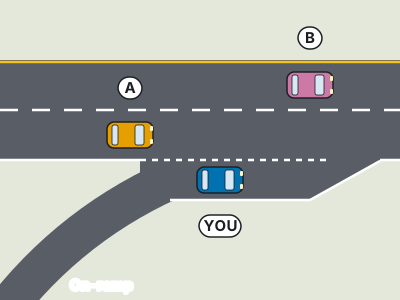
18. When merging into traffic, what speed should you try to reach before entering the lane?
- At least 10 mph below traffic
- A complete stop at the end of the ramp
- The same speed traffic is currently moving
- Whatever speed lets you stay ahead of trucks
Show answer
The same speed traffic is currently moving. South Dakota advises matching the current traffic speed when merging, using the acceleration lane to build speed before entering. Stopping at the end of the ramp is a serious error unless traffic forces it, because drivers behind may not expect a sudden stop and you lose room to accelerate. The cue is the ramp’s purpose: use it to find a gap and blend with the flow, then yield to vehicles already on the road.
Study this in the handbook: Controlling speed
19. What does this divided-highway warning sign announce?

- A mandatory U-turn point
- An end to every posted speed limit
- A physical separation or divided highway condition ahead
- A shoulder reserved for passing
Show answer
A physical separation or divided highway condition ahead. South Dakota's warning sign table includes Divided Highway signs, which alert drivers before the roadway pattern changes. The mandatory U-turn option conflicts with the warning purpose and with the separate rules limiting U-turns. Use the split-arrow median symbol as the cue to expect traffic streams separated by a divider and position your vehicle for the proper side. The manual describes warning signs as usually yellow with black symbols, alerting you to a change in the road ahead.
Study this in the handbook: Warning, railroad and work zone signs
20. Where must an SR22 form be received in South Dakota after a qualifying suspension or revocation?
- At any driver exam station
- At the central administrative office
- At the county treasurer’s counter only
- In the glove box of the insured vehicle
Show answer
At the central administrative office. The SR22 process is not handled by presenting a form at a local exam station. South Dakota requires the filing to be received at the central administrative office, and the document must come directly from the insurance company. The exam-station choice is tempting because drivers often handle license tasks there, but the manual expressly says those stations cannot accept SR22 forms. The cue is filing source and destination: insurer sends it centrally.
Study this in the handbook: Instruction and Restricted Minor's Permits
QualitySpace is expanding to South Dakota
We are a California-based independent insurance brokerage working on licensing in more states. We cannot help with South Dakota insurance yet. Leave your email and we will let you know when we can.
Every question is written from the official South Dakota Driver License Manual. Need paper? Printable SD practice test with answer key.
Last verified 2026-10-05. How we check every question · Study all 202 as flashcards
Frequently asked questions
How many questions are on this South Dakota practice test?
This fixed set has 20 questions. It is test 7 of 10 from the 202 question South Dakota bank.
How does this fixed test relate to the full South Dakota bank?
Each numbered test is a fixed set of questions in a fixed order, so you can retake the same test later and compare. Every test mixes road signs and the other topics in about the same proportion as the full bank. Tests 1 to 10 together cover 200 of the 202 questions in the South Dakota bank, each once. The full practice page mixes the whole bank at random.
Last verified 2026-10-05. See the South Dakota DMV facts page for sourced state details.
Return to the full South Dakota practice test · Study road signs