
20 question exam format · Real sign images & audio · Free

AK Permit Practice Test

Practice the Alaska knowledge test the way it is actually given: 20 questions, 80 percent to pass. Every question has a plain English explanation and narrated audio. 180 questions in the bank, free, no account required.

Question bank
180
State
Alaska
Format
Fixed question set
Cost
Free

The real Alaska knowledge test is the DMV exam used for a learner permit. This page contains the full free 180 question study bank, with an explanation after each answer. Use the numbered 20 question tests below when you want a fixed study session.

The real Alaska knowledge test: 20 questions; passing score 16 correct answers to pass (80%) (official source). This practice bank has 180 questions.

Alcohol and DUIEmergenciesLaws and paperworkParkingRight of wayRoad signsSafe drivingSignals and markingsSpeed limits

180-question bank · Real sign images & audio · Free

Alaska practice test has 180 questions. Every question comes with a plain-English explanation the moment you answer.

Real exam format: 20 questions, 16 correct to pass.

Start here

Run 20 questions to warm up.

Find your gaps

Diagnose weak topics and retry what you've missed.

Simulate the real thing

Practice under graded exam conditions or run the whole bank.

Random draw every attempt. Scored against the 80% passing standard.

Free means actually free: no subscription, no auto-renew, no card required, no locked features. This site is funded by our insurance work, not by test-prep charges.

See facts and key topics for Alaska DMV (minimum age, fees, wait times, question counts by topic) before you start, or print it to bring with you on test day.

How to use this AK practice test

  1. Take the 20 question exam-length practice test above once, untimed, to find your weak topics.
  2. Work through the numbered 20 question sets below. Each one is fixed, so a second attempt is a fair comparison.
  3. Read the explanation on every miss. The wording comes from the Alaska Driver Manual, which is what the examiners use.
  4. When you pass three sets in a row at 80 percent or better, book the real test.

AK practice tests, 20 questions each

Fixed sets in a fixed order so you can retake one and compare your score.

  1. Test 1
  2. Test 2
  3. Test 3
  4. Test 4
  5. Test 5
  6. Test 6
  7. Test 7
  8. Test 8
  9. Test 9

Printable AK practice test with answer key

Frequently asked questions

How many questions are in the Alaska practice bank?

This free page contains the full 180 question bank. The numbered tests each contain 20 fixed questions.

How does this practice test relate to the real Alaska test?

The real test facts are shown above from the official source. This page is an educational practice bank and is separate from the DMV test.

Can I use the Alaska practice test for free?

Yes. The practice questions, explanations, and numbered tests are free to use with no account required.

Last verified 2026-09-05 against the Alaska Driver Manual, which sets the real exam at 20 questions and 16 correct to pass.

All 20 questions, AK exam length

Every question below comes from the Alaska question bank on this page. Open a question to see the correct answer and the explanation. Nothing here is hidden behind a signup.

  1. 1. At an uncontrolled intersection, two vehicles approach with a danger of collision. Which driver must yield?

    1. The driver on the left yields to the driver on the right
    2. The driver on the right yields to the driver on the left
    3. The driver going faster yields to the slower driver
    4. Both drivers continue because neither has a stop sign
    Show answer

    The driver on the left yields to the driver on the right. Alaska assigns the yield duty to the vehicle on the left when two vehicles reach an uncontrolled intersection in a position and time that co Full explanation in Test 1

  2. 2. For an adult driver in Alaska, what alcohol concentration creates a legal presumption of driving under the influence?

    1. .08 or more
    2. .02 or more
    3. .04 or more in every vehicle
    4. .12 or more
    Show answer

    .08 or more. Alaska states that a breath or blood alcohol concentration of . Full explanation in Test 1

  3. 3. When may a driver turn right on red in Alaska?

    1. After a full stop, when safe, unless a sign prohibits the turn
    2. Without stopping if no vehicle is nearby
    3. Only after waiting for the next green arrow
    4. At any time while pedestrians are crossing
    Show answer

    After a full stop, when safe, unless a sign prohibits the turn. A right turn on red is permitted only after a full stop, when the turn can be made safely, and when no No Turn on Red sign restricts it. Full explanation in Test 1

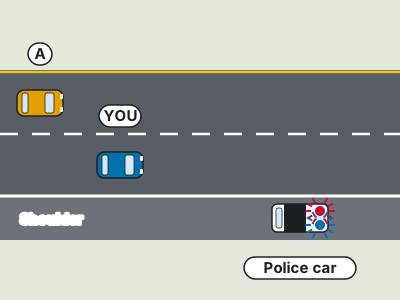
  4. 4. What must a driver do if moving to another lane away from an approaching emergency vehicle is not possible?

    1. Slow to a reasonable speed and drive safely around the scene
    2. Stop in the lane and wait for the emergency vehicle to leave
    3. Pass the emergency vehicle at the posted maximum speed
    4. Drive onto the sidewalk to create more room
    Show answer

    Slow to a reasonable speed and drive safely around the scene. When a lane change is impossible, or only one lane travels in that direction, the driver must slow to a reasonable speed and pass the scene Full explanation in Test 2

  5. 5. Who may supervise a person driving under an Alaska instruction permit?

    1. A licensed driver at least 21 with at least one year driving the same vehicle type
    2. Any licensed driver at least 18 with six months of experience
    3. A licensed driver at least 25 with two years of experience
    4. Only a driving school instructor may supervise
    Show answer

    A licensed driver at least 21 with at least one year driving the same vehicle type. The supervising person must be licensed, at least 21 years old, and experienced with the same type or class of vehicle. Full explanation in Test 2

  6. 6. How far behind an emergency scene may a driver park when fire apparatus displays flashing red or blue lights?

    1. At least 100 feet
    2. At least 250 feet
    3. At least 500 feet
    4. At least 1,000 feet
    Show answer

    At least 500 feet. A driver may not park within 500 feet where fire apparatus has stopped and displays flashing red or blue lights. Full explanation in Test 3

  7. 7. What kind of instruction does a regulatory speed sign provide?

    1. A legal instruction that must be understood and obeyed
    2. A suggestion that may be ignored when traffic is light
    3. A route marker for trucks seeking a different highway
    4. A warning that applies only during construction
    Show answer

    A legal instruction that must be understood and obeyed. Regulatory signs communicate instructions backed by state statute, regulation, or local ordinance. Full explanation in Test 3

  8. 8. What does a lane-ending warning require a driver to anticipate?

    1. The roadway narrows ahead, requiring a safe move into the remaining lane
    2. A new lane will open on the side shown by the sign
    3. The right lane becomes a permanent passing lane
    4. All traffic must stop before the lane markings change
    Show answer

    The roadway narrows ahead, requiring a safe move into the remaining lane. A lane-ending warning shows that the roadway will narrow ahead, so the driver must plan a safe move into the lane that remains. Full explanation in Test 4

  9. 9. Where should you stop for a stop sign when a crosswalk or stop line is present?

    1. Behind the crosswalk or at the painted stop line
    2. Past the crosswalk so the front bumper enters the intersection
    3. Beside the sign, even if that blocks the sidewalk
    4. Only after entering the intersecting roadway
    Show answer

    Behind the crosswalk or at the painted stop line. Alaska's stop sign procedure places the vehicle behind the crosswalk, at the painted stop line, or behind the intersecting roadway shoulder Full explanation in Test 4

  10. 10. What information do Alaska guide signs provide?

    1. Destination, route guidance, and place names
    2. Mandatory stop instructions and penalties
    3. Warnings about all dangerous conditions ahead
    4. Only emergency telephone numbers
    Show answer

    Destination, route guidance, and place names. Guide signs provide destination information, route guidance, and place names. Full explanation in Test 5

  11. 11. How much does a copy of an Alaska driving record cost?

    1. Free
    2. $50
    3. $10
    4. $2
    Show answer

    $10. For a fee of $10 a driving record may be provided to the driver or to a person the driver designates. Full explanation in Test 5

  12. 12. What equipment may a flag person use to direct traffic through an Alaska work zone?

    1. A red flag or stop/slow paddle
    2. A blue parking placard
    3. A white license plate held overhead
    4. A green highway route shield
    Show answer

    A red flag or stop/slow paddle. Flag persons in highway and street work zones generally wear orange and use red flags or stop and slow paddles to direct traffic safely. Full explanation in Test 5

  13. 13. For what crashes must an Alaska driver submit a certificate of insurance to the DMV, and by when?

    1. Only injury crashes, within 30 days
    2. Only crashes over $2,000, within 10 days
    3. Never, the officer handles it
    4. Any crash with property damage of $501 or more, within 15 days
    Show answer

    Any crash with property damage of $501 or more, within 15 days. A certificate of insurance is required on all crashes with property damage of $501 or more and must be submitted to the DMV within 15 days, Full explanation in Test 6

  14. 14. If moving to the opposite lane is unsafe near a stationary emergency vehicle, how should an Alaska driver pass?

    1. Slow to a reasonable and prudent speed while passing
    2. Stop beside the emergency vehicle
    3. Maintain the posted speed without adjustment
    4. Use the shoulder regardless of traffic
    Show answer

    Slow to a reasonable and prudent speed while passing. When changing lanes is unsafe, or when the road has only one lane in that direction, the manual requires a reasonable and prudent speed whil Full explanation in Test 6

  15. 15. Before passing another vehicle on an Alaska two-lane road, what should the driver check ahead?

    1. A clear path with no no-passing zone or oncoming vehicle
    2. Only the rearview mirror, because the opposing lane is presumed clear
    3. A solid yellow line already in the passing vehicle's lane
    4. A hill crest that hides approaching traffic
    Show answer

    A clear path with no no-passing zone or oncoming vehicle. Safe passing begins with a view far enough ahead to confirm there is no no-passing zone and no oncoming vehicle. Full explanation in Test 7

  16. 16. If speed increases from 20 to 40 mph, how does Alaska's manual describe the change in impact and braking distance?

    1. Both are four times greater
    2. Both are twice as great
    3. Impact rises three times but braking distance stays the same
    4. Neither changes if the road is dry
    Show answer

    Both are four times greater. The manual explains that doubling speed from 20 to 40 mph makes impact and braking distance four times greater, not merely twice as great. Full explanation in Test 7

  17. 17. On a four-lane road, how should an Alaska driver pass a stationary emergency vehicle with flashing overhead lights?

    1. Move to the lane opposite the emergency vehicle when safe
    2. Stop beside the emergency vehicle in the adjacent lane
    3. Pass in the same lane at the posted speed
    4. Use the shoulder regardless of traffic
    Show answer

    Move to the lane opposite the emergency vehicle when safe. On a four-lane road, the driver must pull into the lane opposite a stationary emergency vehicle or tow truck with overhead flashing lights w Full explanation in Test 8

  18. 18. What following rule applies when a driver is close behind another vehicle in Alaska?

    1. The gap must be reasonable and prudent for speed, traffic, and roadway conditions
    2. The gap must always be exactly one car length
    3. A driver may follow closely below 20 mph
    4. Following distance matters only on two-lane roads
    Show answer

    The gap must be reasonable and prudent for speed, traffic, and roadway conditions. Alaska requires a following distance that is reasonable and prudent with regard to speed, traffic, and roadway conditions. Full explanation in Test 8

  19. 19. Under what condition may an Alaska driver drive over a fire hose?

    1. Only with the consent of a fire department official
    2. Whenever the hose is flat
    3. When no water is flowing
    4. At speeds under 5 mph
    Show answer

    Only with the consent of a fire department official. Do not drive over a hose of a fire department without the consent of a department official; crushing a charged hose can cut water to firefig Full explanation in Test 9

  20. 20. How much fuel does the Alaska manual say a commuter saves by driving 60 mph instead of 70 on a 20 mile highway commute?

    1. About 10 gallons a day
    2. About 1.3 gallons each five day work week
    3. No savings
    4. About 50 gallons a week
    Show answer

    About 1.3 gallons each five day work week. If you traveled a 20 mile highway commute at 60 mph instead of 70 mph, you would save approximately 1. Full explanation in Test 9

How this test works

Study the rules, then check the explanation

This page uses the prepared Alaska question bank exactly as provided. Start the test, choose an answer, and read the explanation before moving on. Retakes serve the same 180 questions so you can work through the state set without losing your place.

Want a one-page summary to study or print? See the Alaska DMV cheat sheet, with the most-missed rules from this same question bank.

Looking for another state? Go back to the DMV practice test hub. California remains on the established California DMV practice test page.

Are you a library or school? See the free DMV practice test partner resource for a copy ready listing and referral link.

QualitySpace is expanding to Alaska

We are a California-based independent insurance brokerage working on licensing in more states. We cannot help with Alaska insurance yet. Leave your email and we will let you know when we can.