
Test 7 of 10 · 20 questions · Free 2026
AK Permit Practice Test 7
Jump to the test ↓A fixed 20 question set from the Alaska bank with answers and plain English explanations. The real AK exam is 20 questions, 80 percent to pass; take the full length version on the main practice page.
Question 1 of 20 · 0 right so far
All 20 questions in test 7
Every question below comes from the Alaska question bank on this page. Open a question to see the correct answer and the explanation. Nothing here is hidden behind a signup.
1. How many points does Alaska assign for failing to stop for a school bus while it is loading or unloading?
- 2
- 4
- 9
- 6
Show answer
6. Failing to stop for a school bus while it is loading or unloading carries 6 points, the same as driving without insurance, negligent driving, and failure to yield to an emergency vehicle. Two points is for other moving violations, 4 for following too close or failure to stop or yield, and 9 for leaving the scene of a crash. Two 6 point convictions within 12 months reach the 12 point suspension threshold, and a driver gets a warning letter at the halfway mark.
2. Under Alaska's ignition interlock chart, how long must a driver with a second DUI or Refusal conviction keep the device installed?
- 6 months
- 12 months
- 18 months
- 30 months
Show answer
12 months. Alaska's interlock chart sets 6 months for one DUI or Refusal conviction, 12 months for two, 18 months for three, 24 months for four, and 30 months for five. A second conviction therefore requires 12 months. Six months is the single conviction period, and 18 and 30 months belong to later convictions. The device is required on any vehicle the person operates, and the driver pays for installation and maintenance and must show proof of installation and SR22 financial responsibility when reinstating.
Study this in the handbook: Alcohol, implied consent and under 21 rules
3. How close may a vehicle be parked to an Alaska fire hydrant?
- No closer than 5 feet
- No closer than 15 feet
- No closer than 30 feet
- Any distance if the driver stays inside
Show answer
No closer than 15 feet. Alaska's parking list prohibits parking within 15 feet of a fire hydrant. Five feet understates the required space, while 30 feet belongs to another listed parking reference, not the hydrant. Remaining in the driver's seat does not create an exception. The same list sets other distances, such as 20 feet from a crosswalk or intersection and 50 feet from a railroad crossing, so check which object is nearest before leaving the vehicle.
4. When a school bus ahead is stopped with red signal lights flashing, when may following traffic proceed?
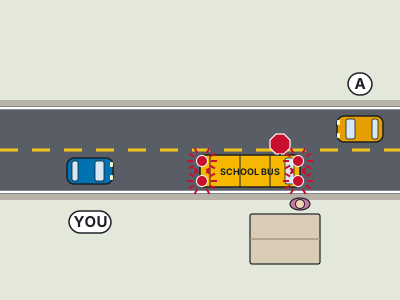
- After the stop sign is retracted, the red lights stop, and the bus resumes motion, unless the driver signals sooner
- As soon as the driver sees no child in the roadway
- After slowing to 10 mph and passing on the left
- Immediately if the following vehicle is in a hurry
Show answer
After the stop sign is retracted, the red lights stop, and the bus resumes motion, unless the driver signals sooner. A driver approaching a stopped school bus from the rear must stop and remain stopped while the red lights flash. The manual identifies the release conditions: the stop sign is retracted, the flashing red lights are discontinued, and the bus resumes motion, or the bus driver signals the vehicle to proceed. Seeing no child in the roadway is not one of the listed release conditions. Treat the extended stop arm and red lights as a complete stop instruction, not a reduced-speed warning.
Study this in the handbook: School buses, passing and railroad crossings
5. When emergency vehicles are responding to an emergency, what must an Alaska driver do?
- Remain in the same lane until the emergency vehicle passes
- Yield to an emergency vehicle approaching from any direction by moving to the lane away from it
- Stop in the lane nearest the emergency vehicle
- Follow the emergency vehicle to clear traffic
Show answer
Yield to an emergency vehicle approaching from any direction by moving to the lane away from it. When an emergency vehicle is responding, the manual directs drivers to yield to it from any direction by moving to the lane away from the emergency vehicle. That action creates a safer path for the responder and reduces the chance of a collision near the scene. Staying in the same lane or stopping beside the vehicle leaves the conflict in place. Following the emergency vehicle is also unsafe and can interfere with its response. Check the surrounding area, signal when changing lanes, and keep clear of the emergency vehicle’s path.
Study this in the handbook: Emergency vehicles and the Move Over law
6. Your vehicle is stuck on Alaska railroad tracks and a train is coming. Which way should you run?
- Straight down the tracks away from the train
- Stay in the vehicle and buckle up
- Toward the vehicle's rear
- Away from the vehicle in the direction the train is coming from, then call 911
Show answer
Away from the vehicle in the direction the train is coming from, then call 911. If your vehicle is on the tracks and the crossing lights begin to flash, you may have only 20 seconds to escape, so get out of the vehicle at once. Once outside, run away from both the tracks and the vehicle, heading in the direction the train is coming from. Once clear, immediately dial 911. Every highway rail crossing also has a typically blue Emergency Notification System sign with a number answered by railroad dispatchers.
Study this in the handbook: Vehicle emergencies, skids and stalls on the tracks
7. What following interval does the Alaska manual recommend for calculating a safe following distance?
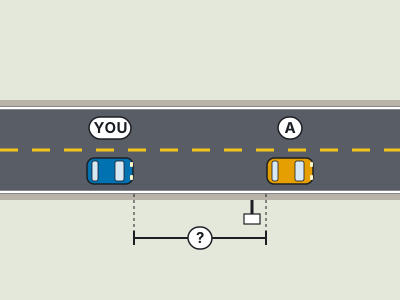
- A one-second interval regardless of weather
- A one-car-length rule at every speed
- The four-second interval method
- A ten-second stop at every landmark
Show answer
The four-second interval method. The manual describes the four-second interval method: watch the vehicle ahead pass a definite point, then count four seconds and compare your arrival at that point. If you reach it before finishing, the gap is too short. The fixed one-car-length choice fails because distance needed changes with speed, and the one-second choice leaves little reaction time. Towing a trailer or driving on a wet or slippery surface calls for six seconds or more. Pick a roadside object as your reference and count consistently while conditions change.
Study this in the handbook: Following distance and large trucks
8. From how far must an Alaska vehicle horn be audible?
- Not less than 200 feet under normal conditions
- At least 50 feet
- At least one mile
- There is no requirement
Show answer
Not less than 200 feet under normal conditions. A vehicle horn must be capable of emitting a sound audible under normal conditions from not less than 200 feet. Audible signal devices may not be used unless necessary to assure safe operation, so the horn is for warning, not for greeting or venting. The equipment list also says no device shall emit an unusually loud sound or whistle. The manual suggests sounding the horn before passing to warn the driver ahead, and it notes you may sound it before backing for extra safety.
Study this in the handbook: Required equipment and maintenance
9. What does a flashing orange upraised hand mean to a pedestrian already in the roadway?
- The pedestrian may proceed to the other side
- The pedestrian must step backward onto the curb
- The pedestrian may enter only outside the crosswalk
- The pedestrian must wait for a vehicle to escort them
Show answer
The pedestrian may proceed to the other side. A flashing orange upraised hand tells pedestrians not to enter the roadway, but someone already in the roadway may proceed to the other side. The pedestrian should remain within the marked crosswalk and show courtesy to others. This differs from the steady hand, which also bars entry and tells a person already crossing to proceed across. The key cue is whether the pedestrian has already entered, not whether the signal looks generally cautionary.
Study this in the handbook: Traffic signals and lane control signals
10. What roadway change does a MERGE warning identify?

- The lane is reserved for vehicles carrying hazardous materials
- The driver must leave the roadway at the next exit
- Traffic may merge from the right, so the driver should be alert and adjust speed
- Traffic from the side must stop and wait indefinitely
Show answer
Traffic may merge from the right, so the driver should be alert and adjust speed. Alaska's sign chart captions the merge warning sign as be alert for traffic merging from the right. Like other warning signs, it alerts the driver to a potentially dangerous condition ahead, and the manual says most warning signs imply the driver should decrease speed. It does not reserve a lane for hazardous materials, require an exit, or make merging traffic wait indefinitely. Watch the joining lane and adjust speed so traffic can merge safely.
Study this in the handbook: Road signs by color and shape
11. What is the minimum age to be issued an Alaska driver's license?
- 16
- 15
- 14
- 18
Show answer
16. Alaska may issue a driver's license to an applicant who is at least 16. Fourteen is the minimum age for an instruction permit, not a license. Applicants who are 16 or 17 must also have held a valid instruction permit for at least 6 months, and a first license before 18 is a provisional license with passenger and hour limits. Eighteen is the age when provisional restrictions end, not the minimum licensing age.
Study this in the handbook: Instruction permits and provisional licenses
12. What condition does the skidding-car warning identify?

- A bridge that is closed to passenger vehicles
- A designated area where drivers may practice racing
- A gravel surface that requires tire chains at all times
- A slippery roadway after rain, frost, or similar conditions
Show answer
A slippery roadway after rain, frost, or similar conditions. The skidding-car symbol warns that the roadway can become slippery after rain, frost, or related weather. Reduce speed and use smooth steering, braking, and acceleration because available traction may be lower than the pavement appearance suggests. It does not identify a racing area, automatically require chains on gravel, or indicate a closed bridge. Fresh precipitation can make the surface especially deceptive. Increase following space and avoid sudden control inputs near the warning.
Study this in the handbook: Road signs by color and shape
13. In the Alaska sign chart, what does a horizontal yellow sign with a large black arrow pointing right tell a driver?
- Make a sharp turn to the right in front of the sign
- A right lane continues straight while the road turns left
- A one-way street begins after the next signal
- A T-intersection where the driver must yield to a bus
Show answer
Make a sharp turn to the right in front of the sign. Alaska's sign chart shows a horizontal yellow sign with a large black arrow and captions it make sharp turn to right in front of this sign. The sign is placed where the road itself turns sharply, so the driver should slow before reaching it and follow the roadway to the right. It does not announce a one-way street or a bus yield rule. Like other warning signs, it implies decreasing speed and adjusting to the situation.
14. Under Alaska's under-21 alcohol rule, what happens if a person under 21 operates a vehicle after consuming any alcohol?
- The person receives only a warning on a first occasion
- The person is lawful until reaching .08
- The rule applies only when a crash occurs
- The person can be arrested or cited for minor operating after consuming alcohol
Show answer
The person can be arrested or cited for minor operating after consuming alcohol. Alaska prohibits a person under 21 from operating a motor vehicle after consuming alcohol in any amount. The manual says that person can be arrested or cited for minor operating after consuming alcohol, so the adult .08 threshold does not provide a safe allowance. A crash is not required, and the rule is not limited to repeat conduct. For study purposes, pair under 21 with any amount, then remember that refusal or a positive breath result can also trigger license revocation.
Study this in the handbook: Alcohol, implied consent and under 21 rules
15. What happens to fines for traffic offenses committed in an Alaska Traffic Safety Corridor?
- They apply only to commercial vehicle operators
- They are waived for a first offense
- They are reduced to the ordinary parking fine
- They are doubled
Show answer
They are doubled. Alaska may designate portions of a highway as Traffic Safety Corridors to promote safer driving. Traffic offense fines in one of these designated areas are doubled, which raises the financial consequence of a violation. The rule is not limited to commercial operators, and nothing in the manual waives or reduces a corridor fine. A driver should watch for the corridor designation and treat it as a signal to tighten speed control and lane discipline. The key number to remember is two times the ordinary fine.
Study this in the handbook: Speed laws and impact
16. When may an Alaska driver signal from a greater distance than the usual turn-signal minimum?
- Only when approaching a railroad crossing
- When traffic conditions or vehicle speed warrant it
- Only after entering the intersection
- Never, because signaling early is prohibited
Show answer
When traffic conditions or vehicle speed warrant it. Alaska permits a driver to signal from a greater distance when traffic conditions or the vehicle’s higher speed make extra warning useful. The rule does not limit early signaling to railroad crossings, and a signal given after entering the intersection arrives too late for approaching road users. Early notice should still match the intended maneuver and should be canceled after the turn so it does not mislead others. Use the normal final-100-foot requirement as the baseline, then extend the signal when speed or surrounding traffic calls for more communication.
Study this in the handbook: Turn signals and pavement markings
17. Where do most collisions happen, according to Alaska's seat belt facts?
- Mostly at night on rural roads
- Mostly on freeways above 65 mph
- Mostly on long trips far from home
- More than 80 percent occur below 40 mph, and three of four fatal collisions occur within 25 miles of home
Show answer
More than 80 percent occur below 40 mph, and three of four fatal collisions occur within 25 miles of home. More than 80 percent of all collisions occur at speeds less than 40 miles per hour, and three out of four collisions causing death occur within 25 miles of home. These facts appear in the manual's safety belt section, which notes that the chances of being killed are almost 25 times greater if you are thrown from the car. Most collisions happen close to home and at lower speeds.
Study this in the handbook: Safety belts and child seats
18. What equipment may a flag person use to direct traffic through an Alaska work zone?
- A white license plate held overhead
- A blue parking placard
- A red flag or stop/slow paddle
- A green highway route shield
Show answer
A red flag or stop/slow paddle. Flag persons in highway and street work zones generally wear orange and use red flags or stop and slow paddles to direct traffic safely. The other objects are not the traffic control equipment described for flagging operations. Drivers should watch the person rather than assume the lane remains open, because a work zone may require an immediate stop, a reduced speed, or a guided movement around the hazard.
19. Which sequence best follows Alaska's lane changing guidance?
- Move first, then check mirrors after entering the lane
- Signal, accelerate sharply, and rely on the inside mirror
- Use mirrors, check blind spots, signal, check again, then move gradually
- Turn on hazards and cross two lanes at once
Show answer
Use mirrors, check blind spots, signal, check again, then move gradually. The manual gives a five-part lane-change sequence: use mirrors, check blind spots, signal intentions, check mirrors and blind spots again, then change lanes gradually and carefully. The second observation matters because another vehicle or motorcycle can enter the blind area after the first scan. Signaling does not make an occupied lane safe, and accelerating sharply or crossing two lanes adds unnecessary risk. Make the checks before lateral movement, confirm a usable gap, and move smoothly so nearby drivers can predict what the vehicle will do.
20. Under what conditions are Alaska’s listed statutory speed limits maximums?
- On every roadway regardless of posted signs or conditions
- On highways that are not otherwise posted and under favorable conditions
- Only inside residential districts during daylight
- Only when emergency vehicles are nearby
Show answer
On highways that are not otherwise posted and under favorable conditions. The manual introduces its listed speed limits as maximums for highways that are not otherwise posted and for favorable conditions. A posted sign can establish a different limit, and traffic, surface, width, or weather can require a lower careful and prudent speed. The residential-only choice ignores the manual’s broader roadway categories. The emergency-vehicle choice concerns a separate rule. Read the table as a ceiling for the stated conditions, then adjust below it whenever the road or weather reduces safety.
Study this in the handbook: Speed laws and impact
QualitySpace is expanding to Alaska
We are a California-based independent insurance brokerage working on licensing in more states. We cannot help with Alaska insurance yet. Leave your email and we will let you know when we can.
Every question is written from the official Alaska Driver Manual. Need paper? Printable AK practice test with answer key.
Last verified 2026-10-05. How we check every question · Study all 201 as flashcards
Frequently asked questions
How many questions are on this Alaska practice test?
This fixed set has 20 questions. It is test 7 of 10 from the 201 question Alaska bank. The real AK exam asks 20 questions and you need 16 correct.
What is the passing score for the real Alaska test?
16 correct answers to pass (80%) That figure comes from the official Alaska source cited on the DMV facts page.
How does this fixed test relate to the full Alaska bank?
Each numbered test is a fixed set of questions in a fixed order, so you can retake the same test later and compare. Every test mixes road signs and the other topics in about the same proportion as the full bank. Tests 1 to 10 together cover 200 of the 201 questions in the Alaska bank, each once. The full practice page mixes the whole bank at random.
Last verified 2026-10-05. See the Alaska DMV facts page for sourced state details.