
Test 5 of 10 · 20 questions · Free 2026
AK Permit Practice Test 5
Jump to the test ↓A fixed 20 question set from the Alaska bank with answers and plain English explanations. The real AK exam is 20 questions, 80 percent to pass; take the full length version on the main practice page.
Question 1 of 20 · 0 right so far
All 20 questions in test 5
Every question below comes from the Alaska question bank on this page. Open a question to see the correct answer and the explanation. Nothing here is hidden behind a signup.
1. In an Alaska roundabout, how do vehicles travel around the center island?
- Counterclockwise
- Clockwise
- Straight through without turning
- Only in reverse
Show answer
Counterclockwise. Vehicles in an Alaska roundabout travel counterclockwise around the center island. Approaching traffic must yield to traffic already in the circle before joining it. Clockwise travel would put a vehicle against the intended circulation and could create a head-on conflict. A roundabout is not a straight-through crossing or a reversing maneuver. Slow before the entrance, choose the proper lane, and follow the pavement markings while moving around the island. The center island is the visual cue for the circular path.
Study this in the handbook: Intersections, right of way and roundabouts
2. If every bulb in an Alaska traffic signal is out and no person directs traffic, what must a driver do?
- Yield only to traffic approaching from the left
- Treat the intersection as an uncontrolled free passage
- Stop, yield to traffic approaching from the right, and proceed only when safe
- Wait in place until a bulb begins working again
Show answer
Stop, yield to traffic approaching from the right, and proceed only when safe. An entirely unlit signal head with no alternate signal or traffic director makes the intersection uncontrolled, but it does not remove the duty to stop. The driver then yields to traffic approaching from the right, exercises extreme caution, and proceeds only when safe. Treating the crossing as free passage invites a collision, and checking only left reverses the stated priority. The manual also says to report the condition to the nearest police department. Stop first, then apply the uncontrolled-intersection scan.
Study this in the handbook: Traffic signals and lane control signals
3. How many points does Alaska assign for leaving the scene of a crash?
- 4
- 6
- 9
- 2
Show answer
9. Leaving the scene of a crash carries 9 points in Alaska, just below the 10 point group that includes DUI and reckless driving. Six points is the value for negligent driving and failing to yield to an emergency vehicle, 4 is for following too close, and 2 is for other moving violations. Points are entered for convictions or bail forfeitures in Alaska or any other state.
4. What can happen if an Alaska driver cannot show proof of liability insurance to an officer?
- A traffic citation, or the vehicle may be impounded
- Nothing, if the driver is insured at home
- Only a written warning
- Immediate license revocation for five years
Show answer
A traffic citation, or the vehicle may be impounded. You must carry proof of liability insurance in the vehicle. Failing to provide it to a law enforcement officer may result in a traffic citation, or the vehicle may be impounded. The minimum coverage is $50,000 per person and $100,000 per accident for bodily injury or death, and $25,000 for property damage. Being insured is not enough without proof, and a five year revocation is not the listed consequence.
Study this in the handbook: Vision, insurance and the point system
5. How much following distance is prohibited behind an emergency vehicle responding to an emergency?
- Closer than 100 feet
- Closer than 500 feet
- Closer than 250 feet
- Closer than 1,000 feet
Show answer
Closer than 500 feet. A vehicle may not follow an emergency vehicle responding to an emergency closer than 500 feet. The rule is about following distance, not about stopping beside an emergency scene or matching the emergency vehicle's speed. The 100, 250, and 1,000 foot figures are distractors that change the statutory spacing. A separate instruction also prohibits parking within 500 feet of fire apparatus stopped with flashing red or blue lights. Notice whether the question describes following or parking, since both protections use the same distance but different actions.
Study this in the handbook: Emergency vehicles and the Move Over law
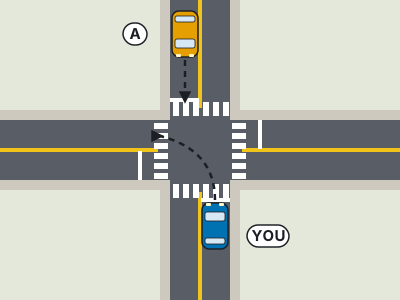
6. On a steady green ball, what must a driver turning left do before crossing opposing traffic?
- Turn immediately because green gives the turning vehicle priority
- Yield to vehicles going straight through from the opposite direction
- Wait for a red signal before making any left turn
- Yield only to vehicles approaching from behind
Show answer
Yield to vehicles going straight through from the opposite direction. A steady green ball permits a legal maneuver, but it does not clear opposing traffic for a left turn. The turning driver must yield to vehicles going straight through from the opposite direction, as well as pedestrians and other traffic with the right of way. Waiting for red is unnecessary and can create a new conflict. Use the green as permission to enter when clear, then let opposing through traffic pass before crossing its lane.
Study this in the handbook: Traffic signals and lane control signals
7. At what distance behind a vehicle going the same direction must an Alaska driver switch to low beams?
- Only when passing
- 50 feet
- 1,000 feet
- 300 feet or more
Show answer
300 feet or more. Change headlights to low beam when 300 feet or more from a vehicle going in the same direction, and change to low beam 500 feet or more from an oncoming vehicle. Headlights are required from half an hour after sunset to half an hour before sunrise and whenever daytime visibility drops to 1,000 feet or less. The 1,000 foot figure is that visibility threshold, not a dimming distance.
Study this in the handbook: Night driving, lighting, weather and animals
8. For a first DUI or refusal conviction, how long must an Alaska ignition interlock device remain installed?
- Three months
- Twelve months
- Nine months
- Six months
Show answer
Six months. One DUI or refusal conviction requires an ignition interlock device for a minimum of six months on any vehicle the person operates. Three and nine months do not appear in the chart, while twelve months applies to the second conviction rather than the first. The driver is also responsible for the installation and maintenance costs of the device. On a test question, count convictions first, then match the count to the installation period instead of assuming every DUI carries a year long device requirement.
Study this in the handbook: DUI revocations and ignition interlock
9. How far away must a driver park from fire apparatus that has stopped and displays flashing red or blue lights?
- At least 100 feet
- At least 500 feet
- At least 250 feet
- At least 1,000 feet
Show answer
At least 500 feet. A driver may not park within 500 feet where fire apparatus has stopped and displays flashing red or blue lights. This protects the response area and is distinct from the rule against following an emergency vehicle closer than 500 feet. The distance choices below 500 feet would place a parked vehicle too near the apparatus, while 1,000 feet adds a restriction not stated here. Read the verb carefully: parking near stopped fire apparatus is different from moving past a stationary vehicle or following one in motion.
Study this in the handbook: Emergency vehicles and the Move Over law
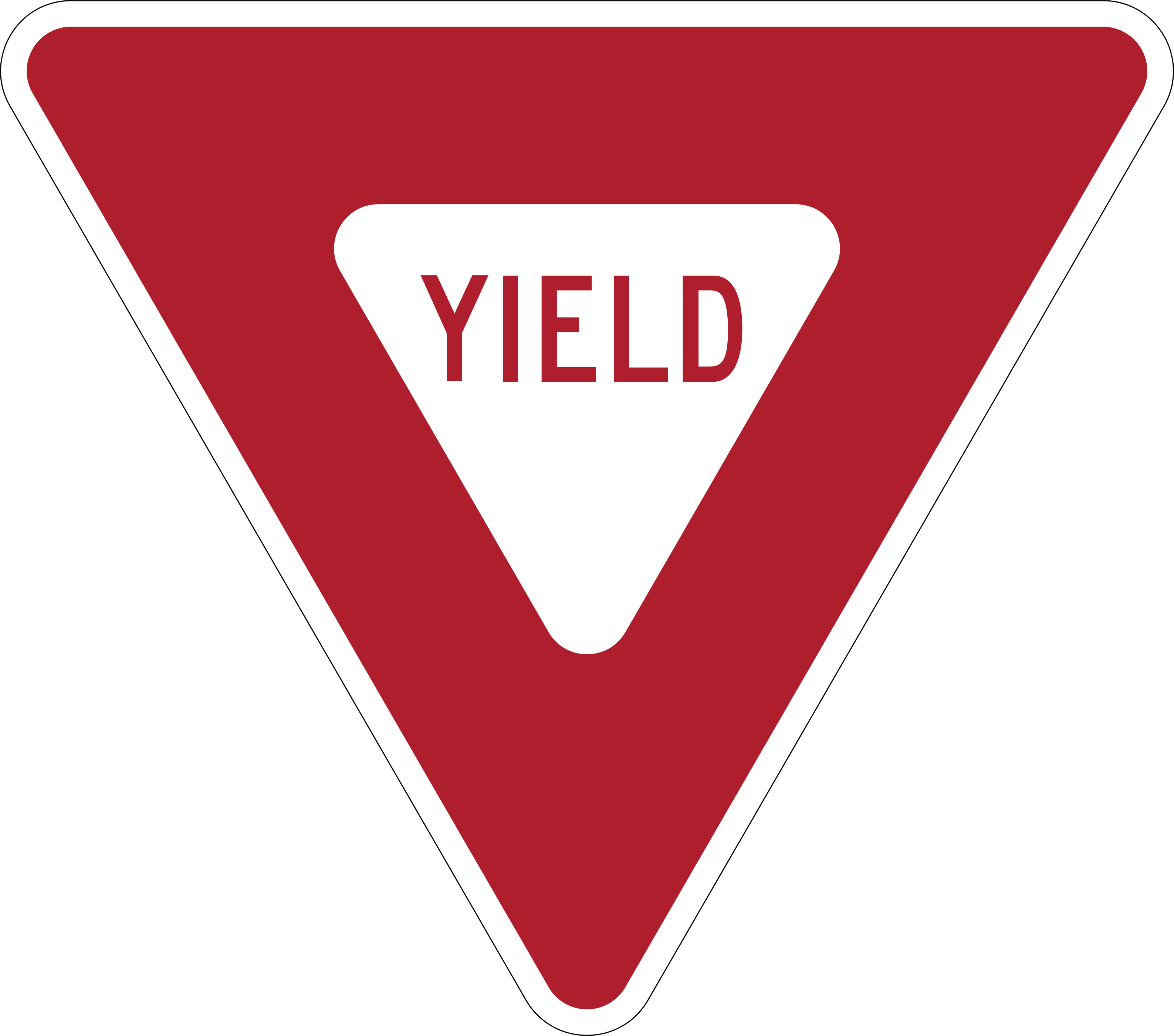
10. When approaching a YIELD sign, what must you be prepared to do?
- Accelerate through before vehicles on the protected street arrive
- Slow down, check both directions, and yield to traffic and pedestrians
- Stop every time, even when no one could be affected
- Yield only to vehicles approaching from the left
Show answer
Slow down, check both directions, and yield to traffic and pedestrians. A YIELD sign calls for a reduced approach speed and an active check to the left and right. Traffic and pedestrians have priority, so the driver gives them room to pass. A full stop is required when stopping is necessary to avoid someone on the protected street, but an empty approach does not automatically require a stop. Looking only left misses a possible road user from the other direction. Slow early enough that stopping remains available.
Study this in the handbook: Road signs by color and shape
11. When entering a roadway from an Alaska driveway, alley, or building, what is required?
- Yield only to vehicles approaching from the left
- Roll through if the driver has activated a turn signal
- Stop and yield to all traffic on the roadway
- Accelerate into the nearest lane before checking traffic
Show answer
Stop and yield to all traffic on the roadway. Entering from a driveway, alley, or building places the driver at the edge of an established roadway, so Alaska requires a stop and a yield to all traffic on that road. Signaling communicates an intention but does not give permission to enter. Looking only left misses traffic from the opposite direction, and acceleration before checking removes the time needed to respond. Pause before the sidewalk or roadway edge, scan the whole conflict area, and join the traffic stream only after it is clear.
Study this in the handbook: School buses, passing and railroad crossings
12. How often do impaired drivers kill someone, according to the Alaska manual?
- Every 10 minutes
- Once a week
- Once a month
- Every 51 minutes, nearly 28 people a day and almost 10,000 a year
Show answer
Every 51 minutes, nearly 28 people a day and almost 10,000 a year. Impaired drivers continue to kill someone every 51 minutes, nearly 28 people a day and almost 10,000 citizens a year, and about 97 percent of Americans see drinking and driving as a threat to themselves and their families. The manual adds that for the cost of a first DUI you could ride 11,370 miles in a taxi, which it describes as almost halfway around the world.
Study this in the handbook: Alcohol, implied consent and under 21 rules
13. How far back may qualifying Alaska or out-of-state DUI or refusal convictions be counted for an administrative revocation period?
- Only the previous 6 months
- The previous 3 years
- The previous 15 years
- Only convictions recorded in Alaska
Show answer
The previous 15 years. For an administrative revocation calculation, Alaska may use qualifying DWI, DUI, or refusal convictions from Alaska or another state when they occurred within the preceding 15 years. The lookback is therefore broader than a recent-year check and is not limited to Alaska records. Choosing three years misses older convictions that remain relevant. When studying the revocation table, connect the prior-offense count with this fifteen-year window before deciding which period applies.
Study this in the handbook: Alcohol, implied consent and under 21 rules
14. Under Alaska law, how must a child who is one year old but weighs less than 20 pounds ride?
- In a booster seat
- In a seat belt
- On an adult's lap
- In a rear-facing child safety seat
Show answer
In a rear-facing child safety seat. Alaska requires a child less than one year of age, or a child one year or older who weighs less than 20 pounds, to be secured in a rear-facing child safety seat that meets federal standards and is used according to the manufacturer's instructions. A booster seat is for children over four and under eight who are under 57 inches and weigh 20 to under 65 pounds. A seat belt alone or an adult's lap does not meet the rule.
Study this in the handbook: Safety belts and child seats
15. When must Alaska drivers use headlights during daylight hours because of reduced visibility?
- Whenever the road is wider than two lanes
- When fog, rain, snow, smoke, or dust reduces visibility to 1,000 feet or less
- Only when another vehicle is within 100 feet
- Only after the sun has fully set
Show answer
When fog, rain, snow, smoke, or dust reduces visibility to 1,000 feet or less. Alaska requires headlights during the day when fog, rain, snow, smoke, or dust reduces visibility to 1,000 feet or less. The rule is based on seeing distance and the listed conditions, not lane count or the presence of a nearby vehicle. Waiting for sunset misses a daytime requirement. Headlights should also be used from one half hour after sunset to one half hour before sunrise. Use the visibility threshold as the quick cue when weather makes the roadway difficult to see.
Study this in the handbook: Turn signals and pavement markings
16. In crashes between cars and large trucks, who sustains most of the fatalities, according to the Alaska manual?
- Truck drivers in most cases
- Pedestrians
- Both equally
- Car occupants, usually the driver, in 78 percent of cases
Show answer
Car occupants, usually the driver, in 78 percent of cases. In large truck crashes, the occupants of a car, usually the driver, sustain 78 percent of the fatalities, and when a car is hit from behind by a truck the results are too often deadly. A car at 55 mph stops in about 130 to 140 feet but a truck needs 400 feet, so never cut in front of a truck or linger in its blind spots.
Study this in the handbook: Following distance and large trucks
17. What is the main purpose of a regulatory sign?
- To state an instruction that drivers must obey
- To identify a campground or rest area
- To give route distances without imposing a rule
- To mark a temporary work crew only
Show answer
To state an instruction that drivers must obey. Regulatory signs establish or display a traffic rule. Their instructions are supported by statute, regulation, or local ordinance, and ignoring them can result in a citation. A campground or rest area belongs to service information, while route distances belong to guide signs. Work crews use construction and maintenance signs. When studying a white sign with black or red lettering, ask what action it requires and follow that instruction rather than treating it as optional advice.
Study this in the handbook: Road signs by color and shape
18. What does a steady orange Don't Walk signal require of a pedestrian who has not entered the roadway?
- Remain on the sidewalk and do not enter
- Cross immediately before the signal changes
- Walk outside the marked crosswalk
- Enter halfway and wait in the travel lane
Show answer
Remain on the sidewalk and do not enter. A steady orange Don't Walk signal means a pedestrian must not leave the sidewalk or enter the roadway in the direction of the signal. A person already crossing when the signal appears shall proceed across the roadway. The hand outline has the same meaning as Don't Walk, so a driver should expect that pedestrians may still be clearing the crossing. The safe cue is to wait before entering and watch the crosswalk until it is clear.
Study this in the handbook: Traffic signals and lane control signals
19. Does an Alaska bicyclist receive license points for traffic violations while riding?
- Yes, the same points as a driver
- Yes, double points
- No, AS 28.15.231(b) says no points are assessed for violations on a bicycle
- Only for violations at night
Show answer
No, AS 28.15.231(b) says no points are assessed for violations on a bicycle. Bicyclists must obey traffic signs, signals and all other traffic laws and follow the rules of the road, but Alaska law AS 28.15.231(b) states that no points are assessed for traffic violations committed while using a bicycle. The manual also reminds drivers that a bicycle is a vehicle, so treat a rider as you would another vehicle and take extra care near young children on bikes.
20. What roadway arrangement is shown by a divided-highway warning?

- A multi-lane roadway is divided by a median
- The roadway is changing from two lanes to one
- Vehicles may cross the median to make U-turns anywhere
- Opposing traffic will share one lane around the next curve
Show answer
A multi-lane roadway is divided by a median. A divided roadway has multiple lanes separated by a divider, and the manual identifies yellow left-edge lines on divided or one-way roadways. The median separates opposing traffic, so it is not an invitation to cross over or make a U-turn wherever convenient. The one-lane choice describes a merge rather than a divided design, and shared opposing traffic would describe an undivided road. As the warning approaches, stay on the vehicle’s side of the divider and follow the lane markings through the separated roadway.
Study this in the handbook: Turn signals and pavement markings
QualitySpace is expanding to Alaska
We are a California-based independent insurance brokerage working on licensing in more states. We cannot help with Alaska insurance yet. Leave your email and we will let you know when we can.
Every question is written from the official Alaska Driver Manual. Need paper? Printable AK practice test with answer key.
Last verified 2026-10-05. How we check every question · Study all 201 as flashcards
Frequently asked questions
How many questions are on this Alaska practice test?
This fixed set has 20 questions. It is test 5 of 10 from the 201 question Alaska bank. The real AK exam asks 20 questions and you need 16 correct.
What is the passing score for the real Alaska test?
16 correct answers to pass (80%) That figure comes from the official Alaska source cited on the DMV facts page.
How does this fixed test relate to the full Alaska bank?
Each numbered test is a fixed set of questions in a fixed order, so you can retake the same test later and compare. Every test mixes road signs and the other topics in about the same proportion as the full bank. Tests 1 to 10 together cover 200 of the 201 questions in the Alaska bank, each once. The full practice page mixes the whole bank at random.
Last verified 2026-10-05. See the Alaska DMV facts page for sourced state details.