
Test 2 of 10 · 20 questions · Free 2026
AK Permit Practice Test 2
Jump to the test ↓A fixed 20 question set from the Alaska bank with answers and plain English explanations. The real AK exam is 20 questions, 80 percent to pass; take the full length version on the main practice page.
Question 1 of 20 · 0 right so far
All 20 questions in test 2
Every question below comes from the Alaska question bank on this page. Open a question to see the correct answer and the explanation. Nothing here is hidden behind a signup.
1. What do Alaska warning signs alert drivers to?
- Actual or potentially dangerous conditions ahead
- Only destinations and route distances
- A required vehicle registration renewal
- A parking fee that must be paid immediately
Show answer
Actual or potentially dangerous conditions ahead. A warning sign calls attention to a danger that may already exist or may develop farther along the roadway. It is not a route guide, payment notice, or registration reminder. The manual also advises extra caution and says most warning signs imply a speed reduction. When a yellow warning sign appears, read the condition it identifies, look farther ahead, and adjust speed and position before the hazard is close. The useful cue is warning equals changing road conditions, not a routine command or destination marker.
Study this in the handbook: Road signs by color and shape
2. How close must a train be for an Alaska driver to be prepared to stop at a crossbuck crossing?
- Within 100 feet
- Within one mile
- Only when the train is at the crossing
- Within 1,500 feet of the crossing
Show answer
Within 1,500 feet of the crossing. At a railroad crossbuck and warning sign, be prepared to stop if a train is within 1,500 feet of the crossing. The manual adds that you must stop even at an unmarked crossing, because trains cannot stop easily or within a short distance. If your vehicle is stuck on the tracks, get out, run away from the tracks and the vehicle in the direction the train is coming, and dial 911 once clear. The typically blue ENS sign lists a number answered by railroad dispatchers.
Study this in the handbook: School buses, passing and railroad crossings
3. What maximum backing speed does the Alaska manual suggest?
- The posted highway speed limit
- No more than 15 mph
- No more than 5 mph
- Any speed that keeps the mirrors clear
Show answer
No more than 5 mph. The manual suggests keeping backing speed at or below 5 mph. Slow movement gives the driver more time to look around the vehicle and stop for a person or vehicle entering the path. Fifteen mph and the roadway limit are far too fast for a maneuver with restricted visibility. Clear mirrors alone are not enough because mirrors do not show every area behind the vehicle. Turn the body and head to look through the rear window, move slowly, and keep scanning both sides before and during the maneuver.
4. Why are good windshield wipers important during rainy nighttime driving?
- They make bald tires safe on wet pavement
- They allow a driver to ignore standing water
- They eliminate the need for headlights
- Streaking and skipping wipers are especially hazardous
Show answer
Streaking and skipping wipers are especially hazardous. The manual warns that windshield wipers which streak and skip are especially hazardous on a rainy night. Clear wiping helps preserve the driver's view, but it does not remove the need to manage speed, lights, traction, or tire condition. Wipers cannot make standing water harmless, replace headlights, or compensate for bald tires. A practical cue is to inspect blades and washer fluid before a trip when rain and darkness are likely.
Study this in the handbook: Vehicle emergencies, skids and stalls on the tracks
5. For what crashes must an Alaska driver submit a certificate of insurance to the DMV, and by when?
- Only injury crashes, within 30 days
- Only crashes over $2,000, within 10 days
- Any crash with property damage of $501 or more, within 15 days
- Never, the officer handles it
Show answer
Any crash with property damage of $501 or more, within 15 days. A certificate of insurance is required on all crashes with property damage of $501 or more and must be submitted to the DMV within 15 days, even if you submitted proof of insurance during the law enforcement investigation. Missing the deadline or being uninsured brings a 90 day suspension for a first occurrence and one year for a second, so file promptly after any crash.
Study this in the handbook: What to do after a crash
6. An Alaska 16-year-old has held a permit for 8 months and logged 40 hours, but got a traffic ticket conviction 3 months ago. Can the teen get a provisional license now?
- Yes, the 40 hours are complete
- No, the teen must wait until 18
- Yes, if a parent signs a waiver
- No, there must be no traffic law conviction within the six months before applying
Show answer
No, there must be no traffic law conviction within the six months before applying. To obtain a first provisional license under 18, the applicant must have held a valid permit for 6 months, have a parent, guardian, or employer certify at least 40 hours of driving (10 in challenging conditions), and must not have been convicted of a traffic law violation within the six months before applying. A conviction 3 months ago falls inside that window. No parental waiver removes it, and the teen does not have to wait until 18, only until six conviction free months pass.
Study this in the handbook: Instruction permits and provisional licenses
7. What must an Alaska provisional license holder show before graduating to a regular driver license?
- Only a birthday of 17
- A second road test
- At least six months on the provisional license with no traffic conviction or repeat minor consuming alcohol conviction in the prior six months
- Completion of a defensive driving course
Show answer
At least six months on the provisional license with no traffic conviction or repeat minor consuming alcohol conviction in the prior six months. Once you get a provisional license, you may not graduate to a driver license for at least six months, and you cannot have been convicted of a traffic law violation or of repeat minor consuming alcohol during the six months before applying. A new parental consent and a $15 fee are needed to remove the restriction. Turning 17 alone does nothing, and a second road test or defensive driving course is not required. At 18 the restrictions end on their own.
Study this in the handbook: Instruction permits and provisional licenses
8. An Alaska provisional license holder wants to drive two friends (not siblings) to the mall. When is that allowed?
- Only if one of the passengers is a parent, legal guardian, or a person at least 21
- Anytime before 1:00 am
- If both friends are 18 or older
- If the trip is under 10 miles
Show answer
Only if one of the passengers is a parent, legal guardian, or a person at least 21. During the provisional stage, the driver may not carry passengers unless one of the passengers is a parent, legal guardian, or a person at least 21 years old. Siblings are the exception and may ride without a parent. The time of day, the friends being 18, and trip distance do not create an exception. The separate hour restriction bars driving from 1:00 am to 5:00 am without a qualifying adult, except for work trips by the most direct route.
Study this in the handbook: Instruction permits and provisional licenses
9. An Alaska driver under 21 has three previous revocations for minor operating after consuming alcohol and is caught again. What is the administrative revocation?
- 30 days
- 60 days
- 90 days
- 1 year
Show answer
1 year. Alaska's administrative revocation periods for minor operating after consuming or refusing testing are 30 days for a first offense, 60 days with one previous revocation, 90 days with two previous revocations, and 1 year with three or more previous revocations. With three prior revocations, this driver faces 1 year. The revocation happens even if the criminal citation is dismissed or the minor is found not guilty.
Study this in the handbook: Alcohol, implied consent and under 21 rules
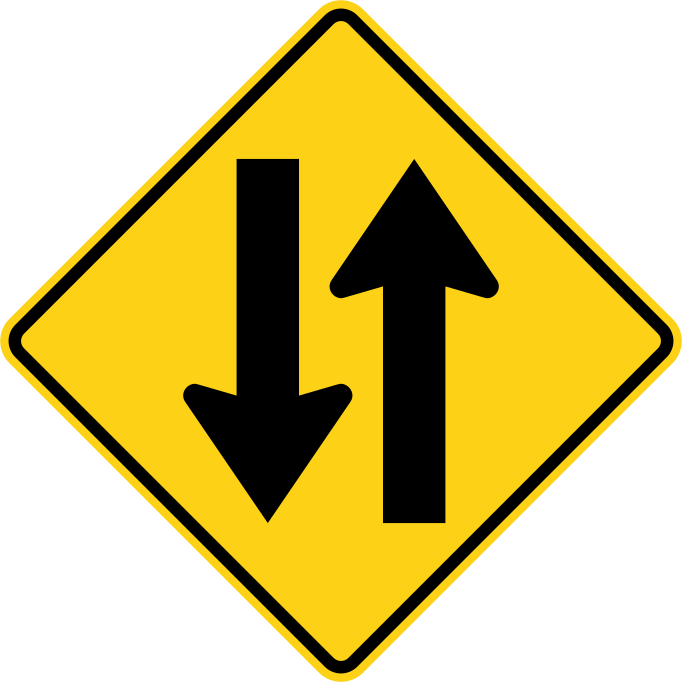
10. What does the two-way road warning tell a driver to do?
- Use both lanes in either direction until the next town
- Keep right of approaching traffic on the two-way road
- Remain left because opposing traffic has a separate road
- Treat the roadway as one-way until a centerline appears
Show answer
Keep right of approaching traffic on the two-way road. The two-way warning marks a roadway where traffic approaches from opposite directions. Keeping right leaves space for oncoming vehicles and follows the manual’s instruction for this condition. Using both lanes in either direction would invite a head-on conflict. Staying left because opposing traffic is elsewhere reverses the needed position, while assuming one-way travel ignores the warning. Look for the centerline and maintain a lane that clearly separates your vehicle from approaching traffic.
Study this in the handbook: Road signs by color and shape
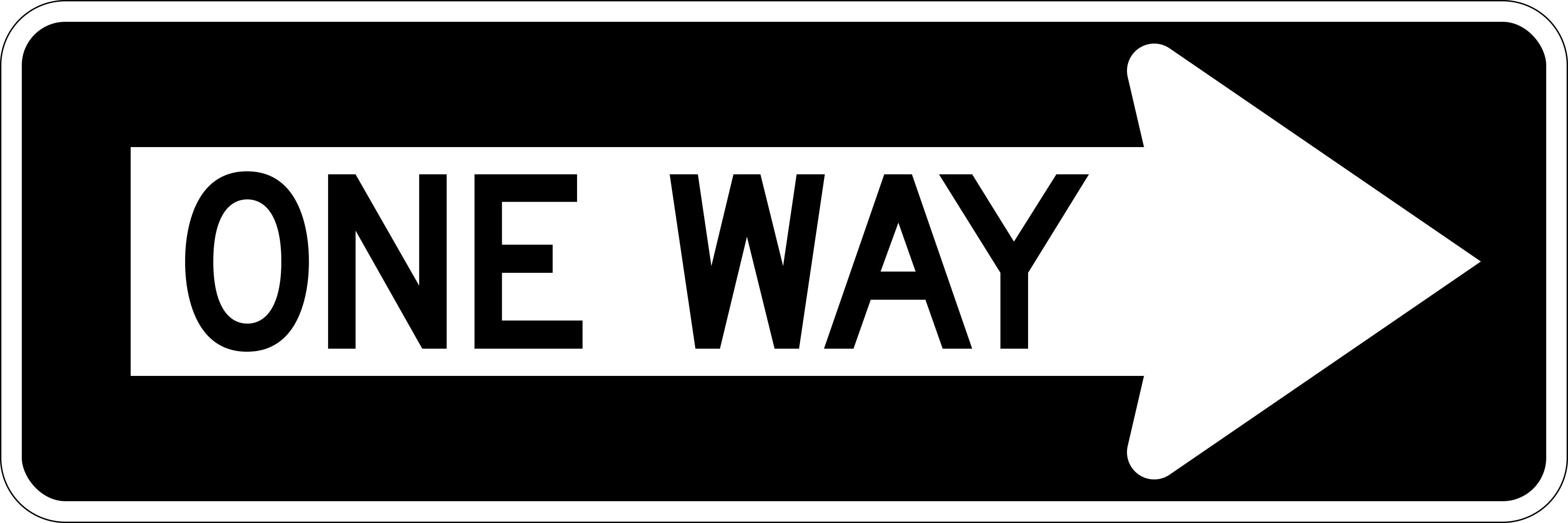
11. What traffic pattern does a ONE WAY sign identify?
- The lane shown is reserved for buses during rush hour
- Traffic may use either direction until the next signal
- Travel only as indicated on the posted street
- Vehicles must turn around before reaching the posted street
Show answer
Travel only as indicated on the posted street. A ONE WAY sign tells drivers that travel on the posted street follows the indicated direction. It does not permit opposing movement, create a bus-only lane, or require an immediate turnaround. A driver entering such a street must align with the displayed direction and remain alert for the roadway’s lane arrangement. Choosing the two-direction option would create a head-on conflict with traffic using the designated flow. Read the arrow before moving into the street.
Study this in the handbook: Road signs by color and shape
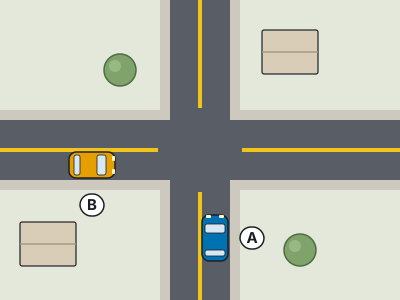
12. At an uncontrolled intersection, two vehicles approach with a danger of collision. Which driver must yield?
- The driver on the left yields to the driver on the right
- The driver on the right yields to the driver on the left
- The driver going faster yields to the slower driver
- Both drivers continue because neither has a stop sign
Show answer
The driver on the left yields to the driver on the right. When two vehicles reach an uncontrolled intersection at a position and time that creates a danger of collision, Alaska puts the duty to yield on the driver of the vehicle on the left. The driver on the right still slows and keeps the vehicle under control, because the manual says you have the right of way only when the other driver gives it to you. A useful check is to picture the other vehicle: if it is on your right, you are the one who yields. A vehicle already within the intersection must also be allowed to clear.
Study this in the handbook: Intersections, right of way and roundabouts
13. What action is required at an Alaska yield sign when traffic or pedestrians need protection?
- Slow down, look both ways, and stop if necessary
- Accelerate to enter before other traffic
- Stop every time even when the roadway is empty
- Proceed without checking for pedestrians
Show answer
Slow down, look both ways, and stop if necessary. A yield sign requires the driver to slow as needed, look left and right, and yield to traffic and pedestrians. Stopping is required when necessary to avoid conflict, not automatically at every empty yield sign. Accelerating defeats the purpose of yielding, and failing to scan for pedestrians omits an explicit part of the instruction. The useful sequence is reduce speed, check both directions, then stop only when the approaching traffic or pedestrian situation makes stopping necessary.
Study this in the handbook: Road signs by color and shape
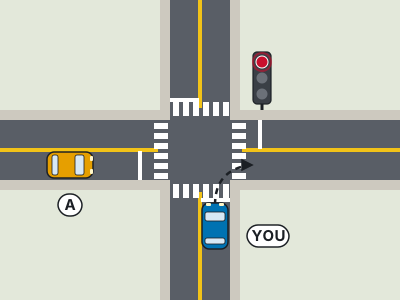
14. When may a driver turn right on red in Alaska?
- Without stopping if no vehicle is nearby
- After a full stop, when safe, unless a sign prohibits the turn
- Only after waiting for the next green arrow
- At any time while pedestrians are crossing
Show answer
After a full stop, when safe, unless a sign prohibits the turn. A right turn on red is permitted only after a full stop, when the turn can be made safely, and when no No Turn on Red sign restricts it. The absence of nearby vehicles does not remove the stop requirement. A green arrow is not required for every right turn, but pedestrians and other road users still must be considered before moving. Treat the red signal as a stop first, then check the sign, crosswalk, and conflicting traffic before turning.
Study this in the handbook: Traffic signals and lane control signals
15. What do Alaska warning signs alert drivers to do?

- Watch for dangerous conditions and adjust driving
- Treat the sign as a route destination
- Follow a mandatory parking instruction
- Maintain speed because the sign is informational
Show answer
Watch for dangerous conditions and adjust driving. A warning sign communicates that an actual or potentially dangerous condition lies ahead. The manual tells drivers to use extra caution, reduce speed when appropriate, and read the sign in relation to the situation on the road. It is different from a guide sign, which supplies route or destination information, and from a regulatory sign, which states an instruction backed by law. A yellow warning sign should prompt an active scan for the hazard rather than passive observation.
Study this in the handbook: Road signs by color and shape
16. On an Alaska two-lane road outside an urban area, when must a driver safely pull over for vehicles behind?
- When two vehicles are visible in the rearview mirror
- Whenever one vehicle follows for more than one mile
- Only when a police vehicle is among the following traffic
- When five or more vehicles are immediately behind
Show answer
When five or more vehicles are immediately behind. On a two-lane roadway outside an urban area, Alaska requires a driver to safely pull over when five or more vehicles are immediately behind. One vehicle, two visible vehicles, or a police presence does not establish the stated trigger. Pulling over must also be safe, so the driver should select a suitable place rather than stopping abruptly on the travel lane. Watch the traffic accumulating behind, communicate the maneuver, and let the line pass before reentering with adequate space.
Study this in the handbook: School buses, passing and railroad crossings
17. How far before a turn must a driver continuously signal the intention to turn or move?
- Only during the final 10 feet
- During the last 100 feet traveled before turning
- At least one mile before every turn
- Only after the vehicle begins turning
Show answer
During the last 100 feet traveled before turning. Alaska requires a hand and arm or directional signal continuously during the last 100 feet traveled before turning or moving the vehicle right or left. The final 10 feet choice gives following traffic too little notice, while signaling only after movement begins is late. A greater distance may be sensible when traffic or speed makes earlier notice safer. Use the 100-foot mark as a minimum cue, keep the signal active through the approach, and cancel it after the maneuver so other drivers are not misled about your next movement.
Study this in the handbook: Turn signals and pavement markings
18. When a school bus is stopped with red lights flashing and its stop sign extended, what must drivers do?
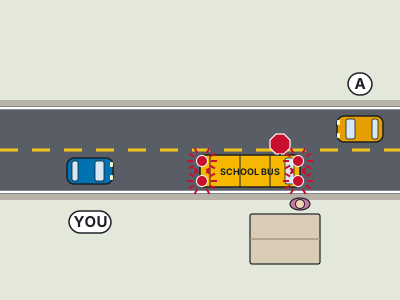
- Stop only when following the bus, never when meeting it
- Pass slowly if no child is visible
- Stop and remain stopped until the signals are discontinued and the sign is retracted
- Use the shoulder to go around the bus
Show answer
Stop and remain stopped until the signals are discontinued and the sign is retracted. A driver approaching a stopped school bus must make a complete stop before reaching it when the red lights flash and the stop sign is extended. The vehicle must remain stopped until the stop sign is retracted and the flashing red lights are discontinued, with the manual also describing the bus resuming motion or signaling the driver. A guess that no child is visible does not replace the signals. Stop before the bus, watch the arm and lights, and proceed only after the required signals end.
Study this in the handbook: School buses, passing and railroad crossings
19. Which motorcycles and scooters may be operated with an Alaska Class D license?
- Any motorcycle
- Those with engine displacements of less than 50cc
- None, all require Class M
- Only three wheeled motorcycles
Show answer
Those with engine displacements of less than 50cc. Motorcycles and motor scooters with engine displacements of less than 50cc can be operated with a Class D license. Class M1 covers motorcycles and scooters of 50cc or more, a 14 or 15 year old may hold an M2 license for scooters under 50cc, and Class M3 covers three wheeled motorcycles and motor driven cycles. The engine size decides which license the rider needs.
Study this in the handbook: Vision, insurance and the point system
20. What does the Alaska manual advise a driver who is taking prescription medicine to do?
- Take an extra dose before driving
- Ask a doctor about driving related side effects
- Mix it with alcohol to test its effect
- Stop all prescribed medicine permanently
Show answer
Ask a doctor about driving related side effects. The manual directs a person taking prescription medicine to ask a doctor about possible side effects related to driving. It does not recommend changing the dose, combining medicine with alcohol, or abandoning treatment without medical advice. Some nonprescription allergy and cold remedies can also affect driving, so the same caution applies beyond prescriptions. The practical cue is to check with a doctor before driving when a medicine may cause drowsiness or reduced alertness. Medication safety is part of impaired driving prevention even when the drug was legally obtained.
Study this in the handbook: Alcohol, implied consent and under 21 rules
QualitySpace is expanding to Alaska
We are a California-based independent insurance brokerage working on licensing in more states. We cannot help with Alaska insurance yet. Leave your email and we will let you know when we can.
Every question is written from the official Alaska Driver Manual. Need paper? Printable AK practice test with answer key.
Last verified 2026-10-05. How we check every question · Study all 201 as flashcards
Frequently asked questions
How many questions are on this Alaska practice test?
This fixed set has 20 questions. It is test 2 of 10 from the 201 question Alaska bank. The real AK exam asks 20 questions and you need 16 correct.
What is the passing score for the real Alaska test?
16 correct answers to pass (80%) That figure comes from the official Alaska source cited on the DMV facts page.
How does this fixed test relate to the full Alaska bank?
Each numbered test is a fixed set of questions in a fixed order, so you can retake the same test later and compare. Every test mixes road signs and the other topics in about the same proportion as the full bank. Tests 1 to 10 together cover 200 of the 201 questions in the Alaska bank, each once. The full practice page mixes the whole bank at random.
Last verified 2026-10-05. See the Alaska DMV facts page for sourced state details.