
Test 3 of 10 · 20 questions · Free 2026
AK Permit Practice Test 3
Jump to the test ↓A fixed 20 question set from the Alaska bank with answers and plain English explanations. The real AK exam is 20 questions, 80 percent to pass; take the full length version on the main practice page.
Question 1 of 20 · 0 right so far
All 20 questions in test 3
Every question below comes from the Alaska question bank on this page. Open a question to see the correct answer and the explanation. Nothing here is hidden behind a signup.
1. What do regulatory signs tell a driver?
- An instruction that must be understood and obeyed
- Only the distance to the next town
- A possible wildlife hazard ahead
- The color of the pavement surface
Show answer
An instruction that must be understood and obeyed. Regulatory signs communicate an instruction backed by statute, regulation, or local ordinance, so the driver must understand and obey it. A destination or mileage clue belongs to guide signs, while a possible hazard is the role of a warning sign. Pavement color is not the function described in the manual. Because violating a regulatory instruction can result in a traffic citation, treat these signs as commands or restrictions rather than general travel information. The sign's wording and color pattern should prompt compliance with the stated rule.
Study this in the handbook: Road signs by color and shape
2. A 19-year-old in Alaska uses a fake driver's license to buy alcohol for the first time. What can DMV do?
- Revoke the driving privilege for 60 days
- Nothing, it is only a store matter
- Revoke for 5 years
- Issue a warning letter
Show answer
Revoke the driving privilege for 60 days. Alaska law allows DMV to revoke the driving privilege of a person who uses a false or fraudulent driver's license to obtain alcohol. The revocation is 60 days for a first offense and 1 year for later offenses. It is not merely a store matter or a warning, and 5 years is the administrative DUI period with three or more priors. Minors using a false license to get alcohol is listed among mandatory administrative revocations.
Study this in the handbook: Alcohol, implied consent and under 21 rules
3. What does a Do Not Enter sign prohibit at a roadway or ramp entrance?
- Turning on headlights before entering a tunnel
- Parking beside the sign for a short time
- Entering a marked crosswalk on foot
- Proceeding beyond the sign into traffic moving the wrong direction
Show answer
Proceeding beyond the sign into traffic moving the wrong direction. A Do Not Enter sign faces traffic entering a roadway or ramp in the wrong direction, and drivers must not proceed beyond it. It is not a parking instruction, a pedestrian crossing instruction, or a lighting reminder. The related Wrong Way sign may appear farther along the prohibited direction, but seeing the second sign is not permission to continue. The strongest cue is the sign's placement at the entrance: it prevents entry into a lane or ramp that carries traffic the other way.
Study this in the handbook: Road signs by color and shape
4. Which vehicles are exempt from Alaska's seat belt law because of their age?
- Vehicles built before 1965 without belts as original equipment that are not custom collector vehicles
- Pickup trucks of any year
- Any vehicle over 20 years old
- No vehicles are exempt
Show answer
Vehicles built before 1965 without belts as original equipment that are not custom collector vehicles. Alaska law requires everyone in a motor vehicle to use a safety belt, with exceptions including vehicles built prior to 1965 that did not have safety belts as original equipment and are not classified as custom collector vehicles. Belts made after 1974 use an inertia reel that locks when the car slows suddenly. A driver may be fined up to $50 and get two points for unrestrained passengers under 16.
Study this in the handbook: Safety belts and child seats
5. What do Alaska regulatory signs communicate to drivers?
- Only the distance to the next fuel station
- A scenic landmark with no required driver response
- A temporary suggestion that may always be ignored
- An instruction backed by statute, regulation, or local ordinance
Show answer
An instruction backed by statute, regulation, or local ordinance. Regulatory signs communicate instructions that drivers must understand and obey. Alaska explains that the instruction is backed by a state statute, regulation, or local ordinance, and violating it can result in a traffic citation. The sign is therefore enforceable guidance, not scenery, an optional suggestion, or a service-distance marker. Read the message early, identify the behavior it controls, and adjust before reaching the regulated area. A useful memory cue is that regulatory signs tell you what the law requires on that roadway.
Study this in the handbook: Road signs by color and shape
6. Before passing another vehicle on an Alaska two-lane road, what should the driver check ahead?
- A hill crest that hides approaching traffic
- Only the rearview mirror, because the opposing lane is presumed clear
- A solid yellow line already in the passing vehicle's lane
- A clear path with no no-passing zone or oncoming vehicle
Show answer
A clear path with no no-passing zone or oncoming vehicle. Safe passing begins with a view far enough ahead to confirm there is no no-passing zone and no oncoming vehicle. Looking only behind misses the primary conflict, while a solid yellow line or a blind hill crest signals that the maneuver should not begin. The driver must also complete the pass without interfering with approaching traffic. Stay back for sight distance, inspect the centerline and opposing lane, and abandon the attempt whenever the view cannot support a complete return to the right lane.
Study this in the handbook: School buses, passing and railroad crossings
7. How should a driver approach an Alaska flashing red ball?
- Stop before the crosswalk or line, look in all directions, then proceed when safe
- Slow down and continue without stopping if the crosswalk is empty
- Wait for a green ball before moving in any direction
- Stop after entering the intersection so the signal is visible
Show answer
Stop before the crosswalk or line, look in all directions, then proceed when safe. A flashing red ball requires a stop behind the crosswalk, stop line, or, if neither exists, before entering the intersection. After stopping, the driver looks in all directions for approaching traffic and pedestrians and proceeds only when it is safe. Treating it like a flashing yellow allows movement without the required stop, while waiting for a green ball describes a different signal operation. Stop at the proper reference point, scan the full intersection, and then continue only after the path is clear.
Study this in the handbook: Traffic signals and lane control signals
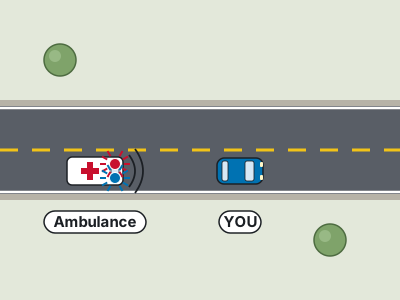
8. When an authorized emergency vehicle approaches with flashing red or blue lights, where should a driver stop?
- At the left edge of the roadway
- In the middle of the intersection
- At the right hand edge, clear of an intersection
- On the shoulder only if the siren is operating
Show answer
At the right hand edge, clear of an intersection. The driver must yield by slowing, moving to the right hand edge of the roadway, clearing the intersection, and stopping for the emergency vehicle. The siren does not have to be operating when the authorized vehicle displays the specified flashing lights. Stopping in an intersection can obstruct the response, and moving left contradicts the stated direction. The shoulder only choice is too narrow because the rule identifies the right edge and a clear intersection, whether or not a usable shoulder exists.
Study this in the handbook: Emergency vehicles and the Move Over law
9. What share of collisions involve fire or submersion, according to the Alaska manual?
- About 25 percent
- Less than one half of one percent
- About half
- Nearly all fatal crashes
Show answer
Less than one half of one percent. Collisions involving fire or submersion make up less than one half of one percent of all traffic collisions. The manual adds that your chances of surviving a burning or submerged vehicle are far greater with a belt on, because you are more likely to stay conscious and able to escape. More than 80 percent of collisions occur at speeds under 40 mph, and three of four fatal collisions happen within 25 miles of home.
Study this in the handbook: Safety belts and child seats
10. How long is an Alaska non-commercial instruction permit valid?
- Six months
- One year
- Until the holder turns 18
- Two years
Show answer
Two years. Each type of non-commercial instruction permit remains valid for two years, which is longer than the six month period required before some teens may seek a provisional license. The one year choice confuses the permit term with the supervisor's experience requirement. Turning 18 does not automatically end the permit's stated validity. The manual also says an original permit can be renewed one time, so the two year period is not the same as an unlimited practice authorization. Keep the permit's duration separate from age based licensing steps and from the minimum holding period for a provisional license.
Study this in the handbook: Instruction permits and provisional licenses
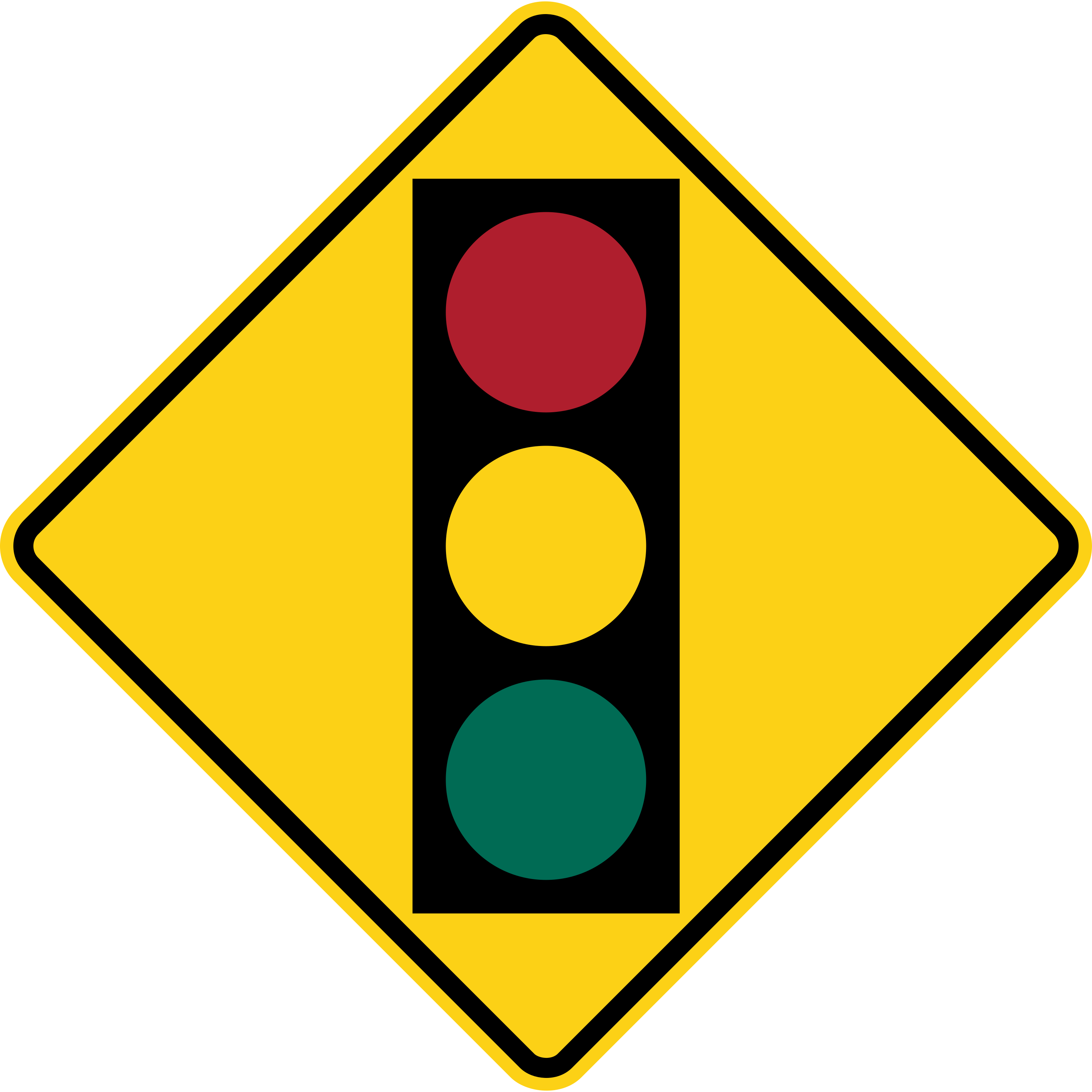
11. What condition is indicated by a traffic signal symbol on a yellow warning sign?
- The next signal is permanently out of service
- A traffic signal is ahead, so the driver should prepare to obey it
- A police checkpoint will stop every vehicle
- Streetlights are being repaired after the intersection
Show answer
A traffic signal is ahead, so the driver should prepare to obey it. The traffic signal symbol gives advance notice of a signal ahead. The driver should look forward, adjust speed as needed, and be ready to obey the indication when reaching the intersection. It does not say that the signal is broken, that police will stop every vehicle, or that streetlights are under repair. Warning signs are meant to identify conditions before the driver arrives at them. The practical cue is to begin scanning for the signal early, especially when a curve, hill, or other obstruction could shorten the available stopping distance.
Study this in the handbook: Road signs by color and shape
12. An authorized emergency vehicle approaches with flashing red or blue lights. What must other drivers do?
- Stop immediately in the intersection to make room
- Maintain speed because only a siren creates a legal duty
- Yield, move to the right edge clear of an intersection, and stop
- Follow the emergency vehicle closely through traffic
Show answer
Yield, move to the right edge clear of an intersection, and stop. When an authorized emergency vehicle shows flashing red or blue lights, drivers in every direction must yield whether or not the siren is operating. The response is to slow, move to the right-hand edge of the roadway clear of an intersection, and stop to await passage. Stopping in the intersection can obstruct the emergency route, and following closely puts the driver in the response path. See the lights, clear the junction, and stop at the edge so the emergency crew has room to proceed.
Study this in the handbook: Emergency vehicles and the Move Over law
13. What speed range does the Alaska manual say most roundabouts are designed for?
- About 30 to 35 mph
- About 15 to 20 mph
- Exactly 5 mph in every roundabout
- The posted freeway speed
Show answer
About 15 to 20 mph. The manual says most roundabouts are designed for speeds of about 15 to 20 mph. Slow down before reaching the circle, enter to the right of the center island, and yield to traffic already inside. The design range is not a universal five-mph requirement, and a freeway speed is inappropriate for a circular intersection. Use the center island, lane markings, pedestrians, and traffic already in the circle to set a controlled pace. The low-speed design supports steady movement without requiring every vehicle to stop.
Study this in the handbook: Intersections, right of way and roundabouts
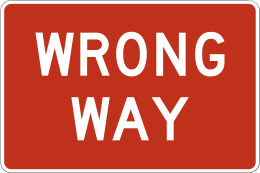
14. If a WRONG WAY sign faces you, what does it indicate?
- A turn is required at the next legal opening
- A construction crew is directing traffic around a lane closure
- The road is temporarily limited to commercial vehicles
- The driver has entered the prohibited direction of a roadway or ramp
Show answer
The driver has entered the prohibited direction of a roadway or ramp. The Alaska manual describes the white on red WRONG WAY sign together with the DO NOT ENTER sign. The DO NOT ENTER sign faces traffic that would enter a roadway or ramp in the wrong direction, and a WRONG WAY sign may be placed further down that prohibited direction. Seeing it means the vehicle is already traveling the prohibited way. It does not announce a required turn, a lane closure, or a commercial vehicle restriction; those would be different messages.
Study this in the handbook: Road signs by color and shape
15. When must headlights be on in Alaska between sunset and sunrise?
- Only after full darkness
- From one half hour after sunset to one half hour before sunrise
- From sunset to sunrise exactly
- From 9 p.m. to 6 a.m.
Show answer
From one half hour after sunset to one half hour before sunrise. Headlights must be turned on from one half hour after sunset to one half hour before sunrise, and in daytime whenever visibility is reduced to 1,000 feet or less by fog, rain, snow, smoke or dust. Change to low beam 300 feet or more behind a vehicle going the same direction and when meeting oncoming traffic. The fatal crash rate at night is higher per mile than by day.
Study this in the handbook: Night driving, lighting, weather and animals
16. What must an Alaska driver with a concealed deadly weapon do during a traffic stop?
- Nothing unless asked
- Place the weapon on the dashboard
- Notify the officer immediately
- Leave the vehicle to show it
Show answer
Notify the officer immediately. Under Alaska law, if you are contacted by an officer and you have a deadly weapon concealed on your person, you must notify the officer immediately. AS 28.35.182 separately requires drivers to stop when signaled by police. Drivers must also have their license, proof of insurance and current registration in their possession and show them on request. The manual advises keeping your hands visible, such as on the steering wheel, and waiting for the officer to ask before retrieving documents from a wallet, purse, console, or glove compartment.
Study this in the handbook: Emergency vehicles and the Move Over law
17. An Alaska driver's suspension period ends, but the driver never reinstated or filed SR22 proof. What is the status of the license?
- The suspension continues beyond the ending date until privileges are properly reinstated with proof of financial responsibility
- It is automatically valid again
- It is valid only for work
- It becomes a provisional license
Show answer
The suspension continues beyond the ending date until privileges are properly reinstated with proof of financial responsibility. A suspension or revocation continues beyond its ending date unless you properly reinstate your driving privileges and file proof of financial responsibility for the future, usually an SR22 insurance filing. The license does not revive automatically, and there is no automatic work-only or provisional status. A reinstatement fee is required after any suspension, revocation, or limitation. The SR22 filing makes the insurer notify DMV if coverage lapses or is cancelled.
Study this in the handbook: DUI revocations and ignition interlock
18. How do impact and braking distance at 80 mph compare with 20 mph, according to the Alaska manual?
- Four times greater
- They are 16 times greater
- Twice as great
- About the same
Show answer
They are 16 times greater. Increase the speed to 80 mph and the impact and braking distance are 16 times greater than at 20 miles per hour, because both grow with the square of speed. Quadrupling speed does not quadruple the danger; it multiplies it sixteen fold. Speed limits are maximums for favorable conditions, and the basic speed law requires slowing whenever conditions are worse.
Study this in the handbook: Speed laws and impact
19. What does a steady yellow traffic signal ball tell a driver?
- A red light is about to appear, so stop unless stopping is unsafe
- The intersection is reserved for left turns
- Proceed at increased speed before the signal changes
- Stop only if the vehicle behind is also stopping
Show answer
A red light is about to appear, so stop unless stopping is unsafe. A yellow ball warns that a red light is about to appear. Stop unless you are already within the intersection or so close that stopping safely is not possible. The choice encouraging acceleration turns a transition warning into a race and can leave the vehicle in the intersection when cross traffic receives a green signal. As the light changes, check your stopping distance, brake smoothly if there is room, and continue with extreme caution only when the manual's exception applies. Yellow is a decision point, not permission to speed up.
Study this in the handbook: Traffic signals and lane control signals
20. What administrative revocation period is listed for a new DUI or refusal offense when the driver has two prior convictions?
- Six months
- Ninety days
- Three years
- Ten years
Show answer
Three years. Alaska's administrative schedule escalates with prior DUI or Refusal convictions. A first offense is listed as 90 days, one prior conviction produces one year, and two prior convictions produce a three-year revocation. The five-year period belongs to a driver with three or more prior convictions. Do not substitute the first-offense period simply because the new event is the one being reviewed. Count the qualifying history, then select the matching duration from the sequence.
Study this in the handbook: DUI revocations and ignition interlock
QualitySpace is expanding to Alaska
We are a California-based independent insurance brokerage working on licensing in more states. We cannot help with Alaska insurance yet. Leave your email and we will let you know when we can.
Every question is written from the official Alaska Driver Manual. Need paper? Printable AK practice test with answer key.
Last verified 2026-10-05. How we check every question · Study all 201 as flashcards
Frequently asked questions
How many questions are on this Alaska practice test?
This fixed set has 20 questions. It is test 3 of 10 from the 201 question Alaska bank. The real AK exam asks 20 questions and you need 16 correct.
What is the passing score for the real Alaska test?
16 correct answers to pass (80%) That figure comes from the official Alaska source cited on the DMV facts page.
How does this fixed test relate to the full Alaska bank?
Each numbered test is a fixed set of questions in a fixed order, so you can retake the same test later and compare. Every test mixes road signs and the other topics in about the same proportion as the full bank. Tests 1 to 10 together cover 200 of the 201 questions in the Alaska bank, each once. The full practice page mixes the whole bank at random.
Last verified 2026-10-05. See the Alaska DMV facts page for sourced state details.