
Test 21 of 25 · 20 questions · Free 2026
AK Permit Practice Test 21
Jump to the test ↓A fixed 20 question set from the Alaska bank with answers and plain English explanations. The real AK exam is 20 questions, 80 percent to pass; take the full length version on the main practice page.
Question 1 of 20 · 0 right so far
All 20 questions in test 21
Every question below comes from the Alaska question bank on this page. Open a question to see the correct answer and the explanation. Nothing here is hidden behind a signup.
1. In Alaska, you are halfway across a street when the steady DON'T WALK signal comes on. What should you do?
- Stop in the roadway and wait for the next walk signal
- Return to the curb you started from at once
- Quickly proceed across the roadway to the other side
- Stay in place until drivers wave you across
Show answer
Quickly proceed across the roadway to the other side. A steady hand or DON'T WALK display bars starting a new crossing, yet a person already in the roadway should finish without delay. Quickly proceeding across clears the conflict with turning and through traffic. Stopping mid roadway to wait for the next cycle leaves you exposed, returning to the starting curb lengthens your time in traffic, and waiting for waves from drivers gives no protection. Keep moving at a brisk steady pace and watch for turning vehicles as you finish.
Study this in the handbook: Traffic signals and lane control signals
2. In Alaska, a steady yellow X appears over your lane. What does it require?
- Clear the lane safely because a red X is about to appear
- Stay in the lane because yellow X still permits travel in it for now
- Stop at once in the lane and wait for green
- Use the lane only for left turns from now on
Show answer
Clear the lane safely because a red X is about to appear. Yellow over a reversible lane is the warning stage before the lane closes to your direction. Clearing the lane in a safe manner now avoids meeting opposing traffic that will soon receive the lane. Staying put because travel was recently allowed ignores the coming change, stopping inside the lane blocks the very clearance required, and left turn use was never granted by this signal. Check mirrors, signal, and move into a permitted lane smoothly before the red X appears.
Study this in the handbook: Traffic signals and lane control signals
3. You are driving slower than the other traffic on a multi-lane highway. Which lane should you use?
- The left lane, so faster drivers can pass on the right
- Any lane, as long as you stay under the posted limit
- The right, outside lane, except when passing
- The center lane, so you can move either way
Show answer
The right, outside lane, except when passing. On multi-lane highways, a driver going slower than the rest of traffic should use the right, outside lane except when passing. Staying under the posted limit does not make every lane suitable, which is why the any lane choice is wrong. A slow vehicle in the left lane forces faster drivers to pass on the right, and the manual also says slow-moving vehicles must keep right. Center lanes are reserved for left turns and are not driving or passing lanes. Move left only to pass, then return to the right.
Study this in the handbook: Speed laws and impact
4. In Alaska, an officer stops your vehicle after dark. Besides keeping hands visible, what should you do inside the vehicle?
- Turn off every vehicle light so nothing distracts the approaching officer as they walk up
- Keep the high beam headlights on so the officer can see the vehicle clearly
- Turn on the radio so the stop feels calm and routine for everyone inside
- Turn on the interior lights of the vehicle
Show answer
Turn on the interior lights of the vehicle. At night an approaching officer cannot judge a dark cabin, and turning on the interior lights in darkness lets that officer see the driver and passengers before reaching the window. The gesture works with the other stop habits: stay in the vehicle, keep hands visible on the wheel, and wait for the officer to ask before reaching for documents. Killing every light, holding high beams, or filling the cabin with radio noise each leave the officer reading shadows. Light the cabin, sit still, and let the officer direct what happens next.
Study this in the handbook: Emergency vehicles and the Move Over law
5. You wait to turn left from inside an Alaska intersection while oncoming cars stream past. How far forward should you wait?
- Past the center, so your turn finishes faster when a gap comes
- Wait without proceeding past the center of the intersection
- At the stop line, blocking the crosswalk until traffic clears
- Creep forward continuously so oncoming drivers yield to you
Show answer
Wait without proceeding past the center of the intersection. The waiting position for a left turn balances readiness against exposure: advance into the intersection, but hold short of its center while opposing traffic passes. Rolling beyond the center or creeping at oncoming drivers increases the conflict, and sitting on the crosswalk blocks people on foot. Keep wheels straight, watch for the genuine gap, and complete the turn in one smooth movement once the opposing lane is clear.
6. In Alaska, how close may you park to a stop sign?
- No closer than 15 feet from the stop sign
- No closer than 30 feet from the stop sign
- No closer than 20 feet from the stop sign
- No closer than 50 feet from the stop sign
Show answer
No closer than 30 feet from the stop sign. Parking distances keep sight lines open where drivers must read controls and judge cross traffic, and a stop sign needs the longest urban clearance in this group. Fifteen feet protects hydrant access, twenty feet protects crosswalks and fire station entrances, and fifty feet protects railroad crossings. Crowding a stop sign hides it behind your vehicle and forces approaching drivers to guess at the control. Measure generously from the sign itself, and when the distance feels doubtful, choose a space farther away rather than arguing feet at the curb.
7. Your doctor prescribes a new medicine in Alaska and the bottle warns it may cause drowsiness on the highway. What does the manual advise?
- Drive a short test route to learn whether you feel the effect
- Take half doses on driving days without telling the doctor
- Ask the doctor about driving related side effects of the medicine
- Drive only at night, when drowsiness matters less in light traffic
Show answer
Drive only at night, when drowsiness matters less in light traffic. Prescription medicines can slow reactions, blur vision, or cause drowsiness that a driver may not judge accurately from inside the effect. The manual directs drivers to ask the doctor about driving related side effects before those effects are discovered at speed. Test drives, secret half doses, and night only driving each gamble with an unknown impairment. Get the answer first, adjust driving to the medical advice, and skip driving entirely while any dose leaves you impaired.
Study this in the handbook: Alcohol, implied consent and under 21 rules
8. After passing a large truck in Alaska, when should you pull back in front of it?
- When the whole front of the truck shows in your rear view mirror
- As soon as your rear bumper has first cleared the front tire of the truck
- As soon as the truck driver flashes headlights to invite you back over
- Immediately after your vehicle has passed the cab of the truck at speed
Show answer
When the whole front of the truck shows in your rear view mirror. The whole front of the truck in your mirror proves real distance has opened, room the truck needs because its stop takes hundreds of feet beyond a car stop. Pulling in earlier or on a flashed signal reclaims that room, and slowing after the move spends what remains. Complete the pass briskly, hold speed as you settle into the lane, and let the gap behind you grow rather than shrink. The truck driver following space is a safety system you must not dismantle for a moment of convenience.
Study this in the handbook: Following distance and large trucks
9. In Alaska, a pedestrian is in a crosswalk ahead of your turn. Besides yielding, what should you do to help?
- Make eye contact with the pedestrian while you yield
- Wave the pedestrian forward without slowing down your vehicle at all
- Flash the headlights and keep rolling slowly
- Look away so the pedestrian chooses a path
Show answer
Make eye contact with the pedestrian while you yield. Yielding works best when the person on foot knows you have seen them. Eye contact confirms that shared awareness before either of you moves further. A wave sent while the vehicle still rolls, a headlight flash during a slow roll, and looking away each leave doubt about whether you will truly stop. Brake to a clear stop, meet the pedestrian gaze, and hold your position until the crossing clears. That pause costs seconds and prevents the most common crosswalk misunderstanding.
Study this in the handbook: Pedestrians, bicyclists and motorcyclists
10. A white sign with black lettering orders a lane movement at an Alaska intersection as you approach on a green light. How must you treat that order?
- As advice you may follow when traffic around you agrees
- As a warning that the movement becomes dangerous later
- As guidance for drivers who are unfamiliar with the area
- As an instruction that must be understood and obeyed
Show answer
As an instruction that must be understood and obeyed. Regulatory signs state the law at that place: an instruction that must be understood and obeyed, whether it assigns a lane, a turn, or a speed. Treating the order as advice, a future warning, or tourist guidance invites the exact conflict the sign prevents. Read white regulatory panels early, comply before reaching the point they govern, and remember that a green light never cancels a regulatory order posted beside it.
Study this in the handbook: Road signs by color and shape
11. A yellow warning sign shows a small traffic light symbol as you approach a built up stretch in Alaska. What lies ahead?
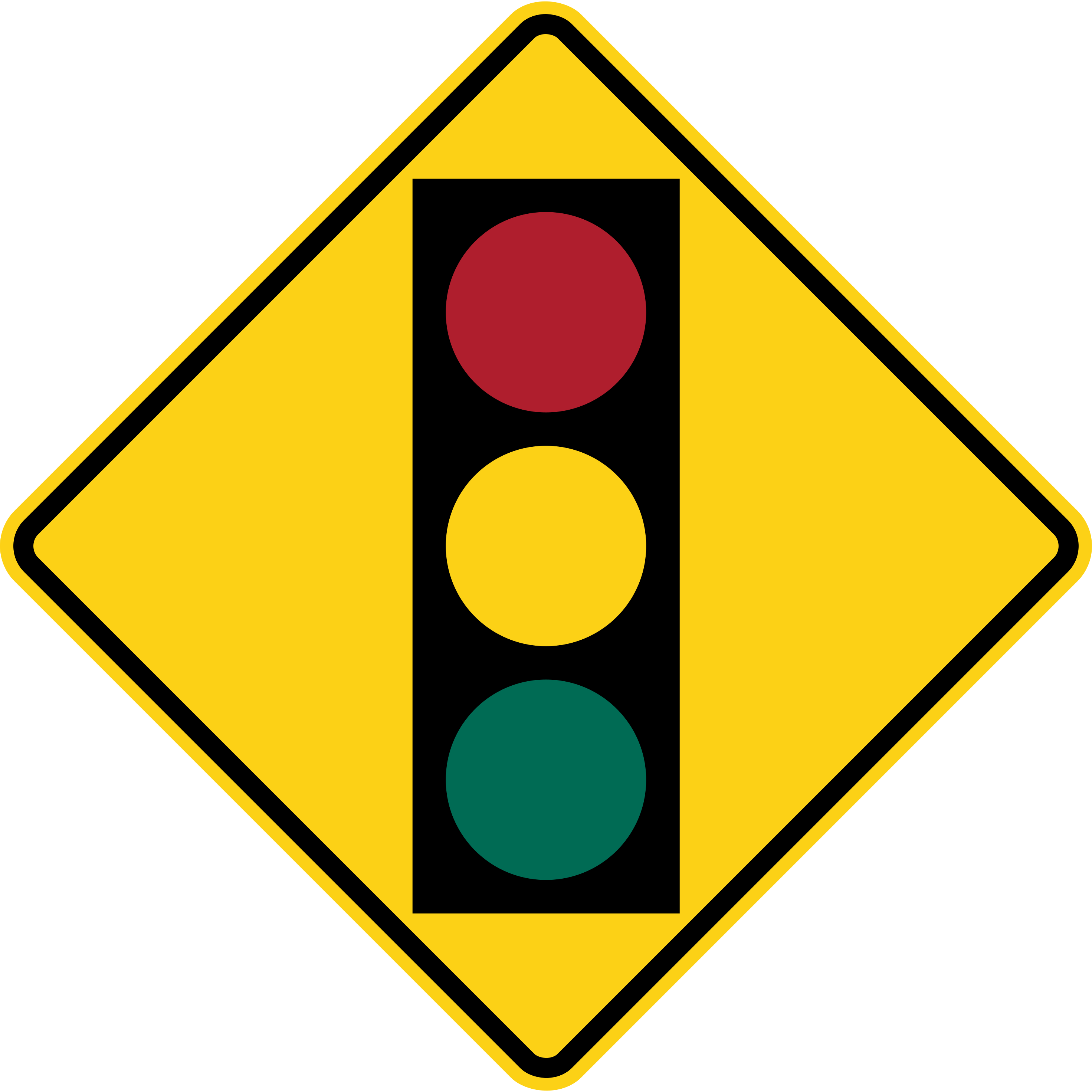
- A railroad crossing where the light symbol stands for the crossing lights
- A school zone where the light flashes only during arrival times
- A drawbridge that opens for boat traffic on a posted schedule
- A traffic signal, so be ready to obey the indication it shows
Show answer
A traffic signal, so be ready to obey the indication it shows. Signalized intersections can hide behind curves, hills, and lines of stopped traffic, so the small light symbol buys preparation time. It does not mark tracks, a school zone, or a movable bridge, each of which has a distinct warning. Lift off the accelerator, cover the brake, and expect the indication to be red or blocked by queued vehicles. Arriving ready to stop keeps a late discovery from becoming a hard brake or a red light entry.
Study this in the handbook: Road signs by color and shape
12. Your vehicle strikes and kills a large wild animal on an Alaska highway late at night. Whom must you notify promptly?
- The nearest road maintenance depot before you leave the scene
- Your insurance company only, before the next business day begins
- A State Trooper or a Fish and Wildlife Officer as soon as possible
- Nobody, provided you move the carcass off the pavement yourself
Show answer
A State Trooper or a Fish and Wildlife Officer as soon as possible. A killed big game animal triggers duties beyond clearing the road: a State Trooper or Fish and Wildlife Officer must be notified as soon as possible so the death is recorded and the carcass handled lawfully. Maintenance depots and insurers serve other purposes, and dragging the animal aside quietly satisfies none of them. Make the vehicle safe first, avoid handling the animal more than needed, and place the notification as soon as you can reach help.
Study this in the handbook: Night driving, lighting, weather and animals
13. Snow begins falling at dusk on your Alaska drive and other drivers approach with their lights on. Which beam should you use?
- High beam, because falling snow makes every extra light useful
- Low beam in rain, fog, snow, or dust conditions like these
- Parking lights, so your vehicle is marked without bright glare
- No lights until darkness is complete and traffic thins out
Show answer
Low beam in rain, fog, snow, or dust conditions like these. Precipitation turns high beams into a glowing wall, bouncing light back from every flake, drop, or dust grain between you and the road. Low beams angle light downward onto the pavement where it helps, without the blinding return. Parking lights cannot substitute for driving beams, and delaying lights altogether leaves you invisible at dusk. Switch to low beam whenever weather fills the air, and slow to match the shorter view it honestly gives.
Study this in the handbook: Turn signals and pavement markings
14. On an Alaska road at night with no opposing traffic, how should speed and beams be set for animal safety?
- Hold highway speed because beams reveal all animals
- Reduce speed and use high beams when possible
- Use parking lights to avoid startling animals
- Increase speed to pass animal areas quickly
Show answer
Reduce speed and use high beams when possible. Night hides animals beyond the headlight edge until closing speed makes the meeting unavoidable, so slower travel plus the longest lawful beam stretches the distance in which a shape becomes recognizable. High beams help without promising full revelation, parking lights abandon both seeing and being seen, and rushing through animal country spends the margin the beams bought. Slow until you can stop inside the lit distance, dim for opposing traffic as required, and scan the beam edges where eyes reflect before bodies appear.
Study this in the handbook: Night driving, lighting, weather and animals
15. In Alaska, you begin a pass on a two lane road. What warning must you give the driver ahead?
- Flash high beams repeatedly until that driver moves right to let you pass
- Wave through the windshield for that driver to speed up
- Sound the horn to warn that driver of your intention to pass
- Rely on the turn signal alone without any horn warning
Show answer
Sound the horn to warn that driver of your intention to pass. The driver you are about to pass may drift, turn, or brake without knowing you are alongside the plan, and a horn warning places your intention in that driver awareness before you enter the opposing lane. Flashing beams and windshield waves communicate poorly and can provoke the wrong response, while the signal alone speaks mainly to drivers behind you. Sound the horn while your setup still allows an abort, confirm the leader holds a steady course, and pass only when oncoming space and the leader behavior both stay predictable.
Study this in the handbook: School buses, passing and railroad crossings
16. In Alaska, within what distance of intersections, railroad crossings, and narrow bridges may you not pass?
- Within only 15 feet of them when your passing speed is kept very low
- Within 100 feet of any of them
- Within only 30 feet of them whenever surrounding traffic is light
- Within only 50 feet of them on rural highways outside built up areas
Show answer
Within 100 feet of any of them. Intersections, crossings, tunnels, and narrow structures concentrate conflicts where a passing vehicle has no escape space, so the protection begins well before them and covers the act of traversing the intersection or crossing itself. Parking clearances and lighter traffic do not shrink that span, and rural location does not remove it. Count the distance generously on approach: if any part of your pass would enter the protected span, hold your position, let the structure or crossing pass, and reconsider only on open road beyond it.
Study this in the handbook: Turn signals and pavement markings
17. In Alaska, your wheels drop off the roadway edge. What are the first control actions?
- Stop feeding gas and hold a firm grip on the steering wheel
- Accelerate to climb back onto the pavement at once
- Turn sharply toward the pavement immediately
- Brake hard with both feet on the pedal
Show answer
Stop feeding gas and hold a firm grip on the steering wheel. A vehicle off the edge sits at two heights and two grips at once, and violent inputs exploit that split. Easing off the gas and gripping the wheel firmly stabilizes the vehicle in a straight roll while you judge the return. Accelerating digs the low wheels, yanking the wheel climbs the edge at a tripping angle, and hard braking locks tires on gravel. Let speed bleed on its own, confirm no vehicles crowd the lane beside you, and only then think about a slow return.
Study this in the handbook: School buses, passing and railroad crossings
18. In Alaska, mandatory insurance law places the duty to carry liability coverage on whom?
- Only the registered owner in every case
- Only the driver and never the owner
- Either the vehicle owner or the driver must carry it
- Only drivers who own their vehicles
Show answer
Either the vehicle owner or the driver must carry it. Borrowed vehicles fill Alaska roads daily, and the mandate closes the gap by accepting coverage carried by either side of the key exchange, owner or driver. Owner only and driver only readings each leave one common arrangement imagined uncovered, and ownership itself never decides whether a trip needs insurance. Before driving any vehicle, confirm that someone in that owner driver pair holds liability coverage meeting state minima and that proof rides inside. The question takes thirty seconds and prevents impoundment, citation, and personal ruin after a crash.
Study this in the handbook: Vision, insurance and the point system
19. In Alaska, allergy remedies and cold pills bought without a prescription pose what driving risk?
- They are always safe for driving at label doses
- They affect driving only when mixed with coffee
- They help alertness on every night drive
- They may contain compounds that can affect your driving
Show answer
They may contain compounds that can affect your driving. Pharmacy shelves sell relief that sedates as surely as many prescription products, and a driver who would never drive on a sleeping pill may drive freely on a cold remedy carrying the same drowsiness. The compounds affect coordination, alertness, and reaction whether or not a doctor visit preceded them. Coffee does not neutralize them, and night driving suffers most from their sleep pressure. Read every label for driving warnings before the first dose meets a trip, and choose nondrowsy remedies or another driver when treatment cannot wait.
Study this in the handbook: Alcohol, implied consent and under 21 rules
20. In Alaska, rain makes the road wet and slippery while you follow a motorcycle. How should your following distance change?
- Allow more following distance for the motorcyclist
- Close the distance so the rider can see you in their mirrors at all times while following
- Keep the ordinary dry road distance, because rain affects cars and motorcycles alike
- Follow closer on the left side so spray from the rider stays off your windshield
Show answer
Allow more following distance for the motorcyclist. Bad weather and slippery surfaces cause greater problems for motorcycles than for cars, because two wheels hold less stability margin when grip falls and skilled riders will slow down for conditions. Following at dry road distance therefore arrives too fast at a rider who may brake, wobble, or change position without car-like steadiness. Allow more following distance for motorcyclists when the surface is wet and slippery, and add still more for spray and glare that rain and wet pavement create at night. Space is the help the rider cannot give themselves.
Study this in the handbook: Pedestrians, bicyclists and motorcyclists
Every question is written from the official Alaska Driver Manual. Need paper? Printable AK practice test with answer key.
Last verified 2026-10-05. How we check every question · Study all 500 as flashcards
Frequently asked questions
How many questions are on this Alaska practice test?
This fixed set has 20 questions. It is test 21 of 25 from the 500 question Alaska bank. The real AK exam asks 20 questions and you need 16 correct.
What is the passing score for the real Alaska test?
16 correct answers to pass (80%) That figure comes from the official Alaska source cited on the DMV facts page.
How does this fixed test relate to the full Alaska bank?
Each numbered test is a fixed set of questions in a fixed order, so you can retake the same test later and compare. Every test mixes road signs and the other topics in about the same proportion as the full bank. Tests 1 to 25 together cover every question in the Alaska bank once. The full practice page mixes the whole bank at random.
Last verified 2026-10-05. See the Alaska DMV facts page for sourced state details.