
Test 1 of 10 · 20 questions · Free 2026
AK Permit Practice Test 1
Jump to the test ↓A fixed 20 question set from the Alaska bank with answers and plain English explanations. The real AK exam is 20 questions, 80 percent to pass; take the full length version on the main practice page.
Question 1 of 20 · 0 right so far
All 20 questions in test 1
Every question below comes from the Alaska question bank on this page. Open a question to see the correct answer and the explanation. Nothing here is hidden behind a signup.
1. What do yellow pavement markings generally separate?
- Only bicycle lanes
- Traffic moving in the same direction
- Traffic moving in opposite directions
- Only parking spaces
Show answer
Traffic moving in opposite directions. Yellow pavement markings, including center lines, separate traffic flows traveling in opposite directions. White markings generally separate lanes moving in the same direction, so the choice “Traffic moving in the same direction” reverses the manual's distinction. Bicycle lanes and parking spaces are not the general meaning of yellow center markings. A quick roadway cue is to look at the center of the road: yellow usually identifies the boundary between opposing traffic streams.
Study this in the handbook: Turn signals and pavement markings
2. On a four lane road, what should you do when passing a stationary emergency vehicle with overhead flashing lights?
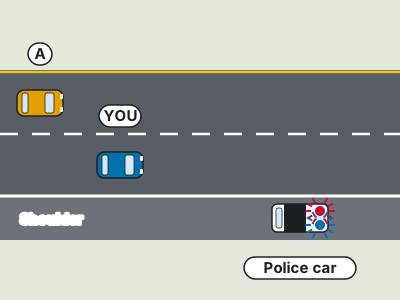
- Pass in the lane closest to it at the posted speed
- Use the lane opposite the emergency vehicle if safe
- Stop in the travel lane until the lights turn off
- Turn around before reaching the scene
Show answer
Use the lane opposite the emergency vehicle if safe. On a four lane road, drivers must move to the lane opposite a stationary emergency vehicle or tow truck when that movement is safe. Remaining beside the vehicle leaves responders exposed and ignores the move over requirement. A complete stop is not the default instruction, and turning around is unnecessary. If changing lanes is unsafe, the manual directs a reasonable and prudent speed when passing. First identify whether the road has four lanes, then decide between moving away and slowing safely.
Study this in the handbook: Emergency vehicles and the Move Over law
3. How long must a 16 or 17 year old hold a valid Alaska instruction permit before receiving a provisional Class D license?
- Only until passing the road test
- At least 30 days
- At least 1 year
- At least 6 months
Show answer
At least 6 months. Applicants who are 16 or 17 must hold a valid instruction permit for at least six months before the DMV can issue a provisional Class D license. Thirty days is too short, and one year adds a requirement the manual does not state. Passing a road test alone does not replace the holding period. The practical cue is to track the permit issue date, because the six month clock runs before the provisional application.
Study this in the handbook: Instruction permits and provisional licenses
4. What should a driver do when railroad crossing gates are down?
- Drive around the gates if no train is visible
- Stay in place and wait until the gates are raised
- Cross quickly before the warning lights change
- Stop on the tracks to watch for the train
Show answer
Stay in place and wait until the gates are raised. Down crossing gates mean the driver must stay in place and not cross the tracks until the gates are raised. Driving around them is against the law, even when a train is not immediately visible. The choice to cross quickly adds the danger of a hidden or second train and leaves no margin for a malfunction or changing signal. Stop before the crossing, keep the vehicle off the tracks, and wait for the complete clearance cue. Never race a train or assume a quiet crossing is safe to enter.
Study this in the handbook: School buses, passing and railroad crossings
5. What happens to an Alaska driver who was uninsured in a crash or fails to prove insurance within 15 days?
- Permanent revocation
- A $25 fine
- Nothing if no one was hurt
- A 90 day suspension for a first occurrence and one year for a second
Show answer
A 90 day suspension for a first occurrence and one year for a second. If you were uninsured or fail to provide proof of insurance within 15 days of a crash, your driver's license will be suspended for 90 days for a first occurrence and one year for a second occurrence. A certificate of insurance is required for any crash with property damage of $501 or more and must reach the DMV within 15 days, even if you showed proof to the officer.
Study this in the handbook: Vision, insurance and the point system
6. What does a lane-ending warning require a driver to anticipate?

- A new lane will open on the side shown by the sign
- The roadway narrows ahead, requiring a safe move into the remaining lane
- The right lane becomes a permanent passing lane
- All traffic must stop before the lane markings change
Show answer
The roadway narrows ahead, requiring a safe move into the remaining lane. A lane-ending warning shows that the roadway will narrow ahead, so the driver must plan a safe move into the lane that remains. Check mirrors and blind spots, signal, and change lanes gradually when a suitable gap is available. The sign does not add a lane, create a permanent passing lane, or require all traffic to stop. Identify the open lane early and avoid waiting until the stripe disappears. The warning gives time to make a controlled transition rather than forcing a sudden lateral move beside other vehicles.
Study this in the handbook: Road signs by color and shape
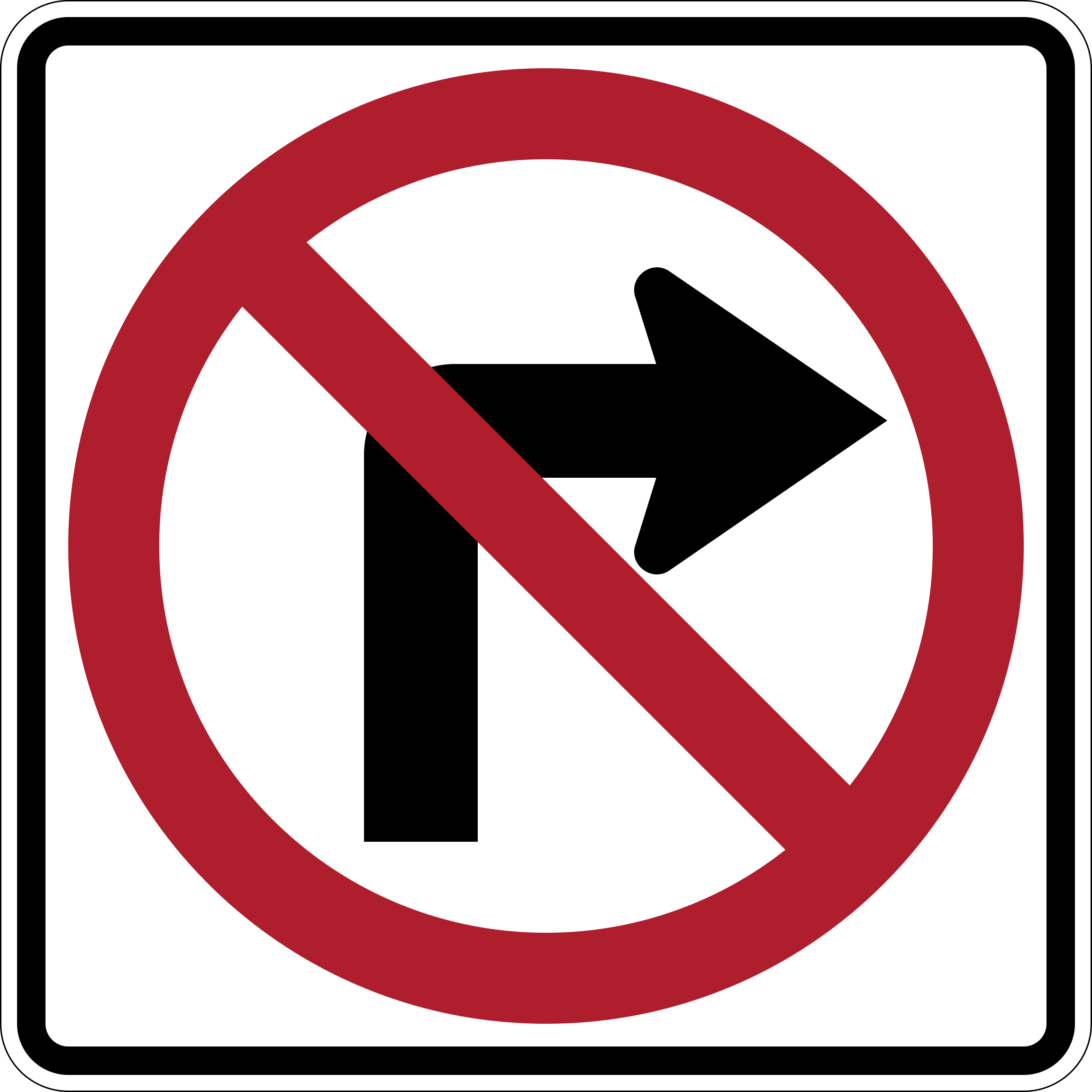
7. A red slash over a right-turn arrow prohibits which maneuver?
- Continuing straight through the junction
- Turning right where the sign is posted
- Parking on the right side of the street
- Yielding to a pedestrian on the right
Show answer
Turning right where the sign is posted. The right-turn arrow shows the movement covered by the prohibition, so the driver may not turn right where the sign applies. Straight travel, curbside parking, and yielding to a pedestrian are separate actions and are not identified by this arrow. Check the route before entering the junction and choose a permitted movement. A red slash is not a command to stop every kind of travel. Match the slash to the symbol beneath it, then obey that specific restriction while continuing to watch for people and traffic.
Study this in the handbook: Road signs by color and shape
8. What does the curved-arrow warning indicate?

- The road is ending and traffic must detour immediately
- A mandatory right turn is posted at the intersection
- A curve is ahead, so the driver should take it at the advisory speed
- A straight section permits passing in both directions
Show answer
A curve is ahead, so the driver should take it at the advisory speed. The curved-arrow warning identifies a bend ahead and gives the driver a cue to adjust speed before reaching it. The advisory speed is a planning reference for taking the curve, not a command to make a turn at a junction. The sign also does not announce a road closure or create a passing zone. Braking and steering should be settled before the bend whenever possible. Reduce speed early, then maintain a controlled path through the curve.
9. About how long does it take the body to cancel the effects of four drinks?
- About four hours
- About two hours
- About one hour
- About eight hours
Show answer
About four hours. The manual says it takes an average of one hour to cancel the effects of one drink, so about four hours to cancel the intoxicating effects of four drinks. Black coffee, fresh air, food, or a cold shower might wake a person up but will not sober them up; alcohol is burned by the liver and only time helps. One and two hours are too short, and eight hours is not the manual's figure.
Study this in the handbook: Alcohol, implied consent and under 21 rules
10. What response do most Alaska warning signs imply?
- Stop in the travel lane at every warning sign
- Ignore the sign unless a police officer is present
- Maintain speed because warning signs are regulatory
- Decrease speed and adjust driving to the situation
Show answer
Decrease speed and adjust driving to the situation. Warning signs identify actual or potentially dangerous conditions ahead. The manual says most imply that the driver should decrease speed, observe extra caution, and adjust driving to the situation. They do not require an officer's presence, and they are not the same as regulatory commands. A full stop at every warning sign would also overstate the instruction. Read the sign as an advance cue to manage speed and attention, then respond to the particular curve, crossing, construction area, or other condition shown.
Study this in the handbook: Road signs by color and shape
11. An Alaska driver receives a DMV revocation notice after a DUI arrest. How long does the driver have to request an administrative hearing?
- Seven days from the Date Issued on the notice
- 24 hours
- 30 days
- 90 days
Show answer
Seven days from the Date Issued on the notice. The request for an administrative hearing must be made in writing within seven days of the Date Issued on the notice, unless the driver qualifies for a late hearing due to physical incapacity. A timely request by a driver with a valid license brings a temporary license good until the hearing date, unless the court has revoked the license. Twenty-four hours, 30 days, and 90 days are not the deadline.
Study this in the handbook: DUI revocations and ignition interlock
12. When entering a protected route at an intersection, to whom must a driver yield?
- All traffic, including non-motorized users, traveling on the protected route
- Only motor vehicles traveling on the protected route
- Traffic approaching from behind the entering vehicle
- No one if the entering driver signals
Show answer
All traffic, including non-motorized users, traveling on the protected route. Alaska's intersection guidance requires a driver entering a protected route to yield to all traffic using that route, including people traveling without motor vehicles. The protection is broader than a vehicle-only rule, so a bicyclist or other non-motorized user must also be considered. Signaling does not create a right to enter, and traffic behind the driver is not the relevant conflict. Identify the protected route first, scan its full width, and proceed only after every road user with priority has cleared.
Study this in the handbook: Pedestrians, bicyclists and motorcyclists
13. What minimum following interval does Alaska regulation require?
- At least six seconds
- One car length per 10 mph
- At least the two second rule, though the manual recommends four seconds
- There is no minimum
Show answer
At least the two second rule, though the manual recommends four seconds. While the manual's chart recommends the four second rule, regulation 13 AAC 02.090 requires at a minimum the two second rule. Pick a fixed object, and if you reach it before finishing the count you are too close, so slow down until the gap opens. The manual raises the count to six seconds or more when towing a trailer or when the surface is wet or slippery, and asks for more distance in rain or snow.
Study this in the handbook: Following distance and large trucks
14. What must you do at a red traffic signal ball?
- Stop before the crosswalk, stop line, or intersection
- Continue through if no vehicle is approaching
- Turn in any direction without stopping
- Stop only when a pedestrian is visible
Show answer
Stop before the crosswalk, stop line, or intersection. A red ball requires a stop behind the crosswalk, at the stop line, or, if neither exists, before entering the intersection. The choice permitting movement whenever the roadway looks empty ignores the signal's command. A right turn can be permitted only after a full stop, when safe, and when no No Turn on Red sign restricts it. The useful visual cue is the red circular signal itself: stop at the proper boundary first, then evaluate whether a legally permitted movement remains.
Study this in the handbook: Traffic signals and lane control signals
15. What minimum following interval does Alaska law require, while the manual recommends a longer interval for ordinary driving?
- Six seconds only when traffic is light
- Exactly four seconds in every condition
- One second behind a passenger vehicle
- At least two seconds
Show answer
At least two seconds. Alaska's rule sets a floor of at least two seconds, but the manual presents four seconds as an easier everyday method for judging space behind another vehicle. Wet or slippery pavement and trailer towing call for six seconds or more. The four-second method is not a license to follow closely when conditions worsen. A driver should count from the moment the vehicle ahead passes a fixed point and increase the interval whenever stopping or visibility becomes harder.
Study this in the handbook: Following distance and large trucks
16. How long is each Alaska non-commercial instruction permit valid, and how many renewals are allowed?
- One year, with unlimited renewals
- Two years, with one renewal
- Six months, with two renewals
- Three years, with no renewal
Show answer
Two years, with one renewal. Each type of Alaska non-commercial instruction permit remains valid for two years and may be renewed one time. The renewal limit prevents treating the permit as an indefinitely extendable credential. Six months refers to a separate requirement for a 16 or 17 year old who seeks a provisional Class D license, not the permit's validity period. Study the two numbers together: two years describes duration, and one time describes the permitted renewal count.
Study this in the handbook: Instruction permits and provisional licenses
17. An Alaska driver is 19. When will the current driver's license expire, and what must be passed to renew it?
- On the 21st birthday; a road test
- Five years from issue; nothing extra
- 90 days after the 21st birthday; an alcohol awareness test
- On the 25th birthday; a vision test only
Show answer
90 days after the 21st birthday; an alcohol awareness test. A driver's license issued to someone under 21 expires 90 days after the 21st birthday, and an alcohol awareness test must be passed before it can be renewed. The license does not expire exactly on the birthday, no road test is required for this renewal, and the 25th birthday is not part of the rule. The alcohol awareness test can be taken online through the address listed in the manual.
Study this in the handbook: Instruction permits and provisional licenses
18. What is the penalty for littering in Alaska?
- A $25 ticket
- A warning
- A fine up to $1,000, and the court may also order litter pickup
- Community service only
Show answer
A fine up to $1,000, and the court may also order litter pickup. Under AS 46.06.080, littering is a violation that can bring a fine of up to $1,000, and the court may also order the person to gather and dispose of litter in an area and for a length of time it sets. A minor littering violation of five pounds or less can be settled by mailing a $50 fine. A $25 ticket, a warning, or community service alone understates the penalty. The same law requires loads to be covered or secured so nothing escapes onto the highway.
19. What does a sign marked "Do not turn right on red signal" require?
- Do not make a right turn on red at that location
- Turn right on red without stopping
- Use the right lane for trucks only
- Prepare for a road hazard ahead
Show answer
Do not make a right turn on red at that location. A sign saying do not turn right on red removes that turning option at the displayed location. The driver must wait for a signal that permits the movement or for another lawful instruction, rather than treating a clear intersection as permission. Stopping first does not override the prohibition, and the sign does not direct trucks or announce a roadway hazard. Check the sign before reaching the corner, identify the restricted movement, and choose a permitted path without blocking the crosswalk.
Study this in the handbook: Road signs by color and shape
20. Why are streaking or skipping windshield wipers especially hazardous during a rainy night?
- They prevent water from reaching the roadway
- They increase tire traction on wet pavement
- They automatically switch headlights to high beam
- They reduce visibility when darkness and rain already make seeing difficult
Show answer
They reduce visibility when darkness and rain already make seeing difficult. Streaking or skipping blades are hazardous because they leave the driver with poorer visibility during a rainy night, when darkness, glare, and water already make hazards harder to see. The manual calls good wipers and washer fluid valuable safety essentials. Wipers do not increase tire grip, change headlight settings, or keep water off the pavement. Check blade condition before bad weather, keep the windshield clean, and replace or clean worn blades so the glass can be cleared when visibility deteriorates.
Study this in the handbook: Vehicle emergencies, skids and stalls on the tracks
QualitySpace is expanding to Alaska
We are a California-based independent insurance brokerage working on licensing in more states. We cannot help with Alaska insurance yet. Leave your email and we will let you know when we can.
Every question is written from the official Alaska Driver Manual. Need paper? Printable AK practice test with answer key.
Last verified 2026-10-05. How we check every question · Study all 201 as flashcards
Frequently asked questions
How many questions are on this Alaska practice test?
This fixed set has 20 questions. It is test 1 of 10 from the 201 question Alaska bank. The real AK exam asks 20 questions and you need 16 correct.
What is the passing score for the real Alaska test?
16 correct answers to pass (80%) That figure comes from the official Alaska source cited on the DMV facts page.
How does this fixed test relate to the full Alaska bank?
Each numbered test is a fixed set of questions in a fixed order, so you can retake the same test later and compare. Every test mixes road signs and the other topics in about the same proportion as the full bank. Tests 1 to 10 together cover 200 of the 201 questions in the Alaska bank, each once. The full practice page mixes the whole bank at random.
Last verified 2026-10-05. See the Alaska DMV facts page for sourced state details.