
Test 19 of 25 · 20 questions · Free 2026
AK Permit Practice Test 19
Jump to the test ↓A fixed 20 question set from the Alaska bank with answers and plain English explanations. The real AK exam is 20 questions, 80 percent to pass; take the full length version on the main practice page.
Question 1 of 20 · 0 right so far
All 20 questions in test 19
Every question below comes from the Alaska question bank on this page. Open a question to see the correct answer and the explanation. Nothing here is hidden behind a signup.
1. In Alaska, you need to turn around on a highway near a curve. What visibility rule governs that turn?
- Do not turn around near a curve or hill you cannot see 500 feet or more each way from
- Turn around there whenever you cannot see at least 100 feet in each direction
- Turn around on highway curves because traffic there travels more slowly
- Sound your vehicle horn loudly and complete the turn without a sight rule
Show answer
Do not turn around near a curve or hill you cannot see 500 feet or more each way from. A turn around crosses every lane of a highway at walking pace, so the maneuver needs sight distance measured in many seconds of travel for the traffic that will arrive while you are broadside. Five hundred feet in each direction supplies that time, while a hundred feet evaporates at highway closing speed. Curves and hills hide the very traffic the rule counts, and a horn announces without protecting. Drive to a straight, open stretch or a side road, and begin only when the full count of visibility stands clear both ways.
Study this in the handbook: School buses, passing and railroad crossings
2. In Alaska, does switching from beer to wine or liquor change how alcohol affects your body for driving?
- Yes, wine affects driving less than any beer
- Yes, liquor leaves the body without affecting judgment or driving
- Yes, beer never impairs driving at any amount
- No, the amount of alcohol entering the body is what counts
Show answer
No, the amount of alcohol entering the body is what counts. Blood alcohol measures alcohol itself, not the beverage that delivered it, so the body and the driving task respond to quantity rather than to labels. Wine, liquor, and beer each deliver the same drug in different dress, and standard servings carry comparable alcohol loads. Switching drinks to game sobriety fools only the drinker, because the liver, brain, and eyes keep accounts in pure alcohol. Count total alcohol consumed across every glass, and let that count rather than beverage folklore decide that someone else must drive.
Study this in the handbook: Alcohol, implied consent and under 21 rules
3. In Alaska, you strike an unattended vehicle and cannot find its owner. What must you leave?
- A written note with your name, address, and telephone number
- A note with only the date and time of the crash
- Cash for the visible damage on the windshield
- Nothing, because unattended damage needs no notice
Show answer
A written note with your name, address, and telephone number. The owner of a struck unattended vehicle returns to damage with no explanation, and the note you leave is the bridge between that moment and a fair settlement. Your name, address, and telephone number make contact possible, while a bare date, a cash guess, and silence each strand the owner with repair costs and no recourse. Stop, try honestly to locate the owner first, then leave the note where it will be found and protected from weather, and keep your own record of the time, place, and damage you saw.
Study this in the handbook: Vision, insurance and the point system
4. A bicyclist ahead of you in Alaska extends one arm straight out to the right side before a corner. What turn is signaled?
- A right turn, shown by the right arm extended straight out
- A stop, because any extended arm warns drivers to brake
- A left turn begun from the right side of the lane
- A lane change to the shoulder for slower bicycle traffic
Show answer
A right turn, shown by the right arm extended straight out. Rider hand signals mirror driver intentions, and a right arm extended straight to the right announces a right turn. Stops bend the left arm downward, left turns signal leftward, and a shoulder drift carries no such definite arm. Reading the signal early lets you hold back rather than pass into the rider turn path. Give the rider the turn space, and confirm the move starts before treating the signal as finished.
5. You settle into a parallel space beside an Alaska curb and straighten the wheel. How close must your wheels end to that curb?
- Within two feet, provided the vehicle sits parallel to traffic
- Any distance, so long as the vehicle is fully out of the turn lane
- Within 12 inches of the near curb when you finish parking
- Touching the curb, because contact proves the correct distance
Show answer
Within 12 inches of the near curb when you finish parking. A parked vehicle should hug the curb so its side stays clear of passing traffic while its tires remain off the concrete. Finishing within twelve inches of the near curb achieves that balance. Two feet out narrows the travel lane, resting against the curb damages tires, and guessing by lane position alone ignores the measured limit. Glide in slowly at the end of the maneuver and stop with the wheels inside that foot.
6. In Alaska, you back up where houses line the street. What caution and hidden danger must you expect?
- Use extraordinary caution because children may hide behind and between parked vehicles
- Use normal caution because children in the area can be expected to stay on sidewalks at all times
- Back at a normal road speed so you clear driveways and parking rows more quickly
- Watch only through the center of the rear window while the vehicle is backing up
Show answer
Use extraordinary caution because children may hide behind and between parked vehicles. Residential backing crosses play space, and small children can stand completely hidden behind a parked vehicle or in the gap between two of them. Extraordinary caution means creeping, turning to scan both rear corners, and stopping for any movement, sound, or doubt. Sidewalk assumptions fail at driveways and curb cuts, and ordinary speed leaves no margin when a child steps out at bumper height. Walk behind the vehicle first when you can, then back as if a child is present until the whole path is visibly clear.
7. On a wet Alaska road, what control do bald tires fail to give when you try to stop?
- Extra stopping power on smooth wet pavement
- Directional control of the vehicle during the stop
- Better steering on standing water at speed
- Protection against skidding on dry roads
Show answer
Directional control of the vehicle during the stop. Tread channels water away so rubber can grip pavement, and a bald casing rides up on the water film until steering and braking inputs fade together. That lost directional control during a wet stop is the danger, not a hidden reserve of power or water ability, and dry performance cannot redeem a tire that fails whenever rain falls. Drive on tires with sound tread, slow earlier on wet surfaces, and replace worn tires before the season tests them rather than after a slide teaches the lesson.
Study this in the handbook: Vehicle emergencies, skids and stalls on the tracks
8. Entering an Alaska freeway, how should you use the acceleration lane before merging?
- Stop at the end of that lane and wait for a wave
- Merge slowly and accelerate after joining traffic
- Reach cruising speed in that lane before attempting to merge
- Enter at ramp speed and brake to match traffic
Show answer
Reach cruising speed in that lane before attempting to merge. Freeway traffic cannot safely absorb a vehicle arriving far below its speed, so the acceleration lane exists to erase that speed difference before the merge point. Reaching cruising pace there lets you slip into a gap as an equal rather than an obstacle. Stopping at the end, merging slowly, and braking to match each transfer your speed problem to drivers already flowing. Use the full lane, mirror and shoulder check as speed builds, and merge into the gap your pace has prepared.
Study this in the handbook: School buses, passing and railroad crossings
9. In Alaska, a yellow arrow appears for your turn and you can still stop safely. What does it tell you?
- The indicated turn is fully protected, so proceed through it without yielding to anyone
- A red light is about to appear, so stop the indicated movement unless you cannot stop safely
- Stop only after completing the indicated turn and clearing the far side of the intersection fully
- Yield briefly and then make the indicated turn at any time while the yellow arrow shows
Show answer
A red light is about to appear, so stop the indicated movement unless you cannot stop safely. A yellow arrow warns that red is next for that turning movement. A driver who can stop safely should stop rather than start or continue the turn on the strength of the yellow. Only a driver already inside the intersection or too close to stop safely should carry through and finish the indicated turn. Yellow arrow gives no protected right of way, and stopping after the turn reverses the required order. Read it as the end of permission, not as extra time to turn.
Study this in the handbook: Traffic signals and lane control signals
10. Every light on the signal facing you is dark at an Alaska intersection and nobody is directing traffic. What must you do?
- Treat the green timing as still running and proceed without stopping
- Stop, yield to traffic approaching from your right, and go only when safe
- Honk continuously while crossing so others clear a path for you
- Follow the vehicle ahead through without making your own stop
Show answer
Stop, yield to traffic approaching from your right, and go only when safe. A signal with every bulb dark has stopped controlling the intersection, so drivers fall back on uncontrolled intersection rules. Stop first, yield to traffic approaching from your right, and proceed only with extreme caution when the way is truly safe. Assuming the old timing still protects you, leaning on the horn, or tailgating another vehicle through each removes the judgment the fallback demands. Treat every approach as occupied until your own eyes confirm it is clear.
Study this in the handbook: Traffic signals and lane control signals
11. Why does a safety belt raise survival in a burning or submerged vehicle in Alaska crashes?
- The belt holds you away from all fire and water
- Belts unlock doors automatically during a crash
- You are more likely to stay conscious and therefore able to escape the vehicle
- An unbelted occupant escapes faster by being thrown clear
Show answer
You are more likely to stay conscious and therefore able to escape the vehicle. Escape from fire or water is a race run by a conscious person, and the belt greatest gift in those rare crashes is keeping the occupant awake and oriented by preventing the head strikes that cause unconsciousness. The belt neither seals the cabin nor opens doors, and ejection trades escape for lethal impact outside. Buckle before every move, keep the belt snug and untwisted, and know your buckle release by touch, because the same belt that guards a routine crash guards your exit from the extraordinary one.
Study this in the handbook: Safety belts and child seats
12. In Alaska, what does operating a motor vehicle say about chemical breath testing under implied consent?
- Only licensed drivers older than 21 years consent to breath testing at all
- Operating consents to a breath test for alcohol concentration of blood or breath
- Consent to breath testing applies only after a crash causing personal injuries to anyone
- Adult drivers may refuse the very concept of implied consent while driving
Show answer
Operating consents to a breath test for alcohol concentration of blood or breath. The consent travels with the privilege itself: choosing to operate on Alaska roads accepts the breath test that measures alcohol in blood or breath when law enforcement lawfully requires it. Turning 21, avoiding crashes, and personal disagreement do not detach that acceptance from the act of driving. Understanding consent before any stop prevents the roadside mistake of treating the test as optional hospitality. The request that follows a lawful arrest therefore meets a duty created at the moment the vehicle first moved under your control.
Study this in the handbook: Alcohol, implied consent and under 21 rules
13. In Alaska, traffic ahead slows on a highway. How should you slow to protect the driver behind?
- Brake hard at the last moment to save brake wear
- Coast without braking until the gap vanishes
- Slow gradually over a long distance
- Slow suddenly so the driver behind wakes up
Show answer
Slow gradually over a long distance. A gentle early slowdown stretches the event over distance, giving the driver behind repeated chances to notice, lift, and match your pace without panic braking. Waiting to brake hard, coasting dark until the gap disappears, and chopping speed to startle the follower each collapse that gift of time. Begin easing off when brake lights bloom several vehicles ahead, touch your own lamps early, and let the slowdown arrive as information rather than emergency for everyone behind you.
Study this in the handbook: Following distance and large trucks
14. You back out of an Alaska driveway toward a street where cars and people on foot are passing. What duty applies every time?
- Back quickly so your exposure in the street stays brief
- Yield only to motor vehicles, because walkers must wait for cars
- Give way to street traffic and walkers, ready to stop
- Rely on your mirrors because turning around takes too long
Show answer
Give way to street traffic and walkers, ready to stop. Backing crosses spaces used by drivers, walkers, and riders who have no reason to expect your vehicle. Yielding to all of them, with your foot ready to stop, is the standing duty at driveways, alleys, and parking exits. Quick backing, vehicle only yielding, and mirror dependence each create the surprise the duty prevents. Turn and look, creep at walking pace, and stop the instant anything enters the path behind you.
15. You descend a long Alaska grade in a heavy vehicle and consider coasting partway with the gears in neutral. What does the law say?
- Coasting downhill in neutral is allowed below thirty miles per hour
- Coasting is allowed when the parking brake is set one notch
- Coasting is allowed if the clutch stays pressed only briefly
- Coasting with gears in neutral or clutch disengaged is forbidden
Show answer
Coasting with gears in neutral or clutch disengaged is forbidden. Engine braking is part of speed control on a grade, and disconnecting it by coasting in neutral or holding the clutch in leaves only the service brakes against gravity. Those brakes overheat and fade exactly when the grade is longest. Low speed, a notched parking brake, or a brief clutch press do not restore the lost control. Select the lower gear before the descent steepens and let the engine share the work of holding speed.
Study this in the handbook: School buses, passing and railroad crossings
16. In Alaska, you consider a pass that would end as a solid yellow line appears in your lane. What must the pass satisfy?
- Begin the pass before the line even when the return would end beyond it
- Finish the pass beyond that line whenever no opposing vehicle is visible
- Use the paved opposing shoulder whenever that solid line appears too early
- Finish without interfering with oncoming safety and before that solid line appears
Show answer
Finish without interfering with oncoming safety and before that solid line appears. A pass is judged by its whole span, not by where it starts, and the solid yellow line in your lane marks where opposing protection ends. Planning must place the return before that line while leaving oncoming drivers entirely undisturbed. Ending beyond the line on a seemingly empty road trusts unseen distance, and an opposing shoulder offers no lawful escape. If the arithmetic of speed, length, and sight distance cannot fit the pass before the line, the correct decision is to stay in line and wait for the next lawful opening.
Study this in the handbook: Turn signals and pavement markings
17. What colors does Alaska use for service signs showing fuel, food, and lodging?
- White lettering on a blue background
- White lettering on a green background
- Black lettering on a yellow background
- Black lettering on an orange background
Show answer
White lettering on a blue background. Services that help a traveler, such as fuel, food, lodging, and rest areas, appear with white lettering over blue. Green with white lettering carries destinations and routes, yellow with black lettering warns of danger, and orange with black lettering covers work areas. Knowing the blue pairing lets you find help without confusing it with a warning that needs braking. Glance for blue when you need a service, then signal and leave the highway in an orderly way.
Study this in the handbook: Road signs by color and shape
18. The pictured orange sign is posted along an Alaska road. What should you watch for?
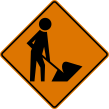
- Deer crossing the roadway unexpectedly at dawn or dusk
- A rest area open to the right
- Trucks that must use the right lane
- A crew working on or beside the roadway
Show answer
A crew working on or beside the roadway. Orange work warnings call attention to people and equipment near the traveled way. This one points to a crew working on the roadway itself or right beside it. Deer warnings use an animal picture, rest areas are service announcements, and lane orders for trucks are regulatory messages. Slow early, scan both edges and any open lane beside the work, and be ready for a worker or a vehicle to move near your path without much warning.
19. The light turns steady yellow just as you near an Alaska intersection and you can still stop comfortably. What does it tell you?
- Speed up because yellow grants a short extension to enter
- Enter quickly before cross traffic receives its green
- Stop only after rolling past the stop line into the box
- Red is coming next, so stop unless a stop would be unsafe
Show answer
Red is coming next, so stop unless a stop would be unsafe. Steady yellow is the final warning that red is coming, and a driver who can stop safely must do so before the line. Using it as a hurry signal, racing the cross street green, or rolling into the box each converts warning time into exposure. Only a stop that itself would be unsafe, such as one inviting a rear strike at the last instant, excuses continuing. Brake firmly and early when the yellow appears with room to spare.
Study this in the handbook: Traffic signals and lane control signals
20. In Alaska, you stop for pedestrians at a crosswalk on a multi lane road. How far back should you stop?
- Close to the crosswalk so your vehicle shields the pedestrians
- Well back from the crosswalk so other drivers can see the pedestrians and stop too
- Past the crosswalk when the first lane beyond looks clear
- On the crosswalk when no other vehicles are near
Show answer
Well back from the crosswalk so other drivers can see the pedestrians and stop too. Where you stop shapes what drivers beside you can see. Holding well back leaves a sight window so a driver in the next lane can spot people crossing in front of your vehicle and stop in time. Crowding the crosswalk turns your hood and roof into a screen that hides those people until they step past you. Rolling through because the far lane looks clear ignores people still in your own path. Stop early, stay back, and let the whole crossing empty before you move.
Study this in the handbook: Pedestrians, bicyclists and motorcyclists
Every question is written from the official Alaska Driver Manual. Need paper? Printable AK practice test with answer key.
Last verified 2026-10-05. How we check every question · Study all 500 as flashcards
Frequently asked questions
How many questions are on this Alaska practice test?
This fixed set has 20 questions. It is test 19 of 25 from the 500 question Alaska bank. The real AK exam asks 20 questions and you need 16 correct.
What is the passing score for the real Alaska test?
16 correct answers to pass (80%) That figure comes from the official Alaska source cited on the DMV facts page.
How does this fixed test relate to the full Alaska bank?
Each numbered test is a fixed set of questions in a fixed order, so you can retake the same test later and compare. Every test mixes road signs and the other topics in about the same proportion as the full bank. Tests 1 to 25 together cover every question in the Alaska bank once. The full practice page mixes the whole bank at random.
Last verified 2026-10-05. See the Alaska DMV facts page for sourced state details.