
Test 11 of 25 · 20 questions · Free 2026
AK Permit Practice Test 11
Jump to the test ↓A fixed 20 question set from the Alaska bank with answers and plain English explanations. The real AK exam is 20 questions, 80 percent to pass; take the full length version on the main practice page.
Question 1 of 20 · 0 right so far
All 20 questions in test 11
Every question below comes from the Alaska question bank on this page. Open a question to see the correct answer and the explanation. Nothing here is hidden behind a signup.
1. Before settling on a following distance behind traffic in Alaska, which factors must you weigh together?
- Speed, traffic, and roadway conditions all together
- Only the posted limit, because it already accounts for traffic
- Only your brake condition, inspected at the last service visit
- The size of the vehicle ahead and nothing else matters
Show answer
Speed, traffic, and roadway conditions all together. Following distance is a judgment, not a fixed number, and it rests on how fast you travel, how traffic behaves, and what the roadway surface offers. Ignoring any one factor, whether by trusting the posted limit, your brakes alone, or the size of the vehicle ahead, leaves the gap short when conditions turn. Read all three before choosing the interval, and lengthen it the moment speed rises, traffic thickens, or the surface loses grip.
Study this in the handbook: Following distance and large trucks
2. In Alaska, you enter a two way left turn lane marked with arrows for both directions. What else may use that lane?
- Opposing traffic is barred from it at all times
- Through traffic may use it to pass on the left
- Opposing traffic may also use it for left turns
- Buses may use it as a travel lane when late
Show answer
Opposing traffic may also use it for left turns. A two way left turn lane serves left turning drivers approaching from either direction, so an opposing driver may be waiting or turning in the same center space. That sharing demands caution on entry and a yield to oncoming traffic and pedestrians during the turn. Through passing and bus travel misuse the lane and create head on risk at close range. Enter only to prepare your left turn, keep speed low, and leave the lane by completing the turn rather than traveling along it.
Study this in the handbook: Traffic signals and lane control signals
3. On a divided Alaska roadway, what does a single solid yellow line mark?
- The right edge of the divided roadway
- A lane where passing is permitted
- The center lane for left turns only
- The left edge of the divided roadway
Show answer
The left edge of the divided roadway. On divided roadways the left edge carries a single solid yellow line, matching the yellow used where opposing traffic lies beyond the edge. It is not the right edge, which uses white, and it grants no passing permission. The center left turn lane belongs to undivided multi lane roads with their own arrows and signing. Keep the yellow edge on your left, stay within your lane, and treat crossing it as movement toward opposing traffic or the divider.
Study this in the handbook: Turn signals and pavement markings
4. In Alaska, children younger than what age should ride restrained in the rear seats for best protection?
- Younger than 13 years old
- Younger than 6 years old only
- Younger than 8 years old only
- Younger than 18 years old in all seats
Show answer
Younger than 13 years old. The rear seat removes children from frontal crash forces and airbag deployment zones that strike smallest occupants hardest, and best practice holds that protection through the twelfth year. Lower age cutoffs graduate children into front exposure years early, while extending the rule to legal adulthood overstates its span. Seat every child under thirteen in back with the restraint fitted to size, even when the front seat beckons on short trips, and let the thirteenth birthday rather than convenience or complaint mark the change.
Study this in the handbook: Safety belts and child seats
5. A small television plays a movie within the driver view inside a moving Alaska vehicle at night. What does the law say?
- It is allowed when the screen faces slightly away from the driver
- Operating a visual screen while driving breaks the law
- It is allowed on highways where traffic is light after dark
- It is allowed if a passenger narrates the scenes aloud
Show answer
Operating a visual screen while driving breaks the law. Moving images inside the driver view pull eyes and thought from the road continuously, so driving with a visual screen device operating is illegal in Alaska. Slight angles, empty highways, and helpful narration do not remove the lure of the screen. Entertainment belongs to passengers outside the driver sight lines or waits until the vehicle is parked. Kill the screen before moving, and let the road keep the only motion your eyes follow.
6. In Alaska, your brakes fail while driving. Which combined responses does the handbook list?
- Turn the engine completely off and coast to a stop with gears in neutral
- Pump the parking brake rapidly while staying in high gear
- Pump the failed brake pedal faster while holding full highway road speed
- Use the parking brake, shift to a lower gear, and rub tires on the curb
Show answer
Use the parking brake, shift to a lower gear, and rub tires on the curb. When the service brakes fail, slowing must be rebuilt from every remaining system: parking brake friction, engine braking through a lower gear, and curb contact that scrubs speed from the tires themselves. Shutting down and coasting discards engine help, sidewalks endanger people who never consented to your emergency, and pumping a truly failed system spends the seconds those backups need. Work the three backups together, steer toward the least harmful stopping place, and sound warnings for others while the vehicle sheds speed by every means left.
Study this in the handbook: Vehicle emergencies, skids and stalls on the tracks
7. Firefighters work a fire beside an Alaska street with hoses stretched across your path home. When may you drive over a hose?
- Whenever the hose looks flat and traffic behind you presses
- At walking pace when no firefighter stands beside that hose
- After honking twice to announce that you are crossing it
- Only with the consent of a fire department official at the scene
Show answer
Only with the consent of a fire department official at the scene. A fire hose is a lifeline under pressure, and driving over it can burst the line or cut water to firefighters inside a burning building. Crossing is allowed only with the consent of a fire department official who knows whether that line is charged and expendable. Flat appearance, pressure from traffic behind, horn warnings, and an empty curb beside the hose grant nothing. Wait, reroute, and let the official decide if any vehicle may pass over.
Study this in the handbook: Emergency vehicles and the Move Over law
8. After an oncoming vehicle passes at night in Alaska, what happens during glare recovery?
- You drive virtually blind while the pupil readjusts to weaker light
- Your night vision sharpens beyond its normal level immediately afterward
- Only your color vision fades away for a short recovery interval of time
- Recovery finishes instantly whenever your headlamp lenses are kept clean
Show answer
You drive virtually blind while the pupil readjusts to weaker light. Bright opposing lamps force the pupil small, and the seconds while it opens again to darkness leave the road ahead nearly formless even for healthy eyes. That blind interval is a normal part of night meeting, not a personal failure, and clean lamps soften without deleting it. Slow slightly before meetings on dark roads, glance toward the right edge during the pass, and hold a steady line until shapes return. Older drivers and some medical conditions lengthen the interval, demanding even more margin after each meeting.
Study this in the handbook: Turn signals and pavement markings
9. In Alaska, your vehicle breaks down at night on a major road. What danger and warning does the handbook stress?
- Danger only from fast traffic that approaches your broken vehicle from ahead
- No roadside warning is needed at all when the moon in the sky is bright
- Use your high beam headlights aimed backward to warn traffic behind you
- Danger of being hit from behind, so use hazard lights with all four signals flashing
Show answer
Danger of being hit from behind, so use hazard lights with all four signals flashing. Darkness hides a stalled vehicle until following headlights are nearly upon it, and the rear impact that follows is the classic disabled vehicle death. Hazard lamps flashing all four signals together declare the obstruction in a language every driver reads instantly. The threat comes from behind rather than ahead, moonlight marks nothing reliably, and aimed beams blind the people who need to see you. Set hazards the moment trouble strands you at night, add hood or cloth warnings, and wait for help away from the traffic side.
Study this in the handbook: Turn signals and pavement markings
10. Leaving an Alaska expressway, where should your slowing take place?
- In the travel lane well before your exit from the expressway
- In the deceleration lane after you move into it
- On the shoulder before the exit ramp begins
- After you pass the exit and stop beyond it
Show answer
In the deceleration lane after you move into it. Travel lanes are for flow and deceleration lanes are for speed loss, and using each for its purpose keeps an exit from becoming a rear end trap. Slowing early among fast traffic, borrowing the shoulder, and stopping beyond a missed exit each place a slow or stopped vehicle where others expect speed. Hold freeway pace until your exit lane receives you, then brake inside that lane where followers expect slowing. The transition feels brief at first, so plan the exit early and be in the proper lane well before the ramp.
Study this in the handbook: School buses, passing and railroad crossings
11. In Alaska, a front wheel drive vehicle slides. What throttle use helps pull it out of the skid?
- Hard acceleration to spin the front wheels straight
- No throttle because driven wheels cannot help
- Easy acceleration to pull out of the skid
- Full throttle only after the skid fully ends
Show answer
Easy acceleration to pull out of the skid. Front and four wheel drive vehicles can use their driven wheels as a gentle tow rope out of a slide, pulling the nose toward the intended path while steering points the way. That help arrives only with easy throttle, because hard spin shreds the little grip available and full delay wastes the interval when direction can still be saved. Feed power in softly as you steer toward the target, feel for the tires to bite, and ease off again the moment the vehicle straightens under you.
Study this in the handbook: Vehicle emergencies, skids and stalls on the tracks
12. You join an Alaska roundabout that has a raised center island in the middle. Which way do you enter around it?
- To the left of the island, against the circling traffic
- Straight over the island when the circle looks empty
- To the right of the island when a gap in traffic allows
- From whichever side gives the shortest path to your exit
Show answer
To the right of the island when a gap in traffic allows. Roundabout circulation runs one way around the island, and entry to the right of the island joins that flow. Crossing left or climbing the island breaks the pattern every other driver relies on, and shortcut thinking ignores that entries yield to circulating traffic. Approach slowly, yield to the circle, and slip in to the right of the island when a genuine gap appears. Once inside, continue around without stopping until your exit arrives.
Study this in the handbook: Intersections, right of way and roundabouts
13. In Alaska, red reflectors, red flags, or flares appear near the roadway. What should a driver do there?
- Slow down and be able to stop, because those markers burn bright red to warn of trouble
- Hold your present speed because red markers show the edge of a parking area
- Stop only when a uniformed flag person also waves a flag at your vehicle
- Pass the marked trouble area quickly to leave the danger zone sooner
Show answer
Slow down and be able to stop, because those markers burn bright red to warn of trouble. Red burning markers are placed where something ahead has already gone wrong or needs protection, such as a crash, a stalled vehicle, or workers near the lane. Slowing with the ability to stop converts that warning into time to choose a path. Parking readings waste the warning, waiting for a flag person ignores markers that speak for themselves, and hurrying through spends the margin the red light bought you. Lift off early, scan for people and wreckage around the glow, and creep past only when the way is plain.
14. In Alaska, you approach a school bus displaying flashing yellow or amber warning lights. What must you do?
- Stop at once, even before the bus itself stops
- Pass the bus quickly before its red lights begin
- Reduce the speed of your vehicle as you approach
- Hold your speed, because duties begin only when red lights flash and the stop sign extends
Show answer
Reduce the speed of your vehicle as you approach. Yellow or amber warning lights announce that the bus is preparing to stop for children, and drivers approaching it must reduce speed at that warning rather than waiting for the red stage. Slowing early lets you bring the vehicle to a complete stop when the bus stops, its red lights flash, and the stop sign extends. Stopping instantly at amber can surprise following traffic, and passing to beat the red lights places children at risk. Read amber as the start of your duty, ease off, and be fully ready to stop behind or facing the bus.
Study this in the handbook: School buses, passing and railroad crossings
15. In Alaska, you pass a vehicle on its left. When may you return to the right lane?
- As soon as your front bumper draws even with it
- When oncoming traffic honks for you to return
- Halfway through the pass to shorten opposing time
- Only after you are safely clear of the vehicle you passed
Show answer
Only after you are safely clear of the vehicle you passed. Returning early is the classic passing collision, because the passed vehicle still occupies the space your rear quarter is about to enter. The safe moment arrives only when distance truly separates the vehicles and the right lane can receive you without forcing the other driver to brake. Bumper alignment measures the middle of the pass, an oncoming honk warns of danger rather than clearance, and impatience to shorten opposing exposure creates the very crash it fears. Hold the left lane until clear, signal right, and settle back smoothly.
Study this in the handbook: School buses, passing and railroad crossings
16. A green panel overhead lists Fairbanks with a mileage figure and an exit number in Alaska. What kind of information is it giving?
- Regulatory instructions that drivers must obey at the exit
- Destination, route guidance, and place names for travelers
- Warnings about dangerous conditions beyond the exit ramp
- Services such as fuel and lodging available off the highway
Show answer
Destination, route guidance, and place names for travelers. Guide signs carry the geography of a trip: destinations, route guidance, and place names, often with mileage that tells how far a turn or town still lies ahead. They give no regulatory order, danger warning, or service listing, which live on white, yellow, and blue signing instead. Read green panels early, note the distance figure, and position for your exit without late lane changes. On long Alaska stretches, that mileage also warns when fuel planning matters.
Study this in the handbook: Road signs by color and shape
17. In Alaska, you enter a roundabout with a center island. How must you enter?
- Enter to the left of the island when a gap allows
- Enter to the right of the island when a gap in traffic allows
- Enter beside the island at the speed of freeway traffic
- Stop inside the entry until circulating traffic waves you in with a hand signal
Show answer
Enter to the right of the island when a gap in traffic allows. Slow on the approach, aim to pass to the right of the center island, and wait for a real gap in circulating traffic before you join. Entering on the left side sends you against the flow that the island directs. Rolling in at highway speed removes the time needed to spot pedestrians, riders, and vehicles already circling. A wave from another driver never replaces your own gap judgment, because that driver cannot clear every lane for you. Hold at the entry line until the space fits your whole entry.
Study this in the handbook: Intersections, right of way and roundabouts
18. An orange sign shows a person holding a flag as you near road work in Alaska. What should you prepare for?
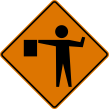
- A pedestrian crossing where the flag marks a school route
- A detour that sends all traffic onto a gravel side road
- Stopping for a flagger who is directing traffic ahead
- The end of the work zone where normal speed resumes
Show answer
Stopping for a flagger who is directing traffic ahead. A flagger can stop your lane completely while opposing traffic uses the single open path, so the warning exists to prevent a fast arrival at a standing queue. It is not a school crossing marker, a detour order, or permission to speed back up. Slow early, watch for brake lights ahead, and stop where the flagger directs. Proceed only on a clear signal and at the pace the open lane safely allows.
19. What colors does Alaska use for guide signs that give destinations and route guidance?
- Black lettering on a yellow background
- White lettering on a green background
- Black lettering on an orange background
- White lettering on a blue background
Show answer
White lettering on a green background. Route and destination guidance comes on signs with white lettering over green. That pairing helps a driver separate guidance from warnings, work messages, and service messages at a glance. Yellow with black lettering warns of conditions ahead, orange with black lettering covers work areas, and blue with white lettering points to services. When you need a place name, a route marker, or mileage, look for the green background and read it early enough to choose your lane calmly.
Study this in the handbook: Road signs by color and shape
20. A guest at your Alaska home has four drinks during an evening visit and asks when the alcohol will wear off. About how long does it take?
- About four hours for the body to cancel the effects of four drinks
- About one hour, because each drink clears while the next is poured
- About thirty minutes once coffee and food have been served
- About eight hours regardless of how many drinks were taken
Show answer
About four hours for the body to cancel the effects of four drinks. The body clears alcohol at a pace drinks cannot hurry, roughly an hour per drink in the manual accounting, so four drinks need about four hours to cancel their effects. Coffee, food, and feeling alert do not compress that schedule, and pouring the next drink does not mean the previous one finished clearing. Count drinks, count hours from the last drink with margin, and keep the guest off the road until both counts honestly agree.
Study this in the handbook: Alcohol, implied consent and under 21 rules
Every question is written from the official Alaska Driver Manual. Need paper? Printable AK practice test with answer key.
Last verified 2026-10-05. How we check every question · Study all 500 as flashcards
Frequently asked questions
How many questions are on this Alaska practice test?
This fixed set has 20 questions. It is test 11 of 25 from the 500 question Alaska bank. The real AK exam asks 20 questions and you need 16 correct.
What is the passing score for the real Alaska test?
16 correct answers to pass (80%) That figure comes from the official Alaska source cited on the DMV facts page.
How does this fixed test relate to the full Alaska bank?
Each numbered test is a fixed set of questions in a fixed order, so you can retake the same test later and compare. Every test mixes road signs and the other topics in about the same proportion as the full bank. Tests 1 to 25 together cover every question in the Alaska bank once. The full practice page mixes the whole bank at random.
Last verified 2026-10-05. See the Alaska DMV facts page for sourced state details.