
Test 23 of 25 · 20 questions · Free 2026
AK Permit Practice Test 23
Jump to the test ↓A fixed 20 question set from the Alaska bank with answers and plain English explanations. The real AK exam is 20 questions, 80 percent to pass; take the full length version on the main practice page.
Question 1 of 20 · 0 right so far
All 20 questions in test 23
Every question below comes from the Alaska question bank on this page. Open a question to see the correct answer and the explanation. Nothing here is hidden behind a signup.
1. You settle in behind the same vehicle for mile after mile on an Alaska highway without passing or changing lanes. What risk grows?
- Your tires lose grip because steady following overheats them
- Long following breeds complacency and you stop treating it as a danger
- The driver ahead must legally pull over after ten minutes together
- Your fuel use rises until the engine begins to stall
Show answer
Long following breeds complacency and you stop treating it as a danger. Familiarity dulls attention, and a vehicle you have followed uneventfully for miles stops registering as something that could brake, swerve, or shed debris. That complacency delays your reaction when the routine finally breaks. Tire heat, a timed pull over rule, and fuel starvation are not the mechanism at work. Break the pattern by refreshing your gap, scanning beyond the lead vehicle, and passing or changing lanes when a safe opportunity serves your route.
2. In Alaska, how close may you park to the entrance of a fire station?
- No closer than 15 feet from that entrance
- No closer than 30 feet from that entrance
- No closer than 20 feet from that entrance
- No closer than 50 feet from that entrance
Show answer
No closer than 20 feet from that entrance. Fire apparatus must swing out of the station without threading between parked vehicles, so the entrance keeps a clear margin on the street. That margin matches the crosswalk figure, sits above the hydrant figure, and sits below the stop sign and railroad figures. Blocking even part of the entrance delays a response where seconds decide outcomes. Park beyond the stated distance from the driveway apron, check for station doors and warning devices, and leave the whole exit path visibly open before you walk away.
3. In Alaska, what danger does combining alcohol with other drugs create for highway safety?
- Combinations always cancel each other out safely
- Only illegal combinations endanger highway safety
- The combination can exceed the danger of either alcohol or drugs alone
- Combinations matter only for passengers, never drivers
Show answer
The combination can exceed the danger of either alcohol or drugs alone. Alcohol depresses judgment and reflexes while many other drugs sedate, stimulate, or distort perception on their own tracks, and together those tracks multiply confusion faster than either substance predicts alone. Cancellation is pharmacological fantasy, legality does not tame the interaction, and passengers are not the people steering through it. Read every medicine label for alcohol warnings, tell prescribers about drinking honestly, and treat any combination as a complete bar to driving even when each part alone felt familiar or mild during past use.
Study this in the handbook: Alcohol, implied consent and under 21 rules
4. On a long Alaska highway drive at steady speed, what habit helps prevent monotony and road hypnosis?
- Vary speed from time to time within legal and safe limits
- Hold one exact speed without change for hours
- Stare at one point ahead to rest the eyes
- Drive faster than surrounding traffic to stay engaged with the road
Show answer
Vary speed from time to time within legal and safe limits. Long steady travel dulls alertness until the road seems to drive itself, a state that leaves a driver slow to notice braking, drifting, or animals ahead. Small lawful changes in speed from time to time refresh attention and break that trance. Holding one exact pace for hours deepens the dullness, fixing the eyes removes the scanning that spots hazards, and switching lights off trades a false refresh for real danger. Pair speed variation with mirror checks, eye movement, and regular breaks out of the vehicle.
Study this in the handbook: Turn signals and pavement markings
5. People are hurt in your Alaska crash and help has been called. Which care does the handbook direct while you wait?
- Move injured people to the nearest building whatever their injuries
- Give injured people food and drink to keep their strength up
- Leave injured people unmoved unless needed, stop serious bleeding, keep them warm
- Have injured people walk to your vehicle to stay out of weather
Show answer
Leave injured people unmoved unless needed, stop serious bleeding, keep them warm. Crash injuries punish well meant handling: moving a person can turn a stable fracture or spinal injury into permanent harm. The directed care is conservative: leave injured people unmoved unless danger forces it, control serious bleeding, keep them warm, and have an ambulance called. Food, drink, building transfers, and walking to shelter all risk worsening hidden injuries. Stay with them, talk calmly, and hand over to medical help the moment it arrives.
Study this in the handbook: Vision, insurance and the point system
6. In Alaska, when is backing on a controlled access highway or its ramps allowed?
- Only when directed by police, fire, or construction flag personnel
- Whenever traffic using the controlled highway happens to look light at the time
- To drive backward one exit ramp in order to recover a freeway exit you missed
- Whenever your vehicle hazard warning flashers have been switched on beforehand
Show answer
Only when directed by police, fire, or construction flag personnel. Freeway traffic arrives at speeds that turn a backing vehicle into a stationary obstacle, so the maneuver is banned on the controlled highway and on its entrance and exit ramps alike. Only direction from police, fire, or construction flag personnel, who can protect the movement, lifts that ban. Light traffic, missed exits, and hazard lamps each tempt exceptions the rule refuses. Continue to the next exit for every routing mistake, and back on freeways only under the shield of authorized direction at the scene.
Study this in the handbook: School buses, passing and railroad crossings
7. You are in a lane with a sign showing only a left turning arrow for that lane in Alaska. What movement must you make from it?
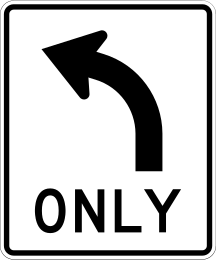
- Go straight if the lane beside you is empty at the moment
- Turn right across the other lanes when a gap appears
- Back up and change into a through lane behind traffic
- Make a left turn from that lane when the signal allows
Show answer
Make a left turn from that lane when the signal allows. Lane control signs assign each lane a movement so turning and through traffic do not cross paths unexpectedly. A left only lane commits you to that turn, even when a gap tempts you straight or right. Backing to change lanes in moving traffic is more dangerous than completing the turn and circling back. Signal, turn when the indication allows, and rejoin your route afterward. Other drivers plan around the movement your lane promises.
Study this in the handbook: Road signs by color and shape
8. A yellow diamond ahead warns of a rough merge and narrowing lanes on an Alaska road in winter darkness. What is it alerting you to?
- A detour that leaves the highway at the next exit ramp
- Actual or potentially dangerous conditions ahead of you
- A service area with fuel and food at the next interchange
- The end of state maintenance for the winter season
Show answer
Actual or potentially dangerous conditions ahead of you. Warning signs exist to alert drivers to actual or potentially dangerous conditions ahead, giving time to slow, reposition, and prepare before the hazard arrives. Detours, services, and maintenance season notices each use different signing and colors. Reading the yellow diamond as advance notice rather than information trivia is the habit that matters. Lift off the speed early, scan for the specific condition named or pictured, and be ready for the road to demand a stop or lane change.
Study this in the handbook: Road signs by color and shape
9. In Alaska, you start your vehicle inside a closed garage to warm it up. What does the handbook say about this?
- It is safe if the garage door is opened after the first few minutes of warming
- Never run a vehicle in a closed garage
- It is safe when the vehicle windows are left fully open
- It is safe if you stay inside the vehicle the whole time
Show answer
Never run a vehicle in a closed garage. Exhaust carries carbon monoxide, a colorless and odorless poisonous gas that can make a driver dangerous and can cost a life, and a closed garage traps that gas around the running vehicle from the first minute. The rule admits no warming exception, window arrangement, or waiting strategy inside the space. Start the vehicle and move it out into open air promptly, or leave it off until you are ready to depart. Keep the exhaust system tight and fresh air moving through the cabin on every drive.
Study this in the handbook: Required equipment and maintenance
10. You miss your Alaska freeway exit while traveling at speed. What must you do?
- Back up on the shoulder to the missed exit
- Stop and wait for a gap to cross to the exit
- Go to the next exit without backing up
- Turn across the median to return at once
Show answer
Go to the next exit without backing up. A missed exit costs minutes, while recovering it by backing, stopping, or crossing the median risks lives at freeway closing speeds. Continuing to the next exit keeps you inside the flow every other driver predicts. Shoulder backing still travels against the stream expectation, a stopped vehicle waiting to cross becomes an obstacle, and median turns are reserved for authorized vehicles. Ride to the next interchange, exit lawfully, and re-enter toward your destination with the small delay accepted as the price of a safe mistake.
Study this in the handbook: School buses, passing and railroad crossings
11. Rain and fog shrink your view and loosen tire grip on an Alaska highway that is posted for faster travel. What speed does the law require now?
- Careful, prudent speed matched to weather that cuts sight and grip
- The posted maximum, because the limit already allows for bad weather
- Five miles per hour under the slowest vehicle traveling ahead of you
- Any speed that keeps pace with traffic, even when visibility drops
Show answer
Careful, prudent speed matched to weather that cuts sight and grip. Limits are set for favorable conditions, and rain or fog takes those conditions away. The lawful response is a careful and prudent speed fitted to how far you can see and how well tires grip, even when that pace falls well below the posted figure. Chasing the maximum, copying a neighbor, or flowing with traffic all ignore the shortened stopping distance in front of you. Slow early, add following room, and let visibility set your speed.
Study this in the handbook: Speed laws and impact
12. In Alaska, another driver begins passing you. What does the law forbid you to do?
- Increase your speed while being passed
- Hold your speed steady until the pass ends
- Move right slightly when safe to help
- Check mirrors to follow the passing vehicle
Show answer
Increase your speed while being passed. Speeding up while another driver occupies the opposing lane stretches that driver exposure to oncoming traffic and can trap both vehicles side by side when a vehicle appears ahead. The lawful and courteous response holds speed steady, eases right where safe, and keeps the passer progress predictable through mirrors. Racing converts a routine pass into a contest nobody can safely win. Let the maneuver complete in the space its driver planned, and resume normal speed judgments only after the vehicle has returned ahead of you or fallen behind.
Study this in the handbook: Turn signals and pavement markings
13. In Alaska, you are involved in a crash and your vehicle blocks traffic. What must you do first?
- Drive to the nearest police station to report it
- Keep driving slowly until traffic clears behind you
- Leave the vehicle blocking while you call for help
- Stop at once and move the vehicle out of the way if possible
Show answer
Stop at once and move the vehicle out of the way if possible. The first duty after any crash is to stop, because moving onward abandons people who may be hurt and duties the law attaches to the scene. If the vehicle blocks traffic and can move, easing it out of the way prevents the second collision that turns one crash into several. Reporting, calling, and exchanging details all follow once vehicles and people are as safe as the scene allows. Set warnings where you can without stepping into traffic, then work through help and information in order.
Study this in the handbook: Vision, insurance and the point system
14. A large truck ahead of you is turning right at an Alaska intersection. What trap must car drivers avoid?
- Waiting patiently behind the truck until its wide turning maneuver finishes completely
- Getting between the truck and the curb, where you can be caught in a squeeze
- Giving the wide turning truck some extra maneuvering room on its left side
- Watching the turn signals of the truck carefully before making any move
Show answer
Getting between the truck and the curb, where you can be caught in a squeeze. A long trailer cuts inside the path of its cab, so space that looks open beside a turning truck shrinks as the trailer sweeps toward the curb. A car that fills that space gets squeezed between steel and concrete with no exit. Waiting behind, granting room, and reading signals are the protective habits rather than traps. Hold back whenever a truck signals or swings wide for a right turn, and never accept the curb side invitation its wide swing appears to offer.
Study this in the handbook: Following distance and large trucks
15. You haul brush and loose boxes toward an Alaska dump run on public roads with an open pickup bed. What does the law require?
- The load may not travel unsecured on Alaska public roads
- Loose loads are allowed when you drive below forty miles per hour
- A passenger must ride in back holding the load in place
- Only loads extending past the bed need any securing at all
Show answer
The load may not travel unsecured on Alaska public roads. Debris falling from vehicles becomes a swerving hazard for everyone behind, so loads may not travel unsecured on Alaska roads. Slow driving cannot promise a box will stay put, a passenger in the bed is endangered rather than helpful, and items inside bed walls still escape over bumps and wind. Tie, tarp, or contain every load before leaving, and check the securing again whenever the road roughens or speed rises.
16. In Alaska, lane signals over a reversible lane are not lit at all. What must you do about that lane?
- Enter it because dark signals mean either direction may use it
- Enter it only in the direction of heavier traffic
- Use it as a left turn lane until signals light up
- Do not enter the lane while its signals are dark
Show answer
Do not enter the lane while its signals are dark. A reversible lane belongs to a direction only as its overhead signal permits. When no signal is illuminated, no direction has been granted the lane, so entering it gambles on opposing traffic receiving it at the same time. Heavier flow does not assign the lane, and borrowing it for left turns invents a use the signals never granted. Stay in lanes with a permitted indication, and enter the reversible lane only when the signal over it allows your travel.
Study this in the handbook: Traffic signals and lane control signals
17. In Alaska, when must a pedestrian refuse to start crossing on a green light?
- When any motor vehicle happens to be waiting at the far curb of the crossing street ahead
- When the green light for traffic has only just turned on at the crossing street
- When another pedestrian nearby is crossing the same street at a slower walking pace
- When the green is stale and about to run out, or a steady or flashing hand signal shows
Show answer
When the green is stale and about to run out, or a steady or flashing hand signal shows. A green that has been showing for a while can end while you are still mid street, trapping you as cross traffic starts. A steady or flashing hand carries the same warning not to begin. Starting then gambles that drivers will wait beyond their signal. A vehicle waiting at the curb, a fresh green, and a slower fellow walker do not by themselves bar a lawful start made with the walk indication. Check the pedestrian signal first, judge the width honestly, and begin only with time to finish.
Study this in the handbook: Pedestrians, bicyclists and motorcyclists
18. In Alaska, a motorcycle rides on one side of a wide lane. May you move your car into that same lane beside it?
- Yes, whenever the lane is wide enough for both vehicles
- Yes, if you sound the horn before moving beside the motorcycle
- No, a motorcycle needs a full lane width like other vehicles
- Yes, provided you stay on the opposite side of the lane from the rider at all times
Show answer
No, a motorcycle needs a full lane width like other vehicles. A skilled rider constantly changes position within the lane to see and be seen and to avoid objects on the road, so the space beside the motorcycle is working room rather than spare pavement. Moving into the same lane is not only illegal but extremely hazardous, even when the lane is wide and the rider hugs one side. Treat the motorcycle as a full vehicle occupying its whole lane: wait behind it, or pass only by changing completely into another lane with the usual checks, signal, and clearance before returning.
Study this in the handbook: Pedestrians, bicyclists and motorcyclists
19. In Alaska, a steady green arrow points down over a reversible lane. What does it allow?
- Travel only after the arrow changes to yellow X
- Travel in the lane below the arrow
- Use of the lane by opposing traffic at the same time
- Parking in the lane when traffic is light
Show answer
Travel in the lane below the arrow. A downward green arrow grants travel in the lane beneath it. Waiting for a yellow X reverses the sequence, since yellow warns that permission is ending. Opposing traffic cannot share the granted lane at the same time, and light traffic never turns a travel lane into parking space. Enter or stay in the lane only while the green arrow serves your direction, and leave it in an orderly way when the indication changes toward yellow and red.
Study this in the handbook: Traffic signals and lane control signals
20. In Alaska, one deer crosses ahead of you and the road looks clear again. What danger remains?
- The animal that crossed will reverse back across the road at once every time
- Following animals never cross the road after the first animal has crossed it
- Only very young fawns ever cross after an adult deer has led the way over
- Other deer or moose may follow, because they often travel in pairs or groups
Show answer
Other deer or moose may follow, because they often travel in pairs or groups. Herd animals read safety from the animal ahead of them, so the first crossing often trails a second and third through the same gap seconds later. Clearing your path of the leader therefore opens the moment of greatest temptation and greatest risk at once. Reversal by the same animal is possible yet secondary, and neither age nor a lonely appearance cancels the group habit. Hold your slower speed well past the crossing point, scan both ditches for movement, and resume pace only when the herd has plainly finished crossing.
Study this in the handbook: Night driving, lighting, weather and animals
Every question is written from the official Alaska Driver Manual. Need paper? Printable AK practice test with answer key.
Last verified 2026-10-05. How we check every question · Study all 500 as flashcards
Frequently asked questions
How many questions are on this Alaska practice test?
This fixed set has 20 questions. It is test 23 of 25 from the 500 question Alaska bank. The real AK exam asks 20 questions and you need 16 correct.
What is the passing score for the real Alaska test?
16 correct answers to pass (80%) That figure comes from the official Alaska source cited on the DMV facts page.
How does this fixed test relate to the full Alaska bank?
Each numbered test is a fixed set of questions in a fixed order, so you can retake the same test later and compare. Every test mixes road signs and the other topics in about the same proportion as the full bank. Tests 1 to 25 together cover every question in the Alaska bank once. The full practice page mixes the whole bank at random.
Last verified 2026-10-05. See the Alaska DMV facts page for sourced state details.