
Test 8 of 10 · 20 questions · Free 2026
AK Permit Practice Test 8
Jump to the test ↓A fixed 20 question set from the Alaska bank with answers and plain English explanations. The real AK exam is 20 questions, 80 percent to pass; take the full length version on the main practice page.
Question 1 of 20 · 0 right so far
All 20 questions in test 8
Every question below comes from the Alaska question bank on this page. Open a question to see the correct answer and the explanation. Nothing here is hidden behind a signup.
1. What speed principle applies when an Alaska driver cannot stop within the clear distance ahead?
- The driver must not drive faster than allows a stop within that distance
- The driver may continue if the headlights reach the next hill
- The driver may exceed the limit until another vehicle appears
- The driver should close the gap to the vehicle ahead
Show answer
The driver must not drive faster than allows a stop within that distance. Alaska's assured-clear-distance rule ties speed to the space the driver can see and safely use for stopping. If the vehicle cannot stop within that clear distance, speed is too high even when the posted limit has not been exceeded. Headlight reach and the presence of another vehicle do not create permission to outrun visibility. Increase the visible stopping space or reduce speed, especially around darkness, curves, hills, and weather that shorten the view. The cue is stop within what you can see.
Study this in the handbook: Speed laws and impact
2. After entering an Alaska roundabout, what should a driver do while traveling inside the circle?
- Stop in the circle whenever another vehicle approaches
- Continue through without stopping and follow lane directions
- Reverse toward the previous entrance if the exit is missed
- Drive clockwise around the center island
Show answer
Continue through without stopping and follow lane directions. Once inside an Alaska roundabout, the driver should keep moving and follow the instructions shown by signs or pavement markings. Stopping within the circle interrupts the circulating flow, and reversing toward an entrance creates an especially dangerous conflict. Traffic travels counterclockwise, so the clockwise option is opposite the design. If an exit is missed, the driver may continue around and try again. Slow before entry, yield at the approach, choose the proper lane, then maintain a steady path through the circle.
Study this in the handbook: Intersections, right of way and roundabouts
3. What following interval does Alaska recommend when towing a trailer or driving on a wet or slippery road?
- One second, because the trailer slows the vehicle
- Six seconds or more
- Two seconds in every condition
- Four seconds only when traffic is stopped
Show answer
Six seconds or more. The four-second method becomes six seconds or more when a driver is towing a trailer or the road surface is wet or slippery. Those conditions increase the time and distance needed to respond, so retaining the ordinary four-second gap is not enough for the recommendation. The two-second figure is a regulatory minimum noted elsewhere, not this expanded safety interval. Choose a fixed point, count the interval after the vehicle ahead passes it, and add space whenever traction or vehicle length raises the stopping demand.
Study this in the handbook: Following distance and large trucks
4. What can unsafe driving around an emergency vehicle cause?
- A waiver of all traffic rules near the scene
- A longer green signal at the next intersection
- Permission to follow the emergency vehicle closely
- A crash, personal injury, and citations
Show answer
A crash, personal injury, and citations. The manual warns that failure to vacate the lane or unsafe driving around emergency vehicles can lead to a crash, personal injury, and citations. This warning applies even when a driver is trying to get past the scene quickly. A traffic signal does not change the risk, and drivers never gain permission to follow closely or ignore other rules. Slow down, create space, and obey directions from the emergency response area. The practical cue is to treat the scene as a protected work zone and avoid abrupt movements.
Study this in the handbook: Emergency vehicles and the Move Over law
5. Where must an Alaska driver stop at a stop sign?
- After entering the intersection to improve visibility
- Behind the crosswalk, stop line, or intersecting roadway shoulder line
- Only beside the sign post
- Anywhere within the nearest travel lane
Show answer
Behind the crosswalk, stop line, or intersecting roadway shoulder line. The stop-sign rule places the vehicle behind the crosswalk, at the painted stop line, or, if neither exists, behind the shoulder line of the intersecting roadway. After stopping there, the driver yields to pedestrians, bicyclists when present, and traffic before entering. Stopping after entering the intersection can put the vehicle into the path of people or cross traffic. Locate the first applicable stopping reference before reaching the junction, make a complete stop, and then check both directions before proceeding.
Study this in the handbook: School buses, passing and railroad crossings
6. What does the Alaska manual say a tight fuel cap can save a driver?
- About $120 per year, since loose or missing caps let 147 million gallons evaporate annually
- Nothing measurable
- About $1,000 per year
- About $5 per year
Show answer
About $120 per year, since loose or missing caps let 147 million gallons evaporate annually. Loose, damaged or missing fuel tank caps cause 147 million gallons of fuel to evaporate each year, and making sure the cap is tight can save about $120 per year. The same smart driving section notes that underinflated tires wasted 1.2 billion gallons of fuel in 2005, that cruise control over 10,000 miles saves more than 60 gallons, and that tire rotation adds up to 10,000 miles of tire life.
Study this in the handbook: Required equipment and maintenance
7. What must a driver do at an uncontrolled intersection in Alaska?
- Accelerate before crossing the side road
- Maintain speed because no sign assigns a limit
- Stop only when another driver waves
- Slow down and have the vehicle under control
Show answer
Slow down and have the vehicle under control. At an uncontrolled intersection, Alaska requires the driver to slow down and have the vehicle under control at the cross street or crossroad. The absence of a stop or yield sign does not remove that duty. The driver approaching from the right must also slow and remain in control, rather than assume automatic priority. Look for the crossroad and unmarked crosswalk, reduce speed early, and be ready to stop for other road users.
Study this in the handbook: Intersections, right of way and roundabouts
8. Which passenger is specifically allowed without a parent in an Alaska provisional license holder's vehicle?
- A sibling
- Any classmate under 21
- A friend from work under 21
- No passenger under 21 in any circumstance
Show answer
A sibling. During the provisional period, a sibling may ride without a parent in the vehicle. The rule otherwise limits passengers unless a parent, legal guardian, or qualifying adult at least 21 is present. The classmate and coworker choices invent relationship exceptions that the manual does not list. The absolute prohibition is also too broad because siblings are expressly identified as an exception. A useful test cue is to distinguish the sibling exception from the separate requirement about a supervising adult, since those provisions address different passenger situations.
Study this in the handbook: Instruction permits and provisional licenses
9. How many points does Alaska assign to a minor operating a vehicle after consuming alcohol?
- 2
- 6
- 4
- 10
Show answer
6. Minor operating after consuming carries 6 points on the Alaska point schedule, while adult driving under the influence carries 10. It also brings an administrative revocation (30 days for a first offense) and, as an infraction, court-ordered community service and/or a fine up to $1,000. The 2 and 4 point choices belong to less serious moving violations such as following too close or other moving violations.
10. Which court conviction requires revocation of Alaska driving privileges?
- An expired registration
- A single speeding ticket
- Reckless driving
- A parking violation
Show answer
Reckless driving. Alaska must revoke driving privileges for court convictions including DUI or chemical test refusal, driving while license is cancelled, suspended, or revoked, reckless driving, failing to stop and render aid at an injury crash, perjury to the department, unlawful flight to avoid arrest, and vehicle felonies such as manslaughter or assault with a vehicle. A single speeding ticket, an expired registration, or a parking violation is not on that list.
Study this in the handbook: Speed laws and impact
11. Who may supervise a person driving under an Alaska instruction permit?
- Only a driving school instructor may supervise
- Any licensed driver at least 18 with six months of experience
- A licensed driver at least 25 with two years of experience
- A licensed driver at least 21 with at least one year driving the same vehicle type
Show answer
A licensed driver at least 21 with at least one year driving the same vehicle type. The supervising person must be licensed, at least 21 years old, and have at least one year of driving experience with the same type or class of vehicle. The six month option lowers both the age and experience requirement, while the older supervisor option adds requirements that Alaska does not impose. The manual does not limit supervision to a driving school instructor; any licensed driver who meets the age and experience rule qualifies. For a passenger vehicle, the supervisor also sits beside the learner. Connect the age and one year requirement to the vehicle being driven.
Study this in the handbook: Instruction permits and provisional licenses
12. In an unposted Alaska residential district, what default speed limit applies?
- 55 mph
- 15 mph
- 20 mph
- 25 mph
Show answer
25 mph. Alaska lists 25 mph as the default speed for a residential district when no sign establishes another limit. The 15 mph value belongs to an alley, while 20 mph applies to a business district and school zone in the same table. A driver should still lower speed when pedestrians, weather, or visibility require it, because the general speed law calls for a careful and prudent pace. Identify the district first, then verify whether local authorities have posted a change.
Study this in the handbook: Speed laws and impact
13. When must an Alaska crash inside a municipality be reported to local police immediately?
- Only when someone dies
- For any contact between vehicles
- When there is an injury or total property damage of $2,000 or more
- Only when the other driver leaves
Show answer
When there is an injury or total property damage of $2,000 or more. If there is an injury, or total property damage is $2,000 or more, and the crash occurred within a municipality, immediately contact the local police department by dialing 911. Outside a municipality the report goes to the state troopers. A written crash report may also be required, and a certificate of insurance must be filed with the DMV within 15 days for damage of $501 or more.
Study this in the handbook: What to do after a crash
14. What does a STOP AHEAD legend painted on the pavement tell an Alaska driver?
- The roadway becomes a no-passing zone immediately
- The stop sign ahead has been removed from service
- Stopping is forbidden until the next intersection
- A stop sign condition is ahead, so use extreme caution and be prepared to stop
Show answer
A stop sign condition is ahead, so use extreme caution and be prepared to stop. Alaska lists STOP AHEAD, SCHOOL, and R X R as special pavement legends that indicate special conditions to the driver. They are not regulatory, but they are used only where a condition such as a STOP sign, school buildings, or a railroad crossing requires extreme caution. The manual says to pay special heed to these legends and be prepared to stop. The legend does not cancel the sign, forbid stopping, or create a no-passing zone.
Study this in the handbook: Turn signals and pavement markings
15. How much does a copy of an Alaska driving record cost?
- Free
- $50
- $10
- $2
Show answer
$10. For a fee of $10, Alaska will provide a driving record to the driver or to a person the driver designates. The record matters because convictions for moving violations add points, and enough points lead to suspension. When a driver applies for insurance, the application generally contains a statement authorizing the insurance company to receive a copy of the driving record of everyone covered by the policy. A free copy, a $2 charge, or a $50 charge does not match the fee printed in the manual.
Study this in the handbook: Vision, insurance and the point system
16. At a STOP sign, which action is required before entering the intersection?

- Stop only after a pedestrian enters the crosswalk
- Reduce speed and continue if no vehicle is approaching
- Make a complete stop before the intersection or at the stop line, then yield
- Stop beyond the crosswalk so the front wheels can see cross traffic
Show answer
Make a complete stop before the intersection or at the stop line, then yield. A STOP sign requires the vehicle to become fully stationary before the intersection or at the stop line. The driver must stop behind the crosswalk, check both directions for vehicles and pedestrians, and yield the right-of-way. Merely slowing is inadequate, even on an empty street. Stopping past the crosswalk can put the vehicle into the pedestrian path and reduce the view of traffic. Use the stop line as the first stopping point, then proceed only after the intersection is clear.
Study this in the handbook: Road signs by color and shape
17. What court penalty applies in Alaska when a minor is convicted of operating after consuming alcohol?
- Mandatory jail
- The court must order community service and/or a fine up to $1,000
- No court penalty, only DMV action
- A $5,000 fine
Show answer
The court must order community service and/or a fine up to $1,000. A minor operating a vehicle after consuming alcohol, or a minor refusing chemical testing, is an infraction. Upon conviction the court must order community service and/or a fine up to $1,000. Mandatory jail and a $5,000 fine are not listed. The court penalty is separate from, and in addition to, the DMV administrative revocation, which starts at 30 days for a first offense.
Study this in the handbook: Alcohol, implied consent and under 21 rules
18. A vehicle is entering an Alaska roundabout while another vehicle is already circulating. Who has priority?
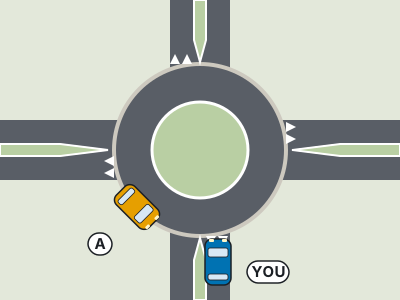
- The vehicle already in the circle
- The vehicle entering from the approach road
- The larger vehicle, regardless of position
- The vehicle that signals first
Show answer
The vehicle already in the circle. Traffic already circulating in the roundabout has priority over a vehicle waiting to enter. The entering driver should slow down, look for a gap, and yield before joining the counterclockwise flow. Stopping inside the circle is not the routine response once entry has occurred, so the approach line is where the decision belongs. A larger vehicle or an early signal does not change the order. The manual adds that if another vehicle arrives at the same time, you yield to the vehicle on your right.
Study this in the handbook: Intersections, right of way and roundabouts
19. Under Alaska's tips for sharing the road with vulnerable road users, what should a driver do when turning or otherwise entering a crosswalk?
- Slow down and be prepared to stop
- Sound the horn so pedestrians leave the crossing
- Pass a vehicle stopped at the crosswalk on either side
- Speed up before pedestrians can reach the roadway
Show answer
Slow down and be prepared to stop. Alaska's safety tips for vulnerable road users tell drivers to slow down and be prepared to stop when turning or otherwise entering a crosswalk. The same list says to establish eye contact and yield to pedestrians in crosswalks, to stop well back so other drivers can see the people crossing, and never to pass vehicles stopped at a crosswalk because someone may be crossing out of view. Sounding the horn or speeding up does not meet the duty to yield.
Study this in the handbook: Pedestrians, bicyclists and motorcyclists
20. What does the five-sided school sign warn drivers to expect?

- A five-lane divided highway beginning ahead
- A hospital entrance where parking is prohibited
- A school area or school crosswalk requiring reduced speed
- A pedestrian-free zone near a sports facility
Show answer
A school area or school crosswalk requiring reduced speed. The five-sided school sign identifies a school area or school crosswalk. The manual associates that setting with reduced speed and tells drivers to prepare to stop for pedestrians. It does not mark a hospital, describe the number of highway lanes, or exclude pedestrians. Children may enter the roadway unexpectedly, so scan beyond the sign and cover the brake. A driver who waits until the crosswalk is occupied may not leave enough room to stop smoothly.
Study this in the handbook: Road signs by color and shape
QualitySpace is expanding to Alaska
We are a California-based independent insurance brokerage working on licensing in more states. We cannot help with Alaska insurance yet. Leave your email and we will let you know when we can.
Every question is written from the official Alaska Driver Manual. Need paper? Printable AK practice test with answer key.
Last verified 2026-10-05. How we check every question · Study all 201 as flashcards
Frequently asked questions
How many questions are on this Alaska practice test?
This fixed set has 20 questions. It is test 8 of 10 from the 201 question Alaska bank. The real AK exam asks 20 questions and you need 16 correct.
What is the passing score for the real Alaska test?
16 correct answers to pass (80%) That figure comes from the official Alaska source cited on the DMV facts page.
How does this fixed test relate to the full Alaska bank?
Each numbered test is a fixed set of questions in a fixed order, so you can retake the same test later and compare. Every test mixes road signs and the other topics in about the same proportion as the full bank. Tests 1 to 10 together cover 200 of the 201 questions in the Alaska bank, each once. The full practice page mixes the whole bank at random.
Last verified 2026-10-05. See the Alaska DMV facts page for sourced state details.