
Test 9 of 10 · 20 questions · Free 2026
AK Permit Practice Test 9
Jump to the test ↓A fixed 20 question set from the Alaska bank with answers and plain English explanations. The real AK exam is 20 questions, 80 percent to pass; take the full length version on the main practice page.
Question 1 of 20 · 0 right so far
All 20 questions in test 9
Every question below comes from the Alaska question bank on this page. Open a question to see the correct answer and the explanation. Nothing here is hidden behind a signup.
1. During what hours may an Alaska provisional license holder generally not drive without a qualifying adult?
- 10:00 pm to 4:00 am
- 11:00 pm to 6:00 am
- 1:00 am to 5:00 am
- Midnight to 7:00 am
Show answer
1:00 am to 5:00 am. The ordinary restricted period is from 1:00 am through 5:00 am unless a parent, legal guardian, or licensed adult at least 21 accompanies the driver. The other time ranges are plausible but do not match Alaska's stated hours. There is also a narrow employment exception when the trip is to or from work, within employment, and follows the most direct route. Remember the exact window as an early morning restriction, and then check whether a listed adult or the employment condition removes the usual limitation.
Study this in the handbook: Instruction permits and provisional licenses
2. What does a steady red X mean above a reversible lane?
- Do not use the lane
- Travel in the lane is permitted
- Clear the lane because a green arrow is next
- Use the lane only to pass
Show answer
Do not use the lane. A steady red X means drivers must not use the reversible lane, while opposing traffic is permitted to use it. A steady green arrow permits travel, and a steady yellow X tells drivers to clear the lane safely because a red X is approaching. The passing choice is also wrong because the signal controls whether the lane may be entered at all. Look overhead before entering a lane that can change direction.
Study this in the handbook: Traffic signals and lane control signals
3. If a tire blows out while driving, what does the Alaska manual advise first?
- Brake hard and turn sharply
- Do not apply the brakes and concentrate on steering
- Accelerate until the tire cools
- Turn off the engine immediately in the travel lane
Show answer
Do not apply the brakes and concentrate on steering. For a tire blowout, the emergency guidance begins with not applying the brakes and concentrating on steering. Then slow down gradually, brake softly, and pull completely off the pavement. Hard braking or a sharp turn can make the vehicle harder to control, while acceleration increases the danger. The cue is smooth control: hold the path, reduce speed progressively, and leave the roadway only when the vehicle is stable.
Study this in the handbook: Vehicle emergencies, skids and stalls on the tracks
4. What minimum liability insurance must an Alaska driver carry?
- $50,000 per person and $100,000 per accident for bodily injury or death, and $25,000 for property damage
- $25,000, $50,000 and $10,000
- $15,000, $30,000 and $5,000
- $100,000 combined single limit
Show answer
$50,000 per person and $100,000 per accident for bodily injury or death, and $25,000 for property damage. The minimum amount of liability insurance coverage in Alaska is $50,000 per person and $100,000 per accident for bodily injury or death, and $25,000 for property damage. If you were uninsured in a crash or fail to provide proof within 15 days, your license is suspended for 90 days for a first occurrence and one year for a second. After a license action, proof of financial responsibility for the future is usually provided through an SR22 insurance filing.
Study this in the handbook: Vision, insurance and the point system
5. What do orange flags and signs indicate in Alaska?
- A railroad crossing that is always closed
- A hospital entrance
- A high hazard area involving maintenance or construction
- A permanent speed increase
Show answer
A high hazard area involving maintenance or construction. Orange flags and signs identify a high hazard area, specifically one associated with maintenance and construction. They are a warning to increase attention and prepare for changed paths, workers, equipment, or unusual traffic movement. The hospital, railroad, and speed choices assign unrelated meanings. When orange is present near a work area, expect guidance devices or a flag person and be ready to slow or stop.
6. What does Alaska's Move Over rule require when an emergency vehicle is on the shoulder?
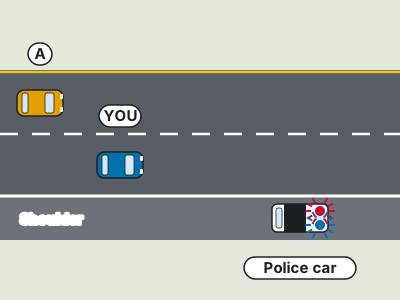
- Stop beside the emergency vehicle and ask whether help is needed
- Give the emergency vehicle additional safety by moving over
- Pass on the shoulder at the posted speed
- Maintain the lane so traffic flow is never interrupted
Show answer
Give the emergency vehicle additional safety by moving over. Alaska directs drivers to give emergency vehicles on the shoulder additional safety by moving over, and the manual labels this as the law. The lane maintenance choice ignores the hazard created by passing traffic close to people and vehicles stopped at the roadside. Move into a neighboring lane when that can be done safely, keep a careful lookout, and avoid making a sudden lane change that creates a second crash risk. The shoulder and flashing emergency lights are the cue to create space early, not to wait until you are alongside the response vehicle.
Study this in the handbook: Speed laws and impact
7. When may an Alaska driver approaching from the right rely on having the right-of-way?
- Whenever the road has no traffic signal
- Whenever the driver reaches the intersection first
- Only when the other driver gives it and no vehicle is already in the intersection
- Any time the driver is traveling on a major highway
Show answer
Only when the other driver gives it and no vehicle is already in the intersection. Being on the right does not make a driver automatically safe to proceed. Alaska says the right-of-way exists only when the other driver gives it and only when another vehicle is not already within the intersection. That language requires observation and cooperation, even at an uncontrolled crossing. Arriving first or traveling on a major road is not enough. Reduce speed, confirm the space is open, and make sure the other driver has actually yielded before moving through.
Study this in the handbook: Intersections, right of way and roundabouts
8. What must a driver do if moving to another lane away from an approaching emergency vehicle is not possible?
- Stop in the lane and wait for the emergency vehicle to leave
- Slow to a reasonable speed and drive safely around the scene
- Pass the emergency vehicle at the posted maximum speed
- Drive onto the sidewalk to create more room
Show answer
Slow to a reasonable speed and drive safely around the scene. When a lane change is impossible, or only one lane travels in that direction, the driver must slow to a reasonable speed and pass the scene safely. Waiting in the lane is not the stated default, and the posted maximum may be too fast for the conditions around responders. A sidewalk is not a lawful escape route. First look for a safe lane away from the emergency vehicle. If that cannot be done, reduce speed substantially and leave adequate space while proceeding past the scene.
Study this in the handbook: Emergency vehicles and the Move Over law
9. Which condition requires a driver to choose a careful and prudent speed below the posted maximum?
- A rough, icy, wet, or otherwise low traction road surface
- A clean dry road with light traffic
- A desire to arrive earlier than planned
- A vehicle with a full fuel tank
Show answer
A rough, icy, wet, or otherwise low traction road surface. Alaska's speed limitation law requires a careful and prudent speed when the road surface is rough, icy, wet, or otherwise provides poor traction. The posted maximum applies under favorable conditions and does not guarantee that speed is safe in every circumstance. Light traffic on a dry road does not itself require a reduction, and schedule pressure or fuel level has no role in the rule. Assess traction along with traffic, roadway width, and weather before deciding how fast you can safely travel.
Study this in the handbook: Speed laws and impact
10. Under Alaska's implied consent law, when may officers require a blood or urine sample?
- At any traffic stop
- When you are involved in a crash that causes death or serious physical injury to another person
- Only with your written permission
- Only for commercial drivers
Show answer
When you are involved in a crash that causes death or serious physical injury to another person. Implied consent lets officers require a breath sample after a lawful DUI arrest, and a blood or urine sample for alcohol or controlled substance testing if you are involved in a crash that causes death or serious physical injury to another person. It does not apply at every traffic stop, and it does not depend on written permission or a commercial license. Driving in Alaska is itself the consent.
Study this in the handbook: Alcohol, implied consent and under 21 rules
11. What principle does the Alaska manual give about controlling a vehicle?
- Control yourself before attempting to control the vehicle
- Let anger determine how firmly to steer
- Use speed to force other drivers to react
- Focus on the vehicle and ignore your own condition
Show answer
Control yourself before attempting to control the vehicle. The manual links vehicle control to personal self-control: a driver must manage their own state before trying to manage the vehicle. Anger, panic, or impulsive reactions can turn an ordinary situation into a steering, braking, or judgment error. The other choices encourage emotional driving or pretend that the driver's condition has no effect. Before moving or responding to another road user, settle your attention, keep both the route and surroundings in view, and choose a deliberate maneuver. Calm judgment is part of safe control.
12. A red slash over a left-turn arrow means what?
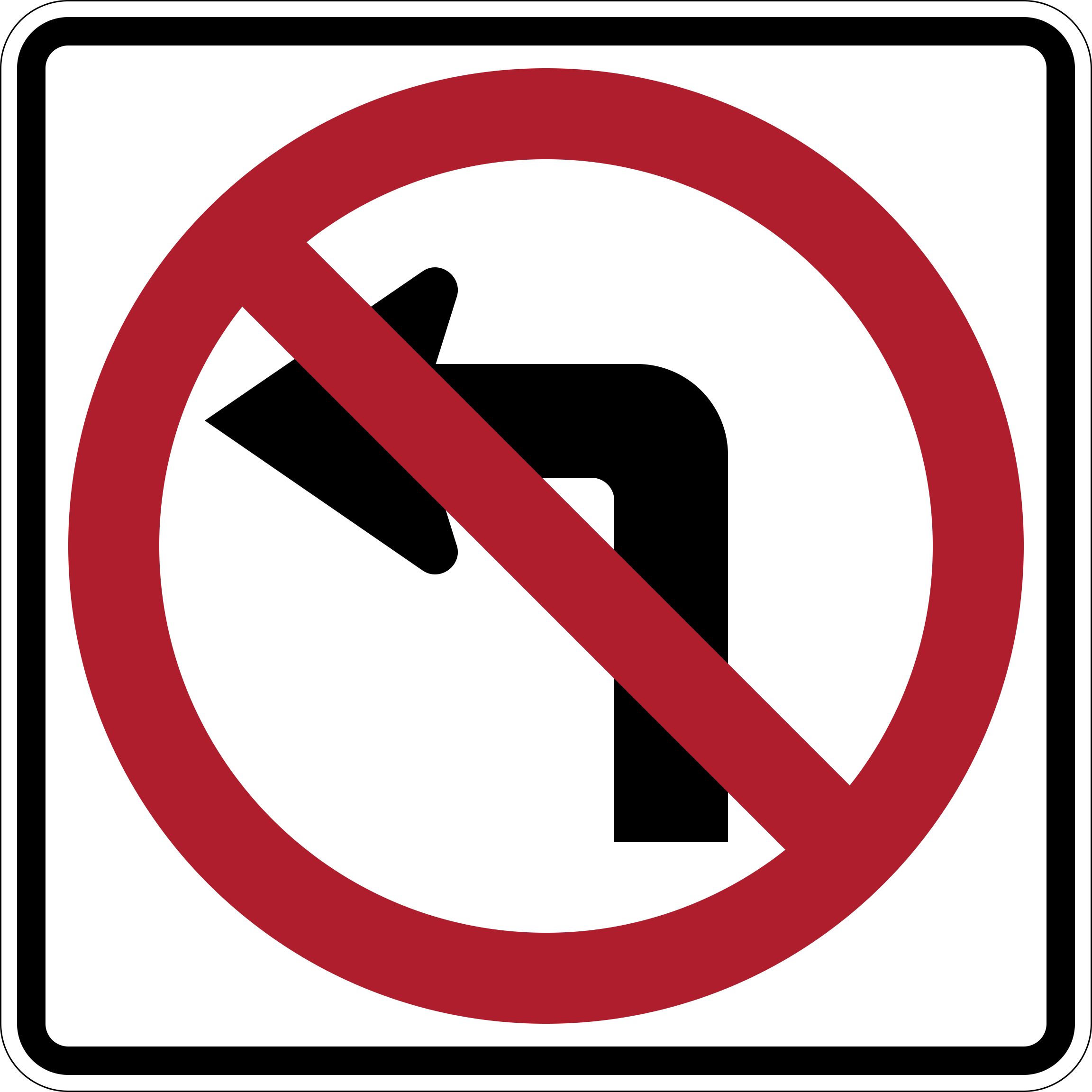
- Left turns are required from every lane
- The pictured left-turn movement is prohibited
- Only U-turns are forbidden at this location
- The road becomes a two-way street after the sign
Show answer
The pictured left-turn movement is prohibited. A red circle and diagonal slash identify the movement shown by the arrow as prohibited. With a left-turn arrow, the restriction applies to making that left turn at the posted location. It does not require left turns, automatically ban U-turns, or change a one-way roadway into a two-way street. The driver should follow the available route and wait for a legal turning point. The visual cue is the arrow itself, since the pictured direction tells you which movement the sign controls.
Study this in the handbook: Road signs by color and shape
13. What should a driver do when approaching the railroad crossbuck shown here?
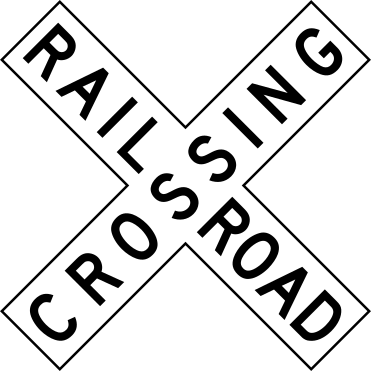
- Shift gears while crossing to clear the tracks faster
- Accelerate because the crossing has priority over trains
- Stop only if a gate is already across the lane
- Be prepared to stop for trains
Show answer
Be prepared to stop for trains. The railroad crossbuck and its warning message tell drivers to prepare for trains. A gate is not the only cue that requires caution, so waiting for a barrier would be too late. Trains cannot stop easily, nor within a short distance, so acceleration does not create a safe crossing. The manual also says never to shift gears on the crossing; with a manual transmission, shift down before the tracks. Slow, look, listen, and make sure the crossing can be cleared before entering it.
Study this in the handbook: School buses, passing and railroad crossings
14. Where should a driver look before backing a vehicle?
- Look forward and use the horn instead of checking behind
- Rely only on the inside mirror
- Open the door and extend the head outside
- Turn the body and head to look through the rear window
Show answer
Turn the body and head to look through the rear window. The manual warns that mirrors alone do not show everything behind a vehicle. Before backing, the driver should turn the body and head to look through the rear window, move slowly, and keep the eyes moving around the vehicle. Opening the door and leaning out is specifically described as dangerous, while a horn cannot reveal a child, pedestrian, or object. Keep the left hand at the top of the wheel and steer in the direction the rear should travel.
15. What share of new cars had antilock brakes as of 2010, according to the Alaska manual?
- About 50 percent
- About 10 percent
- 89 percent of new cars and 99 percent of new light trucks
- None until 2015
Show answer
89 percent of new cars and 99 percent of new light trucks. As of 2010, 89 percent of new cars and 99 percent of new light trucks have antilock brakes. The manual lists this fact alongside a warning never to pump the brakes if your vehicle has antilock brakes. It also notes that at 50 mph a driver travels about 55 feet while reacting, and once the brakes are applied the vehicle may go another 160 feet or more before stopping, so following distance still matters.
Study this in the handbook: Required equipment and maintenance
16. What information do Alaska guide signs provide?
- Only emergency telephone numbers
- Mandatory stop instructions and penalties
- Warnings about all dangerous conditions ahead
- Destination, route guidance, and place names
Show answer
Destination, route guidance, and place names. Guide signs provide destination information, route guidance, and place names. The choice describing mandatory stops belongs to regulatory signs, while warnings about dangerous conditions belong to warning signs. Guide signs help drivers plan their path and judge where an exit or turn leads, so the manual advises paying special attention to mileage information. A green and white guide sign is a planning cue: read it early, confirm the route before changing lanes, and avoid sudden movements caused by waiting until the last moment.
Study this in the handbook: Road signs by color and shape
17. What penalty may an Alaska driver receive for failing to restrain a passenger under 16?
- A fine up to $50 and two demerit points
- License revocation
- A warning only
- A $500 fine
Show answer
A fine up to $50 and two demerit points. A driver may be fined up to $50 and may receive two demerit points on their operator's license for failure to restrain passengers under age 16. A driver may not transport a child under 16 unless the required safety device is provided and each child is properly secured. The American Academy of Pediatrics also recommends the rear seat for all children under 13.
Study this in the handbook: Safety belts and child seats
18. What alcohol concentration triggers Alaska's administrative action threshold for a person operating a commercial motor vehicle?
- .10 or higher
- .08 or higher only
- .04 or higher
- .01 or higher for every driver
Show answer
.04 or higher. The Alaska revocation list uses a lower threshold for a person operating a commercial motor vehicle: .04 or higher after an arrest for driving under the influence. The ordinary .08 figure remains relevant to a general motor vehicle operator, but it is not the only threshold in the manual. This distinction is easy to miss when a question mentions only alcohol concentration. Attach .04 to the commercial vehicle context, and do not apply that number indiscriminately to private passenger driving.
Study this in the handbook: DUI revocations and ignition interlock
19. What maximum speed may be posted on selected Alaska highways?
- There is no posted maximum
- 45 mph only
- 75 mph on every highway
- 65 mph
Show answer
65 mph. Alaska permits selected highways to be posted at 65 mph. This is a posted exception in the speed table, not a command to drive 65 mph everywhere and not proof that every highway has that limit. Conditions still matter, because the manual requires a careful and prudent speed that is reasonable for traffic, surface, width, and weather. Look for the actual sign, then reduce speed whenever conditions make the posted number unsafe.
Study this in the handbook: Speed laws and impact
20. When do Alaska's provisional passenger and hour restrictions NOT apply?
- When the driver is 17
- On weekends
- In the summer months
- With an off system license restricted to areas not connected to the land highway system or to a highway with average daily traffic of 499 or greater
Show answer
With an off system license restricted to areas not connected to the land highway system or to a highway with average daily traffic of 499 or greater. The passenger and hour restrictions do not apply to a provisional holder with an off system license, which is restricted to areas not connected to the land highway system or not connected to a highway with average daily traffic volume of 499 or greater. Age 17, weekends, and summer are not exceptions. Otherwise the restrictions last until age 18 or until the driver completes six conviction free months and removes them at DMV.
Study this in the handbook: Instruction permits and provisional licenses
QualitySpace is expanding to Alaska
We are a California-based independent insurance brokerage working on licensing in more states. We cannot help with Alaska insurance yet. Leave your email and we will let you know when we can.
Every question is written from the official Alaska Driver Manual. Need paper? Printable AK practice test with answer key.
Last verified 2026-10-05. How we check every question · Study all 201 as flashcards
Frequently asked questions
How many questions are on this Alaska practice test?
This fixed set has 20 questions. It is test 9 of 10 from the 201 question Alaska bank. The real AK exam asks 20 questions and you need 16 correct.
What is the passing score for the real Alaska test?
16 correct answers to pass (80%) That figure comes from the official Alaska source cited on the DMV facts page.
How does this fixed test relate to the full Alaska bank?
Each numbered test is a fixed set of questions in a fixed order, so you can retake the same test later and compare. Every test mixes road signs and the other topics in about the same proportion as the full bank. Tests 1 to 10 together cover 200 of the 201 questions in the Alaska bank, each once. The full practice page mixes the whole bank at random.
Last verified 2026-10-05. See the Alaska DMV facts page for sourced state details.