
Test 10 of 10 · 20 questions · Free 2026
AK Permit Practice Test 10
Jump to the test ↓A fixed 20 question set from the Alaska bank with answers and plain English explanations. The real AK exam is 20 questions, 80 percent to pass; take the full length version on the main practice page.
Question 1 of 20 · 0 right so far
All 20 questions in test 10
Every question below comes from the Alaska question bank on this page. Open a question to see the correct answer and the explanation. Nothing here is hidden behind a signup.
1. If the accelerator becomes jammed, which response is listed in the Alaska emergency guidance?
- Release the steering wheel so the vehicle can coast straight
- Turn the ignition key off before controlling the vehicle's direction
- Pump the accelerator until it returns to normal
- Slap the pedal, use the brakes, shift to neutral, and concentrate on steering
Show answer
Slap the pedal, use the brakes, shift to neutral, and concentrate on steering. A jammed accelerator requires the driver to regain control in several linked moves. Slap the pedal hard with the foot, apply the brakes, shift to neutral, and keep attention on steering. The manual's list does not include turning off the ignition, releasing the wheel, or pumping the accelerator, and none of those keeps the vehicle on a safe path. The immediate cue is to separate engine power from the wheels with neutral while using the brakes and maintaining a safe path.
Study this in the handbook: Vehicle emergencies, skids and stalls on the tracks
2. After a full stop at a red traffic signal, when may a driver make a right turn?
- Whenever the vehicle reaches the crosswalk
- When the turn is safe and no No turn on red sign restricts it
- Only after waiting for three light cycles
- Even if pedestrians or cross traffic make it unsafe
Show answer
When the turn is safe and no No turn on red sign restricts it. A right turn on red is permitted only after a full stop, when the turn can be made safely, and when no No turn on red sign prohibits it. Reaching the crosswalk is not the same as stopping before it, and a timed wait is not required. Safety still includes checking pedestrians and cross traffic. The sequence to remember is stop, check for a restriction, yield as needed, then turn only when clear.
Study this in the handbook: Traffic signals and lane control signals
3. What should an Alaska driver do when an animal is walking on or along the highway?
- Swerve toward the animal to make it leave
- Honk continuously and maintain speed
- Exercise care, slow when circumstances require, and be able to stop
- Assume the animal will yield because it is off the pavement
Show answer
Exercise care, slow when circumstances require, and be able to stop. Alaska requires drivers to exercise care around animals, slow when circumstances require, and remain able to stop if necessary. An animal or its handler may move unpredictably, so maintaining speed or swerving toward it can create a collision. Reduce speed early, scan both the roadway and shoulder, and leave room for movement before passing. The important cue is the possibility that the animal may enter the vehicle's path, not whether its feet are currently on the pavement. A controlled stop is safer than a sudden swerve.
Study this in the handbook: Night driving, lighting, weather and animals
4. If moving to the opposite lane is unsafe near a stationary emergency vehicle, how should an Alaska driver pass?
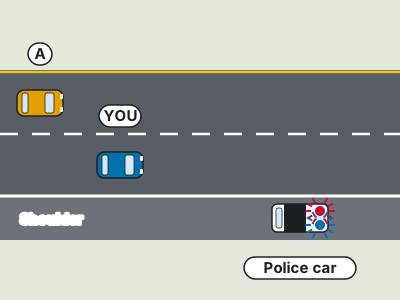
- Slow to a reasonable and prudent speed while passing
- Stop beside the emergency vehicle
- Maintain the posted speed without adjustment
- Use the shoulder regardless of traffic
Show answer
Slow to a reasonable and prudent speed while passing. When moving to the opposite lane is unsafe, or when you are on a two lane road, the manual requires a reasonable and prudent speed while passing the stationary emergency vehicle. The driver should not stop beside responders or assume the posted limit is suitable near people and equipment. The shoulder is not an automatic travel path. Reduce speed early, watch for workers and traffic, and pass with enough control to react to sudden movement. The lane change is preferred when safe, but careful speed is the fallback when it is not.
Study this in the handbook: Emergency vehicles and the Move Over law
5. Under Alaska's following law, what factors must a driver consider before choosing a following distance?
- Speed, traffic, and roadway conditions
- Only the color and model of the vehicle ahead
- The driver's destination and the time of day only
- Whether the following driver is in a hurry
Show answer
Speed, traffic, and roadway conditions. Alaska's following rule uses a reasonable and prudent distance judged with regard to speed, traffic, and roadway conditions. A vehicle's appearance or the driver's schedule cannot safely determine the gap. Watch how quickly the space closes, account for congestion and surface quality, and leave enough room to react. The practical cue is that distance changes with the moving environment rather than staying fixed for every trip.
Study this in the handbook: Following distance and large trucks
6. How often may an Alaska driver take a defensive driving course (DDC) for a point reduction?
- Once every 3 years
- Once every 12 months
- Once in a lifetime
- As often as desired
Show answer
Once every 12 months. Credits may be earned for violation free driving and/or completing a defensive driving course, and a DDC may be taken once every 12 months for a point reduction. The three year, lifetime, and unlimited choices do not match the rule. Separately, a provisional license holder with 6 or more points in 12 months or 9 or more in 24 months must complete a driver improvement course approved by the Division.
Study this in the handbook: Vision, insurance and the point system
7. A 20-year-old passenger in an Alaska car is not wearing a seat belt. Who is issued the citation?
- The driver only
- The passenger
- No one, because adult passengers are exempt
- The vehicle owner
Show answer
The passenger. Alaska law AS 28.05.095 requires everyone in a motor vehicle to use a safety belt. Passengers 18 and older are issued their own citation for failing to wear a seat belt, so the 20-year-old passenger is cited. The driver is responsible for all passengers under the age of 16. Adult passengers are not exempt, and the vehicle owner is not the one cited under this rule.
Study this in the handbook: Safety belts and child seats
8. After a crash in Alaska, an officer with probable cause asks you to blow into a portable preliminary breath tester and you refuse. What is that refusal?
- A felony
- Not an offense
- An infraction
- A misdemeanor with jail
Show answer
An infraction. Alaska's implied consent law lets an officer require a preliminary breath test at the scene if you were in a crash or committed a moving violation and the officer has probable cause to believe alcohol impairs your driving. Refusing the preliminary breath test is an infraction. That is different from refusing the chemical test after a lawful DUI arrest, which can be a misdemeanor or felony. Refusing is still an offense, so the no offense choice is wrong.
Study this in the handbook: Alcohol, implied consent and under 21 rules
9. How does Alaska classify refusing a chemical test after a lawful DUI arrest?
- Always an infraction
- No offense if the driver is sober
- A civil matter only
- A criminal misdemeanor or felony, depending on the number of prior DUI offenses
Show answer
A criminal misdemeanor or felony, depending on the number of prior DUI offenses. Depending on your number of prior DUI offenses, refusing chemical testing after a lawful arrest can be a criminal misdemeanor or felony, and it results in two separate criminal charges, DUI and Refusal, which the court can treat separately. It is not a civil matter only, and the manual lists no exception for a driver who believes they are sober. Refusing the roadside preliminary breath test is the infraction. There is no work purpose driving during a refusal revocation.
Study this in the handbook: Alcohol, implied consent and under 21 rules
10. What should you generally do when you see an Alaska warning sign?

- Observe extra caution and usually reduce speed
- Treat it as a destination marker only
- Ignore it unless a police officer is present
- Accelerate to clear the hazard before it changes
Show answer
Observe extra caution and usually reduce speed. Warning signs identify actual or potentially dangerous conditions ahead, so the useful response is to become more alert and adjust speed to the situation. The choice about treating the sign as a destination marker confuses warning signs with guide signs, which provide route and place information. A yellow diamond may appear before a curve, crossing, or other hazard, and the symbol tells you what to expect. Use the sign as an early cue: scan farther ahead, ease off the accelerator when appropriate, and be ready for a sudden change in traffic or road design.
Study this in the handbook: Road signs by color and shape
11. At what minimum age may a person obtain an Alaska non-commercial instruction permit?
- 16 years
- 15 years
- 14 years
- 18 years
Show answer
14 years. Alaska allows a person who is 14 years of age or older to obtain a non-commercial instruction permit. The permit is for learning to drive, and the learner must be accompanied by a qualified licensed driver while practicing. Sixteen is associated with other licensing milestones, including the possible issue of a provisional Class D license after permit time, but it is not the starting age for this permit. Keep the permit age and the later license stages separate when reviewing the progression.
Study this in the handbook: Instruction permits and provisional licenses
12. At an uncontrolled intersection, what right-of-way protection does Alaska give a non-motorized user?
- The rule applies only inside a marked bicycle lane
- The user must always wait for every vehicle
- The user has priority only after waving to drivers
- The user has right-of-way over motorized vehicles
Show answer
The user has right-of-way over motorized vehicles. At an uncontrolled intersection, Alaska gives a non-motorized user the right-of-way through the crossing over motorized vehicles. A person walking or bicycling does not need to wave, stand in a special lane, or surrender priority to every approaching car. Drivers must slow, watch the crossing, and yield rather than treating the absence of traffic signals as permission to continue. The important cue is the word uncontrolled: the protection still applies where signs and lights do not direct the movement.
Study this in the handbook: Pedestrians, bicyclists and motorcyclists
13. What does a flashing yellow ball signal require?
- Reduce speed, use caution, and yield to pedestrians and vehicles in the intersection
- Stop and remain stopped until a green light appears
- Make the indicated turn without checking traffic
- Treat the signal as permission to speed through
Show answer
Reduce speed, use caution, and yield to pedestrians and vehicles in the intersection. A flashing yellow ball calls for reduced speed and caution, with yielding to pedestrians and vehicles already in the intersection. It does not impose the complete stop required by a flashing red signal, and it does not authorize a hurried movement. The driver must still evaluate the intersection rather than assuming an unqualified green indication. Remember the paired cue: flashing yellow means caution and yielding, while flashing red means stop before proceeding when safe.
Study this in the handbook: Traffic signals and lane control signals
14. What kind of instruction does a regulatory speed sign provide?
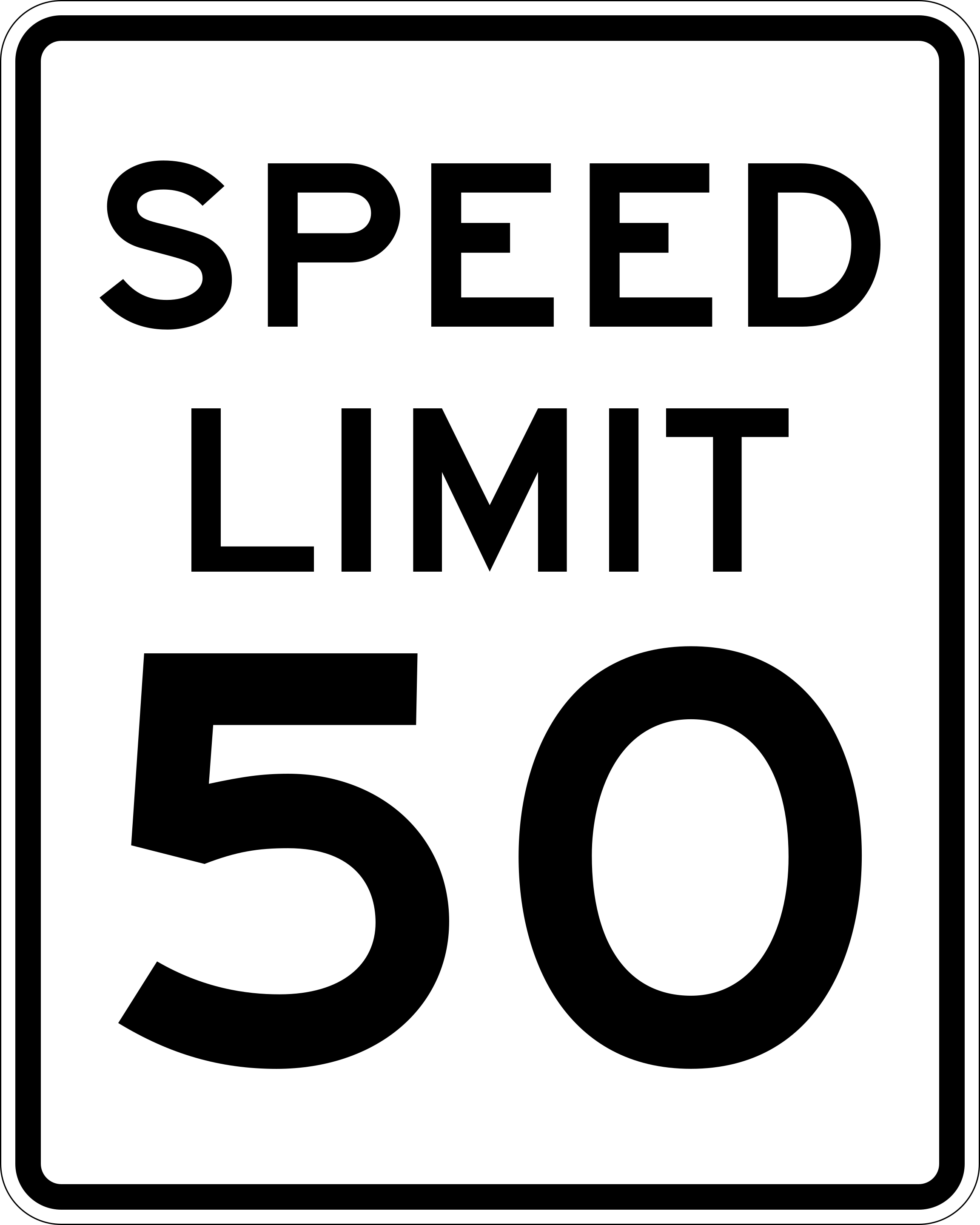
- A legal instruction that must be understood and obeyed
- A suggestion that may be ignored when traffic is light
- A route marker for trucks seeking a different highway
- A warning that applies only during construction
Show answer
A legal instruction that must be understood and obeyed. Regulatory signs communicate instructions backed by state statute, regulation, or local ordinance. A posted speed instruction therefore carries legal force rather than serving as an optional suggestion. Light traffic does not erase the limit, and the sign is not a truck detour or temporary work-zone message unless its separate wording says so. Violating a regulatory instruction can lead to a traffic citation. Treat the black or red wording on white as a rule that governs your driving.
Study this in the handbook: Road signs by color and shape
15. On an unposted Alaska roadway that is not a business district, alley, school zone, or residential district, what is the default speed limit?
- 25 mph
- 55 mph
- 35 mph
- 65 mph in every case
Show answer
55 mph. The Alaska default-speed table assigns 55 mph to any other roadway when no different limit is posted. That category is separate from a residential district, which has a lower default, and from selected highways that may carry a 65 mph sign. A driver cannot treat 65 mph as an automatic statewide limit. First identify the road category and whether a sign changes it. The phrase any other roadway is the study cue for the 55 mph figure.
Study this in the handbook: Speed laws and impact
16. What should a driver do after seeing an Alaska construction and maintenance sign?
- Adjust speed and prepare for special conditions
- Ignore it unless workers are standing in the lane
- Use the sign as permission to pass on the shoulder
- Stop immediately wherever the sign is posted
Show answer
Adjust speed and prepare for special conditions. Construction and maintenance signs identify work in the road or temporary conditions that require special alertness. The manual directs drivers to adjust speed and prepare for those conditions. Waiting until a worker is visibly in the lane can leave too little time to respond to cones, lane shifts, equipment, or a flag person. The sign does not by itself require an immediate stop, and it never authorizes shoulder passing. Reduce speed early, scan beyond the sign, and follow the temporary traffic control.
Study this in the handbook: Road signs by color and shape
17. Who may alter Alaska speed limits under the manual?
- Only an emergency vehicle operator
- Only a driver who has entered the highway
- Only a school crossing guard
- Local authorities or the State Department of Transportation and Public Facilities
Show answer
Local authorities or the State Department of Transportation and Public Facilities. The manual states that local authorities or the State Department of Transportation and Public Facilities may alter speed limits. A driver cannot change a posted limit by choosing a different pace, and a school crossing guard or emergency vehicle operator does not receive that general authority. Drivers must obey the limit displayed for the road while also reducing speed when traffic, surface, width, or weather make the posted maximum unsafe. The agency names in the rule are the key memory cue.
Study this in the handbook: Speed laws and impact
18. What vision must an Alaska applicant have to qualify for a license?
- 20/20 in both eyes
- Any vision with corrective lenses
- 20/70 in one eye
- At least 20/40 in each eye or with both eyes together
Show answer
At least 20/40 in each eye or with both eyes together. To qualify you must have, in each eye or with both eyes together, at least 20/40 vision, with or without corrective lenses. If lenses are needed to reach the standard, you must wear them while driving. A vision test is required before any original, renewal, or duplicate license is issued, and an applicant who cannot qualify is denied until able to meet the standard. A certified statement from a licensed physician or optometrist may be submitted in place of the test.
Study this in the handbook: Vision, insurance and the point system
19. What must a driver do before suddenly stopping or decreasing speed?
- Turn off all vehicle lights
- Signal the intention for the benefit of other drivers
- Move into the left lane without checking
- Accelerate until the road is clear
Show answer
Signal the intention for the benefit of other drivers. A driver should signal an intention before suddenly stopping or reducing speed so other drivers have warning of the change. Turning off lights gives following traffic less information, and moving left without checking adds a lane conflict. Acceleration does not address the risk created by an unexpected slowdown. The practical cue is to communicate before changing speed, scan mirrors for approaching traffic, and brake smoothly whenever conditions allow. Signaling does not replace checking the road, but it gives nearby drivers time to react to the vehicle’s next movement.
Study this in the handbook: Turn signals and pavement markings
20. What movement is a center lane marked for left turns intended to support?
- Temporary parking during congestion
- Passing slower traffic straight ahead
- Left turns only
- Driving straight until the next traffic signal
Show answer
Left turns only. A center lane marked for left turns is a shared turning space, not a travel lane for overtaking or continuing straight. The sign examples in the manual identify the center lane as a place to make left turns. Using it to pass or cruise creates conflict with drivers approaching from the opposite direction who need the same lane to turn. Treat the yellow-lined center area as a short maneuver lane: enter only for the permitted left-turn movement and leave it promptly.
Study this in the handbook: Turn signals and pavement markings
QualitySpace is expanding to Alaska
We are a California-based independent insurance brokerage working on licensing in more states. We cannot help with Alaska insurance yet. Leave your email and we will let you know when we can.
Every question is written from the official Alaska Driver Manual. Need paper? Printable AK practice test with answer key.
Last verified 2026-10-05. How we check every question · Study all 201 as flashcards
Frequently asked questions
How many questions are on this Alaska practice test?
This fixed set has 20 questions. It is test 10 of 10 from the 201 question Alaska bank. The real AK exam asks 20 questions and you need 16 correct.
What is the passing score for the real Alaska test?
16 correct answers to pass (80%) That figure comes from the official Alaska source cited on the DMV facts page.
How does this fixed test relate to the full Alaska bank?
Each numbered test is a fixed set of questions in a fixed order, so you can retake the same test later and compare. Every test mixes road signs and the other topics in about the same proportion as the full bank. Tests 1 to 10 together cover 200 of the 201 questions in the Alaska bank, each once. The full practice page mixes the whole bank at random.
Last verified 2026-10-05. See the Alaska DMV facts page for sourced state details.