
Test 6 of 10 · 20 questions · Free 2026
AK Permit Practice Test 6
Jump to the test ↓A fixed 20 question set from the Alaska bank with answers and plain English explanations. The real AK exam is 20 questions, 80 percent to pass; take the full length version on the main practice page.
Question 1 of 20 · 0 right so far
All 20 questions in test 6
Every question below comes from the Alaska question bank on this page. Open a question to see the correct answer and the explanation. Nothing here is hidden behind a signup.
1. What must a driver do before moving out of an Alaska parking place?
- Back into traffic without signaling
- Sound the horn and move immediately
- Look, signal, and yield the right-of-way
- Wait only for a larger vehicle to pass
Show answer
Look, signal, and yield the right-of-way. Leaving a parking place is a movement into a traffic stream, so the driver must look, signal, and yield the right-of-way. Looking finds approaching road users, signaling communicates the intended movement, and yielding prevents the parked vehicle from forcing traffic to brake. A horn is not a substitute for those checks, and vehicle size does not determine priority. Make the observation before moving, keep the signal on during the maneuver, and enter only when the path is safe.
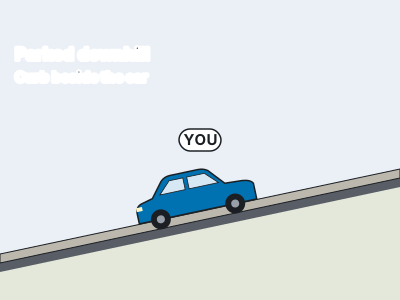
2. When parking downhill beside a curb in Alaska, which way should the front wheels point?
- Straight ahead regardless of the slope
- Away from the curb
- Toward the curb
- Toward the centerline
Show answer
Toward the curb. For downhill parking beside a curb, Alaska directs the driver to turn the front wheels toward the curb. If the vehicle begins to roll, that positioning helps keep it from moving into the traffic lane. The uphill instruction is different: the wheels turn away from the curb. Straight wheels ignore the slope, and turning toward the centerline increases the hazard. Before releasing the brake, check the slope, curb, gear selection, and parking brake together.
3. What does Alaska law presume when a person operates with a breath or blood alcohol concentration of .08 or more?
- The person is presumed to be driving under the influence
- The person receives only a warning
- The person may drive if no crash occurred
- The person is presumed sober until a court hearing
Show answer
The person is presumed to be driving under the influence. At .08 or more, Alaska law presumes the operator is driving under the influence. That presumption is not limited to a crash, and a later court process does not turn the reading into a presumption of sobriety. The warning choice understates the consequence because the manual also describes administrative revocation after a qualifying result. Focus on the threshold written as .08, and do not substitute the lower under 21 alcohol rule or a personal feeling of impairment for the statutory standard described here.
Study this in the handbook: DUI revocations and ignition interlock
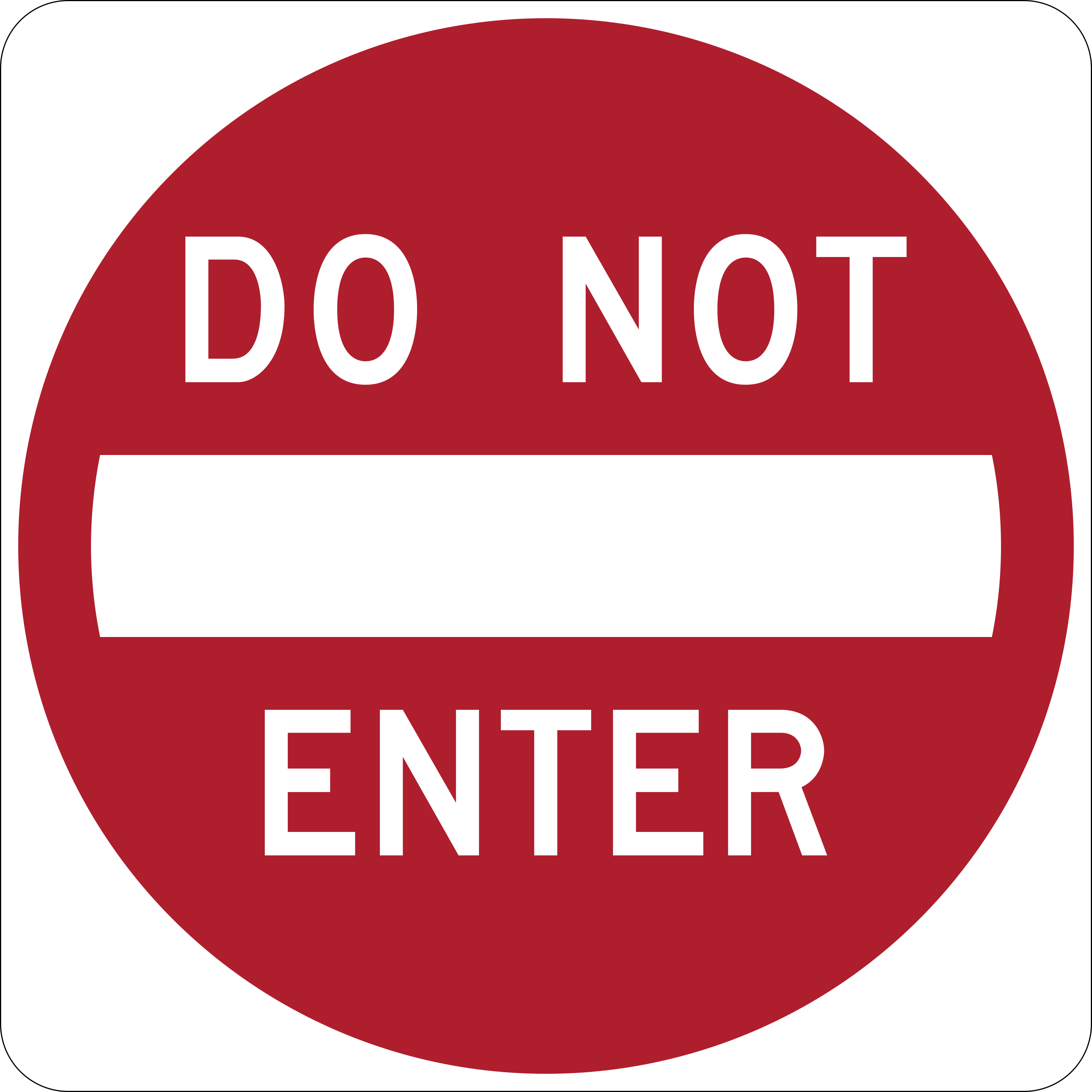
4. What does a red and white DO NOT ENTER sign prohibit?
- Continuing beyond the sign into the roadway or ramp it faces
- Parking within 100 feet of the roadway
- Turning left at the next intersection
- Driving on the roadway only during daylight
Show answer
Continuing beyond the sign into the roadway or ramp it faces. A DO NOT ENTER sign faces traffic that would enter a roadway or ramp in the wrong direction. The driver must not proceed beyond that sign. It is not a parking restriction, a turn instruction, or a time-of-day rule. A WRONG WAY sign may appear farther along the prohibited direction, but seeing that second sign does not make the first one optional. Treat the red and white face as an immediate instruction to keep out.
Study this in the handbook: Road signs by color and shape
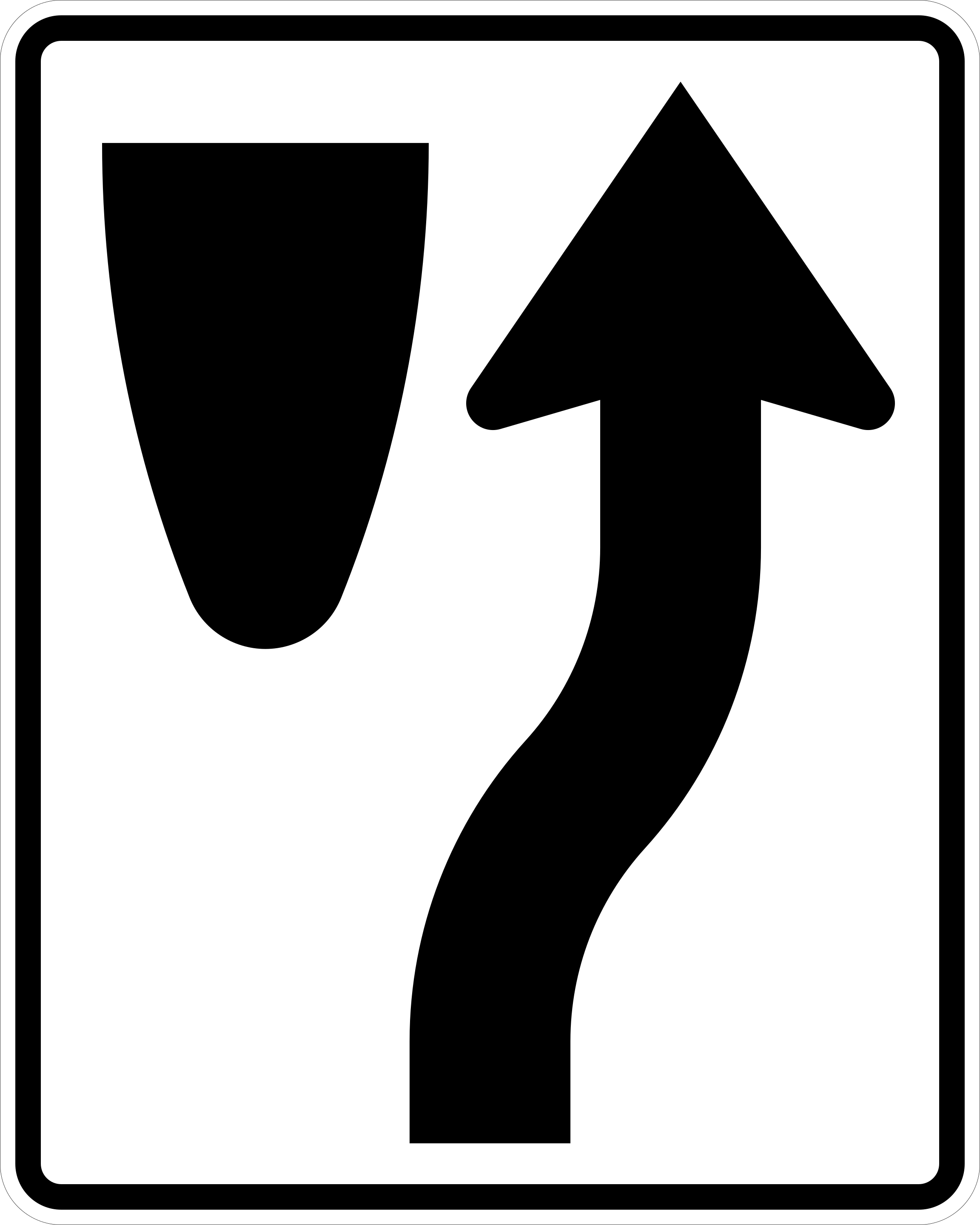
5. What does a KEEP RIGHT sign direct a driver to do?
- Turn right immediately regardless of lane markings
- Use the right lane only when preparing to pass
- Avoid the right side of the roadway until the next signal
- Remain to the right of the sign or the marked obstruction
Show answer
Remain to the right of the sign or the marked obstruction. KEEP RIGHT directs traffic to stay on the right side of the sign or obstruction. The instruction is about passing the object safely, not about reserving the lane for passing or banning the right side. It also does not replace a turn arrow or require an immediate turn. Watch the roadway geometry and keep the vehicle on the indicated side as you go around the divider. A sudden move left could place the vehicle in conflict with opposing traffic.
Study this in the handbook: Road signs by color and shape
6. Under what condition may an Alaska driver drive over a fire hose?
- When no water is flowing
- Whenever the hose is flat
- Only with the consent of a fire department official
- At speeds under 5 mph
Show answer
Only with the consent of a fire department official. Do not drive over a hose of a fire department without the consent of a department official. The manual says driving over any fire hose is not permissible under Alaska law, because damage or injury could occur to you or your vehicle and rescue workers could be endangered. It lists a $100 fine and 2 points for the violation. Also keep at least 500 feet back when following an emergency vehicle that is responding.
Study this in the handbook: Emergency vehicles and the Move Over law
7. During recovery from a skid, in which direction should the front wheels be turned?
- Toward the center line regardless of travel direction
- Straight toward the nearest curb
- Opposite the skid with a sharp steering movement
- In the direction of the skid
Show answer
In the direction of the skid. Skid recovery begins with control and a calm steering response. The manual directs the driver to turn the front wheels in the direction of the skid, then avoid sudden braking, oversteering, and overcorrection. A sharp movement toward a curb or center line can turn a loss of traction into a second hazard. Once grip returns, slow gently by depressing and releasing the brake pedal. Think of the steering wheel as following the slide, not fighting it with an abrupt reversal.
Study this in the handbook: Vehicle emergencies, skids and stalls on the tracks
8. What following rule applies when a driver is close behind another vehicle in Alaska?
- The gap must always be exactly one car length
- The gap must be reasonable and prudent for speed, traffic, and roadway conditions
- A driver may follow closely below 20 mph
- Following distance matters only on two-lane roads
Show answer
The gap must be reasonable and prudent for speed, traffic, and roadway conditions. Alaska requires a following distance that is reasonable and prudent with regard to speed, traffic, and roadway conditions. The manual's rule is flexible because a safe gap changes with weather, surface, congestion, and the time needed to react. One car length is not a universal measure, and low speed does not make tailgating acceptable. Leave enough space for the vehicle ahead to brake without forcing an emergency response. Recheck the gap whenever speed, visibility, or pavement conditions change.
Study this in the handbook: Following distance and large trucks
9. When must an Alaska crash generally be reported to the DMV?
- Only at the next license renewal
- Within 24 hours in every case
- Within 30 days only if a vehicle was towed
- Within 10 days, unless police investigated it
Show answer
Within 10 days, unless police investigated it. The manual says to report a crash to the Division of Motor Vehicles within 10 days, but the report is not required if a police officer investigated the crash. The 24 hour choice creates a deadline the cited procedure does not give, and towing or license renewal does not determine the reporting rule. After a reportable crash, record the deadline and check whether police investigation supplies the stated exception.
Study this in the handbook: What to do after a crash
10. What is one purpose of Alaska traffic signs?
- They guarantee that a road is free of hazards
- They warn of conditions ahead requiring caution
- They replace the driver's duty to control the vehicle
- They authorize every maneuver a driver wants to make
Show answer
They warn of conditions ahead requiring caution. Traffic signs warn drivers about conditions ahead that require caution or extra alertness, and they also help identify routes. A sign does not guarantee that the roadway is clear, remove the need for vehicle control, or grant permission for every maneuver. When studying a sign, connect its message to the action it prompts, such as slowing, yielding, choosing a lane, or watching for a hazard ahead.
Study this in the handbook: Road signs by color and shape
11. When leaving a roundabout, to whom must a driver yield at the marked crosswalk?
- No one, because exiting traffic always has priority
- Only vehicles approaching from the left
- Pedestrians and bicyclists crossing there
- Only a pedestrian accompanied by a crossing guard
Show answer
Pedestrians and bicyclists crossing there. An exit from a roundabout can place a vehicle directly across a marked crosswalk, so the driver must yield to pedestrians and bicyclists using that crossing. The duty applies even when the vehicle has completed the circular portion and is turning onto the next street. A crossing guard is not required, and vehicle priority does not erase protection for people in the crosswalk. Scan the exit before accelerating, then continue only after the crossing path is clear.
Study this in the handbook: Pedestrians, bicyclists and motorcyclists
12. How much fuel does the Alaska manual say a commuter saves by driving 60 mph instead of 70 on a 20 mile highway commute?
- About 10 gallons a day
- About 1.3 gallons each five day work week
- No savings
- About 50 gallons a week
Show answer
About 1.3 gallons each five day work week. If you traveled a 20 mile highway commute at 60 mph instead of 70 mph, you would save approximately 1.3 gallons of gas each five day work week. The manual explains that fuel consumption increases about 5 percent for every five miles per hour driven above 60 mph, and that using cruise control for 10,000 miles could save more than 60 gallons. Smart driving saves money and reduces air pollution.
13. What information is commonly shown on a blue service sign?
- Convenience services such as gas, phone, food, or lodging
- A maximum speed established by state law
- A warning about a dangerous curve ahead
- The name of the next highway exit only
Show answer
Convenience services such as gas, phone, food, or lodging. Blue service signs help motorists locate practical facilities rather than regulate vehicle movement. The manual lists gas, phone, food, lodging, rest areas, campgrounds, and litter barrels as examples. A speed limit is a regulatory message, a dangerous curve is a warning, and route or exit information belongs to guide signs. Use the blue color as a quick category cue, then read the symbol or wording to identify which convenience is available and where to turn safely.
Study this in the handbook: Road signs by color and shape
14. What is the fee for an original Alaska instruction permit, and for removing a provisional restriction?
- $15 for each
- $50 and $25
- $100 and $10
- Free for both
Show answer
$15 for each. The fee for an original instruction permit is $15, and to remove a provisional restriction a new parental consent must be provided and a new license issued for a fee of $15. A driver 18 or older may obtain a license without provisional restrictions and without parental consent for the same $15 fee. The driving test through the DMV also costs $15.
Study this in the handbook: Instruction permits and provisional licenses
15. According to the Alaska manual, how much alcohol is in 12 ounces of beer compared with liquor and wine?
- Half as much as a shot
- Twice as much as a glass of wine
- The same as a 1.5 ounce shot of 80 proof liquor or 4 ounces of wine
- Almost none
Show answer
The same as a 1.5 ounce shot of 80 proof liquor or 4 ounces of wine. The same amount of alcohol is present in 12 ounces of beer as in a single 1.5 ounce shot of 80 proof alcohol or 4 ounces of wine. Switching from liquor or wine to beer therefore does not make a driver safer. The manual adds that it takes an average of one hour to cancel the effects of one drink, so four drinks take about four hours, and the best policy is not to drive after drinking.
Study this in the handbook: Alcohol, implied consent and under 21 rules
16. How should a driver respond to a flashing yellow ball at an Alaska intersection?
- Turn only after a police officer gives permission
- Stop and remain stopped until a green ball appears
- Accelerate because cross traffic must yield
- Reduce speed, use caution, and yield as needed
Show answer
Reduce speed, use caution, and yield as needed. A flashing yellow ball tells the driver to reduce speed and exercise caution, then yield to pedestrians and vehicles in the intersection. It is not a red signal requiring a prolonged stop, and it does not grant automatic priority over traffic already in the intersection. The driver should be prepared to adjust to what is actually ahead rather than proceeding at the former speed. No officer permission is involved. Slow, scan, and yield whenever another road user has the right of way.
Study this in the handbook: Traffic signals and lane control signals
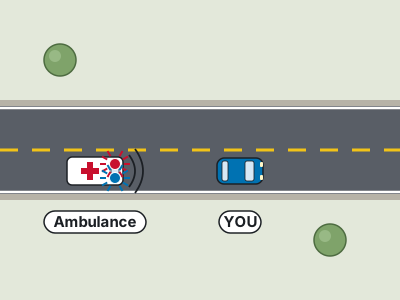
17. When an authorized emergency vehicle displays flashing red or blue lights, what must other drivers do?
- Follow closely so the emergency vehicle clears traffic
- Keep speed and pass the emergency vehicle on the left
- Stop in the middle of the intersection
- Slow, pull to the right clear of the intersection, and stop
Show answer
Slow, pull to the right clear of the intersection, and stop. The manual is explicit on this point. The required response is to slow, pull to the right-hand edge clear of an intersection, and stop to await the emergency vehicle. The rule applies whether or not a siren is operating. Stopping in the middle of an intersection blocks the route, while passing or following closely creates another hazard. Use the visible lights as the immediate cue, then clear the intersection before completing the stop.
Study this in the handbook: Emergency vehicles and the Move Over law
18. What does Alaska mean by having control of a motor vehicle?
- Keeping the vehicle moving at the posted limit at all times
- Directing and regulating its course and speed while being able to slow or stop
- Using cruise control so the driver never touches the pedals
- Relying on other drivers to create a safe path
Show answer
Directing and regulating its course and speed while being able to slow or stop. Vehicle control means the driver can direct and regulate the vehicle's course and speed and can slow or stop when desired. Maintaining a posted number, using cruise control, or trusting surrounding drivers does not prove that control exists. Fatigue, strong emotion, and distraction can weaken the driver's ability even when the vehicle is mechanically sound. Keep hands, attention, and speed coordinated with the roadway. A good cue is that control includes both steering and the ability to change speed promptly when circumstances demand it.
19. An at-fault Alaska driver may be found liable in civil court after a crash. How long can the driving privilege be suspended under the Financial Responsibility law, and how can it end early?
- Up to 30 days; by paying a fine
- Up to three years; by making a financial settlement with the other parties
- Permanently; no way to end it
- One year; by retaking the road test
Show answer
Up to three years; by making a financial settlement with the other parties. Under Alaska's Financial Responsibility law, if there is a reasonable possibility you may be found liable in civil court, your privilege to drive will be suspended for up to three years. You can end the suspension at any time during that period by making a financial settlement with the other parties in the crash. Paying a fine, retaking a road test, or waiting 30 days do not end it, and the suspension is not permanent.
Study this in the handbook: Vision, insurance and the point system
20. An Alaska driver is convicted of driving 15 mph over the limit (not in a school zone). How many points are assessed?
- 4
- 2
- 6
- 10
Show answer
4. Alaska's speeding points are 2 for 3 to 9 mph over the limit, 4 for 10 to 19 mph over, and 6 for 20 mph or more over. At 15 mph over, the driver receives 4 points. Speeding in a school zone or playground crosswalk carries 6 points regardless of the amount. Ten points is reserved for the most serious offenses such as DUI and reckless driving.
QualitySpace is expanding to Alaska
We are a California-based independent insurance brokerage working on licensing in more states. We cannot help with Alaska insurance yet. Leave your email and we will let you know when we can.
Every question is written from the official Alaska Driver Manual. Need paper? Printable AK practice test with answer key.
Last verified 2026-10-05. How we check every question · Study all 201 as flashcards
Frequently asked questions
How many questions are on this Alaska practice test?
This fixed set has 20 questions. It is test 6 of 10 from the 201 question Alaska bank. The real AK exam asks 20 questions and you need 16 correct.
What is the passing score for the real Alaska test?
16 correct answers to pass (80%) That figure comes from the official Alaska source cited on the DMV facts page.
How does this fixed test relate to the full Alaska bank?
Each numbered test is a fixed set of questions in a fixed order, so you can retake the same test later and compare. Every test mixes road signs and the other topics in about the same proportion as the full bank. Tests 1 to 10 together cover 200 of the 201 questions in the Alaska bank, each once. The full practice page mixes the whole bank at random.
Last verified 2026-10-05. See the Alaska DMV facts page for sourced state details.