Every question below comes from the New Jersey question bank on this page. Open a question to see the correct answer and the explanation. Nothing here is hidden behind a signup.
1. A New Jersey resident plans to learn with a parent instead of a driving school. What is the minimum age for this examination permit?
- 17
- 16
- 18
- 21
Show answer
17. New Jersey's examination permit does not need a student enrollment or an instructor, and it is available once a resident is at least 17 and Full explanation in Test 1
2. What do double yellow and white solid lines prohibit?
- Passing
- Turning into every driveway
- Using a railroad crossing
- Parking at a fire hydrant
Show answer
Passing. Double yellow and white solid lines prohibit passing. Full explanation in Test 2
3. What should a driver do at a flashing yellow traffic signal?
- Slow down and proceed with care
- Stop and wait for green
- Accelerate before the signal changes
- Treat it as a flashing red stop sign
Show answer
Slow down and proceed with care. A flashing yellow light tells the driver to slow down and proceed with care. Full explanation in Test 3
4. A New Jersey probationary driver under 21 has a job that starts at 4:30 a.m. What makes driving to work during the restricted hours lawful?
- A parent's spoken permission
- Carrying a signed certification from the employer on business letterhead
- Nothing, because the hours rule has no exceptions
- Displaying an extra pair of GDL decals
Show answer
Carrying a signed certification from the employer on business letterhead. New Jersey allows an exemption from the 11:01 p.m. to 5:00 a.m. Full explanation in Test 4
5. A New Jersey driver experiences a tire blowout. What should the driver do first?
- Brake hard before moving toward the shoulder
- Turn sharply toward the nearest open lane
- Release the steering wheel so the vehicle can coast freely
- Hold the steering wheel firmly and keep the vehicle straight
Show answer
Hold the steering wheel firmly and keep the vehicle straight. During a blowout, the first priority is keeping the vehicle pointed straight. Full explanation in Test 5
6. Which statement describes New Jersey's yellow and dashed center-line combination?
- Pass whenever the solid line is on your side
- Cross the lines to make a U-turn at any time
- Ignore the markings if no vehicle is visible
- Pass only when the dashed line is on your side, and finish before it becomes solid
Show answer
Pass only when the dashed line is on your side, and finish before it becomes solid. A mixed yellow marking permits passing from the side with the broken line, and the driver must finish before that section changes to solid. Full explanation in Test 6
7. How long must a New Jersey permit holder under 21 practice with a supervising driver before a probationary license can be issued?
- At least three months, with no suspensions or postponements
- At least one full year of supervised practice
- At least six months, with no suspensions or postponements
- No set period once the 50 practice hours are logged
Show answer
At least six months, with no suspensions or postponements. Under 21, the supervised stage in New Jersey lasts at least six months, and that time must be free of suspensions or postponements before th Full explanation in Test 7
8. What is the New Jersey response when an engine dies and power steering fails?
- Release the wheel so the vehicle can center itself
- Keep a firm grip because extra hand power is needed, then stop safely
- Turn off all warning lights and continue at normal speed
- Apply the parking brake sharply while making a fast turn
Show answer
Keep a firm grip because extra hand power is needed, then stop safely. If an engine dies and power steering is lost, the driver should keep a firm grip because extra hand power is needed to turn or maintain cont Full explanation in Test 8
9. A motorist becomes angry in traffic. What should the driver do before continuing?
- Use the horn repeatedly
- Follow another vehicle closely
- Make an abrupt lane change
- Take time to cool off
Show answer
Take time to cool off. Strong emotion can impair judgment, so an angry or excited motorist should take time to cool off. Full explanation in Test 9
10. What do yellow edge lines separate from the travel lane?
- Opposing traffic lanes
- The shoulder
- A railroad crossing gate
- A pedestrian waiting area
Show answer
The shoulder. Yellow edge lines separate the shoulder from the travel lane and show the edge of the highway. Full explanation in Test 10
11. Is it lawful in New Jersey to drive across private property to bypass a traffic signal or stop sign?
- Yes, whenever the property entrance is open to the public
- Yes, but only if the driver activates hazard lights
- No, unless the maneuver is made after midnight
- No, using public or private property to avoid the control is a motor-vehicle violation
Show answer
No, using public or private property to avoid the control is a motor-vehicle violation. New Jersey specifically treats operating a vehicle on public or private property to avoid a traffic-control signal or sign as a moving viola Full explanation in Test 11
12. What does New Jersey law impose on a driver convicted of failing to stop for a pedestrian in a marked crosswalk, when no one is seriously injured?
- A $54 fine with no points
- A written warning for a first offense
- A $1,000 fine and 8 points
- A $200 fine, with possible community service of up to 15 days
Show answer
A $200 fine, with possible community service of up to 15 days. N.J.S.A. 39:4-36 sets a $200 fine for a driver convicted of failing to stop and stay stopped for a pedestrian in a marked crosswalk, and the Full explanation in Test 1
13. What fine range may apply to a New Jersey Move Over law violation?
- $25 to $75
- $100 to $500
- Only a warning for a first offense
- $500 to $1,000
Show answer
$100 to $500. A New Jersey Move Over violation carries a fine of not less than $100 and not more than $500. Full explanation in Test 2
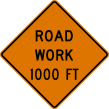
14. What do New Jersey road work signs alert motorists to?
- Permanent license restrictions
- Temporary roadway conditions such as lane shifts and detours
- The current color of a traffic signal
- A guaranteed dry road surface
Show answer
Temporary roadway conditions such as lane shifts and detours. Road work signs alert motorists to temporary roadway conditions, including lane closings, lane shifts, flaggers, uneven pavement, and detour Full explanation in Test 3
15. What is New Jersey's speed limit on rural roads where no limit is posted?
- 35 mph
- 50 mph
- 55 mph
- 65 mph
Show answer
50 mph. New Jersey's speed table sets 50 mph for non-posted rural roadways. Full explanation in Test 4
16. A New Jersey motorcycle rider notices a vehicle following too closely. What does the manual advise the rider to do?
- Speed up quickly to get away from the vehicle
- Brake suddenly to warn the driver behind
- Move closer to the vehicle ahead
- Open up additional following distance ahead
Show answer
Open up additional following distance ahead. The motorcycle section of the New Jersey manual says many riders complain about tailgaters, motorists that follow too closely. Full explanation in Test 5
17. In bad weather, how much longer can a truck, tractor-trailer or bus take to stop, according to the New Jersey manual?
- About 5 percent longer
- No longer than a car
- About twice as long
- As much as 25 percent longer
Show answer
As much as 25 percent longer. Large vehicles have deep blind spots, called no-zones, and they need more room to stop than cars do. Full explanation in Test 6
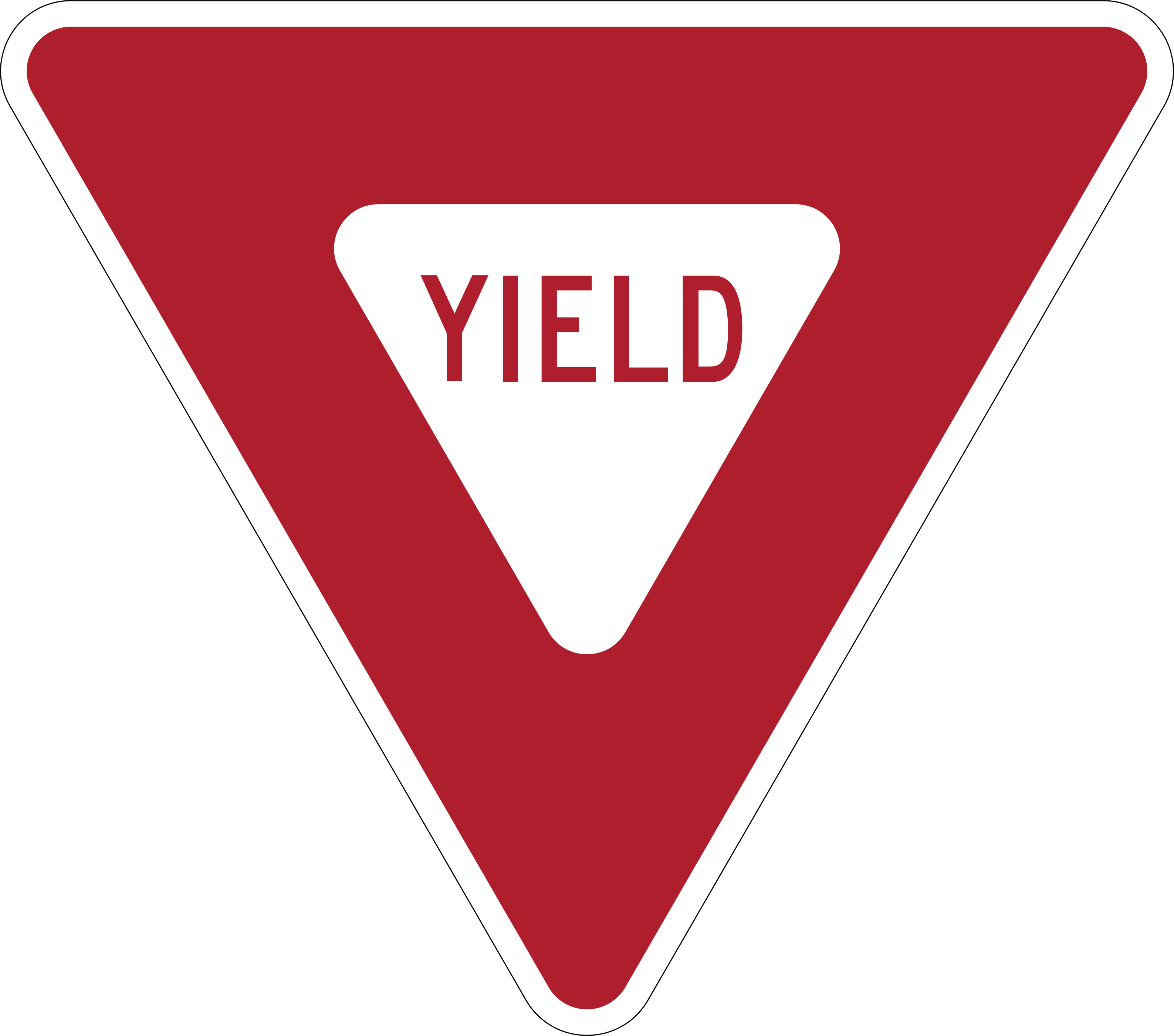
18. A red-bordered inverted triangle in New Jersey identifies which instruction?
- YIELD
- STOP
- No passing
- Railroad crossing ahead
Show answer
YIELD. The inverted triangle is the distinctive shape assigned to a YIELD sign. Full explanation in Test 7
19. What do road arrows show when used with other signs?
- The location of the nearest inspection station
- That passing is always permitted
- That the roadway is closed to all traffic
- The correct direction a motorist must take in that lane
Show answer
The correct direction a motorist must take in that lane. Road arrows, when used with other signs, show the correct direction a motorist must take in that lane. Full explanation in Test 8
20. A pedestrian has not entered the roadway and faces an orange steady raised palm. What should happen?
- Start crossing quickly
- Remain on the sidewalk and do not enter
- Walk diagonally against traffic
- Enter after a driver waves
Show answer
Remain on the sidewalk and do not enter. The steady raised palm tells a person still on the sidewalk or curb not to enter the roadway. Full explanation in Test 9
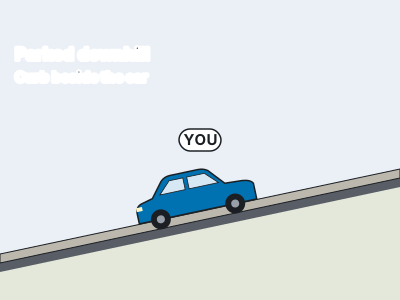
21. How should a New Jersey motorist secure a vehicle parked facing downhill?
- Turn the wheels straight and use first gear
- Turn the wheels away from the curb and use neutral
- Leave it in drive with the brake set
- Set the hand brake, turn the wheels toward the curb, and use park or reverse with a manual transmission
Show answer
Set the hand brake, turn the wheels toward the curb, and use park or reverse with a manual transmission. When parking a vehicle facing downhill, the hand brake should be set, the wheels should be turned toward the curb, and the vehicle should be Full explanation in Test 10
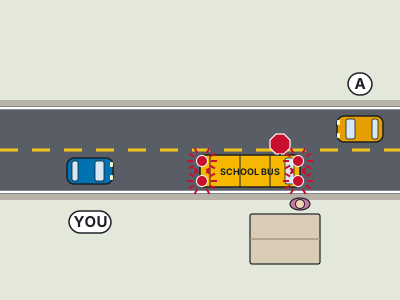
22. On a two-lane road, a school bus ahead has flashing red lights. How far away must approaching motorists stop?
- At least 10 feet
- At least 50 feet
- At least 25 feet
- Only after the bus begins moving again
Show answer
At least 25 feet. On a two-lane road, a motorist must stop at least 25 feet from a school bus with flashing red lights. Full explanation in Test 11
23. What kinds of hazards can New Jersey warning signs identify?

- Only toll booths and route numbers
- Only vehicle inspection stations and rest areas
- Only lane-use rules printed on white signs
- Road conditions, deer crossings, railroad crossings, school crossings, or curved roadways
Show answer
Road conditions, deer crossings, railroad crossings, school crossings, or curved roadways. The manual says warning signs can alert motorists to road conditions, deer crossings, railroad crossings, school crossings, or curved roadwa Full explanation in Test 1
24. May a GDL permit or probationary license holder use a hands-free cellular telephone while driving?
- Yes, if the phone is mounted securely
- No, neither handheld nor hands-free cellular use is allowed
- Yes, but only before 11:01 p.m.
- Yes, when a passenger answers the call
Show answer
No, neither handheld nor hands-free cellular use is allowed. New Jersey’s GDL restriction covers both handheld and hands-free cellular telephones, along with other handheld electronic devices. Full explanation in Test 2
25. What should a motorist do after reading a road work warning sign?
- Follow the directions and prepare to slow down or stop
- Ignore the sign if no worker is visible
- Accelerate before the lane pattern changes
- Stop in the active travel lane immediately
Show answer
Follow the directions and prepare to slow down or stop. The manual directs motorists to always read road work signs, follow directions, and prepare to slow down or stop. Full explanation in Test 3
26. What does New Jersey law require for trash or debris carried in a vehicle?
- There is no requirement
- It must be in the trunk
- It must weigh under 50 pounds
- It must be covered to keep it from littering the roadway
Show answer
It must be covered to keep it from littering the roadway. All trash, debris or rubbish carried in a vehicle must be covered to keep it from littering the roadway, under N.J.S.A. 39:4-63 and 39:4-64. Full explanation in Test 4
27. During what hours may a New Jersey permit or probationary holder under 21 not drive?
- From 10:00 p.m. until 6:00 a.m.
- From midnight until 4:00 a.m.
- From 11:01 p.m. until 5:00 a.m.
- From 9:01 p.m. until 5:01 a.m.
Show answer
From 11:01 p.m. until 5:00 a.m.. The hour restriction for the listed permit and probationary holders under 21 begins at 11:01 p.m. and ends at 5:00 a.m. Full explanation in Test 5
28. A New Jersey motorist's vehicle becomes disabled. What are the first steps the manual lists?
- Stop in the lane and put out flares
- Leave the vehicle and walk for help
- Pull off as far as possible onto the shoulder or median, turn on the emergency flashers, and raise the hood
- Wait in the travel lane with the lights off
Show answer
Pull off as far as possible onto the shoulder or median, turn on the emergency flashers, and raise the hood. If a motorist's vehicle becomes disabled, he or she must pull off as far as possible onto the shoulder or median, turn on the emergency flas Full explanation in Test 6
29. What does a white steady pedestrian silhouette or countdown indication allow?
- Pedestrians must wait until every vehicle stops
- Only turning vehicles may use the crosswalk
- Pedestrians may cross anywhere without watching traffic
- Pedestrians may cross in the indicated direction
Show answer
Pedestrians may cross in the indicated direction. The white pedestrian indication permits people facing it to cross in the shown direction. Full explanation in Test 7
30. What must an applicant under 18 present when applying for a New Jersey driver license?
- A court order waiving all testing
- A letter from an employer confirming full-time work
- A completed consent form signed by a parent or guardian
- A signed statement from any adult passenger
Show answer
A completed consent form signed by a parent or guardian. Applicants younger than 18 must present a completed consent form signed by a parent or guardian when applying for a New Jersey driver licens Full explanation in Test 8
31. What program must a person who has never held a driver license complete in New Jersey?
- The defensive driving point-removal course
- The commercial vehicle endorsement course
- The vehicle inspection program
- The Graduated Driver License Program
Show answer
The Graduated Driver License Program. New Jersey places first-time drivers in the Graduated Driver License Program before they receive a basic driver license. Full explanation in Test 9
32. What should a New Jersey driver do after missing an exit on a highway, parkway, or turnpike?
- Cross the median to return to the missed ramp
- Back up on the exit ramp when traffic clears
- Stop in the travel lane and wait for a gap
- Continue to the next exit
Show answer
Continue to the next exit. If a motorist misses an exit on a New Jersey highway, parkway, or turnpike, the safe instruction is to continue to the next exit. Full explanation in Test 10
33. For a first DUI with BAC from 0.10% to below 0.15%, what interlock period follows license restoration?
- Three months
- Nine to 15 months
- Exactly two years
- Seven months to one year
Show answer
Seven months to one year. The BAC range from 0.10% to below 0.15% places a first DUI in the seven month to one year ignition interlock period after driving privilege Full explanation in Test 11
34. When should a New Jersey driver slow down to help avoid hydroplaning?
- Only after the tires leave the road surface
- Only when driving on a dry center lane
- When heavy rain, standing water, or slush is present
- After accelerating above 55 mph
Show answer
When heavy rain, standing water, or slush is present. The manual specifically advises slowing down when heavy rain, standing water, or slush is present because those conditions increase the chan Full explanation in Test 1
35. A New Jersey special learner permit holder is supervised by a qualified adult who is not a parent or guardian. Besides the permit holder’s dependents, how many additional passengers may ride?
- No additional passengers
- Two additional passengers
- One additional passenger
- As many as the vehicle’s seat belts allow
Show answer
One additional passenger. For a special learner permit holder, New Jersey limits passengers to any parent, guardian or dependent of the permit holder plus one additio Full explanation in Test 2
36. Where does the New Jersey manual specifically tell drivers to slow down even when no reduced limit is posted?
- Only on interstates during daylight
- Only on roads with a school-zone sign
- Only after a vehicle begins skidding
- At intersections and railroad crossings
Show answer
At intersections and railroad crossings. The manual lists intersections and railroad crossings among places where motorists should always slow down. Full explanation in Test 3
37. A school bus stops on the opposite side of a dual-lane highway, separated by a safety island or raised median. What should a New Jersey driver do?
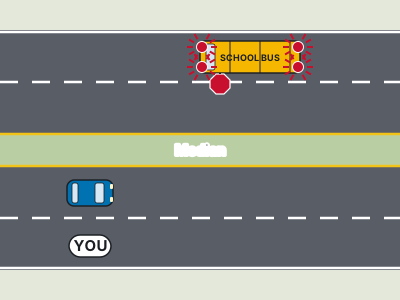
- Stop 25 feet behind the bus
- Slow to 10 mph
- Continue at the posted speed without checking
- Pass the bus at 35 mph if no children are visible
Show answer
Slow to 10 mph. On a dual-lane highway, a driver on the far side of a safety island or raised median should slow to 10 mph when a school bus has stopped. Full explanation in Test 4
38. A single solid white line crosses a New Jersey road at an intersection. Where should the motorist stop?
- Past the line inside the intersection
- Behind the line for the traffic signal or sign
- Beside the line only if a pedestrian is present
- On the shoulder before reaching the intersection
Show answer
Behind the line for the traffic signal or sign. At an intersection, one solid white line marks the stopping point for a traffic signal or sign. Full explanation in Test 5
39. What fine can follow a violation of New Jersey's child passenger restraint law?
- Not less than $50 nor more than $75, plus fees and court costs
- $500 to $1,000
- A warning only for a first offense
- $5 per child
Show answer
Not less than $50 nor more than $75, plus fees and court costs. New Jersey requires children under age eight who are under 57 inches tall to ride in a federally approved child restraint system or booster Full explanation in Test 6
40. What does a cross buck sign require a New Jersey driver to do?
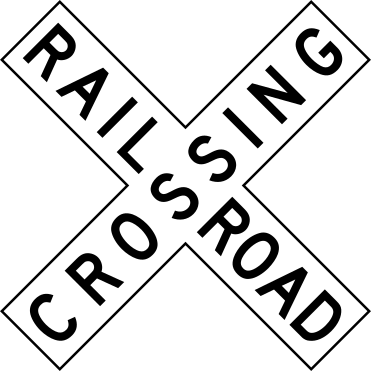
- Stop only when a gate is lowered
- Yield the right-of-way to trains
- Pass the tracks without checking both directions
- Treat the sign as permission to cross anywhere
Show answer
Yield the right-of-way to trains. The cross buck is an X-shaped railroad crossing sign, and the manual says it means the same as a Yield sign. Full explanation in Test 7
41. How long may a motorist drive in New Jersey with a valid license from another country?
- Up to 30 days
- Until the foreign license expires, regardless of time
- Only while accompanied by a New Jersey license holder
- Up to one year
Show answer
Up to one year. A motorist with a valid license from another country may drive in New Jersey with that license for up to a year. Full explanation in Test 8
42. What are New Jersey warning signs for?

- License renewal fees and document requirements
- Parking payment instructions at municipal meters
- Road conditions that need caution and specific hazards
- Information about motorist services only
Show answer
Road conditions that need caution and specific hazards. New Jersey warning signs identify road conditions that need caution and specific hazards encountered during road operations. Full explanation in Test 9
43. Which organization is associated with New Jersey’s designated-driver campaign?
- The National Highway Traffic Safety Administration
- The Safe Neighborhood Services Fund
- The Hero Campaign for Designated Drivers
- The New Jersey Driver Improvement Program
Show answer
The Hero Campaign for Designated Drivers. The manual identifies New Jersey as the first state to officially launch the Hero Campaign for Designated Drivers. Full explanation in Test 10
44. If a vehicle leaves the pavement onto a shoulder, what recovery method is recommended?
- Stay on the shoulder, ease off the gas, then return at 25 mph or less
- Brake hard while cutting across the lane
- Accelerate onto the pavement
- Turn sharply back at the original speed
Show answer
Stay on the shoulder, ease off the gas, then return at 25 mph or less. A vehicle can become unstable when a frightened driver jerks it back onto the roadway. Full explanation in Test 11
45. Which sign tells a New Jersey driver not to enter a roadway or ramp?
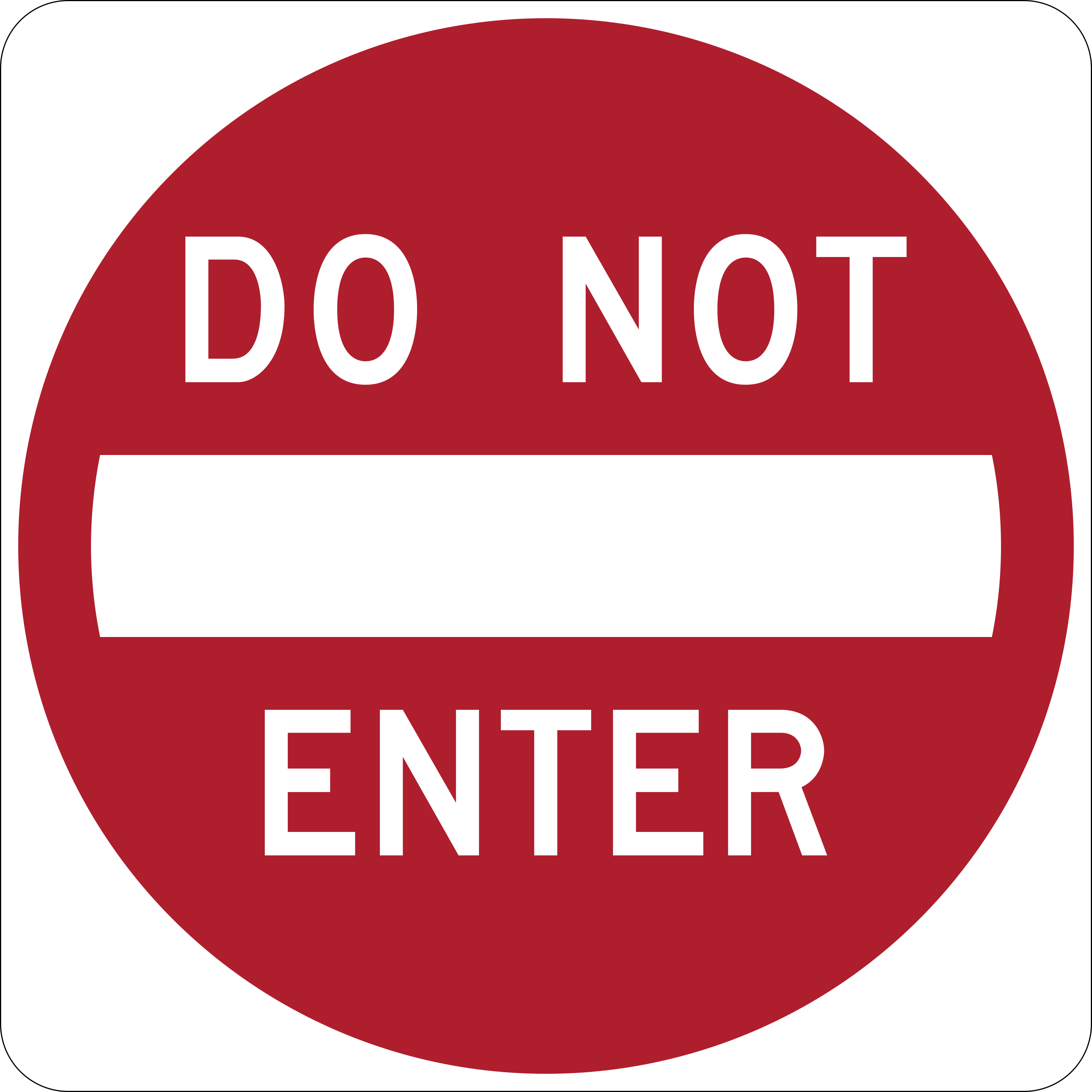
- A red octagon with white lettering
- A yellow pennant with three sides
- A blue rectangle with service information
- The white square with a red circle and horizontal white band
Show answer
The white square with a red circle and horizontal white band. DO NOT ENTER uses a white square containing a red circle crossed by a horizontal white band. Full explanation in Test 1
46. If a solid yellow line is on your side of the road, what passing action is allowed?
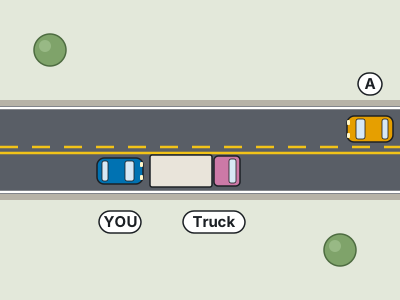
- Pass whenever the road ahead appears clear
- Do not pass
- Pass only at night
- Cross the line to avoid a slow vehicle
Show answer
Do not pass. When the solid yellow line is on the motorist’s side, passing is prohibited. Full explanation in Test 2
47. What authority does a New Jersey flagger have in a road work zone?
- Authority only after a police officer arrives
- The same authority as a regulatory sign
- Authority to change the posted speed limit permanently
- Authority to waive every traffic law in the work zone
Show answer
The same authority as a regulatory sign. The manual gives flaggers the same authority as a regulatory sign, so a motorist may be cited for disobeying their directions. Full explanation in Test 3
48. While turning left at a New Jersey intersection, what must a driver do before crossing the opposing lane?
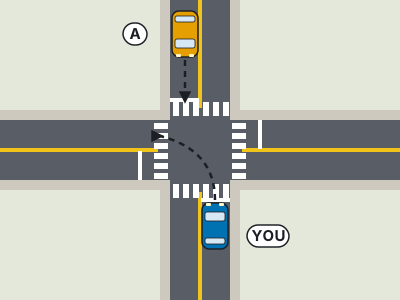
- Turn first because a green signal gives absolute priority
- Wait only for a police officer’s hand signal
- Yield to oncoming traffic and stop for pedestrians in the crosswalk
- Yield to vehicles behind the turning car
Show answer
Yield to oncoming traffic and stop for pedestrians in the crosswalk. A left turn crosses the path of approaching vehicles and may also cross a pedestrian route. Full explanation in Test 4
49. If New Jersey law enforcement asks a driver using prescription medication for proof, what must the driver show?
- Proof of the prescription
- A receipt for the vehicle
- A note from a passenger
- A certificate showing the last oil change
Show answer
Proof of the prescription. When asked, a motorist using prescription drugs must show proof of the prescription to law enforcement. Full explanation in Test 5
50. What is the ordinary maximum idling time for a vehicle in New Jersey?
- Five minutes at all locations
- Three minutes
- Ten minutes when parked
- There is no statewide limit
Show answer
Three minutes. New Jersey law requires motorists to restrict vehicle idling to three minutes or less. Full explanation in Test 6
