Every question below comes from the Indiana question bank on this page. Open a question to see the correct answer and the explanation. Nothing here is hidden behind a signup.
1. What must a driver do when approaching an intersection with a non-operating traffic signal?
- Continue because a dark signal grants priority
- Stop before entering and yield as required
- Yield only to vehicles approaching from the left
- Wait for a police officer before moving under any circumstance
Show answer
Stop before entering and yield as required. A non-operating signal requires the driver to stop before entering the intersection. Full explanation in Test 1
2. Where may a speed advisory sign appear?
- With a warning sign, showing an advisory speed for the condition ahead
- Only on a blue service sign at an upcoming exit
- Only below a red STOP sign
- On a brown sign marking a state park entrance
Show answer
With a warning sign, showing an advisory speed for the condition ahead. Speed advisory signs may accompany warning signs and give drivers a recommended speed for the condition ahead, such as an exit, roundabout, Full explanation in Test 2
3. Two drivers stop at an all-way stop at the same time. Which driver must yield under Indiana's rule?
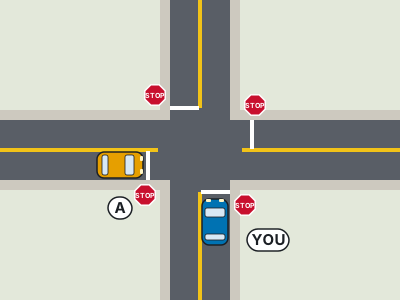
- The driver on the right yields to the driver on the left
- The driver on the left yields to the driver on the right
- The driver going straight always yields to a turning driver
- The larger vehicle automatically proceeds first
Show answer
The driver on the left yields to the driver on the right. At an all-way stop, Indiana first gives priority to the vehicle that stopped first. Full explanation in Test 3
4. For which of these reasons must the Indiana BMV suspend a juvenile's driving privileges after notice from the school?
- A single failed test
- One tardy arrival
- A second suspension from school in one school year
- Missing an after-school club
Show answer
A second suspension from school in one school year. The BMV must suspend a juvenile's driving privileges when the principal or administrator reports an expulsion or exclusion, a second or late Full explanation in Test 4
5. On a two-way road, what does the yellow pennant-shaped sign pictured warn drivers not to do?
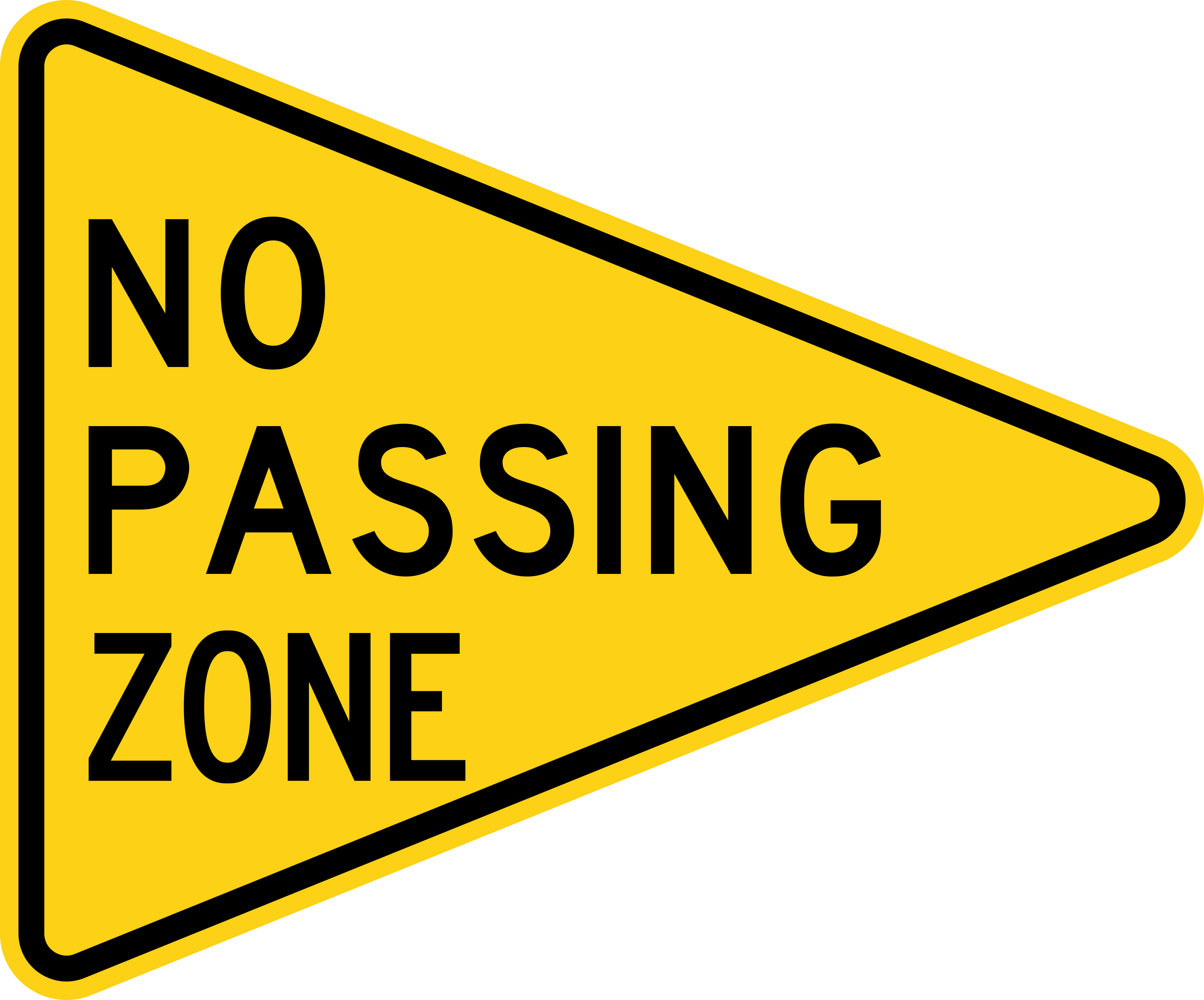
- Turn right at the next intersection
- Pass another vehicle on the left
- Stop for a school bus on the shoulder
- Enter a highway from an acceleration lane
Show answer
Pass another vehicle on the left. Indiana uses the pennant shape for a No Passing Zone warning. Full explanation in Test 5
6. Which vehicle is required to make a stop at a railroad crossing under Indiana's listed special-stop rule?
- A private sedan carrying only its driver
- A vehicle carrying explosives or flammable liquids
- A bicycle approaching a marked crossing
- A passenger car following a school bus at a safe distance
Show answer
A vehicle carrying explosives or flammable liquids. Indiana identifies vehicles carrying explosives or flammable liquids as one class that must always stop at railroad crossings. Full explanation in Test 6
7. What does a steady yellow traffic light indicate?
- The green light has ended and the signal is about to turn red
- The driver has a new protected turn
- Cross traffic must stop for the next full minute
- The driver may enter regardless of the intersection's condition
Show answer
The green light has ended and the signal is about to turn red. A steady yellow light means the green phase has ended and the signal is about to turn red. Full explanation in Test 7
8. What is the Indiana speed limit for trucks with a declared gross vehicle weight above 26,000 pounds on a rural interstate?
- 65 mph
- 55 mph
- 60 mph
- 70 mph
Show answer
65 mph. On rural interstates, trucks with a declared gross vehicle weight greater than 26,000 pounds may not exceed 65 mph or the posted limit, whil Full explanation in Test 8
9. What do blue traffic signs display?

- Warnings about a series of curves
- Rules prohibiting turns and parking
- Directions to recreational and cultural sites
- Road services and information
Show answer
Road services and information. Blue signs provide road service information, such as amenities available at an upcoming exit. Full explanation in Test 9
10. Unless posted otherwise, what is the speed limit in an Indiana alley?
- 10 mph
- 15 mph
- 20 mph
- 30 mph
Show answer
15 mph. In alleys, vehicles may not exceed 15 mph or the posted limit. Thirty mph is the limit in most urban residential areas. Full explanation in Test 10
11. How far behind a disabled vehicle should a red emergency reflective triangle normally be placed on the roadside?
- Exactly 1,000 feet regardless of the road
- 50 feet in every location
- 100 feet unless the vehicle is on a divided highway
- 200 feet, or 500 feet on a hill or curve
Show answer
200 feet, or 500 feet on a hill or curve. Indiana's roadside emergency guidance places a red emergency reflective triangle 200 feet behind the disabled vehicle under ordinary conditi Full explanation in Test 1
12. Which category includes the Winding Road sign in Indiana's examples?

- Railroad-crossing shape signs
- Traffic regulation signs
- Traffic guidance signs
- Warning signs
Show answer
Warning signs. Winding Road is included in Indiana's group of warning-sign examples. Full explanation in Test 2
13. What must an Indiana driver do when approaching an emergency vehicle with alternately flashing red or red and blue lights?
- Pass in the emergency vehicle's lane
- Stop beside the emergency vehicle
- Change lanes away from the authorized vehicle
- Turn off the headlights and continue
Show answer
Change lanes away from the authorized vehicle. Indiana requires motorists approaching an authorized emergency vehicle with the specified flashing lights to change lanes away from it. Full explanation in Test 3
14. At what blood alcohol concentration does Indiana identify operation of a vehicle as exceeding the legal limit?
- .08
- .10
- .12
- .05
Show answer
.08. The manual identifies a BAC in excess of .08 as exceeding Indiana's legal limit for operating a vehicle while intoxicated. The .05, . Full explanation in Test 4
15. What does a red flashing traffic light at an Indiana intersection require a driver to do?
- Slow without stopping if the cross street is empty
- Treat it as a yellow signal and continue carefully
- Wait for a green arrow before moving in any direction
- Treat it as a stop sign and stop completely before proceeding with caution
Show answer
Treat it as a stop sign and stop completely before proceeding with caution. A red flashing light is equivalent to a stop sign. Full explanation in Test 5
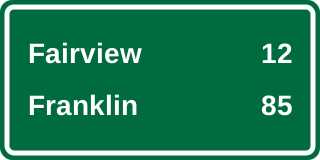
16. What kind of information does a green traffic sign provide?
- A warning about a temporary work zone
- A warning that the pavement is slippery
- A legal requirement to stop immediately
- Permitted movements, directions, or guidance
Show answer
Permitted movements, directions, or guidance. Green signs guide a driver through permitted movements and directions, including highway entrances, exits, and distances to destinations. Full explanation in Test 6
17. What does a flashing arrow board that shows no direction mean in an Indiana work zone?
- Stop immediately
- Use caution, but no lane change is required
- The work zone is closed
- Move to the left lane
Show answer
Use caution, but no lane change is required. Flashing arrow boards are often used to indicate a lane closure or crossover, with lane markings, cones, barrels or barricades outlining the Full explanation in Test 7
18. An Indiana driver has nine speeding tickets and one reckless driving conviction within 10 years. What happens?
- Nothing, speeding tickets do not count
- A five-year HTV suspension
- A 10-year HTV suspension
- A lifetime suspension
Show answer
A five-year HTV suspension. Section C of the Habitual Traffic Violator law covers 10 or more traffic violations in 10 years when one is a major offense, and it brings a Full explanation in Test 8
19. A driver who receives an Indiana license before turning 21 keeps what license status until reaching that age?
- Probationary
- Commercial
- Learner's permit
- Unrestricted adult
Show answer
Probationary. An Indiana license issued to someone younger than 21 remains probationary until the holder turns 21. Full explanation in Test 9
20. How many points does Indiana assess for a hand-held device violation?
- 1 point
- 2 points
- 4 points
- 8 points
Show answer
4 points. A violation for a hand-held device carries 4 points in Indiana, the same as unsafe lane movement and disregarding a stop or yield sign. Full explanation in Test 10
21. What do white lane markings separate on an Indiana road?
- The roadway from a bicycle path
- Lanes of traffic moving in opposite directions
- Lanes of traffic moving in the same direction
- A parking lane from a fire lane
Show answer
Lanes of traffic moving in the same direction. Line color tells you which way the traffic on the other side is going. Full explanation in Test 1
22. Unless posted otherwise, what is the speed limit for passenger vehicles on an Indiana rural interstate?
- 55 mph
- 60 mph
- 70 mph
- 65 mph
Show answer
70 mph. On rural interstates, outside urban areas of at least 50,000 people, passenger vehicles may not exceed 70 mph or the posted limit. Full explanation in Test 2
23. For an indefinite Indiana no-insurance suspension, how long must an effective SR22 generally be maintained to terminate the suspension?
- Continuously for 30 days
- Until the next license renewal only
- Continuously for 180 days
- For one calendar year in every case
Show answer
Continuously for 180 days. For no-insurance suspensions that became effective on or after December 31, 2021, the suspension is indefinite. Full explanation in Test 3
24. What are common hours for Indiana school zone speed limits?
- 24 hours a day, every day
- Only 8 a.m. to 9 a.m.
- Only on weekends
- 7 a.m. to 4:30 p.m., Monday through Friday, or when beacons flash
Show answer
7 a.m. to 4:30 p.m., Monday through Friday, or when beacons flash. Common school zone hours in Indiana are 7 a.m. to 4:30 p.m., Monday through Friday, or whenever the school speed limit beacons are flashing. Full explanation in Test 4
25. How long is an Indiana learner's permit valid for a resident who is not a lawful temporary resident?
- 180 days
- 12 months
- Six years
- Two years
Show answer
Two years. Learner's permits are valid for two years from the date of issuance, except for lawful temporary residents, whose permits end with their aut Full explanation in Test 5
26. A flashing raised hand at a pedestrian signal tells a person who has not entered the street to:
- Begin crossing before the signal changes
- Cross only in the center lane
- Not start crossing
- Wait for a vehicle to wave them through
Show answer
Not start crossing. Indiana's pedestrian signals show DON'T WALK or a raised hand when it is not safe for pedestrians to cross, and the words or symbols flash t Full explanation in Test 6
27. When changing lanes, which action is required before moving into the new lane?
- Use a turn signal to alert other drivers
- Sound the horn continuously
- Wait until another driver signals first
- Turn off all vehicle lights
Show answer
Use a turn signal to alert other drivers. Indiana's lane change rules list the steps in order: make sure there is no traffic ahead in the lane you want to enter, check your mirrors f Full explanation in Test 7
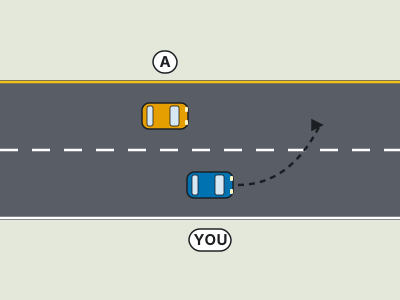
28. When changing lanes, what should a driver do to check the blind spot before moving into the adjacent lane?
- Rely only on the inside rearview mirror
- Briefly turn the head toward the lane being entered
- Turn on the hazard lights and drift over
- Look at the speedometer instead of the adjacent lane
Show answer
Briefly turn the head toward the lane being entered. Indiana's lane-change procedure calls for a brief head turn toward the lane being entered. Full explanation in Test 8
29. How much roadway should an Indiana driver allow a motorcyclist or motor driven cycle operator?
- Half of a lane
- The width of a full lane
- A shoulder whenever available
- Only the right tire track
Show answer
The width of a full lane. Indiana says motorcyclists and motor driven cycle operators must be given the width of a full lane. Full explanation in Test 9
30. What reinstatement fee does Indiana charge after a first no-insurance suspension that occurred after January 1, 2015?
- $150
- $250
- $500
- $1,000
Show answer
$250. For no-insurance suspensions after January 1, 2015, reinstatement fees are $250 for a first, $500 for a second, and $1,000 for a third or la Full explanation in Test 10
31. What share of fatal crashes nationally involve a fatigued driver, according to Indiana's manual?
- About 2 percent
- An estimated 17.6 percent
- About 50 percent
- About 90 percent
Show answer
An estimated 17.6 percent. Nationally, an estimated 17.6 percent of all fatal motor vehicle crashes involved a fatigued driver. Full explanation in Test 1
32. What is the maximum width of a vehicle that may operate on Indiana public highways without a special permit?
- 7 feet 6 inches
- 8 feet
- 8 feet 6 inches
- 10 feet
Show answer
8 feet 6 inches. Indiana's tractor trailer section lists 8 feet 6 inches as the maximum width for a vehicle operating without a special permit. Full explanation in Test 2
33. Which equipment is excluded from Indiana's definition of a telecommunications device?
- CB radio operated by an FCC licensed operator, and communication systems in commercial vehicles over 10,000 pounds
- Pagers
- Text messaging devices
- Smartphones used hands free
Show answer
CB radio operated by an FCC licensed operator, and communication systems in commercial vehicles over 10,000 pounds. Indiana defines a telecommunications device as an electronic or digital device such as a wireless telephone, personal digital assistant, pag Full explanation in Test 3
34. What must a new Indiana license applicant submit to prove supervised driving practice?
- A parent's verbal statement
- A letter from a driving school
- State Form 54706, the Log of Supervised Driving Practice, showing 50 hours
- Nothing, practice is on the honor system
Show answer
State Form 54706, the Log of Supervised Driving Practice, showing 50 hours. At the time of application for a driver's license, you must submit a completed State Form 54706, the Log of Supervised Driving Practice, sho Full explanation in Test 4
35. Until what age is an Indiana probationary driver's license valid?
- 18 years exactly
- 21 years exactly
- 21 years and 30 days
- 25 years
Show answer
21 years and 30 days. A license obtained before 21 is probationary until the holder turns 21, and it is valid until the driver is 21 years and 30 days old. Full explanation in Test 5
36. Which group accounts for 64 percent of fatigue-related crashes, according to Indiana's manual?
- Drivers over 65
- Commercial drivers
- Parents of teenagers
- Young adults ages 16 to 29
Show answer
Young adults ages 16 to 29. Although anyone can make the fatal mistake of driving without adequate rest, young adults ages 16 to 29 are at the highest risk, accounting Full explanation in Test 6
37. Under Indiana law, aggressive driving during one continuous episode requires at least how many listed actions?
- One
- Two
- Five
- Three
Show answer
Three. Indiana defines aggressive driving as doing or committing at least three listed actions during one episode of continuous driving. Full explanation in Test 7
38. Which information may a rectangular traffic sign convey?
- Traffic regulations that drivers must obey
- The private ownership of a roadway
- A driver's medical history
- The age of the nearest vehicle
Show answer
Traffic regulations that drivers must obey. A rectangular traffic sign may convey a traffic regulation that drivers must obey, including a speed limit or a turn movement prohibition. Full explanation in Test 8
39. Where is a pennant-shaped traffic sign posted, and what does it warn you not to do?
- On the right side of a one-way road, not to turn right
- At a railroad crossing, not to stop on the tracks
- On the left side of a two-way road, not to pass on the left
- Near a school, not to enter the crossing area
Show answer
On the left side of a two-way road, not to pass on the left. Pennant-shaped signs are posted on the left-hand side of two-way roads to warn that passing another vehicle on the left is prohibited. Full explanation in Test 9
40. How close may an Indiana driver park to a fire hydrant?
- Within 5 feet
- Within 10 feet
- No closer than 15 feet
- Only beyond 25 feet
Show answer
No closer than 15 feet. Indiana lists parking within 15 feet of a fire hydrant as prohibited, so a vehicle must stay at least that far away. Full explanation in Test 10
