
Test 10 of 25 · 20 questions · Free 2026
IN Permit Practice Test 10
Jump to the test ↓A fixed 20 question set from the Indiana bank with answers and plain English explanations.
Question 1 of 20 · 0 right so far
All 20 questions in test 10
Every question below comes from the Indiana question bank on this page. Open a question to see the correct answer and the explanation. Nothing here is hidden behind a signup.
1. Unless posted otherwise, what is the speed limit in an Indiana alley?
- 10 mph
- 15 mph
- 20 mph
- 30 mph
Show answer
15 mph. In alleys, vehicles may not exceed 15 mph or the posted limit. Thirty mph is the limit in most urban residential areas. Ten and twenty mph are not Indiana defaults. A posted sign can set a different limit, but the default in an alley is the lowest on the urban list. Drivers entering a street from an alley must stop and yield.
Study this in the handbook: Speed limits, following distance and stopping
2. How many points does Indiana assess for a hand-held device violation?
- 1 point
- 2 points
- 4 points
- 8 points
Show answer
4 points. A violation for a hand-held device carries 4 points in Indiana, the same as unsafe lane movement and disregarding a stop or yield sign. Two points is the value for failing to use headlights or missing brake or signal lights. Eight points is for driving while suspended or a speed contest. One point is not a value on the list. Like other points, they stay active on the driver record for two years from the conviction date.
Study this in the handbook: Points, driver safety program and insurance
3. What reinstatement fee does Indiana charge after a first no-insurance suspension that occurred after January 1, 2015?
- $150
- $250
- $500
- $1,000
Show answer
$250. For no-insurance suspensions after January 1, 2015, reinstatement fees are $250 for a first, $500 for a second, and $1,000 for a third or later suspension. So $500 and $1,000 belong to later suspensions. One hundred fifty dollars was the first suspension fee before 2015. The fee is in addition to any SR22 requirement, although a driver may avoid the fee by having the insurer electronically submit an SR22 and keeping it continuously for 180 days. Indiana's minimum coverage is $25,000 per person, $50,000 per accident and $25,000 for property.
Study this in the handbook: Points, driver safety program and insurance
4. How close may an Indiana driver park to a fire hydrant?
- Within 5 feet
- Within 10 feet
- No closer than 15 feet
- Only beyond 25 feet
Show answer
No closer than 15 feet. Indiana lists parking within 15 feet of a fire hydrant as prohibited, so a vehicle must stay at least that far away. Parking within five or ten feet places the vehicle inside the prohibited area. The wording is important: the manual identifies the nearest fifteen feet as illegal, while it does not require a blanket 25 foot gap. A useful curbside cue is to look for the hydrant before leaving the vehicle and keep at least fifteen feet of clearance.
Study this in the handbook: Seat belts, child restraints and parking
5. On a roadway divided by a barrier or unimproved median, when must an Indiana driver stop for a school bus with flashing red lights and an extended stop arm?
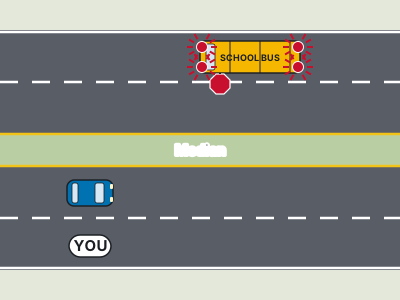
- Only when traveling in the same direction as the school bus
- Only when traveling toward the front of the bus
- In both directions in every case
- Only if children are visible beside the bus
Show answer
Only when traveling in the same direction as the school bus. A divided roadway changes the stopping duty: the driver stops for the school bus only while traveling in the bus's direction when a barrier or unimproved median separates traffic. A universal two direction stop ignores that condition, and waiting to see children is unsafe because the red lights and stop arm already provide the warning. The cue is the physical separation plus same direction, not merely the presence of a bus. On an undivided roadway, do not assume the opposing lane is exempt from the ordinary stop requirement.
Study this in the handbook: Move Over law, school buses and pedestrians
6. At an all-way stop, which vehicle proceeds first when it stopped before the other vehicles?
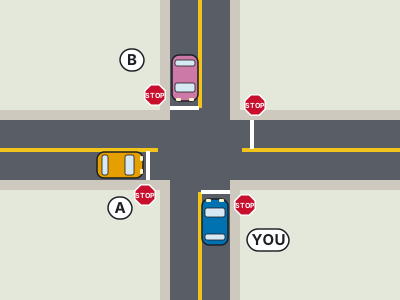
- The first vehicle to stop at the intersection
- The vehicle making a left turn
- The vehicle farthest to the right, regardless of arrival
- The vehicle with the highest posted lane position
Show answer
The first vehicle to stop at the intersection. The all-way-stop sequence begins with the vehicle that stopped first. A right-side comparison is needed only when two drivers arrive at the same time, and even then the left vehicle yields. A left turn does not automatically outrank a vehicle that arrived earlier. Lane position also has no role in this rule. Make a complete stop, note the arrival order, and proceed only when the intersection is clear and the earlier stopping vehicle has moved safely.
Study this in the handbook: Lane markings, lane changes and passing
7. When may a driver turn after facing a flashing yellow arrow?
- Only after the arrow becomes a red arrow
- Immediately, without checking the crosswalk
- Only after yielding to pedestrians and oncoming traffic
- After yielding to vehicles behind the driver
Show answer
Only after yielding to pedestrians and oncoming traffic. A flashing yellow arrow permits the turn only after the driver yields the right of way to pedestrians and oncoming traffic. It is not a protected movement, so the driver must check the crosswalk and the opposing lanes before turning. Waiting for the arrow to turn red misreads the signal, because a red light or arrow means your right of way has ended, and traffic behind the vehicle is not the group you yield to. A good cue is that flashing yellow means conditional movement, with the conflict check first.
Study this in the handbook: Traffic signals and turning on red
8. What does Indiana's Move Over law require when approaching an emergency vehicle with its lights flashing?
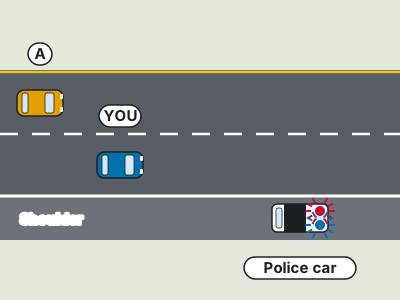
- Yield the right of way, move over and stop, or change lanes
- Stop beside the emergency vehicle
- Pass between the emergency vehicle and the shoulder
- Keep the same lane and speed unless the emergency vehicle honks
Show answer
Yield the right of way, move over and stop, or change lanes. Indiana's Move Over law requires motorists to yield the right of way when approaching an emergency vehicle with flashing lights. The listed actions are moving right and coming to a complete stop, or changing lanes. Staying in place until a horn sounds ignores the visual warning, and stopping beside or passing between the vehicle and shoulder puts people in the danger area. The key cue is to create lateral space or stop to the right as the situation permits.
Study this in the handbook: Move Over law, school buses and pedestrians
9. How does traffic enter, exit and move through an Indiana roundabout?
- Enter by a left turn and circulate clockwise
- Cross straight through the center island
- Enter and exit only by right turns, moving counterclockwise
- Enter in either direction depending on the lane
Show answer
Enter and exit only by right turns, moving counterclockwise. An Indiana roundabout is a circular intersection where every vehicle enters with a right turn, travels counterclockwise around the center island, and leaves with another right turn. There is no left turn into the circle and no clockwise travel, and nothing crosses the center island. Entering drivers always yield to traffic already circulating. In a multi-lane roundabout, know which lane you need before entering and do not change lanes in the circulatory roadway. A traffic circle differs because it may have both clockwise and counterclockwise traffic.
Study this in the handbook: Turns, all way stops, roundabouts and interstates
10. What information is commonly displayed by a white traffic sign?
- Temporary conditions caused by highway maintenance
- Nearby parks and cultural attractions
- Traffic regulations such as speed limits
- Railroad crossings only
Show answer
Traffic regulations such as speed limits. White signs commonly display rules that drivers must obey, including speed limits and turn restrictions. They can also provide helpful information, such as state highway markers, so the color does not mean every white sign is a command. Orange is used for temporary construction conditions, brown points to recreational or cultural sites, and circular signs warn about railroad crossings. For this sign, read the printed message carefully and follow the regulation shown. The white background should make you think of a traffic rule or official road information.
Study this in the handbook: Traffic sign colors and shapes
11. What does an equilateral triangle traffic sign tell a driver to do?
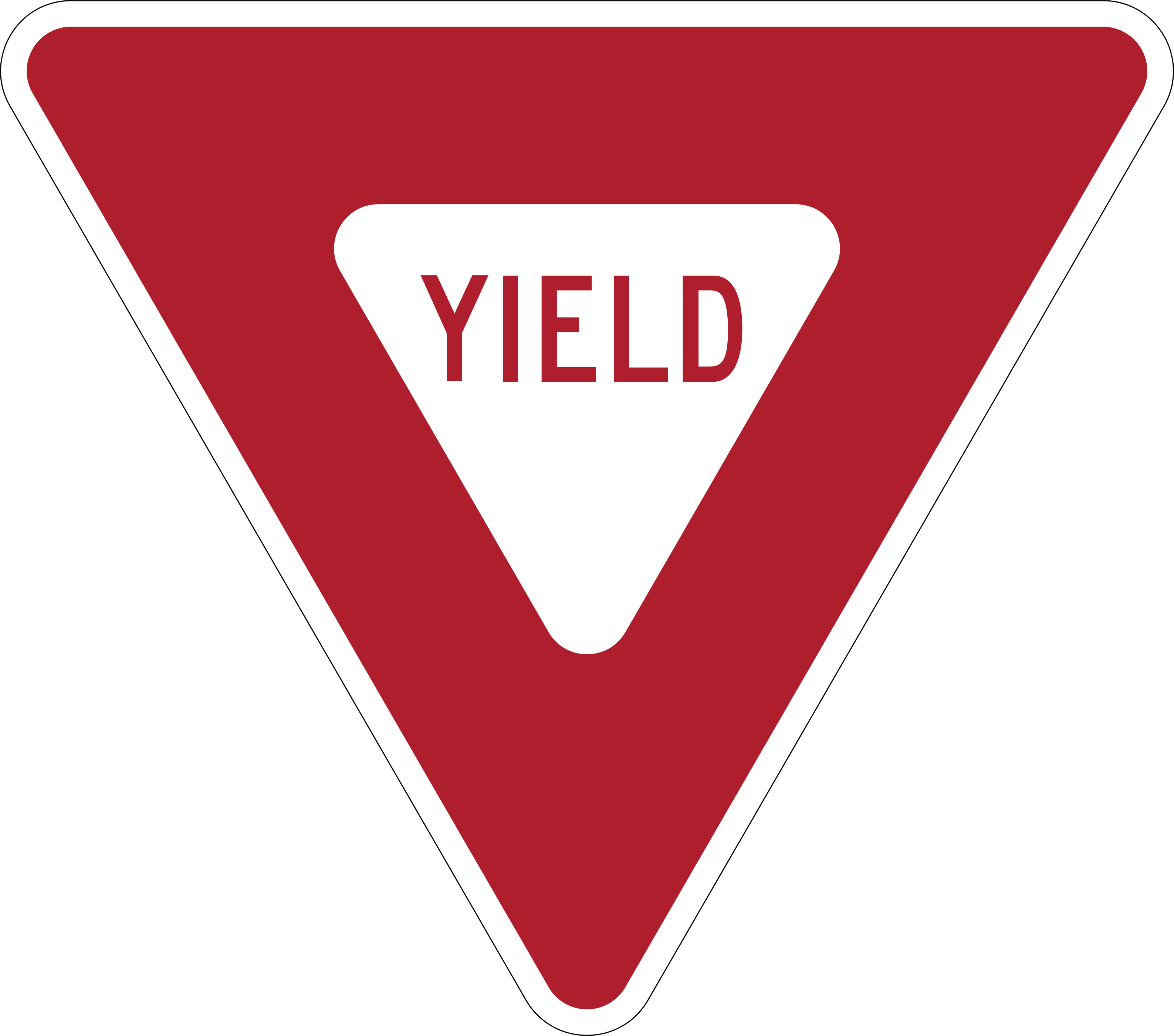
- Slow down near an intersection and be ready to stop and yield
- Pass vehicles only on the left side
- Look for a railroad crossing directly ahead
- Continue at the posted speed without checking cross traffic
Show answer
Slow down near an intersection and be ready to stop and yield. The manual says a three-sided, equal-length triangle warns drivers to slow as they approach an intersection and prepare for a complete stop to yield to drivers or pedestrians. It therefore calls for caution and readiness, not uninterrupted travel. A pennant concerns passing, a circle points to a railroad crossing, and the choice about keeping speed ignores the shape's warning function. As the triangle comes into view, ease off the accelerator, scan both sides, and be prepared to stop if another road user has the right of way.
Study this in the handbook: Traffic sign colors and shapes
12. Under Indiana law, which child must use a child restraint system such as a car seat or booster seat?
- Any passenger younger than 12 years of age
- Only a passenger younger than six years of age
- A passenger younger than 10 years of age only when seated in front
- A passenger younger than eight years of age
Show answer
A passenger younger than eight years of age. Indiana requires passengers younger than eight years of age to be properly secured in a child restraint system, such as a child car seat or booster seat. The rule is based on the passenger's age, not on whether the child is sitting in front or back. A choice using age 12 confuses this requirement with the manual's recommendation to place children younger than 12 in the back seat when a passenger air bag is present. A useful reminder is to check the child's age before every trip and use the restraint as directed.
Study this in the handbook: Seat belts, child restraints and parking
13. What violation class applies when a driver fails to follow Indiana's amber-light parked-vehicle Move Over requirement?
- Class A infraction
- Class C misdemeanor
- Level 6 felony
- Class B infraction
Show answer
Class B infraction. Failing to follow the Move Over requirement for an authorized parked vehicle with amber flashing lights is a Class B infraction. The driver should change lanes away from the vehicle when possible; if that cannot be done, the driver must slow to 10 miles per hour below the posted limit and proceed cautiously. A Class A infraction is tied to the emergency-vehicle rule described separately, while the misdemeanor and felony choices do not match this amber-light parked-vehicle violation.
Study this in the handbook: Move Over law, school buses and pedestrians
14. After failing Indiana's computer-based knowledge exam, when may the applicant try it again?
- Later the same hour
- On the next business day
- After waiting 30 calendar days
- Only at the next annual renewal
Show answer
On the next business day. The manual sets the retest wait at the next business day after a failed knowledge exam. The applicant cannot simply restart during the same hour, and no 30-day or annual-renewal delay appears in this rule. This timing applies to the computer-based knowledge exam process described for the branch. Keep the testing sequence in mind: a failed attempt ends that day's opportunity, so plan to return on the following business day rather than expecting an immediate second try.
Study this in the handbook: Learner's permits, knowledge exam and skills exam
15. During the first 180 days of an Indiana probationary license, which person may ride with the driver without another accompanying adult?
- Any friend from school
- The driver's spouse
- A neighbor with a valid license
- A coworker of any age
Show answer
The driver's spouse. Indiana generally bars passengers during the first 180 days of a probationary license, but the manual specifically allows the driver's spouse without another accompanying individual. The same family exception includes a child, stepchild, sibling, or step or half-sibling. A school friend, coworker, or neighbor does not qualify merely because of that relationship or because the person may hold a license. Identify a listed family relationship before relying on the exception.
Study this in the handbook: The probationary license for drivers under 21
16. A vehicle is being passed on the left. What should its driver do while the other vehicle completes the maneuver?
- Accelerate so the passing vehicle must return sooner
- Move onto the shoulder to create a passing lane
- Brake sharply as soon as the other vehicle draws alongside
- Allow the vehicle to pass safely without increasing speed
Show answer
Allow the vehicle to pass safely without increasing speed. When another vehicle is passing on the left, the safest cooperation is to maintain a predictable path and avoid adding speed. Accelerating extends the time spent beside the other vehicle and can create a conflict if the passing driver needs to return right. Driving onto the shoulder is not a normal passing response, and abrupt braking can surprise traffic behind you. The roadside cue is a vehicle overtaking from the left: hold your lane, keep a steady pace, and give it room to finish before changing speed or position.
Study this in the handbook: Lane markings, lane changes and passing
17. Why should a driver slow down when heavy rain creates standing water on the road?
- Rain makes the posted speed limit legally higher
- Water can cause hydroplaning and loss of control
- The tires gain extra friction when water covers the road
- Only the vehicle's headlights are affected by standing water
Show answer
Water can cause hydroplaning and loss of control. Standing water can separate the tires from the pavement, a condition called hydroplaning. As speed increases, the tires may contact only a thin mixture of oil, dirt, and water, leaving little or no friction for braking, acceleration, or steering. That is why heavy rain and puddles call for reduced speed. The condition affects control, not merely visibility or headlight performance. A driver should avoid worn tires, slow before entering deeper water, and test the brakes after leaving puddles by pumping them.
Study this in the handbook: Weather, night driving, drowsiness and distraction
18. What type of information does a diamond-shaped traffic sign provide?
- An upcoming road condition or hazard
- A required stop at every intersection
- A nearby recreational destination only
- A route number or mileage distance only
Show answer
An upcoming road condition or hazard. Diamond-shaped signs warn drivers about upcoming road conditions and hazards. A stop requirement is associated with the eight-sided shape, while recreational and cultural sites use brown signs and route or destination information is commonly conveyed by rectangular signs. Shape recognition gives a driver an early warning before the words or symbol are fully read. When a diamond appears ahead, reduce surprise by scanning for the roadway change or hazard it announces.
Study this in the handbook: Traffic sign colors and shapes
19. What does a solid yellow line on the driver's side of the center line indicate?
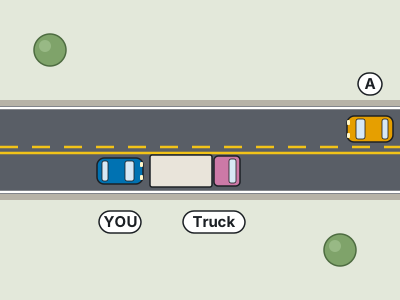
- Passing is required immediately
- Traffic is moving in the same direction
- The lane is reserved for parking
- Passing is dangerous and illegal there
Show answer
Passing is dangerous and illegal there. A solid yellow line on the driver’s side of the center line identifies a prohibited passing situation. Crossing it to overtake would put the vehicle into the opposing traffic area where the manual says passing is dangerous and illegal. It does not mark parking space or same-direction lanes, and it never requires an immediate pass. Slow down, remain in your lane, and wait for a legal passing condition indicated by the roadway markings.
Study this in the handbook: Lane markings, lane changes and passing
20. What do yellow or fluorescent yellow-green school zone signs warn a driver about?

- A state highway route marker
- A railroad crossing with a train approaching
- A mandatory lane change around a work crew
- Entering an area near a school where children may cross
Show answer
Entering an area near a school where children may cross. School zone signs use yellow or fluorescent yellow-green to warn that the vehicle is entering an area near a school where children may cross. The driver should slow according to the posted rule, scan for children, and expect vehicles to stop or turn near the school. Railroad warnings, work-zone directions, and route markers use different sign messages. The sign is an advance warning, not proof that a crossing is occupied, so keep looking after passing it. Extra attention is needed wherever children may move unpredictably near the roadway.
Study this in the handbook: Warning, regulation and guidance signs
QualitySpace is expanding to Indiana
We are a California-based independent insurance brokerage working on licensing in more states. We cannot help with Indiana insurance yet. Leave your email and we will let you know when we can.
Every question is written from the official Indiana Driver's Manual. Need paper? Printable IN practice test with answer key.
Last verified 2026-10-05. How we check every question · Study all 500 as flashcards
Frequently asked questions
How many questions are on this Indiana practice test?
This fixed set has 20 questions. It is test 10 of 25 from the 500 question Indiana bank.
How does this fixed test relate to the full Indiana bank?
Each numbered test is a fixed set of questions in a fixed order, so you can retake the same test later and compare. Every test mixes road signs and the other topics in about the same proportion as the full bank. Tests 1 to 25 together cover every question in the Indiana bank once. The full practice page mixes the whole bank at random.
Last verified 2026-10-05. See the Indiana DMV facts page for sourced state details.