
Test 4 of 25 · 20 questions · Free 2026
IN Permit Practice Test 4
Jump to the test ↓A fixed 20 question set from the Indiana bank with answers and plain English explanations.
Question 1 of 20 · 0 right so far
All 20 questions in test 4
Every question below comes from the Indiana question bank on this page. Open a question to see the correct answer and the explanation. Nothing here is hidden behind a signup.
1. For which of these reasons must the Indiana BMV suspend a juvenile's driving privileges after notice from the school?
- A single failed test
- One tardy arrival
- A second suspension from school in one school year
- Missing an after-school club
Show answer
A second suspension from school in one school year. The BMV must suspend a juvenile's driving privileges when the principal or administrator reports an expulsion or exclusion, a second or later suspension from school in one school year, a habitual truancy finding, or withdrawal from school. A single failed test, one tardy and skipping a club are not on the list. The rule ties the privilege to staying in school and in good standing.
Study this in the handbook: The probationary license for drivers under 21
2. At what blood alcohol concentration does Indiana identify operation of a vehicle as exceeding the legal limit?
- .08
- .10
- .12
- .05
Show answer
.08. The manual identifies a BAC in excess of .08 as exceeding Indiana's legal limit for operating a vehicle while intoxicated. The .05, .10, and .12 choices replace the figure stated in the manual with different thresholds. This is a BAC measure, not a count of drinks, and a driver should not treat a value below the threshold as a guarantee of safe driving. The practical cue is that impairment can still make driving unsafe even before a statutory limit is reached.
Study this in the handbook: Operating while intoxicated and habitual traffic violators
3. What are common hours for Indiana school zone speed limits?
- 24 hours a day, every day
- Only 8 a.m. to 9 a.m.
- Only on weekends
- 7 a.m. to 4:30 p.m., Monday through Friday, or when beacons flash
Show answer
7 a.m. to 4:30 p.m., Monday through Friday, or when beacons flash. Common school zone hours in Indiana are 7 a.m. to 4:30 p.m., Monday through Friday, or whenever the school speed limit beacons are flashing. Local authorities may also set lower limits whenever children are present. The limit is not in force all day every day unless posted, and an 8 to 9 a.m. window or weekends only are not the stated hours.
Study this in the handbook: Speed limits, following distance and stopping
4. What must a new Indiana license applicant submit to prove supervised driving practice?
- A parent's verbal statement
- A letter from a driving school
- State Form 54706, the Log of Supervised Driving Practice, showing 50 hours
- Nothing, practice is on the honor system
Show answer
State Form 54706, the Log of Supervised Driving Practice, showing 50 hours. At the time of application for a driver's license, you must submit a completed State Form 54706, the Log of Supervised Driving Practice, showing proof of the 50 hours of driving practice. Multiple logs may be used if needed, and the log must be signed by a parent or legal guardian when the applicant is under 18. The hours include the night driving portion required by the graduated program.
Study this in the handbook: Learner's permits, knowledge exam and skills exam
5. When turning left at an intersection with a flashing yellow light, whom must the driver yield to?
- Only vehicles on the cross street traveling from the right
- Only vehicles approaching from behind
- No one, because flashing yellow grants an unprotected turn priority
- Oncoming traffic and pedestrians
Show answer
Oncoming traffic and pedestrians. The general flashing-yellow instruction is to slow down and use caution, but a left turn carries an additional yielding duty. The turning driver must give way to oncoming traffic and pedestrians who could conflict with the movement. The signal does not create a protected turn, and vehicles behind the driver are not the relevant opposing movement. Cross-street traffic generally yields to the flashing-light approach, subject to the driver's duty to watch for people and vehicles crossing. The cue is left-turn geometry plus intermittent yellow.
Study this in the handbook: Traffic signals and turning on red
6. What does Indiana's manual say about stopping or shifting gears on railroad tracks?
- Avoid both, and never start across unless the tracks can be cleared without stopping
- Stop briefly on the tracks to look both ways
- Shift to a lower gear on the tracks
- Shifting is fine if the crossing is gated
Show answer
Avoid both, and never start across unless the tracks can be cleared without stopping. Avoid stopping or shifting gears while crossing railroad tracks, and never begin to cross unless the tracks can be cleared without stopping. A stall on the tracks is the danger, and if it happens all occupants should leave the vehicle immediately and call the number on the emergency notification sign, then 911. Never try to race a train to a crossing; its speed is deceiving.
Study this in the handbook: Railroad crossings, work zones and vehicle size limits
7. At a yield sign, how should a driver judge whether the other approach has priority?
- The other vehicle must always stop before reaching the intersection
- The other vehicle should not have to brake to avoid a collision
- The yield approach may enter first if its driver flashes headlights
- Priority belongs to whichever vehicle is traveling faster
Show answer
The other vehicle should not have to brake to avoid a collision. The yield approach must protect the movement of traffic that already has the right of way. Indiana gives a practical test: a vehicle approaching from another direction should not need to brake to avoid a collision with you. That makes the yielding driver responsible for timing the entry, even if the road appears nearly clear. The other choices reverse the relationship or substitute speed and courtesy signals for legal priority. Slow early, identify the gap, and wait when your entry would force braking.
Study this in the handbook: Turns, all way stops, roundabouts and interstates
8. When personal information other than your mailing address changes, how soon must an Indiana credential be amended?
- Within 10 days, online
- Within 30 days, at a BMV branch with documents
- Within one year
- At the next renewal
Show answer
Within 30 days, at a BMV branch with documents. You may change your mailing address online, but if any other information has changed you cannot order a replacement online. You must visit a BMV branch to amend your credential within 30 days of the change and present the documents listed in Appendix A. A change to your principal (legal) address also requires a branch visit with documents. Name changes must first be made with the Social Security Administration, allowing at least one business day before visiting the branch. Waiting a year or until renewal misses the 30 day deadline.
Study this in the handbook: Renewing, amending and replacing your license
9. When a person with a visual disability is crossing, what right of way must Indiana drivers yield?
- Only at a signalized intersection
- Only when the person uses a marked crosswalk
- Always yield the right of way
- Yield only after sounding the horn
Show answer
Always yield the right of way. Indiana directs drivers to always yield the right of way to persons who are visually impaired. The manual identifies a white cane or trained guide dog as common travel aids, but the duty is not limited to signalized intersections or marked crosswalks. Waiting for a horn or requiring an extra condition could leave a vulnerable pedestrian in the vehicle's path. The cue is the person's visual disability, which calls for a full yield and careful patience wherever the crossing occurs.
Study this in the handbook: Move Over law, school buses and pedestrians
10. How many judgments for major offenses such as reckless driving or OWI within 10 years make an Indiana driver a Section B Habitual Traffic Violator?
- Two
- Three
- Five
- Ten
Show answer
Three. Section B applies to drivers with three judgments within a 10-year period for major offenses such as intoxicated driving, reckless driving, drag racing, leaving the scene, resisting law enforcement, or vehicle felonies, and it brings a 10-year suspension. Two judgments is the Section A count, which requires injury or death. Ten is the Section C count of traffic violations. Five is not a count used in the HTV law.
Study this in the handbook: Points, driver safety program and insurance
11. What happens if the adult who co-signed financial liability for an Indiana minor withdraws it?
- Nothing changes for the minor
- The minor's insurance is canceled
- The minor pays a $50 fee
- The minor's learner's permit or license is canceled until a new adult signs
Show answer
The minor's learner's permit or license is canceled until a new adult signs. The adult who signs for a minor's financial liability may withdraw it at any time by filing State Form 55834, and a written request to withdraw financial liability cancels the minor's learner's permit or driver's license under IC 9-24-9-4(b). The minor must then apply for an amended permit with a new person willing to sign. The signature carries real responsibility for the minor's driving.
Study this in the handbook: The probationary license for drivers under 21
12. What area is identified by a five-sided traffic sign?

- A railroad crossing with multiple tracks
- A no-passing zone on a rural road
- A highway entrance or exit
- An area near a school where children may cross
Show answer
An area near a school where children may cross. Five-sided signs warn that the vehicle is entering an area near a school where children may cross the road. That shape should prompt a slower, more attentive approach and careful scanning for students. Circular signs warn of railroad crossings, pennants mark no-passing zones, and green guidance signs can identify highway entrances or exits. The school warning does not guarantee that children are visible, so do not wait for a person to appear before reducing speed. Watch the roadside, crosswalks, and vehicles that may stop suddenly.
Study this in the handbook: Traffic sign colors and shapes
13. Which kind of sign displays rules that drivers must obey about traffic speed or movement?
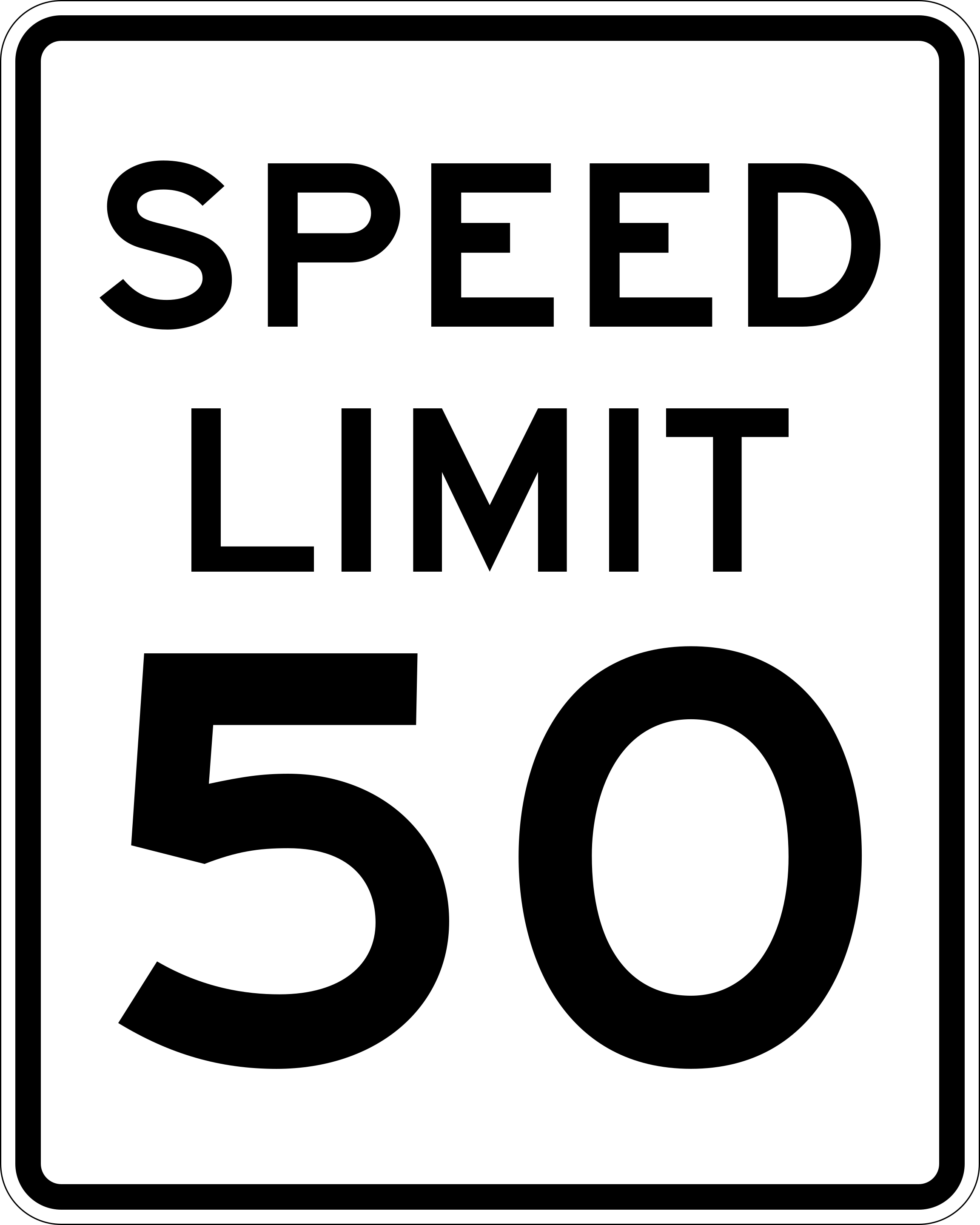
- A traffic guidance sign
- A warning sign
- A traffic regulation sign
- A route marker only
Show answer
A traffic regulation sign. Traffic regulation signs are the category used for rules governing speed or movement. Their messages are mandatory, so a driver follows the posted limit, turn restriction, lane instruction, or similar rule when it applies. Guidance signs instead provide information about roads, entrances, exits, or destinations. Warning signs prepare drivers for conditions and hazards ahead, but they do not serve the same general regulatory role. A route marker identifies a highway or route and is informational rather than a standalone command about how traffic must move.
Study this in the handbook: Warning, regulation and guidance signs
14. A truck, bus, or tractor-trailer is disabled on an Indiana roadway or its shoulder. Instead of reflective triangles, what warning devices may its driver display?
- At least six fuses or three liquid burning flares
- A white flag
- A single reflector
- One flashlight
Show answer
At least six fuses or three liquid burning flares. A driver of a disabled truck, bus, or tractor-trailer must display three bidirectional emergency reflective triangles meeting Federal Motor Vehicle Safety Standard No. 125, or at least six fuses or three liquid burning flares. Place a lighted flare or fuse, red electric lantern, or red reflector on the traffic side of the vehicle, then one device about 100 feet toward approaching traffic and one about 100 feet in the opposite direction. On a divided highway the device goes 200 feet away, and within 500 feet of a curve or hill crest it goes at least 500 feet away. A white flag, a single reflector, or one flashlight is not on the list.
15. When must Indiana drivers use headlights, even if they are not driving at night?
- Whenever the vehicle is on a road with a centerline
- Only when rain lasts more than one hour
- Only when another driver flashes headlights
- When visibility is less than 500 feet
Show answer
When visibility is less than 500 feet. Indiana requires headlights from sunset to sunrise and also whenever visibility is less than 500 feet. The daytime condition is based on what the driver can see, not on the road's centerline, the duration of rain, or another motorist's request. Reduced visibility can occur in fog, severe weather, or another condition that makes objects difficult to detect. Turn the lights on early, keep the vehicle visible, and remember that the rule applies even during daylight when the view ahead is shortened.
Study this in the handbook: Weather, night driving, drowsiness and distraction
16. What kind of condition does an orange traffic sign usually warn drivers about?
- A permitted turn or route toward a destination
- A temporary condition related to highway construction or maintenance
- A nearby state park or other cultural interest site
- A regulation such as a posted speed limit
Show answer
A temporary condition related to highway construction or maintenance. Orange signs concern temporary traffic conditions, especially changes created by highway construction and maintenance projects. Drivers should expect workers, altered lanes, equipment, or a short-term control and adjust speed early. The permitted-movement choice describes green guidance signs, and a state park belongs to the brown category for recreational and cultural interest sites. Speed limits and other rules are displayed on white regulatory signs. Spotting orange should trigger a work-zone mindset: slow down, watch for a flagger or shifted path, and follow each temporary instruction.
Study this in the handbook: Traffic sign colors and shapes
17. When may a driver use an Indiana bicycle lane or bicycle path?
- Whenever traffic is congested
- Whenever the driver is preparing to pass
- Only when signs allow joint use with pedestrians or the driver is on official duty
- Only after a bicyclist waves the vehicle through
Show answer
Only when signs allow joint use with pedestrians or the driver is on official duty. Indiana reserves bicycle paths and lanes for bicycle operation, with narrow exceptions. A driver may enter when signs specify joint use with pedestrians or when the driver is on official duty, such as delivering mail. Congestion does not create a general permission, and preparing to pass is not an exception. A bicyclist also cannot waive away the lane's designated use. Treat the painted lane as protected space unless one of those stated conditions applies. Official duty must be the driver's actual role, not a convenient reason to avoid traffic.
Study this in the handbook: Trucks, motorcycles, bicycles and horse drawn vehicles
18. What are Indiana's local quiet zones at railroad crossings?
- Gated crossings where approaching trains do not sound their horns
- Crossings closed at night
- Zones where trains must slow to 10 mph
- Areas where drivers may not honk
Show answer
Gated crossings where approaching trains do not sound their horns. Be aware of local quiet zones, where locomotive horns are not sounded by approaching trains at some gated crossings. Without the horn warning, you must rely on the gates, lights and your own look and listen check. After one train passes, check that another is not coming the other way behind it. Some trains also run on tracks in the middle of streets, where signals flash red in all directions.
Study this in the handbook: Railroad crossings, work zones and vehicle size limits
19. What is a designated center lane for left turns intended for?
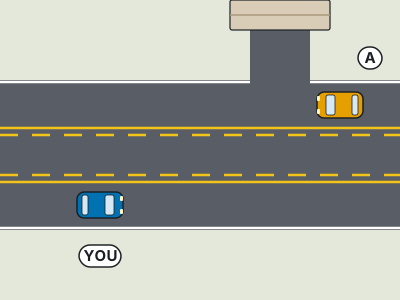
- Left-turning vehicles, not passing
- Continuous straight travel
- Long-term vehicle storage
- Passing slower vehicles in either direction
Show answer
Left-turning vehicles, not passing. A designated center lane on a busy road is reserved for vehicles preparing to turn left. Drivers must not use it to pass, and it is not a through lane or a parking area. Vehicles traveling in the opposite direction may also enter that lane to turn left, so check carefully before moving into it. Look for alternate directional arrows or a CENTER LANE ONLY sign, signal, and use the lane only for the intended turn movement.
Study this in the handbook: Lane markings, lane changes and passing
20. Before making a left turn, what roadway position should a driver use?
- The far-right lane regardless of the road
- The far-left lane for that direction of travel
- The shoulder beside the roadway
- Any lane after crossing the center line
Show answer
The far-left lane for that direction of travel. For a normal left turn, move into the far-left lane for your direction of travel before the turn. The far-right lane is associated with a right turn, while the shoulder is not a turning lane. Crossing the center line to choose a lane is unsafe and may place the vehicle in opposing traffic. Move over well before the intersection, give the signal, and yield to oncoming vehicles and pedestrians before completing the turn.
Study this in the handbook: Lane markings, lane changes and passing
QualitySpace is expanding to Indiana
We are a California-based independent insurance brokerage working on licensing in more states. We cannot help with Indiana insurance yet. Leave your email and we will let you know when we can.
Every question is written from the official Indiana Driver's Manual. Need paper? Printable IN practice test with answer key.
Last verified 2026-10-05. How we check every question · Study all 500 as flashcards
Frequently asked questions
How many questions are on this Indiana practice test?
This fixed set has 20 questions. It is test 4 of 25 from the 500 question Indiana bank.
How does this fixed test relate to the full Indiana bank?
Each numbered test is a fixed set of questions in a fixed order, so you can retake the same test later and compare. Every test mixes road signs and the other topics in about the same proportion as the full bank. Tests 1 to 25 together cover every question in the Indiana bank once. The full practice page mixes the whole bank at random.
Last verified 2026-10-05. See the Indiana DMV facts page for sourced state details.