
Test 8 of 25 · 20 questions · Free 2026
IN Permit Practice Test 8
Jump to the test ↓A fixed 20 question set from the Indiana bank with answers and plain English explanations.
Question 1 of 20 · 0 right so far
All 20 questions in test 8
Every question below comes from the Indiana question bank on this page. Open a question to see the correct answer and the explanation. Nothing here is hidden behind a signup.
1. What is the Indiana speed limit for trucks with a declared gross vehicle weight above 26,000 pounds on a rural interstate?
- 65 mph
- 55 mph
- 60 mph
- 70 mph
Show answer
65 mph. On rural interstates, trucks with a declared gross vehicle weight greater than 26,000 pounds may not exceed 65 mph or the posted limit, while passenger vehicles may go 70 mph. Sixty is the rural divided state highway limit, and 55 is the urban interstate limit. Car drivers should expect heavy trucks to travel slower than surrounding traffic on these roads.
Study this in the handbook: Turns, all way stops, roundabouts and interstates
2. An Indiana driver has nine speeding tickets and one reckless driving conviction within 10 years. What happens?
- Nothing, speeding tickets do not count
- A five-year HTV suspension
- A 10-year HTV suspension
- A lifetime suspension
Show answer
A five-year HTV suspension. Section C of the Habitual Traffic Violator law covers 10 or more traffic violations in 10 years when one is a major offense, and it brings a five-year suspension. The manual uses exactly this example: nine speeding tickets plus one reckless driving conviction. Ten-year suspensions are for Sections A and B, and lifetime is for two intoxicated driving deaths. Speeding tickets count toward the ten. Driving while suspended as an HTV can bring further suspensions set by the court.
Study this in the handbook: Operating while intoxicated and habitual traffic violators
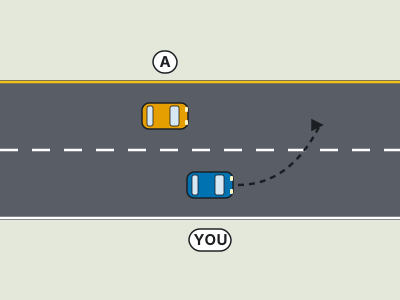
3. When changing lanes, what should a driver do to check the blind spot before moving into the adjacent lane?
- Rely only on the inside rearview mirror
- Briefly turn the head toward the lane being entered
- Turn on the hazard lights and drift over
- Look at the speedometer instead of the adjacent lane
Show answer
Briefly turn the head toward the lane being entered. Indiana's lane-change procedure calls for a brief head turn toward the lane being entered. That check helps reveal a vehicle hidden in the blind spot and confirms there is enough room to move into the adjacent lane. The inside mirror alone cannot show every area beside the vehicle, and the speedometer provides no information about nearby traffic. Hazard lights do not replace a deliberate observation or authorize drifting across the line. Signal after checking the space, then move smoothly only when the lane is clear.
Study this in the handbook: Lane markings, lane changes and passing
4. Which information may a rectangular traffic sign convey?
- Traffic regulations that drivers must obey
- The private ownership of a roadway
- A driver's medical history
- The age of the nearest vehicle
Show answer
Traffic regulations that drivers must obey. A rectangular traffic sign may convey a traffic regulation that drivers must obey, including a speed limit or a turn movement prohibition. The other choices describe private or personal information that traffic signs do not communicate. Rectangular signs can also provide helpful route information and warn about hazardous conditions, but the regulation category is enough to answer this question. When reading one, focus on its words and symbols rather than assuming every rectangle has the same instruction. A speed limit panel is a familiar example of this sign function.
Study this in the handbook: Traffic sign colors and shapes
5. An Indiana driver age 21 or older has six or more active points at renewal. What must the driver do?
- Complete only a vision screening
- Retake the road skills exam automatically
- Take the knowledge exam to renew the license
- Wait until all points disappear before applying
Show answer
Take the knowledge exam to renew the license. At age 21 or older, six or more active points on the driving record trigger the knowledge exam at license renewal. The manual does not make a road-skills exam automatic for this condition, and a vision screening alone is insufficient. The driver also does not have to wait for every point to disappear before applying. Review the active point total at renewal and distinguish this knowledge-test requirement from separate testing rules based on an expired credential or another circumstance.
Study this in the handbook: Renewing, amending and replacing your license
6. What does the slow-moving vehicle emblem indicate?

- A vehicle carrying an oversized load over four feet high
- A vehicle that cannot exceed 25 miles per hour
- A vehicle that must stop at every railroad crossing
- A vehicle traveling at least 45 miles per hour
Show answer
A vehicle that cannot exceed 25 miles per hour. The slow-moving vehicle emblem identifies a vehicle that cannot exceed 25 miles per hour. Its orange fluorescent center and red reflective borders are meant to be recognized from a distance, giving following drivers time to close the speed gap safely. It does not describe a load dimension, guarantee a railroad stop, or indicate a minimum speed. When the emblem appears ahead, ease off the accelerator early, avoid passing without a legal and safe opportunity, and expect the vehicle to travel substantially below ordinary highway speed.
Study this in the handbook: Warning, regulation and guidance signs
7. Which of these signs does the Indiana manual show as an example of a traffic regulation sign?

- Winding Road
- Hospital
- Railroad Crossing
- ONE WAY
Show answer
ONE WAY. The Indiana manual says traffic regulation signs regulate traffic speed as well as movement and display rules which drivers must obey, and ONE WAY appears among its examples of these signs. Winding Road is shown with the warning signs, Hospital appears among the driver services and recreation signs that point to nearby amenities, and the manual says circular signs alert drivers to upcoming railroad crossings. Because a regulation sign states a rule, read its wording and arrows and follow any direction that governs the lane or roadway you are entering.
Study this in the handbook: Warning, regulation and guidance signs
8. After failing an Indiana driving skills exam, how long must the applicant wait to retest?
- The next business day
- Seven days
- 30 days
- Six months
Show answer
Seven days. After a failed driving skills exam, the applicant must wait seven days before retaking it. The next business day rule applies to the knowledge exam, not the skills exam. After a third failed skills exam while holding a learner's permit, the wait grows to two months from the last failure. Thirty days and six months are not Indiana waiting periods.
Study this in the handbook: Learner's permits, knowledge exam and skills exam
9. An Indiana driver is 17 and has held a probationary license for more than 180 days. When may the driver not drive on a Tuesday night without an exception?
- After 9 p.m.
- After 10 p.m.
- After midnight
- After 11 p.m.
Show answer
After 11 p.m.. Once a probationary license has been held for 180 days, a driver under 18 may not drive Sunday through Thursday after 11 p.m., Monday through Friday before 5 a.m., or Saturday and Sunday between 1 a.m. and 5 a.m. Ten p.m. is the earlier curfew for the first 180 days. Nine p.m. and midnight are not the Indiana times. Work, school activities, religious events, or a qualified adult passenger are exceptions.
Study this in the handbook: The probationary license for drivers under 21
10. What should a driver do if a vehicle's wheels drift onto the shoulder?
- Stay on the shoulder, ease off the gas, and return gradually after slowing
- Brake hard and turn sharply toward traffic
- Accelerate along the shoulder until the pavement widens
- Jerk the steering wheel back immediately
Show answer
Stay on the shoulder, ease off the gas, and return gradually after slowing. Indiana warns that an immediate return from the shoulder can throw a vehicle off balance. The safer sequence is to remain along the shoulder, ease up on the gas pedal, slow down, and then guide the vehicle back onto the roadway gradually. A sharp steering correction or hard braking can create a sudden change in traction, while acceleration increases the distance traveled before control is reestablished. Keep both hands steady, look for a safe reentry point, and make the transition only after speed has dropped.
Study this in the handbook: Accidents, collisions and roadside emergencies
11. When an officer stops a driver on a roadway, where should the driver move the vehicle when directed?
- Into the center median so the officer can approach from behind
- Into the nearest travel lane and stop beside moving traffic
- Across the opposite side of a two-lane road
- To the right-side shoulder, not the center median
Show answer
To the right-side shoulder, not the center median. During a law-enforcement stop, the manual directs the driver toward the right-side shoulder while warning against the center median and the opposite side of a two-lane roadway. Those locations can expose both the driver and officer to oncoming traffic. If the shoulder is absent or too narrow, continue slowly to the next safest stopping place rather than forcing an unsafe position. The cue is a safe stopping area on the driver's right. Signal acknowledgment, move over when able, and stop as far off the roadway as practical.
Study this in the handbook: Accidents, collisions and roadside emergencies
12. After moving to Indiana, how long does a new resident have to obtain an Indiana driver's license?
- 14 calendar days
- 45 days
- 60 days
- 120 days
Show answer
60 days. A new Indiana resident has 60 days to obtain an Indiana driver's license. The 14-day and 45-day choices shorten the period and are not the deadline stated for new residents. The 120-day choice extends the time beyond the rule. Think of the requirement as a two-month window that starts when residency begins. That deadline is different from other credential rules, including the time a new driver must hold a learner's permit. Once someone becomes an Indiana resident, the license application should be completed before the 60-day period expires.
Study this in the handbook: Learner's permits, knowledge exam and skills exam
13. What information do white traffic signs commonly display?
- Temporary work-zone conditions only
- Traffic regulations and helpful information such as state highway markers
- Nearby recreational and cultural sites
- Railroad crossings exclusively
Show answer
Traffic regulations and helpful information such as state highway markers. White traffic signs display regulations drivers must obey, including speed limits, and can also provide helpful information such as state highway markers. Temporary traffic conditions are associated with orange signs, while brown signs identify recreational or cultural interests. Railroad crossing warnings are associated with circular signs. The color is a classification clue, so a white sign should prompt attention to a rule or useful roadway information rather than an assumption that it is merely advisory.
Study this in the handbook: Traffic sign colors and shapes
14. What right of way does an official procession such as a funeral procession have?
- Right of way regardless of a conflicting traffic signal
- None if its signal is red
- Right of way only on rural roads
- Right of way only after every vehicle stops
Show answer
Right of way regardless of a conflicting traffic signal. Indiana’s manual gives official processions, including funeral processions, the right of way even when a traffic signal indicates otherwise. That means a driver should not cut through the line or rely on a red or green indication to enter its path. The rule is not limited to rural roads and does not wait for every vehicle in the procession to stop. Look for the connected line of vehicles, remain patient, and let it clear the intersection safely.
Study this in the handbook: Turns, all way stops, roundabouts and interstates
15. Which action helps prevent carbon monoxide poisoning in a vehicle?
- Have the exhaust system checked regularly
- Let the engine run in a closed garage
- Close every vent on a highway in cold weather
- Ignore an unusual roar under the car
Show answer
Have the exhaust system checked regularly. Regular exhaust-system checks help identify leaks before poisonous carbon monoxide enters the passenger compartment. Running an engine in a closed garage can concentrate the gas, and an unusual roar under the car is a warning to investigate rather than ignore. The manual also advises opening the fresh-air vent on highways in cold weather, so closing every vent reverses that guidance. Carbon monoxide has no visible, smellable, or tasteable warning, making prevention and maintenance especially important.
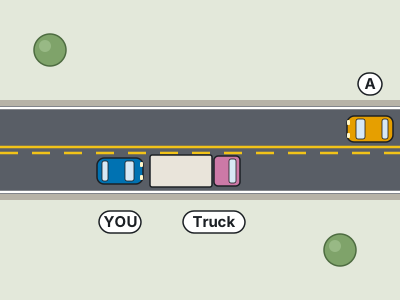
16. A broken yellow line is on the driver's side of a two-way road. When may it be crossed?
- Never, because every yellow line forbids crossing
- Only to park on the opposite shoulder
- To pass another vehicle when it is safe
- Whenever the driver wants to change lanes without signaling
Show answer
To pass another vehicle when it is safe. Yellow markings separate traffic moving in opposite directions. Indiana permits crossing a broken yellow line to pass when the maneuver is safe, while a solid yellow line generally should not be crossed except to turn. The broken marking is not an unlimited permission: the driver still needs clear sight distance, adequate space, and no conflicting traffic. Parking on the opposite shoulder and unsignaled lane changes are not the rule described. The cue is the broken center line combined with a safe opportunity, not the color alone.
Study this in the handbook: Lane markings, lane changes and passing
17. An Indiana motorcycle learner's permit expires after renewal without an endorsement being earned. What happens?
- A new permit is issued immediately
- The rider may keep riding with a passenger
- The rider is fined $500
- The rider must wait one year to reapply, or complete an approved motorcycle safety course
Show answer
The rider must wait one year to reapply, or complete an approved motorcycle safety course. A motorcycle learner's permit is valid for one year and may be issued or renewed no more than three times in a five year period. If you do not obtain a motorcycle endorsement before the expiration of the renewed permit, you must wait one year to reapply for a new motorcycle learner's permit, or you must successfully complete a motorcycle safety course with an approved Ride Safe Indiana provider. A new permit is not issued right away, no fine is described, and riding on without the endorsement is not allowed. The BMV strongly encourages the safety course.
18. How should a driver approach a person riding a horse or operating a horse-drawn vehicle?
- Use the horn to make the rider turn
- Pass closely to avoid delaying traffic
- Approach with caution and watch for hand signals
- Assume the rider must always yield
Show answer
Approach with caution and watch for hand signals. A horseback rider or horse-drawn vehicle deserves the same roadway respect as a motor vehicle. Approach cautiously and watch for hand signals, since the rider may communicate a turn or other movement without ordinary vehicle signals. Passing closely can startle the animal, and using the horn may create an unsafe reaction. The rider does not automatically lose the right to use the road. Slow down, leave room, and read the rider’s signals before proceeding.
Study this in the handbook: Trucks, motorcycles, bicycles and horse drawn vehicles
19. What restraint does Indiana law require for passengers younger than eight years of age?
- A lap belt only
- An adult passenger's arms
- A child restraint system such as a car seat or booster seat
- No restraint in the back seat
Show answer
A child restraint system such as a car seat or booster seat. Passengers younger than eight must be properly secured in a child restraint system, such as a child car seat or booster seat. A lap belt alone is not the manual's stated child restraint requirement, and holding a child in an adult's arms is not a substitute for a secured system. Seating position does not erase the rule. The age cue is under eight, and the equipment cue is an approved child restraint rather than an improvised arrangement inside the vehicle.
Study this in the handbook: Seat belts, child restraints and parking
20. Which activity is specifically prohibited while driving in Indiana unless the telecommunications device is hands free or used to contact 911?
- Adjusting a vehicle mirror
- Listening to a radio broadcast
- Checking the fuel gauge
- Using a cell phone
Show answer
Using a cell phone. Indiana specifically prohibits using a telecommunications device while operating a motor vehicle, with exceptions for hands free communication or a bona fide 911 emergency. Using a cell phone is therefore the activity covered by the rule. Mirror adjustment, radio listening, and reading the fuel gauge are not the telecommunications conduct described in this passage, although any distraction can still be unsafe. The cue is device use while operating, not whether the vehicle is moving quickly or the message seems brief.
Study this in the handbook: Weather, night driving, drowsiness and distraction
QualitySpace is expanding to Indiana
We are a California-based independent insurance brokerage working on licensing in more states. We cannot help with Indiana insurance yet. Leave your email and we will let you know when we can.
Every question is written from the official Indiana Driver's Manual. Need paper? Printable IN practice test with answer key.
Last verified 2026-10-05. How we check every question · Study all 500 as flashcards
Frequently asked questions
How many questions are on this Indiana practice test?
This fixed set has 20 questions. It is test 8 of 25 from the 500 question Indiana bank.
How does this fixed test relate to the full Indiana bank?
Each numbered test is a fixed set of questions in a fixed order, so you can retake the same test later and compare. Every test mixes road signs and the other topics in about the same proportion as the full bank. Tests 1 to 25 together cover every question in the Indiana bank once. The full practice page mixes the whole bank at random.
Last verified 2026-10-05. See the Indiana DMV facts page for sourced state details.