
Test 7 of 25 · 20 questions · Free 2026
IN Permit Practice Test 7
Jump to the test ↓A fixed 20 question set from the Indiana bank with answers and plain English explanations.
Question 1 of 20 · 0 right so far
All 20 questions in test 7
Every question below comes from the Indiana question bank on this page. Open a question to see the correct answer and the explanation. Nothing here is hidden behind a signup.
1. What does a steady yellow traffic light indicate?
- The green light has ended and the signal is about to turn red
- The driver has a new protected turn
- Cross traffic must stop for the next full minute
- The driver may enter regardless of the intersection's condition
Show answer
The green light has ended and the signal is about to turn red. A steady yellow light means the green phase has ended and the signal is about to turn red. A driver approaching the intersection is losing the right of way and should stop if able to do so safely. Yellow does not create a protected turn, impose a timed pause on cross traffic, or permit entry without checking the intersection. If the vehicle is already too close to stop safely, the manual allows completion of the movement rather than a sudden dangerous stop.
Study this in the handbook: Traffic signals and turning on red
2. What does a flashing arrow board that shows no direction mean in an Indiana work zone?
- Stop immediately
- Use caution, but no lane change is required
- The work zone is closed
- Move to the left lane
Show answer
Use caution, but no lane change is required. Flashing arrow boards are often used to indicate a lane closure or crossover, with lane markings, cones, barrels or barricades outlining the path to follow. A flashing arrow board not indicating a direction either way is a signal to use caution but does not require a driver to move over. When an arrow does point, merge early rather than at the last moment so traffic flows smoothly.
Study this in the handbook: Railroad crossings, work zones and vehicle size limits
3. When changing lanes, which action is required before moving into the new lane?
- Use a turn signal to alert other drivers
- Sound the horn continuously
- Wait until another driver signals first
- Turn off all vehicle lights
Show answer
Use a turn signal to alert other drivers. Indiana's lane change rules list the steps in order: make sure there is no traffic ahead in the lane you want to enter, check your mirrors for vehicles preparing to pass you, briefly turn your head toward that lane to check your blind spot, use your turn signal to alert other drivers, and then smoothly move into the new lane. A horn is not a substitute for signaling, and waiting for another driver to signal does not tell others what you plan to do. Turning off lights only reduces visibility. Change only one lane at a time.
Study this in the handbook: Lane markings, lane changes and passing
4. Under Indiana law, aggressive driving during one continuous episode requires at least how many listed actions?
- One
- Two
- Five
- Three
Show answer
Three. Indiana defines aggressive driving as doing or committing at least three listed actions during one episode of continuous driving. The listed conduct includes following too closely, unsafe operation, unnecessary horn use, failure to yield, and unsafe speed. One or two actions do not reach the stated threshold, while five is higher than the minimum described. When reviewing a driving episode, count separate listed behaviors and consider whether they occurred continuously. The key memory cue is three actions in one continuous episode.
Study this in the handbook: Weather, night driving, drowsiness and distraction
5. What does signing a traffic ticket mean in Indiana?
- Only an acknowledgment of receiving the ticket, not an admission of guilt
- Agreement to pay the fine immediately
- Waiver of the right to a hearing
- A guilty plea
Show answer
Only an acknowledgment of receiving the ticket, not an admission of guilt. A traffic ticket requires the driver's signature, and signing it is not an admission of guilt but only an acknowledgment of receiving the ticket. During a stop, do not argue with the officer, do not refuse to sign, and do not be uncooperative. Refusing a breath, urine, blood or performance test when suspected of drunk driving can cost you your driving privileges.
Study this in the handbook: Accidents, collisions and roadside emergencies
6. What score is needed to pass each component of the Indiana knowledge exam?
- 70 percent overall
- 100 percent
- 50 percent
- 80 percent or higher on each component
Show answer
80 percent or higher on each component. On the actual knowledge examination you must have 80 percent or higher correct on each component to pass. The exam is multiple choice and based on Indiana law, defensive driving practices, and the manual; the sign questions come from Chapter 6 and the traffic questions from Chapters 6, 7 and 8. Because each component is scored separately, a strong traffic score cannot rescue a weak signs score.
7. If a vehicle's wheels drift onto the road shoulder, what should the driver do?
- Turn sharply back onto the pavement immediately
- Accelerate until the tires climb back onto the road
- Drive along the shoulder, ease up on the gas, then return gradually
- Stop with the vehicle partly in the traffic lane
Show answer
Drive along the shoulder, ease up on the gas, then return gradually. A sharp return to the pavement can throw the vehicle off balance. The safer sequence is to remain on the shoulder briefly, ease up on the gas pedal to slow, and then guide the vehicle back gradually when it is safe. Accelerating reduces control, while stopping partly in the traffic lane creates a new collision hazard. Keep the steering steady and look for a controlled reentry point. The memory cue is shoulder, slow, gradual return.
Study this in the handbook: Accidents, collisions and roadside emergencies
8. In an urban area with at least 50,000 people, what is the maximum speed on a non-divided state highway when no lower limit is posted?
- 45 miles per hour
- 35 miles per hour
- 65 miles per hour
- 55 miles per hour
Show answer
55 miles per hour. Indiana treats an area with at least 50,000 residents as urban for these default limits. A non-divided state highway there allows up to 55 miles per hour unless a posted limit is lower. The manual's urban list gives 55 for interstates, non-divided state highways and county roads, 30 for most residential areas and 15 for alleys, so neither 45 nor 35 appears on it. Sixty five is a rural interstate figure for heavy trucks and exceeds this urban maximum. Look for the urban population threshold, a state highway without divided lanes, and the absence of a lower posted number.
Study this in the handbook: Speed limits, following distance and stopping
9. For the first 180 days after receiving an Indiana probationary license, during what hours may the driver not drive?
- 10 p.m. to 5 a.m.
- 9 p.m. to 6 a.m.
- 11 p.m. to 4 a.m.
- Midnight to 6 a.m.
Show answer
10 p.m. to 5 a.m.. The initial probationary-license time restriction runs from 10 p.m. through 5 a.m. for the first 180 days. The later restrictions for an under-18 holder after that initial period have different weekday and weekend windows, so those times should not be substituted here. The other choices alter one or both endpoints. Start by identifying whether the driver is still within the first 180 days, then apply the 10 p.m. to 5 a.m. window unless a stated exception applies.
Study this in the handbook: The probationary license for drivers under 21
10. What is the minimum age for an Indiana driver's license without completing a BMV licensed driver education program?
- 16 years
- 16 years and 270 days
- 16 years and 180 days
- 17 years and 6 months
Show answer
16 years and 270 days. With a BMV licensed driver education program, an applicant can be licensed at 16. Without it, the applicant must be at least 16 years and 270 days old. Either way, the applicant needs a valid learner's permit held for at least 180 days, which is why 180 days is a tempting but wrong age figure. Seventeen and a half is not an Indiana threshold. Fifty hours of supervised practice, 10 at night, are also required.
Study this in the handbook: Learner's permits, knowledge exam and skills exam
11. How does a suspended Indiana driver's license affect operating a boat?
- A person with a suspended license may not operate a watercraft
- It has no effect on boating
- Only motorboats over 100 horsepower are affected
- Boating is allowed on private lakes
Show answer
A person with a suspended license may not operate a watercraft. If your driver's license is suspended, you may not operate a watercraft. Boating and driving records are linked in Indiana: operating a watercraft recklessly, while intoxicated, or in violation of watercraft laws can put points on your driver record, and anyone under 15 may not operate a watercraft with more than 10 horsepower. A suspension therefore keeps you off the water as well as the road.
12. What hazard is signaled by a circular traffic sign?

- A school area where children may cross
- An upcoming railroad crossing
- A no-passing zone on a two-way road
- A sharp curve with an advisory speed
Show answer
An upcoming railroad crossing. A circular traffic sign alerts drivers to an upcoming railroad crossing. That shape is an advance cue to look for tracks, signals, gates, and trains, then follow the crossing rules. A five-sided sign marks a school area, a pennant warns against passing, and a rectangular sign can carry an advisory speed. The shape does not tell you whether a train is present, so continue scanning and be prepared to stop. Reduce distractions before the tracks and never assume a quiet crossing is automatically clear.
Study this in the handbook: Traffic sign colors and shapes
13. What do orange traffic signs warn drivers about?
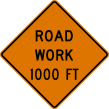
- A permanent speed limit on a state highway
- A nearby hospital or fuel service
- Temporary traffic conditions from construction or maintenance
- A recreational site or state park
Show answer
Temporary traffic conditions from construction or maintenance. Orange signs warn about temporary traffic conditions, especially those created by highway construction and maintenance. A driver seeing orange should expect changed lanes, workers, equipment, or other short-term hazards and follow any posted directions. A permanent speed limit is a regulatory message, services are shown with blue signs, and parks use brown signs. The tempting permanent-speed choice misses the temporary nature of the color. Slow down, watch for workers and channelizing devices, and obey the instructions on the orange sign as the work area approaches.
Study this in the handbook: Traffic sign colors and shapes
14. How far may a fully loaded tractor trailer with hot brakes need to stop, according to Indiana's manual?
- About 140 feet
- About 200 feet
- About 50 feet
- More than 400 feet
Show answer
More than 400 feet. A fully loaded tractor trailer with hot brakes may take more than 400 feet to come to a complete stop, more than the length of a football field, compared with about 130 to 140 feet for a car at 55 mph. Cutting in front of a truck and braking leaves it no room. Trucks also swing wide on turns because the rear wheels follow a shorter path than the front wheels.
Study this in the handbook: Speed limits, following distance and stopping
15. During a traffic stop, where should a driver move when the officer directs a pull-over?
- The opposite side of a two-lane road
- The center median of a freeway
- The right-side shoulder, as far off the roadway as possible
- The left lane beside the patrol vehicle
Show answer
The right-side shoulder, as far off the roadway as possible. Indiana's traffic-stop guidance directs a driver toward the right-side shoulder, with the vehicle pulled as far off the roadway as possible. The center median can expose both people to traffic, and stopping across a two-lane road places the driver and officer near oncoming vehicles. The left-lane choice has no safety basis. If the shoulder is missing or too narrow, continue to the next safest location rather than stopping in a dangerous spot. Signal that you recognize the officer, reduce risk, and follow the patrol vehicle's guidance.
Study this in the handbook: Accidents, collisions and roadside emergencies
16. What does Indiana require during daylight on a load that extends more than four feet beyond the rear of a vehicle?
- A red light at all times
- A red flag of at least 12 square inches at the extreme rear, visible from both sides and the rear
- An orange cone
- Nothing during daylight
Show answer
A red flag of at least 12 square inches at the extreme rear, visible from both sides and the rear. One red flag must be mounted at the extreme rear end of the vehicle's load between sunrise and sunset. The flag must be not less than 12 square inches and visible from both sides and the rear of the vehicle. Between sunset and sunrise a red light replaces the flag. The marker warns following drivers that the load reaches farther back than the vehicle itself.
17. About how far does an average car at 55 mph need to stop, according to Indiana's manual?
- About 50 feet
- About 1,000 feet
- About 400 feet
- Approximately 130 to 140 feet, about half a football field
Show answer
Approximately 130 to 140 feet, about half a football field. The average passenger car traveling at 55 miles per hour can stop in approximately 130 to 140 feet, or about half the length of a football field. A fully loaded tractor trailer with hot brakes may take more than 400 feet, longer than the whole field. That gap is why you should never make a sudden lane change or stop in front of a tractor trailer.
Study this in the handbook: Speed limits, following distance and stopping
18. What do broken white lines normally separate?
- Opposing traffic where passing is always forbidden
- A shoulder and a travel lane that must never be crossed
- Lanes traveling in the same direction where a safe lane change is allowed
- Only lanes reserved for emergency vehicles
Show answer
Lanes traveling in the same direction where a safe lane change is allowed. White lane markings separate multiple lanes moving in the same direction. On most roads with more than two lanes, broken white lines divide those lanes, and a driver may cross one when it is safe to change lanes. They do not separate opposing traffic, which is the job of yellow markings. A broken line is not automatically a shoulder boundary or an emergency-only designation. Check mirrors, the blind spot, and nearby traffic before moving across it, because permission to cross still depends on safety.
Study this in the handbook: Lane markings, lane changes and passing
19. If a collision occurs on the traveled portion of a highway without injury, what should the driver generally do after stopping?
- Leave the vehicle in the travel lane until police arrive
- Drive home before exchanging information
- Move the vehicle off the highway as close to the accident as possible
- Move it only if the other driver agrees
Show answer
Move the vehicle off the highway as close to the accident as possible. Indiana requires a driver involved in a crash to stop immediately or as close as possible without creating unnecessary obstruction. When the accident is on the traveled portion of a highway, the vehicle should be moved off the highway to a nearby location. The manual identifies exceptions when hazardous materials, injury, death, or entrapment are involved, so those circumstances call for leaving the vehicle in place. Do not depart before exchanging required information. The key decision is whether the stated exception makes moving unsafe or improper.
Study this in the handbook: Accidents, collisions and roadside emergencies
20. Which sign is listed in the manual as an example of a white traffic sign?
- SCHOOL BUS STOP AHEAD
- NO TURN ON RED
- SLIPPERY WHEN WET
- STATE PARK
Show answer
NO TURN ON RED. The manual identifies NO TURN ON RED as an example of a white traffic sign. It is a regulatory message, so a driver must obey it even when the intersection otherwise appears clear. SCHOOL BUS STOP AHEAD and SLIPPERY WHEN WET communicate warnings, while STATE PARK identifies a recreational destination. The important cue is that the white sign states a rule governing a movement. Before turning on red, look for this restriction and remember that a full stop and a clear path are required whenever a red turn is otherwise permitted.
Study this in the handbook: Traffic sign colors and shapes
QualitySpace is expanding to Indiana
We are a California-based independent insurance brokerage working on licensing in more states. We cannot help with Indiana insurance yet. Leave your email and we will let you know when we can.
Every question is written from the official Indiana Driver's Manual. Need paper? Printable IN practice test with answer key.
Last verified 2026-10-05. How we check every question · Study all 500 as flashcards
Frequently asked questions
How many questions are on this Indiana practice test?
This fixed set has 20 questions. It is test 7 of 25 from the 500 question Indiana bank.
How does this fixed test relate to the full Indiana bank?
Each numbered test is a fixed set of questions in a fixed order, so you can retake the same test later and compare. Every test mixes road signs and the other topics in about the same proportion as the full bank. Tests 1 to 25 together cover every question in the Indiana bank once. The full practice page mixes the whole bank at random.
Last verified 2026-10-05. See the Indiana DMV facts page for sourced state details.