
Test 12 of 25 · 20 questions · Free 2026
IN Permit Practice Test 12
Jump to the test ↓A fixed 20 question set from the Indiana bank with answers and plain English explanations.
Question 1 of 20 · 0 right so far
All 20 questions in test 12
Every question below comes from the Indiana question bank on this page. Open a question to see the correct answer and the explanation. Nothing here is hidden behind a signup.
1. A crash happened in a rental car and the BMV asks for proof of coverage. Who files the affidavit form?
- The rental company, on the employer or rental vehicle affidavit form
- The driver, on a Certificate of Compliance
- The rental company, with no form at all
- The BMV, after a branch interview
Show answer
The rental company, on the employer or rental vehicle affidavit form. If you were operating a rental vehicle, the rental company must fill out the Affidavit - Proof of Financial Responsibility for Employer or Rental Vehicles - State Form 55434. For a company-owned vehicle, the employer fills out that form. A Certificate of Compliance is submitted electronically by the insurance provider. The cited passage reads: "your employer or the rental company must fill out an Affidavit - Proof of Financial Responsibility for Employer or Rental Vehicles - State Form 55434."
Study this in the handbook: Points, driver safety program and insurance
2. If a crash cannot be avoided, what sort of object should a driver aim for?
- A concrete barrier head on
- A stopped truck from behind
- A tree at full speed
- Something that gives way, like brush or shrubs, rather than something hard
Show answer
Something that gives way, like brush or shrubs, rather than something hard. Choose to hit something that will give way, such as brush or shrubs, rather than something hard. The manual also favors hitting something moving in your direction over something stationary, and something stationary over a head-on collision. A sideswipe may help you slow down. The cited passage reads: "Choose to hit something that will give way, such as brush or shrubs, rather than something hard."
Study this in the handbook: Accidents, collisions and roadside emergencies
3. Above what speed does fuel consumption start climbing steadily for passenger cars and light trucks?
- Above 25 miles per hour
- Above 65 miles per hour
- Only above 75 miles per hour
- Above 45 miles per hour
Show answer
Above 45 miles per hour. Fuel consumption increases steadily above 45 miles per hour. Passenger cars and light trucks use approximately 50 percent more fuel at 75 miles per hour than at 55 miles per hour. The cited passage reads: "Fuel consumption increases steadily above 45 miles per hour, with passenger cars and light trucks using approximately 50 percent more fuel traveling at 75 miles per hour than at 55 miles per hour."
Study this in the handbook: Speed limits, following distance and stopping
4. When may Indiana local authorities set lower school zone speed limits?
- Whenever children are present, beyond the common posted hours
- Only between 7 a.m. and 4:30 p.m. on school days
- Only when beacons are flashing
- Only at the start of the school year
Show answer
Whenever children are present, beyond the common posted hours. Near a school, slow to the lower posted school-zone limit. Common hours are 7 a.m. to 4:30 p.m., Monday through Friday, or when school speed-limit beacons flash. Local authorities may also establish lower limits whenever children are present. The cited passage reads: "may also establish lower speed limits for school zones whenever children are present." Common hours are not the outer bound. Beacons are one trigger, not the only.
Study this in the handbook: Speed limits, following distance and stopping
5. What must a pedestrian never do inside an Indiana roundabout?
- Use the crosswalks at the approaches
- Walk across the circulating lanes to the center island
- Yield to circulating traffic as a driver
- Enter only through right turns
Show answer
Walk across the circulating lanes to the center island. Never walk across the circulating lanes of a roundabout to the center island. Use the approach crosswalks. Vehicles enter and exit through right turns, and incoming traffic yields to traffic circulating in the roundabout. The cited passage reads: "Never walk across the circulating lane(s) in a roundabout to the center island." Approach crosswalks are the walking route. Yielding binds approaching drivers. Right turn entry binds vehicles.
Study this in the handbook: Turns, all way stops, roundabouts and interstates
6. Which act counts toward aggressive driving during one continuous Indiana driving episode?
- Signaling before a lane change
- Overtaking another vehicle on the right by driving off the roadway
- Checking mirrors before merging
- Stopping fully at a stop sign
Show answer
Overtaking another vehicle on the right by driving off the roadway. Overtaking another vehicle on the right by driving off the roadway is one of the acts listed for aggressive driving. Indiana defines aggressive driving as committing at least three listed acts during one continuous driving episode. Other listed acts include following too closely, unsafe stopping, unnecessary horn use, failure to yield, disobeying traffic controls, unsafe speed, and repeatedly flashing headlights.
Study this in the handbook: Turns, all way stops, roundabouts and interstates
7. An applicant under 18 applies for an Indiana learner permit. What contact must be provided?
- An emergency contact aged 18 or older
- A driving instructor phone number
- A parent work address
- An insurance agent contact
Show answer
An emergency contact aged 18 or older. An applicant younger than 18 must provide an emergency contact who is at least 18 years old. The cited passage reads: "provide an emergency contact that is at least 18 years of age or older." The requirement is an emergency contact aged 18 or older; this choice does not specify that requirement. The requirement is an emergency contact aged 18 or older; this choice does not specify that requirement.
Study this in the handbook: Learner's permits, knowledge exam and skills exam
8. The pictured sign marks a parking space. Who is that space reserved for?
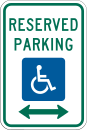
- Any driver stopping for a brief errand
- Drivers with a valid disability parking placard
- Delivery drivers loading freight
- Electric vehicle drivers charging
Show answer
Drivers with a valid disability parking placard. The sign marks parking reserved for people with disabilities. The manual prohibits parking in these spaces without a valid parking placard. It also prohibits parking in the diagonally striped area beside an accessible space, even with a placard, because that area is needed for wheelchair access and ramps. The cited passage reads: "Reserved parking spots for those with disabilities are marked with a sign and pavement markings."
Study this in the handbook: Move Over law, school buses and pedestrians
9. Which vehicles may legally make a U-turn across an interstate median or crossover?
- Any vehicle when traffic is light
- Delivery vans on schedule
- Emergency and highway maintenance vehicles only
- Motorcycles but not cars
Show answer
Emergency and highway maintenance vehicles only. Only emergency vehicles and highway maintenance vehicles are excepted from the prohibition on U-turns across an interstate median or crossover. Other drivers should proceed to the next exit and re-enter in the opposite direction. The cited passage reads: "It is illegal for any vehicle, other than an emergency vehicle or a highway maintenance vehicle, to make a U-turn by crossing the median or crossover of an interstate highway."
Study this in the handbook: Turns, all way stops, roundabouts and interstates
10. A license expired two years ago is being renewed in Indiana. Which combination is required?
- An administrative penalty and a driving skills exam only
- An administrative penalty, a knowledge exam, and a standard vision screening
- A knowledge exam with no penalty or screening
- A driving skills exam and a medical examination
Show answer
An administrative penalty, a knowledge exam, and a standard vision screening. For a license expired two years, the manual requires an administrative penalty, a knowledge exam, and a standard vision screening. Its expiration-based driving-skills-exam requirement begins at five years or more. The cited passage reads: "If you are renewing a driver’s license that has been expired for at least 180 days but not more than five years, you must pay an administrative penalty, pass a knowledge exam, and pass a standard vision screening."
Study this in the handbook: Renewing, amending and replacing your license
11. For a motorcyclist at a steady red signal that fails to turn green, what minimum stop and caution condition does the manual give for proceeding?
- After coming to a complete stop for at least two minutes and exercising due caution
- After stopping for ten seconds and honking
- Immediately, since motorcycles may ignore red lights
- After stopping for five minutes exactly
Show answer
After coming to a complete stop for at least two minutes and exercising due caution. A motorcycle or motor driven cycle operator at a steady red signal that fails to turn green may proceed after a complete stop of at least two minutes while exercising due caution. This rule does not apply to autocycles. The cited passage reads: "An operator approaching an intersection controlled by a traffic signal may proceed through a steady red light if the operator comes to a complete stop for at least two minutes and exercises due caution"
Study this in the handbook: Turns, all way stops, roundabouts and interstates
12. Conventional brakes have failed and the driver tries the parking brake. How should it be held?
- Yank it fully and let go
- Ignore it and steer only
- Hold the release so it can be freed if rear wheels lock
- Pump the gas pedal instead
Show answer
Hold the release so it can be freed if rear wheels lock. If using the parking brake after conventional brake failure, hold the release so you can release the brake to avoid a skid if the rear wheels lock. The manual also advises shifting to a lower gear if possible, pumping the brake pedal fast and hard, and looking for a place to stop off the roadway. The cited passage reads: "You may try to use the parking brake but hold the brake release so it can be released to avoid skidding if the rear wheels lock."
Study this in the handbook: Accidents, collisions and roadside emergencies
13. Which parking habit does Indiana guidance list as a way to make vehicle theft harder?
- Hiding a spare key under the bumper
- Parking with front wheels turned sharply to the right and the emergency brake applied
- Leaving the engine running to save time
- Unlocking one rear door for airflow
Show answer
Parking with front wheels turned sharply to the right and the emergency brake applied. The manual lists parking with the front wheels turned sharply right and applying the emergency brake as precautions that may reduce vehicle theft. It also advises removing keys, locking doors, not hiding spare keys in or around the vehicle, and never leaving the vehicle unattended with the engine running. The cited passage reads: "Park with front wheels turned sharply to the right and apply the emergency brake"
Study this in the handbook: Accidents, collisions and roadside emergencies
14. State Form 42070 for a disability parking placard is complete. How may the placard be obtained?
- Only through a hospital office
- Only through the county clerk
- At any BMV branch or by mailing the form as directed
- Only with a new license plate
Show answer
At any BMV branch or by mailing the form as directed. After completing State Form 42070, you may obtain a disability parking placard at any BMV branch or by mailing the form to the address printed on it. The cited passage reads: "After you have completed State Form 42070, you may get a parking placard at any BMV branch or by mailing it to the address on the form." The manual lists BMV branches and mailing the completed form as the ways to obtain the placard.
15. Which nighttime behavior belongs on Indiana's list of signs that a driver may be impaired?
- Using low beams in traffic
- Stopping fully at stop signs
- Signaling well before turns
- Driving at night without headlights
Show answer
Driving at night without headlights. Driving at night without headlights is one of the manual’s signs that a driver may be impaired. Other signs include wide turns, straddling the center line or weaving, swerving or drifting, stopping for no reason, and inconsistent signaling. The cited passage reads: "Signals inconsistently or drives at night without headlights." Low beams in traffic are lawful courtesy. The manual lists stopping for no reason, not stopping at stop signs, as a possible impairment sign.
Study this in the handbook: Accidents, collisions and roadside emergencies
16. Red colored pavement on an Indiana road enhances which lanes?
- Bike lanes
- Fire lanes only
- Bus or transit lanes
- Shoulder areas
Show answer
Bus or transit lanes. Red pavement may be used to improve the visibility of bus or transit lanes designated for buses, taxis, or other public transit. Green pavement may be used to improve the visibility of bicycle lanes. The cited passage reads: "Red colored pavement may be used to enhance the visibility of bus or transit lanes that are designated for buses, taxis, or other modes of public transit."
Study this in the handbook: Trucks, motorcycles, bicycles and horse drawn vehicles
17. How should a driver handle glare from oncoming headlights at night?
- Stare into the lights to adjust faster
- Close one eye until cars pass
- Look at the center line the whole time
- Look toward the right side of the road instead of directly into the lights
Show answer
Look toward the right side of the road instead of directly into the lights. Oncoming headlights may reduce vision. To avoid glare, do not look directly into the lights of an approaching vehicle; focus on the right side of the road instead. The cited passage reads: "The glare of oncoming headlights may also reduce vision. To avoid glare, do not look directly into the lights of an approaching vehicle, and instead focus on the right side of the road."
Study this in the handbook: Weather, night driving, drowsiness and distraction
18. Which spot is a prohibited place to park in Indiana?
- In a legal marked space
- In an unrestricted space away from any hydrant
- In an open space with no signs
- On a bridge or other elevated structure
Show answer
On a bridge or other elevated structure. Parking on bridges or other elevated structures, such as on a highway or a tunnel, is prohibited in Indiana. The same list of prohibited areas includes highways unless indicated otherwise, intersections, pedestrian crosswalks, sidewalks, the front of any driveway, areas within 15 feet of a fire hydrant, fire lanes, spaces next to yellow curbs, and the spot beside another parked vehicle. Always look for signs before leaving a car.
Study this in the handbook: Turns, all way stops, roundabouts and interstates
19. A court finds a parent delinquent on child support. What may the court order the BMV to do?
- Immediately suspend driving privileges until a court order reinstates them
- Add four points to the record
- Renew the license early as hardship relief
- Place a veteran indicator on the card
Show answer
Immediately suspend driving privileges until a court order reinstates them. A court finding a parent delinquent in child support may order the BMV to suspend driving privileges immediately until the BMV receives a court order to reinstate them. The cited passage reads: "A court that has determined a parent is delinquent in paying child support may order the BMV to immediately suspend the delinquent parent’s driving privileges until the BMV receives an order from the court to reinstate the parent’s driving privileges."
Study this in the handbook: Operating while intoxicated and habitual traffic violators
20. Under the BMV rule for drivers under 21, which conviction history may require completion of a Driver Safety Program?
- After a single parking ticket
- After any one speeding conviction
- After conviction for two or more traffic offenses
- Only after a crash causing injury
Show answer
After conviction for two or more traffic offenses. The BMV may require an Indiana driver under 21 to complete a BMV-approved Driver Safety Program after convictions for two or more traffic offenses. A judge may separately order a driver who commits a traffic offense to attend a DSP. Failure to complete a BMV-required course within 90 days of the mailed notice results in suspension until completion is processed.
Study this in the handbook: Points, driver safety program and insurance
QualitySpace is expanding to Indiana
We are a California-based independent insurance brokerage working on licensing in more states. We cannot help with Indiana insurance yet. Leave your email and we will let you know when we can.
Every question is written from the official Indiana Driver's Manual. Need paper? Printable IN practice test with answer key.
Last verified 2026-10-05. How we check every question · Study all 500 as flashcards
Frequently asked questions
How many questions are on this Indiana practice test?
This fixed set has 20 questions. It is test 12 of 25 from the 500 question Indiana bank.
How does this fixed test relate to the full Indiana bank?
Each numbered test is a fixed set of questions in a fixed order, so you can retake the same test later and compare. Every test mixes road signs and the other topics in about the same proportion as the full bank. Tests 1 to 25 together cover every question in the Indiana bank once. The full practice page mixes the whole bank at random.
Last verified 2026-10-05. See the Indiana DMV facts page for sourced state details.