
Test 6 of 25 · 20 questions · Free 2026
IN Permit Practice Test 6
Jump to the test ↓A fixed 20 question set from the Indiana bank with answers and plain English explanations.
Question 1 of 20 · 0 right so far
All 20 questions in test 6
Every question below comes from the Indiana question bank on this page. Open a question to see the correct answer and the explanation. Nothing here is hidden behind a signup.
1. Which vehicle is required to make a stop at a railroad crossing under Indiana's listed special-stop rule?
- A private sedan carrying only its driver
- A vehicle carrying explosives or flammable liquids
- A bicycle approaching a marked crossing
- A passenger car following a school bus at a safe distance
Show answer
A vehicle carrying explosives or flammable liquids. Indiana identifies vehicles carrying explosives or flammable liquids as one class that must always stop at railroad crossings. The same list includes vehicles carrying passengers for hire and all school buses. A private sedan does not join that special category merely because it is approaching a crossing, and the other choices do not describe the listed duty. The stop must be no closer than 15 feet and no farther than 50 feet from the nearest rail. Remember the range before entering a crossing.
Study this in the handbook: Railroad crossings, work zones and vehicle size limits
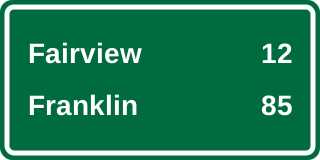
2. What kind of information does a green traffic sign provide?
- A warning about a temporary work zone
- A warning that the pavement is slippery
- A legal requirement to stop immediately
- Permitted movements, directions, or guidance
Show answer
Permitted movements, directions, or guidance. Green signs guide a driver through permitted movements and directions, including highway entrances, exits, and distances to destinations. They help with navigation rather than announcing a pavement hazard or a stop command. Yellow signs warn about road conditions, red signs convey urgent regulations, and orange signs identify temporary construction conditions. When a green sign appears, use its route or destination information to plan the next movement, while still obeying separate regulatory signs and signals. Green guidance never cancels a posted speed limit or other traffic control.
Study this in the handbook: Traffic sign colors and shapes
3. A flashing raised hand at a pedestrian signal tells a person who has not entered the street to:
- Begin crossing before the signal changes
- Cross only in the center lane
- Not start crossing
- Wait for a vehicle to wave them through
Show answer
Not start crossing. Indiana's pedestrian signals show DON'T WALK or a raised hand when it is not safe for pedestrians to cross, and the words or symbols flash to alert pedestrians that the time to safely cross is ending. A person who has not yet entered the street should therefore not start crossing. The flashing hand is not an invitation to hurry across, waiting for a motorist to wave is not part of the signal, and the center lane has no special role. Start crossing only when the WALK display or walking person symbol appears.
4. Which group accounts for 64 percent of fatigue-related crashes, according to Indiana's manual?
- Drivers over 65
- Commercial drivers
- Parents of teenagers
- Young adults ages 16 to 29
Show answer
Young adults ages 16 to 29. Although anyone can make the fatal mistake of driving without adequate rest, young adults ages 16 to 29 are at the highest risk, accounting for 64 percent of fatigue related accidents. Warning signs include falling asleep at stop lights, yawning and heavy eyelids, missing road signs, and not remembering the last few miles. Be prepared to stop driving when any of them appear.
Study this in the handbook: Weather, night driving, drowsiness and distraction
5. If conventional disc or drum brakes suddenly fail, which response is recommended first?
- Shift lower and pump the brake pedal fast and hard
- Release the steering wheel and coast in neutral
- Turn sharply toward the nearest curb
- Apply the accelerator to restore brake pressure
Show answer
Shift lower and pump the brake pedal fast and hard. With conventional disc or drum brake failure, the manual advises shifting to a lower gear if possible and pumping the brake pedal fast and hard several times. That action may build enough pressure to stop the vehicle. A sharp turn can cause a collision or loss of control, while coasting in neutral removes engine braking. Pressing the accelerator cannot restore braking. If the parking brake is tried, the release should be held so it can be released if the rear wheels lock.
Study this in the handbook: Accidents, collisions and roadside emergencies
6. What do yellow lane markings separate on an Indiana roadway?
- Traffic lanes moving in the same direction only
- A bicycle lane from a sidewalk
- Traffic lanes moving in opposite directions
- A parking lane from a loading zone
Show answer
Traffic lanes moving in opposite directions. Yellow lane markings divide traffic traveling in opposing directions. That is why a driver must evaluate a centerline before crossing it for a pass or turn. White lane markings usually separate lanes moving in the same direction, so confusing the two colors can lead to an unsafe movement across opposing traffic. The marking does not by itself identify a bicycle facility or curbside loading space. The cue is a yellow line near the roadway center: expect oncoming vehicles and obey whether the line is broken or solid.
Study this in the handbook: Lane markings, lane changes and passing
7. How much does an Indiana Official Driver Record cost?
- $4
- $25
- Free
- $10
Show answer
$4. A viewable driver record is available through a myBMV.com account, and an Official Driver Record may be purchased for $4. Any outstanding reinstatement requirements and the reinstatement eligibility date appear in the Reinstatement Requirements box near the top of the record. If a court still holds the suspension, the court's phone number is listed so the driver can resolve it.
Study this in the handbook: Points, driver safety program and insurance
8. How far below the area's established maximum must a work-site speed limit be set at minimum?
- At least 5 miles per hour below it
- At the same speed, with no reduction required
- Exactly 15 miles per hour below it
- At least 10 miles per hour below it
Show answer
At least 10 miles per hour below it. Indiana requires work-site speed limits to be at least 10 miles per hour below the maximum established speed for that area. The rule gives a minimum reduction, not an exact reduction of 15, so a work zone may be set lower when its signs require that. Five miles per hour is insufficient, and matching the normal limit ignores the work-site requirement. Watch for the posted work-zone number and whether its sign says the limit applies only while flashing or at all times.
Study this in the handbook: Speed limits, following distance and stopping
9. Unless a different sign is posted, what speed may a vehicle not exceed in most Indiana urban residential areas?
- 15 mph
- 30 mph
- 25 mph
- 45 mph
Show answer
30 mph. The manual sets most urban residential areas at no more than 30 miles per hour or the posted speed limit. Fifteen miles per hour applies to alleys, and 45 miles per hour is not the listed default for this setting. The 25 mile choice may sound cautious, but it is not the figure Indiana gives for most urban residential roads. Remember the location label, because the nearby urban rules use different numbers for interstates, county roads, and alleys.
Study this in the handbook: Speed limits, following distance and stopping
10. In Indiana, two HTV judgments within ten years for intoxicated driving resulting in death can lead to what suspension?
- A 90 day suspension
- A five year suspension
- A lifetime suspension
- A ten year suspension
Show answer
A lifetime suspension. The manual distinguishes two major HTV outcomes. Two qualifying judgments within ten years ordinarily produce ten years, but two judgments for operating while intoxicated resulting in death, or with a .08 percent BAC or more resulting in death, produce a lifetime suspension. That special offense category makes the lifetime choice fit, while the five year option belongs to Section C's ten traffic offenses with a major offense. The ten year choice is the tempting near miss because it applies to other Section A offenses, not this specified fatal intoxication pattern.
Study this in the handbook: Points, driver safety program and insurance
11. What kind of roadway condition may a rectangular traffic sign warn drivers about?
- An upcoming railroad crossing identified by a circular sign
- A hazardous condition such as a sharp curve
- A temporary construction zone identified by an orange sign
- A school area identified by a five-sided sign
Show answer
A hazardous condition such as a sharp curve. Indiana lists hazardous conditions among the information rectangular signs may convey, including an advisory speed for a sharp curve. The railroad-crossing choice describes the role of circular signs, while a five-sided sign warns that a driver is entering an area near a school. Orange signs are associated with temporary traffic conditions such as construction or maintenance. When a rectangle shows an advisory speed or another hazard message, treat it as advance information about the roadway and adjust before reaching the condition.
Study this in the handbook: Traffic sign colors and shapes
12. What do warning signs do for a driver?

- Prepare the driver for upcoming road conditions and hazards
- Authorize the driver to exceed the posted speed limit
- Guarantee that the road ahead is free of pedestrians
- Replace all traffic signals at the next intersection
Show answer
Prepare the driver for upcoming road conditions and hazards. Warning signs prepare drivers for road conditions and hazards that are coming up. They do not grant permission to speed, promise that the roadway is clear, or replace a signal. A driver should use the advance notice to adjust speed, position, and attention before reaching the condition shown. For example, a pedestrian or slippery-road symbol calls for active scanning and smooth control. Treat the warning as an early cue, then obey the separate regulation, signal, or person controlling traffic at the location.
Study this in the handbook: Warning, regulation and guidance signs
13. When must an Indiana learner's permit holder retest at renewal?
- Every time the permit is renewed
- Only after a traffic conviction
- When the permit has been expired for more than 180 days
- Never, once the knowledge test is passed
Show answer
When the permit has been expired for more than 180 days. Indiana learner's permits are valid for two years from the date of issuance. If you visit a BMV branch to renew your learner's permit and it has been expired more than 180 days, you are required to retest. Renewal by itself does not trigger a retest, a traffic conviction is not the stated trigger, and passing the knowledge exam once does not excuse a permit that has lapsed beyond 180 days. Every applicant, including one renewing a permit, must also pass a vision screening unless eligible for online renewal.
Study this in the handbook: Learner's permits, knowledge exam and skills exam
14. Where are pennant-shaped traffic signs posted?
- On the left-hand side of two-way roads
- On the right side of one-way roads
- At school entrances
- Near railroad tracks
Show answer
On the left-hand side of two-way roads. Pennant-shaped traffic signs are posted on the left-hand side of two-way roads. The right side of a one-way road, a school entrance, and a railroad crossing are not the locations named for this sign shape. The manual uses circular signs for railroad crossings and five-sided signs for school areas. The same pennant sign warns drivers not to pass other vehicles on the left, and it marks a No Passing Zone. When you see one, remain behind the vehicle ahead until passing becomes legal and safe.
Study this in the handbook: Traffic sign colors and shapes
15. What are Indiana's minimum liability insurance limits?
- $25,000 per person, $50,000 per accident for bodily injury, and $25,000 property damage, known as 25/50/25
- $15,000, $30,000 and $10,000
- $50,000, $100,000 and $50,000
- $100,000 combined single limit
Show answer
$25,000 per person, $50,000 per accident for bodily injury, and $25,000 property damage, known as 25/50/25. The state minimum insurance standard is $25,000 for bodily injury or death of one individual, $50,000 for bodily injury or death of two or more people in one accident, and $25,000 for property damage in one accident, commonly called 25/50/25 liability insurance. Driving without it brings suspensions and reinstatement fees, and the insurer must file a Certificate of Compliance electronically when the BMV requests proof.
Study this in the handbook: Points, driver safety program and insurance
16. How close to a railroad crossing is passing prohibited under Indiana's listed passing rules?
- Within 25 feet
- Within 250 feet
- Only on the tracks themselves
- Within 100 feet
Show answer
Within 100 feet. Indiana lists railroad crossings among locations where passing is prohibited within 100 feet. That buffer applies before the crossing, when sight lines and the crossing environment demand extra attention. Twenty-five feet is shorter than the stated distance, while 250 feet is not the figure given. Waiting until the vehicle is physically on the tracks would defeat the safety purpose. Scan for the crossing early, remain in your lane, and do not begin a passing maneuver inside the 100-foot approach area.
Study this in the handbook: Lane markings, lane changes and passing
17. What does Indiana's manual identify as the most common factor in collisions?
- Speeding
- Weather
- Failure to yield the right of way
- Mechanical failure
Show answer
Failure to yield the right of way. Among all collisions in Indiana, failure to yield the right of way is the most common factor. Accidents are often caused by a driver's lack of attention, a failure to observe the rules of the road, or both. Knowing who must yield at intersections, when turning left, when entering from a driveway, and at crosswalks removes the single biggest cause of crashes.
Study this in the handbook: Accidents, collisions and roadside emergencies
18. How long do points stay active on an Indiana driver record?
- Six months
- Five years
- Ten years
- Two years from the conviction date
Show answer
Two years from the conviction date. Points stay active for two years from the date of conviction. Six months is too short. Five years is the Habitual Traffic Violator suspension for ten violations in ten years, and ten years is the look-back period for HTV status, so neither is the points rule. A driver 21 or older with six or more active points at renewal must retake the knowledge exam, so old points can still matter at renewal time.
Study this in the handbook: Points, driver safety program and insurance
19. When facing a green arrow at an intersection, when may a driver turn through it?
- Only after waiting for a second solid green arrow
- When the intersection is clear
- Immediately, even if a pedestrian is in the path
- Only after yielding to every vehicle behind the driver
Show answer
When the intersection is clear. A green arrow gives the driver the right of way for the indicated movement, but the intersection still must be clear before entering. The arrow is not permission to drive into an occupied path, and it does not require waiting for another arrow or yielding to vehicles behind. Scan for pedestrians, stalled vehicles, and traffic that has not cleared. The visual cue is a directional green arrow paired with the signal. Use its movement authority only after confirming the space needed for the turn is open.
Study this in the handbook: Traffic signals and turning on red
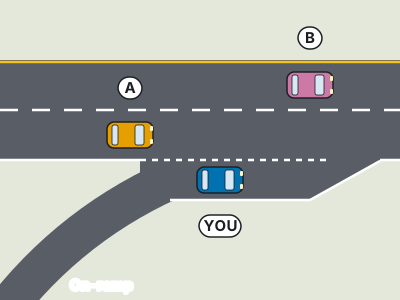
20. Who must yield when a driver enters an Indiana interstate from an on-ramp?
- Interstate traffic must stop for the merging driver
- The driver entering from the ramp yields to interstate traffic
- Both streams must stop before the merge
- The entering driver has priority if signaling
Show answer
The driver entering from the ramp yields to interstate traffic. A driver entering an interstate must yield the right of way to vehicles already traveling on it. The ramp driver should use the acceleration lane to build speed and merge when the path is clear, but signaling does not reverse the yield requirement. Interstate traffic does not have to stop, and both streams are not required to stop. Look for a safe opening while matching the flow, with priority remaining with vehicles already on the highway.
Study this in the handbook: Turns, all way stops, roundabouts and interstates
QualitySpace is expanding to Indiana
We are a California-based independent insurance brokerage working on licensing in more states. We cannot help with Indiana insurance yet. Leave your email and we will let you know when we can.
Every question is written from the official Indiana Driver's Manual. Need paper? Printable IN practice test with answer key.
Last verified 2026-10-05. How we check every question · Study all 500 as flashcards
Frequently asked questions
How many questions are on this Indiana practice test?
This fixed set has 20 questions. It is test 6 of 25 from the 500 question Indiana bank.
How does this fixed test relate to the full Indiana bank?
Each numbered test is a fixed set of questions in a fixed order, so you can retake the same test later and compare. Every test mixes road signs and the other topics in about the same proportion as the full bank. Tests 1 to 25 together cover every question in the Indiana bank once. The full practice page mixes the whole bank at random.
Last verified 2026-10-05. See the Indiana DMV facts page for sourced state details.