
Test 5 of 25 · 20 questions · Free 2026
IN Permit Practice Test 5
Jump to the test ↓A fixed 20 question set from the Indiana bank with answers and plain English explanations.
Question 1 of 20 · 0 right so far
All 20 questions in test 5
Every question below comes from the Indiana question bank on this page. Open a question to see the correct answer and the explanation. Nothing here is hidden behind a signup.
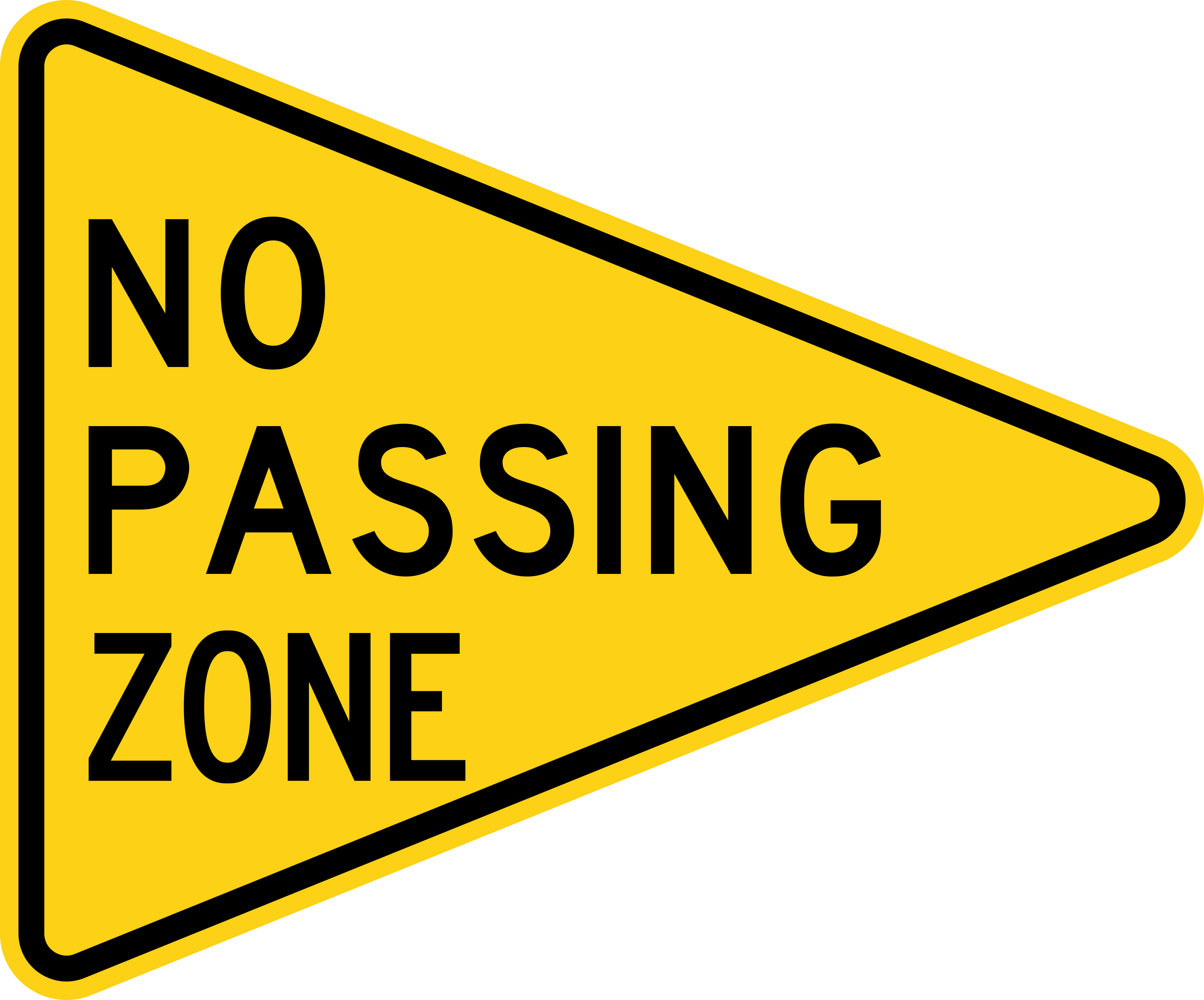
1. On a two-way road, what does the yellow pennant-shaped sign pictured warn drivers not to do?
- Turn right at the next intersection
- Pass another vehicle on the left
- Stop for a school bus on the shoulder
- Enter a highway from an acceleration lane
Show answer
Pass another vehicle on the left. Indiana uses the pennant shape for a No Passing Zone warning. The sign is posted on the left side of a two-way road and tells drivers that passing on the left is unsafe or prohibited in the approaching area. It is not a turn restriction, a school-bus command, or a merge instruction. A useful roadside cue is the unusual flag-like outline on the left side of the roadway. Once seen, remain behind the slower vehicle until passing becomes lawful and the roadway provides enough visibility.
Study this in the handbook: Traffic sign colors and shapes
2. What does a red flashing traffic light at an Indiana intersection require a driver to do?
- Slow without stopping if the cross street is empty
- Treat it as a yellow signal and continue carefully
- Wait for a green arrow before moving in any direction
- Treat it as a stop sign and stop completely before proceeding with caution
Show answer
Treat it as a stop sign and stop completely before proceeding with caution. A red flashing light is equivalent to a stop sign. The driver must come to a complete stop, then proceed with caution only after the applicable right of way is clear. Slowing without stopping treats the signal like a yellow light, and waiting for a green arrow adds a condition the manual does not require. The key visual cue is the flashing red display: stop first, then check vehicles and pedestrians before entering the intersection.
Study this in the handbook: Traffic signals and turning on red
3. How long is an Indiana learner's permit valid for a resident who is not a lawful temporary resident?
- 180 days
- 12 months
- Six years
- Two years
Show answer
Two years. Learner's permits are valid for two years from the date of issuance, except for lawful temporary residents, whose permits end with their authorized stay. If a permit has been expired more than 180 days, the holder must retest to renew it. One hundred eighty days is that retest window and also the holding period before a license. One year is the motorcycle permit term, and six years is the driver's license term for drivers under 75.
Study this in the handbook: Learner's permits, knowledge exam and skills exam
4. Until what age is an Indiana probationary driver's license valid?
- 18 years exactly
- 21 years exactly
- 21 years and 30 days
- 25 years
Show answer
21 years and 30 days. A license obtained before 21 is probationary until the holder turns 21, and it is valid until the driver is 21 years and 30 days old. The driver may not renew it until 21 years and one day, and renewal then gives an unrestricted license. Eighteen is when the under-18 curfews end, not the license expiration. Exactly 21 ignores the 30-day window, and 25 is the supervising driver age.
Study this in the handbook: The probationary license for drivers under 21
5. What suspension follows an Indiana motorist's refusal to submit to a chemical test when there is no prior intoxicated driving conviction?
- One year
- 180 days
- Two years
- 30 days
Show answer
One year. A motorist who refuses a chemical test faces a one year suspension under the manual. The 180 day choice applies when the motorist fails the chemical test, not when the test is refused. Two years is reserved for a refusal by someone with a previous conviction for operating while intoxicated. A useful test question cue is to separate refusal from failure first, then check whether a prior conviction is mentioned. Without that prior conviction, refusal maps to one year.
Study this in the handbook: Operating while intoxicated and habitual traffic violators
6. How long does an Indiana driver ordered to take a Driver Safety Program have to complete it?
- 10 days
- 30 days
- 90 days from the notice
- One year
Show answer
90 days from the notice. Drivers required by the BMV to take a Driver Safety Program must finish it within 90 days of the mailed notice, or their driving privileges are suspended until they complete it. Ten and 30 days are too short, and a year is too long. Any driver can take a BMV-approved course for a four-point credit, but only once every three years.
Study this in the handbook: Points, driver safety program and insurance
7. What does an Indiana yield sign require as a driver approaches an intersection?
- Slow down and be ready to stop for a vehicle or pedestrian with the right of way
- Accelerate so cross traffic must brake first
- Stop at the sign every time, even when the approach is empty
- Enter without checking because a yield sign gives unconditional priority
Show answer
Slow down and be ready to stop for a vehicle or pedestrian with the right of way. A yield sign reduces the driver's priority at the intersection. The approach should be slow enough to evaluate traffic and pedestrians, with a complete stop available if someone with the right of way is approaching. The sign does not create an automatic stop in every empty approach, nor does it authorize a driver to make others brake. A good cue is whether another road user would need to change speed to avoid you. If so, wait and let that road user proceed first.
Study this in the handbook: Turns, all way stops, roundabouts and interstates
8. What does a yellow flashing light without an arrow mean at an Indiana intersection?
- Slow down and use caution while traveling through
- Stop and wait until a steady green light appears
- Speed up because cross traffic must stop for you
- Turn left immediately without checking pedestrians
Show answer
Slow down and use caution while traveling through. A yellow flashing light without an arrow calls for a cautious approach, not a full stop every time and not an invitation to hurry. A driver should reduce speed and watch the intersection carefully. Someone turning left still must yield to oncoming traffic and pedestrians, while cross-street traffic is required to yield to the flashing-light approach. The visual cue is intermittent yellow with no directional arrow. Proceed only after checking for people or vehicles that could enter the path, especially when visibility is limited.
Study this in the handbook: Traffic signals and turning on red
9. If water on the roadway is deeper than the tire treads, what does the manual advise a driver to do?
- Use high beams and maintain the posted maximum
- Slow down and use headlights to be seen
- Brake hard while driving through every puddle
- Speed up to prevent the tires from touching water
Show answer
Slow down and use headlights to be seen. When water is deeper than the tire treads, Indiana advises slowing down and using headlights so other drivers can see the vehicle. Maintaining maximum speed increases the danger of hydroplaning, and high beams are not the stated response. Hard braking in every puddle can reduce control, while speeding up raises the risk created by standing water. Ease off the accelerator, keep the vehicle steady, and leave extra space. The practical cue is depth at the tires, not the posted limit alone, because deeper water can quickly reduce traction.
Study this in the handbook: Weather, night driving, drowsiness and distraction
10. How early may a U.S. citizen renew an Indiana driver's license?
- Only in the final 30 days
- Up to 6 months before
- Up to 24 months before it expires
- Only after it expires
Show answer
Up to 24 months before it expires. A driver's license or identification card may be renewed by U.S. citizens or individuals with permanent lawful status up to 24 months before the credential expiration. Individuals with lawful temporary status can renew only up to 30 days before expiration, and a learner's permit may be renewed up to 30 days before it expires. Renewal includes a standard vision screening unless online renewal applies.
Study this in the handbook: Renewing, amending and replacing your license
11. What does Indiana's manual recommend packing in a vehicle during winter?
- A bag of salt only
- Blankets, extra gloves and warm hats in case you must wait for help or a tow
- Extra fuel cans
- Nothing beyond a phone
Show answer
Blankets, extra gloves and warm hats in case you must wait for help or a tow. During winter months, pack blankets, extra gloves and warm hats in your vehicle in case you must wait for emergency responders or a tow. If you must exit on a roadside shoulder, leave by the passenger side and only after checking for traffic, obstructions or drop offs. Place a warning triangle 200 feet behind the vehicle, or 500 feet on a hill or curve.
Study this in the handbook: Accidents, collisions and roadside emergencies
12. What type of traffic information is conveyed by a red sign?

- A nearby recreational or cultural attraction
- A regulation requiring immediate action for traffic safety
- A temporary highway construction condition only
- A permitted movement or route direction
Show answer
A regulation requiring immediate action for traffic safety. Indiana's manual assigns red to traffic regulations that require immediate action to avoid threats to traffic safety. The manual's example is the Wrong Way sign, so a driver should respond promptly rather than treat the color as general route information. Brown identifies recreational and cultural interest sites, orange warns about temporary construction conditions, and green provides permitted movements or directions. When a red sign appears, read its message and carry out the required action before continuing. The red background signals urgency, while the wording supplies the specific command.
Study this in the handbook: Traffic sign colors and shapes
13. What reinstatement fee follows a second Indiana no-insurance suspension that occurred before 2015?
- $150
- $300
- $1,000
- $225
Show answer
$225. For no insurance suspensions prior to January 1, 2015, the reinstatement fees are $150 for a first suspension, $225 for a second, and $300 for a third and subsequent suspensions. Different fees apply to suspensions after that date. A driver may reinstate without paying the no insurance fee by having the insurer electronically submit proof of future financial responsibility, an SR22, and keeping it in force.
Study this in the handbook: Points, driver safety program and insurance
14. In a multi-lane roundabout, when should a driver choose the needed lane?
- After stopping on the center island
- Before entering the circulatory roadway
- Only after passing the exit
- By changing lanes repeatedly inside the circle
Show answer
Before entering the circulatory roadway. In a multi-lane roundabout, drivers should know which lane they need before entering the circulatory roadway. Changing lanes inside the circle is discouraged because it places vehicles alongside one another while they are negotiating exits. The center island is not a stopping area, and choosing after passing an exit is too late for a smooth path. Read the lane signs and pavement arrows on approach, select the proper lane, and maintain it through the movement.
Study this in the handbook: Turns, all way stops, roundabouts and interstates
15. What does a yellow pennant-shaped traffic sign warn drivers about?
- A nearby fuel station
- A railroad crossing
- A no passing zone
- A school entrance
Show answer
A no passing zone. The pennant shape is used on the left-hand side of a two-way road to warn that drivers should not pass other vehicles on the left. A fuel service sign is an information sign, a railroad crossing uses a circular warning shape, and a school area uses a five-sided shape. Read both the shape and placement together. The left-side pennant is a strong visual cue that the roadway is entering a no passing zone.
Study this in the handbook: Traffic sign colors and shapes
16. A driver is following a vehicle that has slowed and may be turning. What should the following driver do?
- Pass immediately on the shoulder
- Accelerate until the lead vehicle turns
- Slow down and be prepared to stop
- Follow at the same speed without watching the signal
Show answer
Slow down and be prepared to stop. When a lead driver signals an intention to turn, or slows in a way that suggests a turn may be coming, the following driver should slow down and be ready to stop. Passing on the shoulder is not a safe substitute for anticipating the maneuver. Accelerating removes the space needed if the turn begins suddenly, and holding the same speed ignores the warning created by the lead vehicle's change. Watching for a turn signal and easing off early provides a useful safety margin.
Study this in the handbook: Turns, all way stops, roundabouts and interstates
17. Why should a driver reduce speed when roadway conditions include bad weather and poor visibility?
- The vehicle's speedometer becomes inaccurate
- Poor visibility improves tire traction
- The law changes every posted limit to 15 mph
- Those conditions make posted-speed travel more dangerous
Show answer
Those conditions make posted-speed travel more dangerous. The manual identifies bad weather and poor visibility as conditions that make driving at the posted speed, or above it, more dangerous. The speedometer does not become inaccurate, and the manual does not impose a universal 15 mph replacement limit. Poor visibility also does not improve traction. The useful driving cue is to lower speed early, increase attention, and leave more time to recognize hazards instead of treating the posted number as a target in every condition.
Study this in the handbook: Speed limits, following distance and stopping
18. How far ahead may an Indiana driving skills exam be scheduled?
- No more than three weeks and no less than 48 business hours ahead
- Up to six months ahead
- At least 30 days ahead
- Same day only
Show answer
No more than three weeks and no less than 48 business hours ahead. A driving skills exam may be scheduled no more than three weeks, and no less than 48 business hours, ahead of time through IN.gov/BMV or the BMV Contact Center, though a license branch visit may get you a sooner slot. You must provide your own legally equipped, insured vehicle in safe and clean condition, and the examiner may reject an unsuitable vehicle. The BMV charges nothing for the exam itself.
Study this in the handbook: Learner's permits, knowledge exam and skills exam
19. What does a steady DON'T WALK hand symbol mean at a pedestrian signal?
- It is not safe to cross
- Walk only with a police escort
- Cross after sounding the horn
- Cross if traffic appears light
Show answer
It is not safe to cross. The steady hand marks a period when pedestrians should not enter the street. A light traffic gap does not override the signal, and a horn or escort is not part of the ordinary crossing rule. The signal exists to coordinate people on foot with traffic movements at the intersection. Use the WALK display when it permits crossing, and treat the hand as a clear barrier to starting. Remember that a flashing hand also signals that the remaining crossing time is running out.
20. When following a tractor-trailer, what should you do if you cannot see its rearview mirrors?
- Move closer so the driver notices you
- Turn on high beams and stay behind it
- Pass immediately on the right
- Maintain or increase your following distance
Show answer
Maintain or increase your following distance. If the truck’s rearview mirrors are not visible, the truck driver cannot see your vehicle. Increasing space gives you a cushion if the larger vehicle brakes suddenly or if something appears in the roadway. Closing the gap removes reaction time, while passing on the right creates another hazard beside a vehicle with large blind spots. High beams do not solve the visibility problem. Use the mirror check as a practical cue: if you cannot see the truck’s mirrors, back out of its blind area.
Study this in the handbook: Trucks, motorcycles, bicycles and horse drawn vehicles
QualitySpace is expanding to Indiana
We are a California-based independent insurance brokerage working on licensing in more states. We cannot help with Indiana insurance yet. Leave your email and we will let you know when we can.
Every question is written from the official Indiana Driver's Manual. Need paper? Printable IN practice test with answer key.
Last verified 2026-10-05. How we check every question · Study all 500 as flashcards
Frequently asked questions
How many questions are on this Indiana practice test?
This fixed set has 20 questions. It is test 5 of 25 from the 500 question Indiana bank.
How does this fixed test relate to the full Indiana bank?
Each numbered test is a fixed set of questions in a fixed order, so you can retake the same test later and compare. Every test mixes road signs and the other topics in about the same proportion as the full bank. Tests 1 to 25 together cover every question in the Indiana bank once. The full practice page mixes the whole bank at random.
Last verified 2026-10-05. See the Indiana DMV facts page for sourced state details.