
Test 15 of 25 · 20 questions · Free 2026
IN Permit Practice Test 15
Jump to the test ↓A fixed 20 question set from the Indiana bank with answers and plain English explanations.
Question 1 of 20 · 0 right so far
All 20 questions in test 15
Every question below comes from the Indiana question bank on this page. Open a question to see the correct answer and the explanation. Nothing here is hidden behind a signup.
1. In a skid with conventional brakes, which way should the steering wheel turn?
- Sharply away from the slide at once
- Hard to the opposite lock and hold it
- In a controlled manner toward the direction the rear of the car is sliding
- Straight ahead with no steering at all
Show answer
In a controlled manner toward the direction the rear of the car is sliding. If traction is lost or the rear wheels slide sideways, ease off the gas. With conventional brakes, turn the wheel in a controlled manner toward the direction the rear of the car is sliding. When traction returns, straighten the vehicle and proceed slowly. Do not turn quickly away from the skid or steer too far, which could cause a spin.
Study this in the handbook: Speed limits, following distance and stopping
2. Restriction 7 appears on an Indiana credential. What does that code mark?
- A medical condition notation
- Lawful temporary resident status
- Seat Belt Exempt status
- HTV Conditional status
Show answer
Seat Belt Exempt status. Restriction 7 marks Seat Belt Exempt status on the credential. A medical condition notation sits at Restriction 8, one step later in the same numbered list, which makes it an easy misread. Lawful temporary resident status belongs to Restriction 9, the final entry. HTV Conditional status belongs to Restriction 2, far from this part of the list. Because exemptions and notations sit side by side, read the number and its label together before assuming a belt duty has changed, and keep written medical support available if an officer asks about the exemption.
3. How much pressure can tires lose over a single month, and how often should they be checked?
- Up to 1 pound per square inch each month, so check monthly or before long trips
- Up to 5 pounds per square inch each week, checked yearly
- No pressure is ever lost between checks
- Up to 10 pounds per square inch each month, checked daily
Show answer
Up to 1 pound per square inch each month, so check monthly or before long trips. Tires have been known to lose up to 1 psi per month. Check all tires, including the spare, once a month or before a long trip. Check them cold and compare the pressure with the vehicle’s recommended pressure on the door-jamb sticker or in the owner’s manual. The cited passage reads: "Tires have been known to lose up to 1 pound per square inch (psi) every month, so check all tires, including your spare, once a month or before a long trip. Here’s how:"
4. What happens when tire tread falls below about 1/16 of an inch?
- Fuel economy improves by half
- The penny test starts passing again
- The ability to grip the road in adverse conditions is greatly reduced
- Rain traction stays exactly the same
Show answer
The ability to grip the road in adverse conditions is greatly reduced. In the penny test, any part of Lincoln’s head covered by the tread indicates the manual’s legal and safe amount of tread. Below approximately 1/16 inch, the vehicle’s grip in adverse conditions is greatly reduced. Check tires for wear and damage monthly or before a long trip. The cited passage reads: "If your tread gets below that (approximately 1/16 of an inch), your car’s ability to grip the road in adverse conditions is greatly reduced."
5. Which item does the manual list for a winter survival kit?
- A bag of road salt for the highway
- Spare license plates
- Sand or strips of carpet for traction
- A second set of tires
Show answer
Sand or strips of carpet for traction. The manual suggests carrying a winter survival kit that includes sand or strips of carpet for traction, booster cables, blankets, a shovel, a flashlight, extra clothing, candles, matches, nonperishable snack food, and bottled water. It also advises driving with a full tank of gas so that the heater can stay in use as long as possible if you are stranded, and letting the engine warm up before driving in very cold conditions.
6. After applying for a renewed Indiana credential, within what period will the permanent card be mailed?
- Within 3 calendar days
- Within 14 calendar days
- Within 45 calendar days
- Within 90 calendar days
Show answer
Within 14 calendar days. The permanent credential will be mailed from a secure central location within 14 calendar days after application. It is mailed only to the mailing address on file with the BMV and will not be forwarded. The cited passage reads: "Your permanent credential will be mailed to you from a secure central location, within 14 calendar days, after you apply" The manual specifies mailing within 14 calendar days, not three.
7. A driver renews an Indiana credential a week after it expired. What applies to everyone in that spot?
- An administrative penalty
- A mandatory driving skills exam
- A six month suspension
- A new knowledge exam in every case
Show answer
An administrative penalty. The manual states that all individuals are subject to an administrative penalty when a credential is renewed after expiration. For a license expired only one week, the expiration-based thresholds of 180 days for a knowledge exam and five years for a driving skills exam have not been reached. The cited passage reads: "All individuals are subject to an administrative penalty if your credential is renewed after the expiration date."
Study this in the handbook: Renewing, amending and replacing your license
8. What can a button near the base of a pedestrian signal or stop sign do?
- Turn the traffic light green for cars
- Call the police
- Extend the school zone hours
- Activate the walk signal
Show answer
Activate the walk signal. At some intersections there is a button near the base of the pedestrian signal or stop sign that may be pushed to activate the walk signal. Pedestrian signals show the word WALK or a walking person when it is safe to cross, and DON'T WALK or a raised hand when it is not. Those displays flash to warn that the time to cross safely is ending, so drivers should expect people to enter the crosswalk after pressing the button.
9. A driver waiting to turn is in the middle of an intersection when the light turns red. What may the driver do?
- Back out of the intersection at once
- Stop and wait for the next green cycle
- Turn immediately regardless of oncoming traffic
- Turn once oncoming traffic has stopped
Show answer
Turn once oncoming traffic has stopped. If you are in the middle of an intersection when the signal turns red, you may turn once oncoming traffic has stopped. The permission to turn depends on oncoming traffic stopping; it does not permit an immediate turn regardless of that traffic. The cited passage reads: "If you are in the middle of an intersection, you may turn once oncoming traffic has stopped."
Study this in the handbook: Traffic signals and turning on red
10. For drivers and front seat passengers, wearing seat belts raises survival chances by how much?
- By 10 percent
- By 45 percent
- By 90 percent
- Belts do not change survival
Show answer
By 45 percent. Seat belts increase the chance of survival for drivers and front-seat passengers by 45 percent and reduce the risk of serious injury by 50 percent. The cited passage reads: "When worn, seat belts for drivers and front-seat passengers increase the chance of survival by 45 percent and cut the risk of serious injury by 50 percent." Ten shrinks a proven effect. Ninety overstates protection.
Study this in the handbook: Move Over law, school buses and pedestrians
11. Green colored pavement on an Indiana roadway highlights what?
- Truck parking zones
- School crosswalks only
- Toll payment lanes
- Visibility of bike lanes
Show answer
Visibility of bike lanes. Green colored pavement may be used to enhance the visibility of bike lanes. Red colored pavement may be used to enhance the visibility of bus or transit lanes. The cited passage reads: "Green colored pavement may be used to enhance the visibility of bike lanes." The manual associates green pavement with bike-lane visibility, not truck parking. The manual associates green pavement with bike-lane visibility, not school crosswalks only.
Study this in the handbook: Trucks, motorcycles, bicycles and horse drawn vehicles
12. An adult signs financial liability for an Indiana minor at the branch. What must that adult show?
- The minor school report card
- Proof of Indiana voter registration
- A valid identification from the BMV identity document list
- The minor completed practice log
Show answer
A valid identification from the BMV identity document list. An adult who co-signs financial liability must present valid identification from the BMV identity documentation list while the minor applies for a learner’s permit or driver’s license. The identification is for the adult who is accepting financial liability. The cited passage reads: "The adult who co-signs for financial liability must present a valid form of identification from the BMV’s identity documentation list to the BMV while the minor is applying for a learner’s permit or driver’s license."
Study this in the handbook: The probationary license for drivers under 21
13. The pictured blue sign lists GAS, FOOD, and LODGING. What kind of information does this sign give?
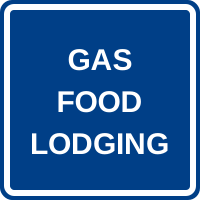
- Road services and amenities at an upcoming exit
- Distances to the next towns
- Recreation and park sites
- A temporary road condition warning
Show answer
Road services and amenities at an upcoming exit. A blue sign listing gas, food, and lodging gives road services and amenity information for an upcoming exit. Distances to towns ride on green guidance signs, so that reading borrows the job of another color. Recreation and park sites belong to brown signs, which point toward leisure stops rather than fuel and beds. A temporary condition warning comes on orange, the construction family color. Use color as the shortcut: blue serves the stop ahead, green guides the route, and orange warns of work. Plan the exit before reaching it.
Study this in the handbook: Traffic sign colors and shapes
14. A judge orders a driver to attend a Driver Safety Program. When does the four point credit actually land on the record?
- After any driving course the driver picks
- Only after completing a BMV approved Driver Safety Program course
- After enrolling but before attending
- After paying the court fine only
Show answer
Only after completing a BMV approved Driver Safety Program course. For a court-ordered Driver Safety Program, the court determines the type of program required. The four-point credit is applied only if the driver completes a BMV-approved DSP. Allow 7 to 10 business days for completion results to be processed. The cited passage reads: "However, the four-point credit will only be applied to your driver record if you complete a BMV-approved DSP course." Unapproved courses earn no credit.
Study this in the handbook: Points, driver safety program and insurance
15. After escaping a vehicle that plunged into water, what must occupants never do?
- Re enter the vehicle to gather possessions
- Call 911 from the roof
- Exit through an open window
- Move children toward the front seats
Show answer
Re enter the vehicle to gather possessions. Never re-enter the vehicle to gather possessions. The manual directs occupants to remove seat belts, open a window, move passengers to the front seats, exit onto the roof, and call 911. The cited passage reads: "arrived by the time your vehicle sinks below the waterline, you may be forced to swim. • Never re-enter the vehicle to gather possessions." Roof calls are encouraged.
Study this in the handbook: Accidents, collisions and roadside emergencies
16. A law enforcement officer directing traffic gives a command that conflicts with a signal or sign. What controls?
- The traffic signal always controls
- The law enforcement officer command must be obeyed
- The posted sign always controls
- Drivers may pick either instruction
Show answer
The law enforcement officer command must be obeyed. When an officer directing traffic gives a command that differs from a traffic signal or sign, the officer’s command must be obeyed. The cited passage reads: "In such a case, the law enforcement officer’s command is the one that must be obeyed." Signals yield to live direction. Signs yield to live direction. The officer’s command must be obeyed when it conflicts with a signal or sign.
Study this in the handbook: Turns, all way stops, roundabouts and interstates
17. When may a vehicle stop or park on the shoulder of an interstate highway?
- Whenever the driver needs a short rest
- Only in an emergency or when the vehicle is disabled
- At any scenic overlook without signs
- During light traffic at night
Show answer
Only in an emergency or when the vehicle is disabled. Except in an emergency or when a vehicle is disabled, do not stop or park on the shoulder of an interstate highway. The cited passage reads: "Except in the event of an emergency or a disabled vehicle, do not stop or park a vehicle on the shoulder of an interstate highway." A short rest is not one of the stated exceptions. Scenery is not one of the stated exceptions to the shoulder-parking rule.
Study this in the handbook: Turns, all way stops, roundabouts and interstates
18. A driver wins a photo exemption for a credential. Must a photo still be captured?
- Yes, a photo must still be captured and kept on file by the BMV
- No photo is captured in any form
- A photo is captured only after five years
- The driver supplies a printed photo instead
Show answer
Yes, a photo must still be captured and kept on file by the BMV. Even when a photo exemption is allowed, a photo must still be captured and kept on file by the BMV. The cited passage reads: "If a photo exemption is allowed, a photo must still be captured to be kept on file by the BMV." The file photo is still captured. The manual requires a photo to be captured even when the exemption is allowed; it does not provide a five-year delay.
19. How does exceeding the posted speed limit affect stopping in an emergency?
- It shortens the distance needed to stop
- It extends the distance required to stop
- It has no effect on dry roads
- It helps only if the brakes are new
Show answer
It extends the distance required to stop. Exceeding the posted limit reduces your ability to steer safely around curves or objects and extends the distance required to stop in an emergency. Higher speed also raises crash severity. The manual also notes that crash severity rises with speed. Slow down in bad weather, on slick or icy roads, and when tires are worn, because the posted limit is a maximum for good conditions and not a target.
Study this in the handbook: Turns, all way stops, roundabouts and interstates
20. A driver holds court granted specialized driving privileges. What must be carried while driving?
- The sentencing judge home address
- Only a verbal claim of permission
- An SR26 cancellation notice
- A copy of the court order, in person or in the vehicle
Show answer
A copy of the court order, in person or in the vehicle. A person with specialized driving privileges must carry a copy of the court order or keep it in the vehicle and produce it when requested by law enforcement. The person must also maintain an effective SR22 on file with the BMV for the duration of those privileges. The cited passage reads: "Carry a copy of the court order granting specialized driving privileges or have the order in the vehicle being operated by the person"
Study this in the handbook: Operating while intoxicated and habitual traffic violators
QualitySpace is expanding to Indiana
We are a California-based independent insurance brokerage working on licensing in more states. We cannot help with Indiana insurance yet. Leave your email and we will let you know when we can.
Every question is written from the official Indiana Driver's Manual. Need paper? Printable IN practice test with answer key.
Last verified 2026-10-05. How we check every question · Study all 500 as flashcards
Frequently asked questions
How many questions are on this Indiana practice test?
This fixed set has 20 questions. It is test 15 of 25 from the 500 question Indiana bank.
How does this fixed test relate to the full Indiana bank?
Each numbered test is a fixed set of questions in a fixed order, so you can retake the same test later and compare. Every test mixes road signs and the other topics in about the same proportion as the full bank. Tests 1 to 25 together cover every question in the Indiana bank once. The full practice page mixes the whole bank at random.
Last verified 2026-10-05. See the Indiana DMV facts page for sourced state details.