
Test 13 of 25 · 20 questions · Free 2026
IN Permit Practice Test 13
Jump to the test ↓A fixed 20 question set from the Indiana bank with answers and plain English explanations.
Question 1 of 20 · 0 right so far
All 20 questions in test 13
Every question below comes from the Indiana question bank on this page. Open a question to see the correct answer and the explanation. Nothing here is hidden behind a signup.
1. How often does the manual say to brush snow off your headlights and taillights in winter weather?
- Once at the start of winter
- Frequently
- Only after a storm ends
- Only at night
Show answer
Frequently. The manual says to brush the snow off your headlights and taillights frequently. Snow, especially when mixed with wind, can sharply reduce visibility, so you need working lights both to see and to be seen by other drivers. Also use your headlights in snow, always watch for icy conditions at intersections, and remember that ramps, bridges, and overpasses may freeze before other parts of the roadway.
2. Facing a green light with no arrow, how many vehicles at a time may move into an intersection to turn left?
- Two vehicles at a time
- Three vehicles at a time
- Only one vehicle at a time
- As many as fit inside the intersection
Show answer
Only one vehicle at a time. At a green light without an arrow, you may turn when the intersection is clear and must yield to oncoming traffic. Only one vehicle at a time may move into the intersection to turn left. The cited passage reads: "Only one vehicle at a time may move into an intersection to turn left." The manual permits only one vehicle at a time to enter for a left turn.
Study this in the handbook: Traffic signals and turning on red
3. A court sends reinstatement information to the Indiana BMV. How long may BMV processing take?
- The same business day in all cases
- Up to 30 calendar days
- Up to 10 business days after the BMV receives it
- Up to 90 days
Show answer
Up to 10 business days after the BMV receives it. BMV processing may take up to 10 business days after receiving the information from the court. The stated period starts at receipt, not when the court sends the information. The cited passage reads: "Processing by the BMV may take up to 10 business days once the information is received from the court." Same day handling is not promised. Thirty days overstates the window.
Study this in the handbook: Points, driver safety program and insurance
4. Which set of signs can point to carbon monoxide poisoning inside a vehicle?
- Drowsiness, bluish skin or lips, headache, and light sensitivity
- Hunger, thirst, and dry eyes only
- A ringing phone and bright dashboard
- Itchy skin and a runny nose only
Show answer
Drowsiness, bluish skin or lips, headache, and light sensitivity. The manual lists drowsiness or dizziness, a bluish tinge to the skin or lips, headache, and increased sensitivity to light as possible symptoms of carbon monoxide poisoning. Carbon monoxide cannot be seen, smelled, or tasted. The cited passage reads: "Symptoms of carbon monoxide poisoning can include drowsiness or dizziness, a bluish tinge to your skin or lips, a headache, and increased sensitivity to light."
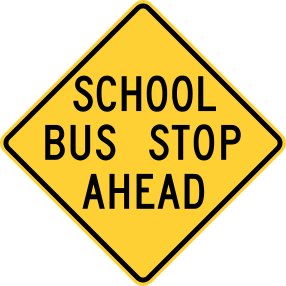
5. The pictured sign warns of a school bus stop ahead. What should a driver be prepared to do there?
- Speed up and clear the area before the bus arrives
- Treat the sign as a ban on parking
- Be prepared to stop as the bus comes to a stop
- Stop only if children are already in the road
Show answer
Be prepared to stop as the bus comes to a stop. The pictured sign warns that a school bus stop lies ahead, where a bus will slow and halt to load or unload children. When yellow flashing lights appear on that bus, they warn drivers the bus will be coming to a stop, so traffic should be ready to stop rather than roll past. Speeding up to clear the area before the bus halts gambles against children stepping toward the curb. Treating the sign as a parking ban misses its warning purpose entirely. Slow early, scan both curbs for children, and expect the red lights and stop arm next.
Study this in the handbook: Trucks, motorcycles, bicycles and horse drawn vehicles
6. A driver nears the crest of a steep Indiana hill on a two lane road. What positioning is required?
- Move left for a better view
- Slow down and move to the right side while watching ahead
- Pass quickly before the crest
- Ride the center line
Show answer
Slow down and move to the right side while watching ahead. Before approaching the crest of a steep hill, slow down, move to the right side of the road, and watch for oncoming vehicles. Never attempt to pass another vehicle when approaching a steep hill or crest. The cited passage reads: "Before approaching the crest of a steep hill, slow down, move to the right side of the road, and watch for oncoming vehicles. Never attempt to pass another vehicle when approaching a steep hill or crest."
Study this in the handbook: Turns, all way stops, roundabouts and interstates
7. A parent applies for an Indiana credential. Which school related situation can help establish residency?
- Having a child at an out of state college
- Owning a vacation home in Indiana
- Working summers in Indiana
- Having a dependent enrolled in an Indiana elementary or secondary school
Show answer
Having a dependent enrolled in an Indiana elementary or secondary school. The manual lists having a dependent enrolled in an Indiana elementary or secondary school as evidence of Indiana residency. It also lists an Indiana residential address without claiming another state as home and being a registered Indiana voter. The cited passage reads: "• Having a dependent who is enrolled in an elementary or secondary school located in Indiana" The listed school-based evidence is a dependent enrolled in an Indiana elementary or secondary school.
Study this in the handbook: Learner's permits, knowledge exam and skills exam
8. During parallel parking, after the front of the car draws even with the front door of the car ahead, the driver turns the wheel sharply right and backs until the car sits at what angle?
- A 20-degree angle
- A 30-degree angle
- A 90-degree angle
- A 45-degree angle
Show answer
A 45-degree angle. Reverse slowly until the front of your vehicle is even with the front door of the parallel car. Turn sharply right and reverse slowly to a 45-degree angle. When your vehicle’s front passes the rear of the parallel car, turn left sharply, then gradually, while backing into the space. The cited passage reads: "Reverse slowly until the front of the vehicle is even with the front door of the parallel car. Turn the wheel sharply to the right and reverse slowly until the vehicle is at a 45-degree angle"
Study this in the handbook: Turns, all way stops, roundabouts and interstates
9. Which set defines distracted driving in Indiana guidance?
- Any activity taking eyes off the road, hands off the wheel, or mind off driving
- Only texting behind the wheel
- Only eating while the vehicle moves
- Only phone calls without a headset
Show answer
Any activity taking eyes off the road, hands off the wheel, or mind off driving. Distracted driving includes any activity taking your eyes off the road, hands off the wheel, or mind off driving. Examples include cell-phone use, texting, and eating. The manual says sending or reading a text takes your eyes off the road for five seconds, which at 55 mph is like driving the length of an entire football field with your eyes closed.
Study this in the handbook: Weather, night driving, drowsiness and distraction
10. A car breaks down in daylight and the driver sets out warning devices. What should be displayed about 100 feet ahead of and behind the car?
- Two orange cones borrowed from a work zone
- Two red flags, one in front and one behind
- One lit flare in front only
- A white flag in front and a red flag behind
Show answer
Two red flags, one in front and one behind. In daytime, a disabled car must display two red flags, approximately 100 feet in front and 100 feet behind. If the car is within 500 feet of a curve, hilltop, or other obstruction, a warning device must be at least 500 feet from the car. The cited passage reads: "In the daytime, drivers of disabled cars must display two red flags: one approximately 100 feet in front of the car and the other approximately 100 feet behind it."
11. What credential must a person hold to operate an autocycle in Indiana?
- A motorcycle endorsement
- A valid Indiana driver license, with no motorcycle permit needed
- A motorcycle learner permit
- Only an identification card
Show answer
A valid Indiana driver license, with no motorcycle permit needed. You may operate an autocycle on Indiana roadways with a valid Indiana driver’s license. A motorcycle learner’s permit or motorcycle endorsement is not required. The operator and each occupant must wear a seat belt. The cited passage reads: "You may operate an autocycle on Indiana roadways if you possess a valid (not expired, suspended, or revoked) Indiana driver’s license. A motorcycle learner’s permit or motorcycle endorsement is not required."
12. Two large trucks enter a multi-lane roundabout together. Which truck driver must yield?
- The driver in the left lane yields to the right
- The first truck to sound its horn proceeds
- The driver in the right lane yields to the driver in the left lane
- Both trucks proceed side by side at speed
Show answer
The driver in the right lane yields to the driver in the left lane. If two large trucks approach or drive through a roundabout at the same time, the driver in the right lane must yield to the driver in the left lane, slowing or stopping as needed for safe passage. Drivers approaching or driving through a multi-lane roundabout must also yield to large vehicles using it at the same time. The cited passage reads: "If two large trucks are approaching or driving through a roundabout at the same time, the driver in the right lane must yield the right of way to the driver in the left lane."
Study this in the handbook: Turns, all way stops, roundabouts and interstates
13. How does the manual describe excessive speed when conditions are ideal?
- Safe if the driver is alert
- Dangerous, and it increases the likelihood of an accident
- Safe on dry roads
- Dangerous only on interstates
Show answer
Dangerous, and it increases the likelihood of an accident. Excessive speed, even when conditions are ideal, is dangerous and increases the likelihood of an accident. Driving at or above the limit in bad weather, on slick roads, or with worn tires is even more dangerous. The effect is worse in bad weather and poor visibility, on slick or icy roads, with unsafe vehicle conditions or worn tires, and when the driver is impaired. Indiana law requires drivers to operate vehicles at the posted speed limit.
Study this in the handbook: Speed limits, following distance and stopping
14. A 19 year old holds an Indiana CDL. Which work may that driver legally do?
- Drive interstate commerce routes freely
- Drive a school bus on intrastate routes
- Drive any commercial vehicle without limits
- Drive a commercial vehicle in intrastate commerce only, with no school bus endorsement
Show answer
Drive a commercial vehicle in intrastate commerce only, with no school bus endorsement. Drivers under 21 may operate commercial motor vehicles for intrastate commerce only and may not apply for school bus endorsements. The cited passage reads: "Drivers under 21 years of age may operate a commercial motor vehicle for purposes of intrastate commerce only and are not eligible to apply for the school bus endorsements." Interstate work waits until 21. School bus endorsements are closed under 21.
15. A 17 year old is cited for operating a vehicle while intoxicated in Indiana. Who may also recommend suspension?
- The Juvenile Court
- The school principal only
- The BMV branch manager only
- A parent or legal guardian only
Show answer
The Juvenile Court. When a driver under 18 is cited for operating a vehicle while intoxicated, the Juvenile Court may also recommend suspension of the driver’s privileges. This provision applies to the 17-year-old in the question. The cited passage reads: "When a driver who is under 18 years of age is cited for operating a vehicle while intoxicated, the Juvenile Court may also recommend a suspension of his or her driving privileges."
Study this in the handbook: Operating while intoxicated and habitual traffic violators
16. How should lane changes be handled when a driver needs to cross several lanes?
- Change only one lane at a time
- Cross all lanes in one sweep
- Change two lanes per signal flash
- Weave quickly between lanes
Show answer
Change only one lane at a time. Change only one lane at a time. Check traffic ahead, mirrors, and the blind spot; signal your intention and move smoothly into the new lane. Do not weave in and out of lanes, because this greatly increases accident risk. The cited passage reads: "Change only one lane at a time. When changing lanes to prepare for a turn, you must give a proper signal before turning or changing lanes."
Study this in the handbook: Lane markings, lane changes and passing
17. Why are Automated Flagger Assistance Devices used at some work sites?
- To replace every speed limit sign
- To close the road to all traffic
- To let flaggers be positioned out of the lane of traffic
- To time the nearby traffic signals
Show answer
To let flaggers be positioned out of the lane of traffic. Automated Flagger Assistance Devices enable flaggers to be positioned out of the lane of traffic. The devices display a STOP or a SLOW sign just like the flagger held sign paddle, or they use red and yellow lights. Obey whichever message or light the device shows as you would a flagger, stopping or proceeding slowly as directed, and keep your speed reduced inside the work zone, where workers are close to traffic and lanes may be narrow.
Study this in the handbook: Railroad crossings, work zones and vehicle size limits
18. An Indiana driver is convicted of unsafe lane movement. How many points result?
- No points if nobody was hurt
- Seven points
- Two points for lane movement
- Four points for lane movement
Show answer
Four points for lane movement. Unsafe lane movement carries four points. The manual also assigns four points to disregarding a stop or yield sign, and two points to no brake or signal lights. The cited passage reads: "Unsafe lane movement 4 points Disregarding a stop sign or yield sign" The tally follows the conviction, not luck. Unsafe lane movement carries four points, not seven. Two prices it like a lighting defect.
Study this in the handbook: Points, driver safety program and insurance
19. Which rule applies to everyone riding in an autocycle in Indiana?
- Each occupant must wear a seat belt
- A motorcycle endorsement is required
- Two autocycles may share one lane side by side
- An autocycle may be used for a skills exam
Show answer
Each occupant must wear a seat belt. The operator and each occupant of an autocycle must wear a seat belt. A valid Indiana driver’s license is required, but a motorcycle permit or endorsement is not. More than one autocycle may not operate in a single traffic lane, and an autocycle may not be used for a driver’s license skills exam. The cited passage reads: "Operator and each occupant must wear a seat belt"
20. What is the fastest speed allowed when operating a motor driven cycle in Indiana?
- 25 miles per hour top
- 45 miles per hour top
- 55 miles per hour top
- 35 miles per hour top
Show answer
35 miles per hour top. An MDC must be operated at no more than 35 miles per hour. It must have its headlamps illuminated, must not carry passengers, and must not be operated on an interstate highway or sidewalk. The cited passage reads: "Must operate at no more than 35 miles per hour" Twenty five understates the allowance. Forty five exceeds what these machines may do. Fifty-five miles per hour exceeds the MDC maximum of 35 miles per hour.
QualitySpace is expanding to Indiana
We are a California-based independent insurance brokerage working on licensing in more states. We cannot help with Indiana insurance yet. Leave your email and we will let you know when we can.
Every question is written from the official Indiana Driver's Manual. Need paper? Printable IN practice test with answer key.
Last verified 2026-10-05. How we check every question · Study all 500 as flashcards
Frequently asked questions
How many questions are on this Indiana practice test?
This fixed set has 20 questions. It is test 13 of 25 from the 500 question Indiana bank.
How does this fixed test relate to the full Indiana bank?
Each numbered test is a fixed set of questions in a fixed order, so you can retake the same test later and compare. Every test mixes road signs and the other topics in about the same proportion as the full bank. Tests 1 to 25 together cover every question in the Indiana bank once. The full practice page mixes the whole bank at random.
Last verified 2026-10-05. See the Indiana DMV facts page for sourced state details.