
Test 17 of 25 · 20 questions · Free 2026
IN Permit Practice Test 17
Jump to the test ↓A fixed 20 question set from the Indiana bank with answers and plain English explanations.
Question 1 of 20 · 0 right so far
All 20 questions in test 17
Every question below comes from the Indiana question bank on this page. Open a question to see the correct answer and the explanation. Nothing here is hidden behind a signup.
1. A car is stuck on railroad tracks as a train approaches and everyone gets out. Which direction should people run?
- Straight along the tracks away from the train
- Directly across to the far side of the tracks
- At a 45-degree angle away from the tracks toward the oncoming train
- Back toward the car once the train passes
Show answer
At a 45-degree angle away from the tracks toward the oncoming train. If people are stuck at a railroad crossing with a train approaching, evacuate, tell others to evacuate, and run at a 45-degree angle away from the tracks toward the oncoming train. After clearing the vicinity, call 911 and report the problem. The cited passage reads: "evacuate the area, inform others to do the same, and run at a 45-degree angle away from the tracks in the direction of the oncoming train."
Study this in the handbook: Railroad crossings, work zones and vehicle size limits
2. Which vehicle counts as an authorized emergency vehicle in Indiana when designated as one and responding to an emergency?
- A private tow truck with amber lights
- A department of correction vehicle
- A funeral coach in a procession
- A school bus on its morning route
Show answer
A department of correction vehicle. The manual lists department of correction vehicles as authorized emergency vehicles when they are designated as emergency vehicles and responding to an emergency. It separately lists recovery vehicles and tow trucks among authorized parked vehicles with amber flashing lights. The cited passage reads: "Vehicles of the department of correction that are designated as emergency vehicles and are responding to an emergency." Tow trucks are authorized parked vehicles, a different class.
Study this in the handbook: Move Over law, school buses and pedestrians
3. When should tire pressure be checked for a true cold reading?
- Right after a highway trip while tires are hot
- Before driving, or at least three hours after driving
- Only during an oil change visit
- Once a year at inspection time
Show answer
Before driving, or at least three hours after driving. Check tire pressure before driving or at least three hours after driving. Compare the reading with the recommended pressure on the driver-door-jamb sticker or in the owner’s manual, not the tire sidewall. Check all tires, including the spare, monthly or before a long trip; tires can lose up to 1 psi per month. The cited passage reads: "Check your tires “cold”- before you’ve driven or at least three hours after you’ve driven."
4. An Indiana probationary driver under 18 must drive at 11:30 p.m. on a Tuesday. Which trip purpose can make that lawful?
- Driving home from lawful employment
- Driving to a friend house
- Driving to buy food for home
- Any trip with a parent note
Show answer
Driving home from lawful employment. Driving to or from lawful employment is a listed exception to the probationary nighttime driving restrictions. Other listed exceptions include participating in, going to, or returning from a school-sanctioned activity or religious event, or traveling with a qualifying accompanying driver. A social visit, grocery trip, or parent’s note is not itself a listed exception. The cited passage reads: "You may drive during the periods described above if you are participating in, going to, or returning from: • Lawful employment"
Study this in the handbook: The probationary license for drivers under 21
5. What steering habit raises the risk of a rollover crash?
- Gentle gradual turns back onto pavement
- Slowing down on curves and ramps
- Keeping tires properly inflated
- Panicked overcorrection of the steering in an emergency
Show answer
Panicked overcorrection of the steering in an emergency. Many rollovers begin when a driver overcorrects the steering as a panicked reaction to an emergency, because excessive steering at highway speed can slide the vehicle sideways until it trips and rolls. Gradual returns to the pavement, slower speeds on curves and ramps, and properly maintained tires all cut the risk instead. Rural undivided roads raise the stakes further, since ditches and soft soil wait off the edge. If the vehicle leaves the road, ease off the gas and steer back gently when safe rather than yanking the wheel at the first scare.
Study this in the handbook: Speed limits, following distance and stopping
6. What insurance duty runs the whole length of court granted specialized driving privileges?
- Maintain an effective SR22 on file with the BMV
- File an SR22 only in the first 30 days
- Carry a Certificate of Compliance instead
- Show insurance only at the final hearing
Show answer
Maintain an effective SR22 on file with the BMV. A person granted specialized driving privileges must maintain an effective SR22 on file with the BMV for the entire duration of those privileges. The person must also carry a copy of the court order or keep it in the vehicle, produce it on law-enforcement request, and carry a validly issued credential while operating a motor vehicle. The cited passage reads: "• Maintain an effective SR22 on file with the BMV for the duration of specialized driving privileges"
Study this in the handbook: Operating while intoxicated and habitual traffic violators
7. The pictured green sign reads EXIT 25. What kind of sign is this?
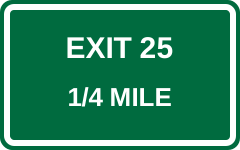
- A guidance sign for highway entrances, exits, and destinations
- A regulation sign that sets speed or movement rules
- A warning sign for a hazard ahead
- A recreation sign for parks and cultural sites
Show answer
A guidance sign for highway entrances, exits, and destinations. This green sign provides highway-exit guidance. Traffic guidance signs give information about the type of road, upcoming highway entrances and exits, and distances to destinations. Brown signs indicate recreational and cultural-interest sites. The cited passage reads: "Traffic guidance signs provide drivers with information about the type of road they are traveling on, upcoming highway entrances and exits, and distances to various destinations." This green exit sign provides guidance rather than setting a speed limit or movement restriction.
Study this in the handbook: Warning, regulation and guidance signs
8. Before pulling out to pass, what must a driver check behind and to the left?
- That the vehicle ahead has noticed the horn
- That the shoulder is wide enough for three cars
- That following traffic has slowed to half speed
- That no other vehicle is already attempting to pass
Show answer
That no other vehicle is already attempting to pass. Before passing, check behind and to the left to make sure another vehicle is not attempting to pass you. The manual’s lane-changing procedure also calls for checking mirrors, briefly turning your head to check the blind spot and available room, signaling, and moving smoothly into the new lane. The cited passage reads: "• Check behind and to the left of your vehicle to make sure that another vehicle is not attempting to pass you"
Study this in the handbook: Lane markings, lane changes and passing
9. A first train clears a multi track crossing. What must a waiting driver do before crossing?
- Make sure another train is not coming on the other track
- Cross immediately behind the first train
- Honk twice and cross slowly
- Assume the second track stays empty
Show answer
Make sure another train is not coming on the other track. After the first train clears a crossing with more than one track, make sure another train is not coming on the other track. Be careful that a train is not approaching in the opposite direction behind the first train. The cited passage reads: "• Watch for additional trains. Where there is more than one track, a driver waiting for the track to clear must make sure another train is not coming on the other track once the first train has cleared."
Study this in the handbook: Railroad crossings, work zones and vehicle size limits
10. Inside a multi lane roundabout circulatory roadway, what lane discipline applies?
- Drivers must change lanes once per circle
- Drivers may change lanes freely inside
- Drivers should not change lanes inside the circulatory roadway
- Drivers should pick a lane only after entering
Show answer
Drivers should not change lanes inside the circulatory roadway. Choose the proper lane before entering a multi-lane roundabout. Signs and pavement markings guide lane choice. Do not change lanes in the circulatory roadway. The cited passage reads: "know which lane they need to be in prior to entering the roundabout. Drivers should not change lanes in the circulatory roadway. YIELD" Once per circle is manufactured. Free swapping ignores pre entry planning. Post entry choice arrives too late.
Study this in the handbook: Turns, all way stops, roundabouts and interstates
11. The BMV receives an SR26 cancellation notice for a driver under an SR22 requirement. What follows?
- Nothing changes while the driver shops for insurance
- The SR22 requirement ends immediately
- The BMV must suspend driving privileges until an effective SR22 arrives or the requirement period expires
- The driver gets a free 180 day pass with no filing
Show answer
The BMV must suspend driving privileges until an effective SR22 arrives or the requirement period expires. When an SR26 cancellation notice reaches the BMV while an SR22 requirement applies, it must suspend driving privileges until it receives an effective SR22 policy or the SR22 requirement period expires. The cited passage reads: "If you have an SR22 requirement and the BMV receives an SR26 (cancellation of SR22 insurance) notice from your insurance provider, Indiana law requires the BMV to suspend your driving privileges"
Study this in the handbook: Points, driver safety program and insurance
12. What should you always do with your windows before driving in winter weather?
- Leave them fogged to keep heat in
- Cover them with a blanket
- Open them slightly
- Clear them
Show answer
Clear them. The manual says to always clear your windows before driving in winter weather. Driving in winter presents a number of dangers due to ice, snow, and very cold temperatures, and a blocked view makes every one of them worse. Allow the engine plenty of time to warm up, brush snow off the headlights and taillights, use your headlights to be seen, and keep a safe distance behind snowplows.
13. A driver of an ordinary private passenger car approaches a crossbuck displayed alone at a railroad crossing. How should the driver treat it?
- As a stop sign requiring a full stop always
- As a yield sign, stopping if a train approaches
- As a guide sign with no duty
- As permission to speed across
Show answer
As a yield sign, stopping if a train approaches. Treat a crossbuck displayed alone as a yield sign and stop if a train is approaching. A crossbuck with a stop sign requires a complete stop and a check that no train is approaching before crossing. The cited passage reads: "When displayed alone, you should treat a crossbuck as a yield sign and the decision to stop or cross the tracks is yours. You must stop if there is a train approaching."
Study this in the handbook: Railroad crossings, work zones and vehicle size limits
14. According to the manual, what felony level can result when disregarding a school bus stop arm causes a death?
- Class B infraction
- Class A misdemeanor in every case
- Level 5 felony
- No criminal grade applies
Show answer
Level 5 felony. Disregarding a school bus stop arm can result in a Class A misdemeanor, a Level 6 felony if bodily injury results, or a Level 5 felony if death results. The cited passage reads: "Disregarding a school bus stop arm can result in a Class A misdemeanor, a Level 6 felony if the offense results in bodily injury, or a Level 5 felony if the offense results in death."
Study this in the handbook: Trucks, motorcycles, bicycles and horse drawn vehicles
15. If a driver believes an officer acted improperly during a stop, how can the officer be identified for a complaint?
- Drivers must memorize the cruiser color only
- Officers must provide their names and badge numbers upon request
- Officers never identify themselves after stops
- Only the agency phone number identifies officers
Show answer
Officers must provide their names and badge numbers upon request. Officers are required to provide their names and badge numbers upon request. Report inappropriate conduct to the officer’s superiors as soon as possible after the encounter. Written complaints can be filed with the agency’s internal affairs division or civilian complaint board. The cited passage reads: "Officers are required to provide their names and badge numbers upon request." The manual says officers must provide their names and badge numbers upon request.
Study this in the handbook: Accidents, collisions and roadside emergencies
16. How does carrying teen passengers affect a teen driver crash risk?
- Crash risk falls with each passenger
- Passengers change nothing about risk
- Risk rises only after five passengers
- The chance of a crash doubles with each passenger present in the vehicle
Show answer
The chance of a crash doubles with each passenger present in the vehicle. Under driving with other teens, the manual states that the chance of a crash doubles with each passenger present in the vehicle. The cited passage reads: "• Driving with other teens. The chance of a crash doubles with each passenger present in the vehicle. • Failure to wear a seat belt. Wearing a seat belt is not just the law but is" The manual says crash risk doubles with each passenger, rather than decreasing.
17. A disabled Indiana applicant is 19 and finished certified driver rehabilitation training. Which permit duties fall away?
- A 180 day holding period and a practice log are both required
- A practice log is required but the holding period is waived
- There is no permit holding period and no practice log is required
- The driving skills exam is waived entirely
Show answer
There is no permit holding period and no practice log is required. Disabled applicants who are 18 or older and finish certified driver rehabilitation training face no learner permit holding period and owe no supervised practice log. Those two duties apply to disabled applicants aged 16 and 17, who must hold the permit 180 days and submit a practice log, so importing them here adds burdens the older group does not carry. The driving skills exam with a BMV examiner remains required for everyone in this path. Rehabilitation training replaces the waiting and logging, never the road test itself.
Study this in the handbook: Learner's permits, knowledge exam and skills exam
18. Where may a pedestrian hybrid beacon be found?
- At a mid-block crosswalk
- Only at railroad crossings
- Only on interstate ramps
- Only inside roundabouts
Show answer
At a mid-block crosswalk. A pedestrian hybrid beacon is a signal used to facilitate pedestrian crossing, and it may be found at a mid-block crosswalk. The beacon stays dark until a pedestrian activates it. After activation it shows a flashing yellow light so that drivers can clear the crossing, then a steady yellow warning that the right of way is ending, then two steady red lights while the pedestrian crosses, and finally alternating flashing red lights before it goes dark again.
19. You share a left turn lane with a bicyclist. What should you do?
- Pass the cyclist on the right
- Pull alongside to turn together
- Turn first so the cyclist can follow
- Stay behind the cyclist until the left turn is safely completed
Show answer
Stay behind the cyclist until the left turn is safely completed. If a motorist is sharing the left turn lane with a bicyclist, stay behind the cyclist until he or she has safely completed the left turn. Do not crowd the cyclist or turn across the cyclist's path. If a bicyclist is entering the intersection from the opposite direction while you turn left, wait for the bicyclist to pass before you turn. These steps keep a motor vehicle from cutting off a rider who has the same rights and responsibilities as other roadway users on most roadways.
Study this in the handbook: Trucks, motorcycles, bicycles and horse drawn vehicles
20. Which vehicle flaw is specifically listed in the manual as a reason a vehicle may be rejected for a driving skills exam?
- A dusty dashboard
- An inoperative door
- A missing floor mat
- A faint radio speaker
Show answer
An inoperative door. An inoperative door is one of the listed reasons a vehicle may be rejected. Other examples include unsafe tires, a missing bumper, broken glass or mirrors, and improper registration. The examiner has discretion to reject a vehicle. The cited passage reads: "• Unsafe tires • Missing bumper • Broken Glass/Mirrors • Door inoperative" A dusty dashboard is not one of the specific examples listed in the manual.
QualitySpace is expanding to Indiana
We are a California-based independent insurance brokerage working on licensing in more states. We cannot help with Indiana insurance yet. Leave your email and we will let you know when we can.
Every question is written from the official Indiana Driver's Manual. Need paper? Printable IN practice test with answer key.
Last verified 2026-10-05. How we check every question · Study all 500 as flashcards
Frequently asked questions
How many questions are on this Indiana practice test?
This fixed set has 20 questions. It is test 17 of 25 from the 500 question Indiana bank.
How does this fixed test relate to the full Indiana bank?
Each numbered test is a fixed set of questions in a fixed order, so you can retake the same test later and compare. Every test mixes road signs and the other topics in about the same proportion as the full bank. Tests 1 to 25 together cover every question in the Indiana bank once. The full practice page mixes the whole bank at random.
Last verified 2026-10-05. See the Indiana DMV facts page for sourced state details.