
Test 1 of 25 · 20 questions · Free 2026
IN Permit Practice Test 1
Jump to the test ↓A fixed 20 question set from the Indiana bank with answers and plain English explanations.
Question 1 of 20 · 0 right so far
All 20 questions in test 1
Every question below comes from the Indiana question bank on this page. Open a question to see the correct answer and the explanation. Nothing here is hidden behind a signup.
1. What must a driver do when approaching an intersection with a non-operating traffic signal?
- Continue because a dark signal grants priority
- Stop before entering and yield as required
- Yield only to vehicles approaching from the left
- Wait for a police officer before moving under any circumstance
Show answer
Stop before entering and yield as required. A non-operating signal requires the driver to stop before entering the intersection. After stopping, the driver may proceed cautiously only after yielding to cross traffic already inside, a vehicle that stopped first, a vehicle arriving simultaneously from the right, and pedestrians. A dark signal does not grant priority, and the rule is broader than watching only the left side. Police direction is not required before every careful movement through the intersection.
Study this in the handbook: Turns, all way stops, roundabouts and interstates
2. How far behind a disabled vehicle should a red emergency reflective triangle normally be placed on the roadside?
- Exactly 1,000 feet regardless of the road
- 50 feet in every location
- 100 feet unless the vehicle is on a divided highway
- 200 feet, or 500 feet on a hill or curve
Show answer
200 feet, or 500 feet on a hill or curve. Indiana's roadside emergency guidance places a red emergency reflective triangle 200 feet behind the disabled vehicle under ordinary conditions. If the vehicle is on a hill or curve, the distance increases to 500 feet so approaching motorists have more warning before reaching the obstruction. Fifty feet and 100 feet are both shorter than the stated distance, and the manual does not create a universal 1,000 foot placement. The same guidance says to pull onto the shoulder if possible, turn on your flashing hazard lights, and keep a reflective vest and triangle in the vehicle.
Study this in the handbook: Accidents, collisions and roadside emergencies
3. What do white lane markings separate on an Indiana road?
- The roadway from a bicycle path
- Lanes of traffic moving in opposite directions
- Lanes of traffic moving in the same direction
- A parking lane from a fire lane
Show answer
Lanes of traffic moving in the same direction. Line color tells you which way the traffic on the other side is going. White markings separate lanes that travel in the same direction, which is why you see them on multi lane highways and on one way streets. Yellow is used between opposing directions. A bicycle path along a road may be marked, but that is not what the manual means by lane markings, and the manual does not describe white lane lines as dividing a parking lane from a fire lane. When you see white beside you, a lane change is between neighbors headed the same way.
Study this in the handbook: Lane markings, lane changes and passing
4. What share of fatal crashes nationally involve a fatigued driver, according to Indiana's manual?
- About 2 percent
- An estimated 17.6 percent
- About 50 percent
- About 90 percent
Show answer
An estimated 17.6 percent. Nationally, an estimated 17.6 percent of all fatal motor vehicle crashes involved a fatigued driver. Going 18 hours without sleep leaves a driver as impaired as one at the .08 legal alcohol limit. Shift workers, parents, people taking sedative medications, and those with an untreated sleep disorder are among the most susceptible, and young adults ages 16 to 29 face the highest risk. Stop driving if you catch yourself yawning, drifting, or unable to remember the last few miles.
Study this in the handbook: Weather, night driving, drowsiness and distraction
5. What must a driver do before entering an intersection from an alley or driveway?
- Roll through if the driver sounds the horn first
- Stop and yield to other vehicles
- Enter first because roadway traffic must yield to driveways
- Stop only when a pedestrian is visible
Show answer
Stop and yield to other vehicles. An alley or driveway is not a free entry into the street. The driver must stop before entering and yield the right of way to other vehicles. A horn does not replace the stop, and traffic on the roadway does not lose priority simply because the entering vehicle is already moving. The rule also is not limited to situations where a pedestrian can be seen. The concrete cue is the transition from a private access point to the street: stop, look, and wait for a safe opening.
Study this in the handbook: Turns, all way stops, roundabouts and interstates
6. What action does an eight-sided traffic sign tell a driver to take?
- Prepare for a railroad crossing
- Watch for children near a school
- Avoid passing on the left
- Stop and yield the appropriate right of way
Show answer
Stop and yield the appropriate right of way. The eight-sided sign shape identifies a stop instruction. It warns that the driver must stop and yield the appropriate right of way at an intersection. Railroad crossings are associated with circular signs, school areas with five-sided signs, and no-passing warnings with a pennant shape. Shape recognition helps a driver interpret a sign even before reading its lettering, so an octagon should trigger a planned stop and an intersection scan.
Study this in the handbook: Traffic sign colors and shapes
7. How far from the nearest rail must certain Indiana vehicles stop at a railroad crossing?
- No closer than 5 feet
- Between 10 and 25 feet
- Not closer than 15 feet and not farther than 50 feet
- At least 100 feet away
Show answer
Not closer than 15 feet and not farther than 50 feet. Vehicles in the listed required categories must stop not closer than 15 feet and not farther than 50 feet from the nearest rail. The rule applies to all vehicles carrying passengers for hire, all school buses, and all vehicles carrying explosives or flammable liquids. Five feet and the 10 to 25 foot range would let the vehicle stop too close, while 100 feet is beyond the 50 foot maximum. The requirement does not apply at abandoned tracks with appropriate signs or where the tracks have been removed. Remember the two boundaries together: fifteen is the minimum gap and fifty is the maximum.
Study this in the handbook: Railroad crossings, work zones and vehicle size limits
8. At an Indiana roundabout, which traffic has priority when a vehicle is approaching the circular roadway?
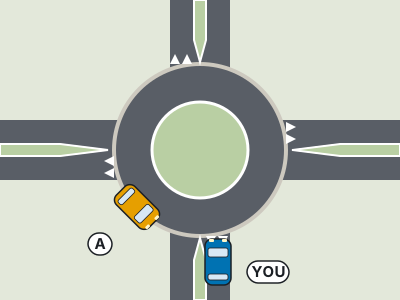
- Traffic entering from the right-hand approach
- Traffic already circulating in the roundabout
- The largest vehicle approaching the entry
- The vehicle that signals first
Show answer
Traffic already circulating in the roundabout. Indiana requires incoming traffic to yield to traffic already circulating in a roundabout. The approach direction does not override that yield, and signaling first does not create priority. A larger vehicle does not gain priority to enter just because of its size; Indiana's separate rule about yielding to large vehicles applies to vehicles moving through a multi-lane roundabout at the same time. The useful driving cue is to slow before the entry, look into the circulating lane, and wait for a safe opening rather than expecting circulating drivers to stop for an entering vehicle.
Study this in the handbook: Turns, all way stops, roundabouts and interstates
9. What should an Indiana driver do if water on the roadway is deeper than the vehicle's tire treads?
- Speed up to clear the water quickly
- Slow down
- Brake hard and keep the same speed
- Maintain speed while using high beams
Show answer
Slow down. When roadway water is deeper than the tire treads, the driver should slow down. Extra speed can reduce tire contact with the pavement and make hydroplaning or loss of control more likely. Braking hard while entering the water is not the stated response, and high beams do not solve the traction problem. Use the water depth as the practical cue: if it reaches beyond the tread depth, ease off the accelerator before entering and keep the vehicle steady. This guidance addresses the risk created by water covering the road, not a need to preserve normal speed through the puddle.
Study this in the handbook: Weather, night driving, drowsiness and distraction
10. Under Indiana law, who must use seat belts while a vehicle is in operation?
- Only occupants under 18
- Only the driver
- Only front seat passengers
- The driver and all passengers
Show answer
The driver and all passengers. Indiana requires the driver and all passengers to use seat belts at all times when the vehicle is in operation. The rule is not limited to the driver, the front row, or minors. Air bags do not remove the belt requirement because the manual explains that the two safety systems work together during a collision. The cue is the vehicle's operation, so buckle every occupant before moving, even on a short trip or in a vehicle equipped with multiple air bags.
Study this in the handbook: Seat belts, child restraints and parking
11. On an Indiana interstate with three or more lanes in one direction, which lanes must trucks stay in?
- The right two lanes
- Only the center lane
- The left two lanes
- Any lane, including the far-left lane
Show answer
The right two lanes. On an interstate section with three or more lanes traveling in one direction, Indiana restricts trucks to the right two lanes. The left two lanes answer puts a truck in the wrong part of the roadway, and the center-only choice is narrower than the rule. Trucks are not free to use every lane just because traffic is moving. Count the lanes in your direction, then keep the truck within the two lanes nearest the right side.
Study this in the handbook: Turns, all way stops, roundabouts and interstates
12. How often may an Indiana driver use the four-point credit for completing a driver safety program?
- Once during a three year period
- Every year
- Twice a year
- Only once in a lifetime
Show answer
Once during a three year period. Each driver is allowed one four point credit during a three year period, and the credit is applied only after completing a BMV approved driver safety program. The BMV may require drivers 21 and older convicted of two or more traffic offenses within 12 months, and drivers under 21 convicted of two or more offenses, to complete the program within 90 days of the mailed notice or face suspension.
Study this in the handbook: Points, driver safety program and insurance
13. Off interstates and state highways, what is the maximum speed for an Indiana school bus unless a lower limit is posted?
- 30 mph
- 45 mph
- 60 mph
- 40 mph
Show answer
40 mph. When not on an interstate or state highway, a school bus may not exceed 40 mph unless a lower limit is posted. On an interstate or highway, the school bus maximum is 60 mph or the posted limit. Thirty and forty-five mph are not the stated figures. Other drivers should expect school buses to travel below the speed of surrounding traffic.
Study this in the handbook: Speed limits, following distance and stopping
14. How soon must an Indiana driver apply for an amended credential after changing a principal address?
- Within 10 days
- Within 60 days
- At the next renewal
- Within 30 days
Show answer
Within 30 days. A driver with an Indiana credential must notify the BMV and apply for an amended credential within 30 days of changing the principal address. The principal address change is done at a branch with documents, while a mailing address can be changed online. Ten days is too short, 60 days is the new resident deadline for getting an Indiana license, and waiting for renewal is not allowed.
Study this in the handbook: Renewing, amending and replacing your license
15. If the rear wheels begin sliding sideways, what initial correction does the manual recommend?
- Pump the brakes repeatedly while turning sharply away
- Accelerate hard to force the tires straight
- Ease off the gas pedal and avoid a fast turn away from the skid
- Turn the wheel as far as possible toward the shoulder
Show answer
Ease off the gas pedal and avoid a fast turn away from the skid. A sideways rear-wheel slide calls for a calm reduction in power. Ease off the gas, keep steering inputs controlled, and avoid snapping the wheel away from the skid. A sharp opposite movement or excessive steering can turn a slide into a spin. The procedure applies to both front-wheel-drive and rear-wheel-drive vehicles. If the vehicle has conventional brakes, guide the steering wheel in the direction the rear is sliding, then straighten the vehicle after traction returns and continue slowly.
Study this in the handbook: Speed limits, following distance and stopping
16. What background color does Indiana's manual identify for a WRONG WAY sign?
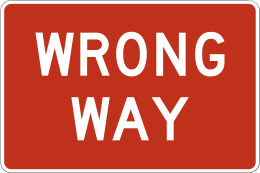
- Yellow
- White
- Red
- Orange
Show answer
Red. The manual uses WRONG WAY as an example of a traffic sign with a red background. Red signs convey traffic regulations that require immediate action to avoid threats to traffic safety. Yellow signs prepare drivers for road conditions and hazards, white signs display regulations or helpful information, and orange signs warn about temporary traffic conditions. The color alone is not permission to continue in the wrong direction, so a driver who sees this message should treat it as an urgent warning and correct the vehicle's path safely.
Study this in the handbook: Traffic sign colors and shapes
17. What do diamond-shaped traffic signs warn drivers about?

- The distance to a destination or highway exit
- Upcoming road conditions and hazards
- A required stop at every intersection
- A nearby recreational or cultural site
Show answer
Upcoming road conditions and hazards. Diamond-shaped signs warn of road conditions and hazards ahead. A Slippery When Wet sign is the manual's example, so the driver should anticipate a change in traction and adjust speed smoothly. Green signs provide destination guidance, eight-sided signs require a stop and yield, and brown signs identify recreational or cultural locations. The diamond is an advance warning, not a command to stop at once. Use the information to prepare early, leaving room for braking and steering if the hazard becomes present.
Study this in the handbook: Traffic sign colors and shapes
18. When may the Indiana BMV require a driver 21 or older to complete a Driver Safety Program?
- After two or more traffic convictions within 12 months
- After a single parking ticket
- Only after a DUI
- Every time the license is renewed
Show answer
After two or more traffic convictions within 12 months. The BMV may require drivers 21 and older who are convicted of two or more traffic offenses within 12 months to take a BMV-approved Driver Safety Program. Drivers under 21 can be required to take it after two or more traffic convictions with no 12 month window stated. A single ticket does not meet the two conviction threshold, a DUI is not the only trigger, and renewal alone does not require the course. A required course must be finished within 90 days of the mailed notice, or the driving privileges are suspended until it is completed.
Study this in the handbook: Points, driver safety program and insurance
19. How is an Indiana driver's license affected by a conviction for operating a watercraft while intoxicated?
- The driving privileges face the same penalties as for a motor vehicle
- It has no effect on the driver's license
- Only the boating license is affected
- It adds a single warning point
Show answer
The driving privileges face the same penalties as for a motor vehicle. A conviction for operating a watercraft while intoxicated brings the same driving privilege penalties as the same offense in a motor vehicle, and the conviction is sent to the BMV and placed on the driver record. Other boating offenses, like reckless operation or operating while suspended, are also added to the record. The license is not shielded from boating conduct, and a warning point is not the rule.
Study this in the handbook: Operating while intoxicated and habitual traffic violators
20. Within 10 years, an Indiana driver has two judgments for leaving the scene of a crash with injury. How long is the HTV suspension?
- 2 years
- 5 years
- 10 years
- Life
Show answer
10 years. Under Section A of the Habitual Traffic Violator law, two judgments within 10 years for offenses resulting in injury or death, such as leaving the scene of an injury crash, bring a 10-year suspension. A lifetime suspension applies only when both judgments are for intoxicated driving resulting in death. Five years is the Section C penalty for ten violations in ten years, and two years is not an HTV period.
Study this in the handbook: Points, driver safety program and insurance
QualitySpace is expanding to Indiana
We are a California-based independent insurance brokerage working on licensing in more states. We cannot help with Indiana insurance yet. Leave your email and we will let you know when we can.
Every question is written from the official Indiana Driver's Manual. Need paper? Printable IN practice test with answer key.
Last verified 2026-10-05. How we check every question · Study all 500 as flashcards
Frequently asked questions
How many questions are on this Indiana practice test?
This fixed set has 20 questions. It is test 1 of 25 from the 500 question Indiana bank.
How does this fixed test relate to the full Indiana bank?
Each numbered test is a fixed set of questions in a fixed order, so you can retake the same test later and compare. Every test mixes road signs and the other topics in about the same proportion as the full bank. Tests 1 to 25 together cover every question in the Indiana bank once. The full practice page mixes the whole bank at random.
Last verified 2026-10-05. See the Indiana DMV facts page for sourced state details.