
Test 9 of 25 · 20 questions · Free 2026
IN Permit Practice Test 9
Jump to the test ↓A fixed 20 question set from the Indiana bank with answers and plain English explanations.
Question 1 of 20 · 0 right so far
All 20 questions in test 9
Every question below comes from the Indiana question bank on this page. Open a question to see the correct answer and the explanation. Nothing here is hidden behind a signup.
1. What do blue traffic signs display?
- Warnings about a series of curves
- Rules prohibiting turns and parking
- Directions to recreational and cultural sites
- Road services and information
Show answer
Road services and information. Blue signs provide road service information, such as amenities available at an upcoming exit. They help a driver locate support or facilities rather than impose a movement rule. Yellow signs warn about roadway conditions, white signs carry regulations, and brown signs identify recreational or cultural interests. If a blue service sign is visible, read the symbols or words and decide whether the indicated facility meets your needs. Do not interpret the blue background as permission to ignore lane markings, speed limits, or other traffic controls.
Study this in the handbook: Traffic sign colors and shapes
2. A driver who receives an Indiana license before turning 21 keeps what license status until reaching that age?
- Probationary
- Commercial
- Learner's permit
- Unrestricted adult
Show answer
Probationary. An Indiana license issued to someone younger than 21 remains probationary until the holder turns 21. The status is tied to the holder's age, not to whether the person has already passed a skills test. It is not a commercial credential, and a full license does not become a learner's permit merely because restrictions apply. The unrestricted adult choice skips the probationary period. Check the driver's age at issuance and the age-based status before judging the credential's privileges.
Study this in the handbook: The probationary license for drivers under 21
3. How much roadway should an Indiana driver allow a motorcyclist or motor driven cycle operator?
- Half of a lane
- The width of a full lane
- A shoulder whenever available
- Only the right tire track
Show answer
The width of a full lane. Indiana says motorcyclists and motor driven cycle operators must be given the width of a full lane. Even when a lane appears wide enough for two vehicles, the rider may need the entire space to maneuver around hazards that another driver cannot see. Half a lane or one tire track crowds the rider and removes room for correction. The shoulder is not a substitute for normal lane space. The practical cue is to treat the smaller vehicle as a full lane user, not as a vehicle to share side by side.
Study this in the handbook: Trucks, motorcycles, bicycles and horse drawn vehicles
4. Where is a pennant-shaped traffic sign posted, and what does it warn you not to do?
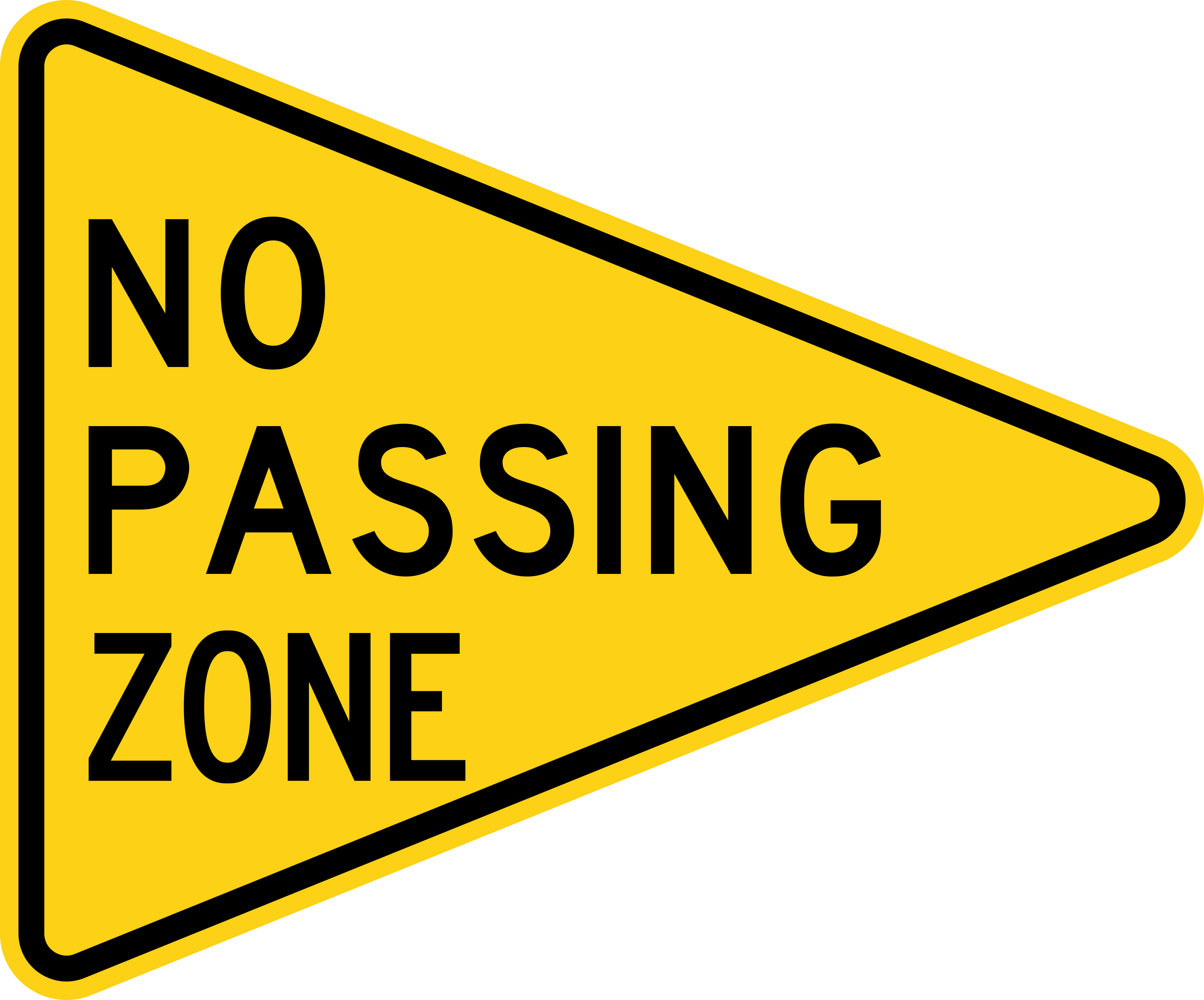
- On the right side of a one-way road, not to turn right
- At a railroad crossing, not to stop on the tracks
- On the left side of a two-way road, not to pass on the left
- Near a school, not to enter the crossing area
Show answer
On the left side of a two-way road, not to pass on the left. Pennant-shaped signs are posted on the left-hand side of two-way roads to warn that passing another vehicle on the left is prohibited. Their unusual shape and left-side placement help identify the beginning of a no-passing zone. A one-way turn restriction, railroad instruction, or school warning uses different sign information. When the pennant appears, stay behind the vehicle ahead unless a legal passing opportunity begins later. Do not cross the center line simply because the opposing lane looks open for a moment.
Study this in the handbook: Lane markings, lane changes and passing
5. How many points does Indiana assign for a driver who fails to use headlights?
- 4 points
- 1 point
- 2 points
- 6 points
Show answer
2 points. Indiana's point table lists failure to use headlights as a two point violation. The four point choice belongs to several more serious examples, including an unsafe lane movement or a hand held device violation, while six points are assigned for failing to yield to an emergency vehicle. One point does not appear in the examples at all. A practical cue is to connect required lighting with a modest but recorded point assessment, the same two points the table gives for missing brake or signal lights, not with the higher penalties for dangerous yielding or driving conduct.
Study this in the handbook: Points, driver safety program and insurance
6. How much more fuel does a passenger car use at 75 mph than at 55 mph, according to the Indiana manual?
- Twice as much
- About 5 percent more
- About the same
- Approximately 50 percent more
Show answer
Approximately 50 percent more. Fuel consumption increases steadily above 45 miles per hour, with passenger cars and light trucks using approximately 50 percent more fuel traveling at 75 miles per hour than at 55. To maximize fuel economy, drive sensibly, observe the speed limit, avoid roof cargo and excess weight, and avoid rapid acceleration or sudden stops. Keeping the vehicle maintained and the tires properly inflated also helps.
Study this in the handbook: Speed limits, following distance and stopping
7. When may a driver cross a solid yellow line on a two-way road?
- Whenever the vehicle is traveling below 25 mph
- Generally only to make a turn
- Only after turning on hazard lights
- For passing whenever the road appears empty
Show answer
Generally only to make a turn. Indiana's lane-marking guidance says a driver should not cross a solid yellow line except to turn. Passing across it is prohibited even when the road appears empty, and low speed or hazard lights do not create permission. The marking separates opposing traffic, so crossing it for an ordinary pass creates a conflict with vehicles coming the other way. Read the line on the driver's side before deciding whether a passing maneuver is legal.
Study this in the handbook: Lane markings, lane changes and passing
8. A school bus displays flashing red lights and extends its stop arm on a two-way road. What should nearby drivers do?
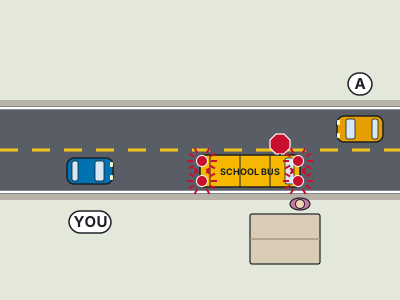
- Pass slowly if no child is visible in the roadway
- Continue if traveling toward the bus because only following traffic stops
- Stop before reaching the bus and wait until the stop warning ends
- Stop only after the bus driver waves to traffic
Show answer
Stop before reaching the bus and wait until the stop warning ends. Flashing red lights and an extended stop arm mean the school bus has stopped for loading or unloading, so nearby drivers must stop. A driver cannot substitute a visual check for children, a slow pass, or a wave from the bus operator. On an ordinary two-way road without a dividing barrier or unimproved median, the duty applies to traffic approaching from both directions. The cue is the bus's red-light and stop-arm combination. Remain stopped until the warning is canceled and the roadway is safe.
Study this in the handbook: Trucks, motorcycles, bicycles and horse drawn vehicles
9. When approaching a red light or stop sign, where should the driver stop if a solid white line is present?
- Beyond the crosswalk in the intersection
- At least one car length after the line
- Beside the nearest parked vehicle
- At the solid white stop line
Show answer
At the solid white stop line. The marked white bar is the driver's primary stopping reference. Stopping beyond the crosswalk or after the line can place the vehicle in the pedestrian or intersection area. A parked vehicle does not determine the stopping point. If there is no stop line, the manual gives alternate locations, including before the crosswalk or before entering the intersection, so the driver should use the visible marking whenever it exists. This keeps the vehicle behind the control point and preserves the crossing area for pedestrians.
Study this in the handbook: Turns, all way stops, roundabouts and interstates
10. What is the speed limit on an Indiana rural state divided highway unless posted otherwise?
- 50 mph
- 55 mph
- 60 mph
- 70 mph
Show answer
60 mph. Vehicles on a rural state divided highway may not exceed 60 mph or the posted limit. Seventy mph is for rural interstates, and 55 mph applies to urban interstates, non-divided state highways and county roads. Fifty mph is not an Indiana default. Knowing the road type is the key to picking the right default limit, and a posted sign always controls.
Study this in the handbook: Turns, all way stops, roundabouts and interstates
11. How long is an Indiana driver's license valid for a driver younger than 75?
- Six years
- Two years
- Four years
- Eight years
Show answer
Six years. An Indiana driver's license is valid for six years for drivers under 75, three years for drivers 75 through 84, and two years for drivers 85 and older. Four years is the validity of a commercial driver's license. Two years is the term for the oldest drivers, and eight years is not an Indiana term. U.S. citizens can renew up to 24 months before expiration.
Study this in the handbook: Learner's permits, knowledge exam and skills exam
12. After the first 180 days, during which weekend hours may an Indiana probationary driver under 18 not drive without an exception?
- Saturday and Sunday between 1 a.m. and 5 a.m.
- Saturday and Sunday after 10 p.m.
- Friday and Saturday after 11 p.m.
- There are no weekend limits
Show answer
Saturday and Sunday between 1 a.m. and 5 a.m.. On Saturday and Sunday, a probationary driver under 18 who is past the first 180 days may not drive between 1 a.m. and 5 a.m. Ten p.m. applies only during the first 180 days, every night. The 11 p.m. rule covers Sunday through Thursday, not the weekend. Weekday mornings before 5 a.m. are also off limits. Work, school, religious events and a qualified adult are exceptions.
Study this in the handbook: The probationary license for drivers under 21
13. Which vehicles are especially affected by strong winds?
- Low sports cars only
- High-profile vehicles such as vans and sport utility vehicles
- Motorcycles only when parked
- Vehicles with manual transmissions only
Show answer
High-profile vehicles such as vans and sport utility vehicles. The manual singles out high-profile vehicles because their larger exposed sides can be affected more strongly by wind. A low sports car is not the only vehicle that can encounter a gust, and transmission type does not determine the vehicle’s exposed profile. A parked motorcycle is not the driving situation described. In strong wind, watch conditions and adjust conservatively. The quick recognition cue is vehicle height and broad side area, especially with vans and sport utility vehicles.
Study this in the handbook: Weather, night driving, drowsiness and distraction
14. An Indiana learner fails the driving skills exam for the third time. How long before the next attempt?
- Two months from the last failed exam
- Seven days
- A full year
- The next business day
Show answer
Two months from the last failed exam. On a third failed driving skills exam while holding a learner's permit, the applicant must wait two months from the date of the last failure. Seven days is the normal wait after a failed skills exam, and the next business day rule applies to the knowledge exam. One year is not a stated period. The manual also lists actions that cause automatic failure of the skills exam, such as causing an accident during the exam, failing to yield the right of way, or not using a seat belt.
Study this in the handbook: Learner's permits, knowledge exam and skills exam
15. How many points does Indiana assess for following another vehicle too closely?
- 2 points
- 6 points
- 4 points
- 8 points
Show answer
6 points. Following another vehicle too closely carries 6 points, the same as failing to yield to an emergency vehicle and speeding 26 or more mph over. Four points apply to unsafe lane movement or a hand-held device. Two points apply to minor equipment violations, and eight to driving while suspended. The manual recommends staying at least two to three seconds behind the vehicle ahead.
Study this in the handbook: Points, driver safety program and insurance
16. What does a flashing yellow arrow require before a driver makes the indicated turn?
- Yield to pedestrians and oncoming traffic before turning
- Stop and wait until a green arrow appears
- Turn immediately because opposing traffic must stop
- Yield only to vehicles, never to pedestrians
Show answer
Yield to pedestrians and oncoming traffic before turning. A flashing yellow arrow permits the turn, but it does not give an unqualified path. The driver must first yield the right of way to pedestrians and oncoming traffic. Waiting for a green arrow is unnecessarily restrictive, while turning immediately ignores the required yield. Limiting the yield to vehicles also misses pedestrians named in the rule. Treat the flashing arrow as permission conditioned on a safe gap, not as protection from traffic or people crossing the roadway.
Study this in the handbook: Traffic signals and turning on red
17. At a railroad crossing, what should a driver do when active warning bells, flashing lights, or gates are operating?
- Stop only if another vehicle has already crossed
- Cross quickly before the gate reaches the pavement
- Treat the signals as advisory and proceed if no train is visible
- Stop and wait until the warning is canceled or an authorized person directs movement
Show answer
Stop and wait until the warning is canceled or an authorized person directs movement. Active bells, flashing lights, or gates require a complete stop and no movement until the warning is canceled or a law enforcement officer or railroad flagman directs the driver to proceed. A train can be hidden or its speed misjudged, so the absence of an immediately visible locomotive does not make the crossing safe. Racing the gate is especially dangerous. The visible cue is any active warning device, which means wait for a clear release rather than making a personal estimate.
Study this in the handbook: Railroad crossings, work zones and vehicle size limits
18. When should a driver use low headlight beams near another vehicle at night?
- Whenever traveling below 35 miles per hour
- Only within 50 feet of an oncoming vehicle
- Only when following within 500 feet
- Within 500 feet of an oncoming vehicle or within 200 feet behind one
Show answer
Within 500 feet of an oncoming vehicle or within 200 feet behind one. Indiana specifies two night-driving distances for lower beams. Use them when approaching within 500 feet of an oncoming vehicle and when following within 200 feet of the rear of another vehicle. The 50-foot choice waits too long, while the 500-foot following distance reverses the manual's figures. Vehicle speed does not determine these beam-change thresholds. Watch the roadway ahead and behind, dim early enough to avoid glare, and restore higher beams only when the required distance from other traffic is clear.
Study this in the handbook: Weather, night driving, drowsiness and distraction
19. Near a school, which speed limit should a driver follow when a school-zone sign shows a lower number?
- The ordinary rural limit
- The highest limit posted anywhere on the route
- The lower posted school-zone limit
- The advisory speed only after dark
Show answer
The lower posted school-zone limit. When driving near a school, Indiana requires drivers to slow to the lower speed limit posted for the school zone. The normal rural number does not override a special school-zone posting, and a higher number from another part of the route has no authority at this location. An advisory speed after dark is not the rule described here. Some school-zone limits operate during common school hours or while beacons flash, and local authorities may set lower limits when children are present. Look for the active school-zone posting and obey its lower figure.
Study this in the handbook: Speed limits, following distance and stopping
20. What should a driver do when bad weather or poor visibility makes the posted speed unsafe?
- Treat the posted limit as a required minimum
- Reduce speed below the posted limit as conditions require
- Speed up to spend less time in the weather
- Keep the same speed unless police direct otherwise
Show answer
Reduce speed below the posted limit as conditions require. Indiana warns that driving at the posted limit can still be dangerous when weather or visibility is poor. A posted number is a maximum under the road conditions, not a command to maintain that speed when traction or sight distance deteriorates. Speeding up shortens the time exposed to weather but lengthens stopping distance and reduces control. Waiting for an officer is not necessary. Ease off early, increase following room, and select a speed that lets the vehicle stop and steer within the visible roadway.
Study this in the handbook: Speed limits, following distance and stopping
QualitySpace is expanding to Indiana
We are a California-based independent insurance brokerage working on licensing in more states. We cannot help with Indiana insurance yet. Leave your email and we will let you know when we can.
Every question is written from the official Indiana Driver's Manual. Need paper? Printable IN practice test with answer key.
Last verified 2026-10-05. How we check every question · Study all 500 as flashcards
Frequently asked questions
How many questions are on this Indiana practice test?
This fixed set has 20 questions. It is test 9 of 25 from the 500 question Indiana bank.
How does this fixed test relate to the full Indiana bank?
Each numbered test is a fixed set of questions in a fixed order, so you can retake the same test later and compare. Every test mixes road signs and the other topics in about the same proportion as the full bank. Tests 1 to 25 together cover every question in the Indiana bank once. The full practice page mixes the whole bank at random.
Last verified 2026-10-05. See the Indiana DMV facts page for sourced state details.