
Key points
Vehicles carrying passengers for hire, school buses and vehicles carrying explosives or flammable liquids must always stop at railroad crossings.
Source: Handbook p. 48
“Vehicles that must stop at railroad crossings include: • All vehicles carrying passengers for hire • All school buses • All vehicles carrying explosives or flammable liquids”
Indiana Driver's Manual, Handbook p. 48A crossbuck alone is like a yield sign; you must stop if a train is approaching.
Source: Handbook p. 48
“When displayed alone, you should treat a crossbuck as a yield sign and the decision to stop or cross the tracks is yours. You must stop if there is a train approaching.”
Indiana Driver's Manual, Handbook p. 48With active bells, lights or gates, stop and wait until the warning ends or an officer or flagman waves you on.
Source: Handbook p. 48
“When there are active warning bells, flashing lights, or lights and gates, you must stop and not proceed until the active warning is canceled or you are directed to proceed by a law enforcement officer or railroad flagman.”
Indiana Driver's Manual, Handbook p. 48It is illegal to drive around a crossing gate that is down.
Source: Handbook p. 48
“It is illegal to drive around a crossing gate that is down.”
Indiana Driver's Manual, Handbook p. 48Never start across unless you can clear the tracks without stopping, and avoid shifting gears while crossing.
Source: Handbook p. 49
“Avoid stopping or shifting gears while crossing railroad tracks. A driver should never begin to cross railroad tracks unless the tracks can be cleared without stopping.”
Indiana Driver's Manual, Handbook p. 49If you are stuck on the tracks or crossing, leave the area and run at a 45 degree angle away from the tracks toward the oncoming train.
Source: Handbook p. 49
“run at a 45-degree angle away from the tracks in the direction of the oncoming train.”
Indiana Driver's Manual, Handbook p. 49A flashing arrow board showing no direction means use caution; no lane change is required.
Source: Handbook p. 47
“A flashing arrow board not indicating a direction either way is a signal to use caution but does not require a driver to move to another lane.”
Indiana Driver's Manual, Handbook p. 47Stop when a flagger holds the orange or red flag horizontally into traffic.
Source: Handbook p. 47
“You must stop when a flagger extends a fluorescent orange/red flag in a horizontal position into the line of traffic.”
Indiana Driver's Manual, Handbook p. 47Without a special permit, a vehicle may be at most 8 feet 6 inches wide.
Source: Handbook p. 49
“The maximum width of any vehicle that may be operated without a special permit is eight feet and six inches.”
Indiana Driver's Manual, Handbook p. 49
Numbers to know
| Number | What it means | Manual |
|---|---|---|
| 15 to 50 feet | required stopping distance from the nearest rail | Handbook p. 48 |
| 20 seconds | time to escape once crossing lights flash and the gate lowers | Handbook p. 49 |
| 45 degrees | angle to run away from the tracks | Handbook p. 49 |
| 8 feet 6 inches | maximum vehicle width without a permit | Handbook p. 49 |
| 13 feet 6 inches | maximum vehicle height without a permit | Handbook p. 49 |
| 80,000 pounds | maximum vehicle weight without a permit | Handbook p. 49 |
Recognize these signs

Railroad crossing ahead 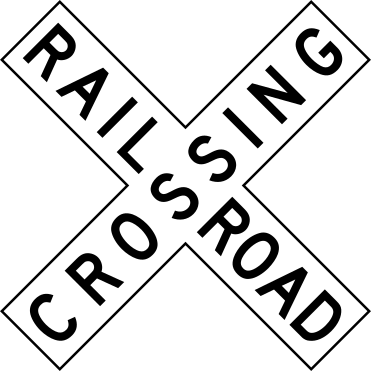
Railroad crossbuck 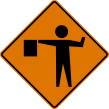
Flagger ahead
3 questions from the Indiana practice test
1. At a railroad crossing, what should a driver do when active warning bells, flashing lights, or gates are operating?
- Stop only if another vehicle has already crossed
- Cross quickly before the gate reaches the pavement
- Treat the signals as advisory and proceed if no train is visible
- Stop and wait until the warning is canceled or an authorized person directs movement
Show answer
Stop and wait until the warning is canceled or an authorized person directs movement. Active bells, flashing lights, or gates require a complete stop and no movement until the warning is canceled or a law enforcement officer or railroad flagman directs the driver to proceed. A train can be hidden or its speed misjudged, so the absence of an immediately visible locomotive does not make the crossing safe. Racing the gate is especially dangerous. The visible cue is any active warning device, which means wait for a clear release rather than making a personal estimate.
2. How far from the nearest rail must certain Indiana vehicles stop at a railroad crossing?
- No closer than 5 feet
- Between 10 and 25 feet
- Not closer than 15 feet and not farther than 50 feet
- At least 100 feet away
Show answer
Not closer than 15 feet and not farther than 50 feet. Vehicles in the listed required categories must stop not closer than 15 feet and not farther than 50 feet from the nearest rail. The rule applies to all vehicles carrying passengers for hire, all school buses, and all vehicles carrying explosives or flammable liquids. Five feet and the 10 to 25 foot range would let the vehicle stop too close, while 100 feet is beyond the 50 foot maximum. The requirement does not apply at abandoned tracks with appropriate signs or where the tracks have been removed. Remember the two boundaries together: fifteen is the minimum gap and fifty is the maximum.
3. What is the maximum width of a vehicle that may operate on Indiana public highways without a special permit?
- 7 feet 6 inches
- 8 feet
- 8 feet 6 inches
- 10 feet
Show answer
8 feet 6 inches. Indiana's tractor trailer section lists 8 feet 6 inches as the maximum width for a vehicle operating without a special permit. The eight foot choice omits the additional six inches, while 7 feet 6 inches is smaller and 10 feet exceeds the stated limit. This measurement concerns the public highway equipment limit, not the width of an ordinary lane. Keep the three dimensions separate when studying: width is 8 feet 6 inches, height is 13 feet 6 inches, and weight is 80,000 pounds.
Practice this topic
Lock it in with signals and markings questions from the free Indiana practice test. Every answer comes with a plain English explanation.
Source: the Indiana Driver's Manual, Chapter 7: Safe Vehicle Operation. This lesson is a plain English summary, not the law itself; where it differs, the manual and the statute govern. Last checked 2026-09-27.