
20 question exam format · Real sign images & audio · Free

VT Permit Practice Test

Practice the Vermont knowledge test the way it is actually given: 20 questions, 80 percent to pass. Every question has a plain English explanation and narrated audio. 180 questions in the bank, free, no account required.

Question bank
180
State
Vermont
Format
Fixed question set
Cost
Free

The real Vermont knowledge test is the DMV exam used for a learner permit. This page contains the full free 180 question study bank, with an explanation after each answer. Use the numbered 20 question tests below when you want a fixed study session.

The real Vermont knowledge test: The knowledge test is online and has 20 questions; passing score You must answer at least 16 questions correctly to pass the test (16 of 20) (official source). This practice bank has 180 questions.

Alcohol and DUIEmergenciesLaws and paperworkParkingRight of wayRoad signsSafe drivingSignals and markingsSpeed limits

180-question bank · Real sign images & audio · Free

Vermont practice test has 180 questions. Every question comes with a plain-English explanation the moment you answer.

Real exam format: 20 questions, 16 correct to pass.

Start here

Run 20 questions to warm up.

Find your gaps

Diagnose weak topics and retry what you've missed.

Simulate the real thing

Practice under graded exam conditions or run the whole bank.

Random draw every attempt. Scored against the 80% passing standard.

Free means actually free: no subscription, no auto-renew, no card required, no locked features. This site is funded by our insurance work, not by test-prep charges.

See facts and key topics for Vermont DMV (minimum age, fees, wait times, question counts by topic) before you start, or print it to bring with you on test day.

How to use this VT practice test

  1. Take the 20 question exam-length practice test above once, untimed, to find your weak topics.
  2. Work through the numbered 20 question sets below. Each one is fixed, so a second attempt is a fair comparison.
  3. Read the explanation on every miss. The wording comes from the Vermont Driver's Manual, which is what the examiners use.
  4. When you pass three sets in a row at 80 percent or better, book the real test.

VT practice tests, 20 questions each

Fixed sets in a fixed order so you can retake one and compare your score.

  1. Test 1
  2. Test 2
  3. Test 3
  4. Test 4
  5. Test 5
  6. Test 6
  7. Test 7
  8. Test 8
  9. Test 9

Printable VT practice test with answer key

Frequently asked questions

How many questions are in the Vermont practice bank?

This free page contains the full 180 question bank. The numbered tests each contain 20 fixed questions.

How does this practice test relate to the real Vermont test?

The real test facts are shown above from the official source. This page is an educational practice bank and is separate from the DMV test.

Can I use the Vermont practice test for free?

Yes. The practice questions, explanations, and numbered tests are free to use with no account required.

Last verified 2026-09-05 against the Vermont Driver's Manual, which sets the real exam at 20 questions and 16 correct to pass.

All 20 questions, VT exam length

Every question below comes from the Vermont question bank on this page. Open a question to see the correct answer and the explanation. Nothing here is hidden behind a signup.

  1. 1. Where can a person take Vermont's learner permit test?

    1. Only at a DMV office
    2. Online through the DMV website
    3. Only through a private driving school
    4. At a town clerk's office
    Show answer

    Online through the DMV website. The learner permit test is administered online through Vermont DMV's website, so an applicant should plan for an online test rather than an Full explanation in Test 1

  2. 2. About how long does the average driver take to apply the brakes after seeing a danger?

    1. About three-fourths of a second
    2. About one-tenth of a second
    3. About two seconds
    4. About five seconds
    Show answer

    About three-fourths of a second. The manual says the average driver takes about three-fourths of a second to apply the brakes after seeing danger. Full explanation in Test 1

  3. 3. What vision standard must a Vermont applicant meet at the license vision screening?

    1. 20/40
    2. 20/20
    3. 20/70
    4. 20/100
    Show answer

    20/40. If the results of the screening determine that your vision does not meet the required standard of 20/40, you will be referred to an eye doct Full explanation in Test 1

  4. 4. What should a driver do when a traffic light turns yellow?

    1. Accelerate so the vehicle reaches the intersection sooner
    2. Prepare to stop, unless stopping safely is no longer possible
    3. Stop immediately in the middle of the intersection
    4. Treat the light exactly like a green arrow
    Show answer

    Prepare to stop, unless stopping safely is no longer possible. A yellow light warns that the signal is about to turn red. Full explanation in Test 2

  5. 5. If a vehicle is parked on a two-lane Vermont road, how close must its right wheels be to the road edge or curb?

    1. Within 6 inches
    2. Within 12 inches
    3. Within 24 inches
    4. Within 36 inches
    Show answer

    Within 12 inches. On a two-lane road, Vermont requires the right wheels of a parked vehicle to be within 12 inches of the right side of the road or curb. Full explanation in Test 2

  6. 6. How long must an applicant under 18 have maintained a clean driving record before applying for a Vermont learner's permit?

    1. The previous two years
    2. The previous six months
    3. The previous one year
    4. The previous three years
    Show answer

    The previous two years. An applicant under 18 must have maintained a clean driving record during the previous two years before applying for a Vermont learner's perm Full explanation in Test 3

  7. 7. What does Vermont's eight-sided stop sign require?

    1. Slow down and continue if no car is visible
    2. Stop, scan the intersection, honor right of way, and then proceed
    3. Stop only when a pedestrian is present
    4. Yield without stopping at a marked crosswalk
    Show answer

    Stop, scan the intersection, honor right of way, and then proceed. The octagonal stop sign requires a stop, an intersection scan, respect for right of way, and then a safe departure. Full explanation in Test 3

  8. 8. At a two-lane roundabout without signs or arrows, what movement is permitted from the right lane?

    1. Right turns or through movements
    2. Left turns only
    3. U-turns across the center island
    4. Any movement without yielding
    Show answer

    Right turns or through movements. At a two-lane roundabout with no signs or arrows, the right lane may make a right turn or continue through. Full explanation in Test 4

  9. 9. Which roadway conditions may Vermont warning signs identify?

    1. Sharp curves, unsafe intersections, or dips in the road
    2. Only legal parking spaces and loading zones
    3. Only fuel stations and lodging areas
    4. Only lanes reserved for buses
    Show answer

    Sharp curves, unsafe intersections, or dips in the road. Vermont says warning signs may identify sharp curves, unsafe intersections, or dips in the road. Full explanation in Test 4

  10. 10. What following distance should you use when conditions are poor or visibility is limited?

    1. More than four seconds
    2. Exactly one second
    3. Two seconds regardless of conditions
    4. No extra distance if headlights are on
    Show answer

    More than four seconds. The manual uses four seconds as a baseline for safe spacing, then calls for more than four seconds when road conditions are poor, visibility Full explanation in Test 5

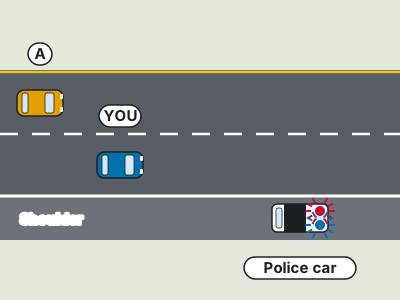
  11. 11. What is required when a stopped emergency vehicle is on a four lane highway and a safe lane change is possible?

    1. Change lanes away from it and proceed cautiously
    2. Keep the same speed and lane
    3. Stop beside the emergency vehicle
    4. Drive onto the median to create space
    Show answer

    Change lanes away from it and proceed cautiously. When a stopped police or emergency vehicle displays flashing lights on a four lane highway, Vermont requires a lane change if it can be comp Full explanation in Test 5

  12. 12. What does a solid green arrow mean for left-turning traffic in Vermont?

    1. Left turns have the right of way while oncoming traffic has a red light
    2. Left turns must yield to oncoming traffic with a green light
    3. The signal is treated as a flashing yellow arrow
    4. Drivers must stop before entering the intersection
    Show answer

    Left turns have the right of way while oncoming traffic has a red light. A solid green arrow gives left turns the right of way, while oncoming traffic faces a red light. Full explanation in Test 5

  13. 13. What does the Vermont manual say about mixing tires on a vehicle?

    1. Never combine different types of tires on the same vehicle
    2. Mixing is fine if the sizes match
    3. Only the front tires must match
    4. Snow tires may be mixed with summer tires
    Show answer

    Never combine different types of tires on the same vehicle. Never combine different types of tires on the same vehicle. Full explanation in Test 6

  14. 14. What does a steady yellow traffic light warn a Vermont driver about?

    1. The light is about to turn red
    2. The driver may accelerate because cross traffic must stop
    3. The intersection is reserved for left turns
    4. The signal has failed and should be treated as a stop sign
    Show answer

    The light is about to turn red. A steady yellow light warns that the signal will soon become red. Assess distance and speed, stopping when that can be done safely. Full explanation in Test 6

  15. 15. You are already in a roundabout when an emergency vehicle approaches. What should you do?

    1. Clear the intersection, then pull over and stop
    2. Stop where you are so the emergency vehicle can pass around you
    3. Back out of the intersection to the previous stop line
    4. Turn across oncoming traffic and follow the emergency vehicle
    Show answer

    Clear the intersection, then pull over and stop. An occupied intersection should be cleared before the driver pulls over for an approaching emergency vehicle. Full explanation in Test 7

  16. 16. When a vehicle is sold in Vermont, who must sign the odometer statement?

    1. The seller only
    2. The buyer only
    3. Both the seller and the buyer
    4. A DMV clerk
    Show answer

    Both the seller and the buyer. Federal law states that the numbers on an odometer must not be altered and that an odometer statement must be signed by the seller and the p Full explanation in Test 7

  17. 17. What is Vermont's Purchase and Use Tax rate on a vehicle?

    1. 3 percent of the price paid
    2. 10 percent of the price paid
    3. A flat $100
    4. 6 percent of the price paid or the fair market value, whichever is greater
    Show answer

    6 percent of the price paid or the fair market value, whichever is greater. Vermont's Purchase and Use Tax is 6 percent of the price you paid for a non leased vehicle or the current fair market value, whichever is gr Full explanation in Test 8

  18. 18. According to the Vermont manual, when does idling waste more fuel than restarting the engine?

    1. After five minutes
    2. Only after 30 minutes
    3. When idling for more than 10 seconds while parked in town
    4. Never, restarting always uses more fuel
    Show answer

    When idling for more than 10 seconds while parked in town. If you are parked in town, idling for more than 10 seconds uses more fuel than shutting off and restarting the engine. Full explanation in Test 8

  19. 19. When turning left in Vermont, which road user has the right-of-way over the turning driver?

    1. An oncoming motor vehicle or bicyclist
    2. A vehicle behind the turner that is changing lanes
    3. A driver approaching from a private driveway behind the turner
    4. No one, because the left-turning vehicle entered first
    Show answer

    An oncoming motor vehicle or bicyclist. A left turn must wait for oncoming traffic, including either a motor vehicle or a bicyclist. Full explanation in Test 9

  20. 20. According to the Vermont manual, what is the leading cause of death for children aged 3 to 14?

    1. Motor vehicle crashes
    2. Drowning
    3. Falls
    4. Illness
    Show answer

    Motor vehicle crashes. Motor vehicle crashes are the leading cause of death for children aged 3 to 14, which is why Vermont's restraint law is written by age: rear Full explanation in Test 9

How this test works

Study the rules, then check the explanation

This page uses the prepared Vermont question bank exactly as provided. Start the test, choose an answer, and read the explanation before moving on. Retakes serve the same 180 questions so you can work through the state set without losing your place.

Want a one-page summary to study or print? See the Vermont DMV cheat sheet, with the most-missed rules from this same question bank.

Looking for another state? Go back to the DMV practice test hub. California remains on the established California DMV practice test page.

Are you a library or school? See the free DMV practice test partner resource for a copy ready listing and referral link.

QualitySpace is expanding to Vermont

We are a California-based independent insurance brokerage working on licensing in more states. We cannot help with Vermont insurance yet. Leave your email and we will let you know when we can.