
Test 4 of 10 · 20 questions · Free 2026
VT Permit Practice Test 4
Jump to the test ↓A fixed 20 question set from the Vermont bank with answers and plain English explanations. The real VT exam is 20 questions, 80 percent to pass; take the full length version on the main practice page.
Question 1 of 20 · 0 right so far
All 20 questions in test 4
Every question below comes from the Vermont question bank on this page. Open a question to see the correct answer and the explanation. Nothing here is hidden behind a signup.
1. After a Vermont junior driver's license has been held for six months, what passenger limit remains?
- No passengers may ride until age 18
- Only one passenger may ride
- Only immediate family members may ride
- No numerical passenger restriction remains, but passengers may not exceed available safety belts
Show answer
No numerical passenger restriction remains, but passengers may not exceed available safety belts. After six months, Vermont removes the numerical passenger restriction for a junior license holder, but the driver still may not transport more people than there are safety belts. That seat-belt ceiling is the remaining practical limit. The one-passenger and family-only choices describe stricter stages or invented limits, while waiting until 18 ignores the six-month transition. Before leaving, count usable belts and make sure every occupant has a designated restraint.
Study this in the handbook: Junior license passenger rules and recalls
2. What extra information may some Vermont warning signs provide?

- A safe speed or a distance to the hazard
- The owner’s name and vehicle registration
- The exact fuel price at the next station
- A guarantee that the lane will remain open
Show answer
A safe speed or a distance to the hazard. Some warning signs add a safe speed or a distance to the condition ahead. That supplemental information helps the driver prepare before reaching a curve, crossing, or other hazard. It does not identify a vehicle owner, advertise a fuel price, or promise that a lane will stay open. Read the main warning and the added plaque together, then adjust speed and attention early. A distance such as a crossing measured in miles means the condition continues or begins ahead, so the driver should remain alert rather than relax immediately after passing the sign.
Study this in the handbook: Road signs
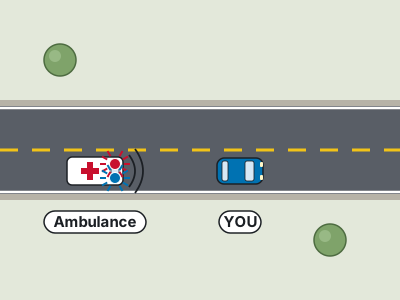
3. An emergency vehicle with flashing blue or red lights and a siren approaches. What must you do?
- Turn left immediately into the nearest side street
- Continue at the speed limit if your lane is open
- Stop in the intersection so the vehicle can pass around you
- Pull to the right and stop until it has gone by
Show answer
Pull to the right and stop until it has gone by. When an emergency or law enforcement vehicle approaches with the specified lights or siren, Vermont's move over rule requires pulling to the right side and stopping. The vehicle must remain stopped until the emergency vehicle has gone by. Continuing at speed fails to yield, and stopping in an intersection can block the emergency path. A sudden left turn creates a second conflict rather than clearing the roadway. Watch mirrors, signal right when safe, and remain stationary until the response vehicle passes.
Study this in the handbook: Emergency vehicles, Move Over and police stops
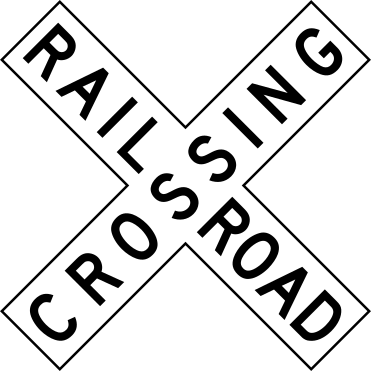
4. Where are Vermont crossbuck signs located, and what do they identify?
- At intersections, where they replace every stop sign
- Before school zones, where they identify a reduced speed
- At work zones, where they mark a lane merge
- At railroad crossings, where they indicate the location of the tracks
Show answer
At railroad crossings, where they indicate the location of the tracks. Crossbuck signs stand at railroad crossings and indicate where the tracks are. They are not school, work-zone, or general intersection signs. The sign does not replace every stop sign, because railroad crossings also use gates, flashing lights, and other controls. After locating the crossbuck, slow down, look both ways, and listen for trains. Smaller signs below it can tell you how many tracks cross the road, which affects the search.
Study this in the handbook: Road signs
5. To slow down on a slippery Vermont road, what should a driver do first?
- Make a sudden steering change toward the shoulder
- Use cruise control to keep the wheels turning steadily
- Take your foot off the gas pedal to reduce speed and maintain control
- Brake hard immediately and lock the wheels
Show answer
Take your foot off the gas pedal to reduce speed and maintain control. The manual says that to slow down on a slippery road you should take your foot off the gas pedal to lower your speed and help keep your vehicle under control. If you need to slow down more, gently squeeze the brakes with slow, steady pressure and let the wheels keep rolling; if they start to lock up, ease off the brake pedal. The manual also says not to make sudden changes in speed or direction and not to use cruise control on snow, ice, rain, gravel, or wet leaves, so hard braking and sharp steering are the wrong first moves.
Study this in the handbook: Floods, winter, skids and visibility
6. When does Vermont law require a driver to turn on headlights because of limited visibility?
- Only when the windshield wipers have been running for ten minutes
- Whenever the road is wider than two lanes
- Only after sunset on roads with a speed limit above 40 mph
- When people or vehicles cannot be clearly seen 500 feet ahead
Show answer
When people or vehicles cannot be clearly seen 500 feet ahead. The visibility threshold is 500 feet. If fog, heavy rain, heavy snow, or another condition prevents you from clearly seeing people or vehicles that far ahead, headlights must be on. Road width and the posted speed limit do not create this particular trigger. Waiting for a fixed period of wiper use is also not the rule. Scan the road ahead whenever visibility deteriorates, and treat the inability to see 500 feet as the practical reminder to switch on headlights.
Study this in the handbook: Floods, winter, skids and visibility
7. What can happen when a person obtains a Vermont license or permit by false representation?
- Only a written warning with no driving consequence
- A fine up to $1,000 or imprisonment up to two years, and a 90-day suspension
- An automatic lifetime license ban with no fine
- A required defensive driving class but no suspension
Show answer
A fine up to $1,000 or imprisonment up to two years, and a 90-day suspension. The manual describes false representation in a license or permit application as a serious offense. It lists a fine of not more than $1,000 or imprisonment of not more than two years, or both, along with a 90-day suspension of the privilege to operate. A warning, class, or lifetime ban does not match that combination. The cue is that dishonesty about age or identity affects both criminal penalties and the driving privilege.
Study this in the handbook: Tests, renewals and license rules
8. When driving near a deer or moose crossing area, when are these animals most likely to be on the highway?
- Only when snow is falling
- Only during the middle of the afternoon
- Late evening, nighttime, and early morning
- Only after a highway warning light flashes
Show answer
Late evening, nighttime, and early morning. Vermont's manual identifies late evening, nighttime, and early morning as the periods when deer and moose are most likely to be on highways. Slow down, scan the roadside, and be ready for a second animal because animals often travel in pairs. Afternoon only, snowfall only, and warning light conditions are too narrow and could create false confidence. Headlights can reveal reflective deer eyes, but a moose may be harder to see because it is darker and taller. Treat a crossing sign as a prompt for sustained caution during those hours.
Study this in the handbook: Bicyclists, motorcycles, trucks and animals
9. How far in advance may signaling before a turn or lane change cover Vermont's requirement?
- One second
- Three to five seconds
- Ten seconds
- Only after beginning the turn
Show answer
Three to five seconds. The manual says signaling three to five seconds before a turn or lane change covers the timing requirement. One second gives other road users too little notice, and ten seconds is not the interval stated in this guidance. Waiting until the maneuver has begun removes the warning altogether. Activate the signal early, continue checking mirrors and blind spots, and keep the indicator on while completing the movement. The same passage also identifies 100 feet as the minimum distance required by law.
Study this in the handbook: Stopping, braking and following distance
10. As a driver approaches a right turn, about how far from the right side of the road should the vehicle be?
- Centered over the lane line
- About one foot
- About six feet
- About three feet
Show answer
About three feet. Before a right turn, the vehicle should be about three feet from the right side of the road. The driver should signal three to five seconds ahead, slow gradually, search left, front, and right, and watch for bicyclists or pedestrians. One foot is the left-turn position near the centerline, so it applies to a different maneuver. Do not swing left before turning right. The cue is a close but controlled approach along the right side of the lane.
Study this in the handbook: Turn signals and turning
11. What do Vermont warning signs usually tell a driver to do?
- Look for fuel, food, or lodging services
- Follow a mandatory parking distance shown by the sign
- Slow down because a hazard or changed road condition may be ahead
- Enter a restricted lane reserved for buses
Show answer
Slow down because a hazard or changed road condition may be ahead. Warning signs identify danger or changing conditions that require a driver to pay attention and reduce speed. A parking distance is a separate regulatory matter, and service information directs travelers to facilities rather than warning about a roadway hazard. A bus-only lane would be controlled by a different sign or marking. When a yellow or green diamond warning sign appears, scan farther ahead, ease off the accelerator, and prepare for the condition named by the sign.
Study this in the handbook: Road signs
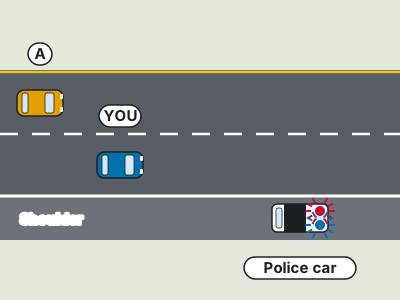
12. On a four-lane Vermont highway, what additional action may be required near a stopped emergency vehicle with flashing lights?
- Stop in the lane beside the emergency vehicle
- Change lanes away from it when the lane change can be made safely
- Use the center median to get around the stopped vehicle
- Continue at normal speed because four lanes provide enough room
Show answer
Change lanes away from it when the lane change can be made safely. On a four-lane highway such as an Interstate, Vermont law adds a lane change, when it can be made safely, to the basic duty to proceed with caution and slow down near a stopped police or emergency vehicle with flashing lights. Stopping beside the vehicle, using the center median, or keeping normal speed does not meet that duty. Check mirrors and the blind spot, signal, and move away only when the next lane is open. If you are unable to change lanes, the manual says you must slow down to 20 mph below the speed limit to go by.
Study this in the handbook: Traffic lights, arrows and roundabouts
13. According to the Vermont manual, what is the leading cause of death for children aged 3 to 14?
- Falls
- Drowning
- Motor vehicle crashes
- Illness
Show answer
Motor vehicle crashes. Motor vehicle crashes are the leading cause of death for children aged 3 to 14, which is why Vermont's restraint law is written by age: rear facing with a harness under two, a harnessed seat or booster for younger children, a booster under eight when not harnessed, and the back seat when practical under 13. The law requires all occupants to be restrained with a safety belt or an approved child seat.
Study this in the handbook: Safety belts and child restraints
14. Beginning with which model year does Vermont require safety belts and defrosters?
- 1964 and later models
- 1975 and later
- 1955 and later
- Every model year
Show answer
1964 and later models. Safety belts and defrosters are required in 1964 and later models under Vermont's equipment rules, while directional signals are required on vehicles manufactured after January 1, 1955. These dates come from the manual's list of proper equipment for the road test vehicle, which also says no road test will be given in a vehicle that lacks safety belts. Keeping the two cutoffs straight is the key: 1955 for signals, 1964 for belts and defrosters.
Study this in the handbook: Equipment, inspection and maintenance
15. What must a Vermont self-service gas station do for a driver with a disabled plate or placard who asks for help?
- Refuse service unless a full-service pump is available
- Charge the full-service price
- Have an attendant dispense the gasoline at the self-service price
- Provide a phone to call for help
Show answer
Have an attendant dispense the gasoline at the self-service price. Self service gasoline stations, when requested by a motor vehicle operator who holds a disabled plate or parking placard, must require an attendant to dispense gasoline at the self service cost. The driver pays the same price as anyone pumping their own fuel. The rule is part of Vermont's provisions for persons with disabilities, alongside reserved parking and possible exemption from the purchase and use tax for adapted vehicles.
16. What can happen to someone who parks illegally in a Vermont disabled parking space?
- A fine and towing charges
- Loss of license for one year
- A warning only
- Nothing unless the lot is private
Show answer
A fine and towing charges. A person who parks in a disabled parking spot illegally may be subject to a fine and towing charges. Using those spaces requires a special registration plate or placard issued by the Vermont DMV, or a comparable plate or device issued by another state for disabled parking. The manual adds that a disabled person's plates or placard may be revoked if they let people who are not disabled abuse those parking privileges.
17. At a Vermont stop sign, where must the vehicle stop before proceeding?
- After the front bumper enters the intersection
- Before the stop line, crosswalk, or intersecting road, whichever comes first
- Beside the sign, even if the crosswalk is farther ahead
- Only when another vehicle is approaching
Show answer
Before the stop line, crosswalk, or intersecting road, whichever comes first. A stop sign requires a full stop before the stop line, crosswalk, or intersecting road, whichever point comes first. The choice “After the front bumper enters the intersection” allows the vehicle to enter the intersection before stopping, which defeats the purpose of controlling the crossing. The choice “Beside the sign, even if the crosswalk is farther ahead” treats the sign itself as the stopping point, even though the required location may be farther ahead. The choice “Only when another vehicle is approaching” wrongly makes stopping depend on nearby traffic. As a driving cue, scan for pavement markings and the edge of the crossing before moving again.
Study this in the handbook: Traffic lights, arrows and roundabouts
18. A Vermont teen is ticketed for underage possession of alcohol and sent to the Teen Alcohol Safety Program. How soon must the teen contact the diversion board?
- Within 15 days
- Within 30 days
- Within 90 days
- Only after a court hearing
Show answer
Within 15 days. The manual says a ticketed minor must contact the Teen Alcohol Safety Program of Vermont Court Diversion, and failing to contact the diversion board within 15 days sends the case to the judicial bureau. There, a person found liable faces a $300 penalty and a license suspension, plus likely higher insurance rates. Thirty and ninety days are too late, and the teen does not wait for a court hearing first.
Study this in the handbook: Tests, renewals and license rules
19. Besides unsafe driving, what else can cause a Vermont Junior Driver's License to be taken away?
- Moving to a new address
- The parent or guardian withdrawing permission
- Failing a school exam
- Buying a second car
Show answer
The parent or guardian withdrawing permission. A Junior Driver's License is a provisional license. The Commissioner of Motor Vehicles may take it away if the driver shows through their actions that they are unsafe, and it may also be taken away if the parent or guardian withdraws permission to drive. An address change, school grades, and buying a car are not listed reasons. The parent or guardian must also sign the junior license application giving permission to be tested.
Study this in the handbook: Junior license passenger rules and recalls
20. What is the minimum age to take Vermont's learner's permit test?
- 15 years old
- 14 years old
- 16 years old
- 18 years old
Show answer
15 years old. A Vermont resident must be at least 15 years old to take the learner's permit test. The manual also recognizes a path for an out-of-state resident enrolled in a Vermont driver education course, but that exception does not lower the stated testing age. Choosing 16 confuses this test requirement with later licensing stages. Before scheduling, a prospective applicant should also check the parent or guardian permission rule for applicants who are 15, 16, or 17.
Study this in the handbook: Learner's Permit and Junior Driver's License
QualitySpace is expanding to Vermont
We are a California-based independent insurance brokerage working on licensing in more states. We cannot help with Vermont insurance yet. Leave your email and we will let you know when we can.
Every question is written from the official Vermont Driver's Manual. Need paper? Printable VT practice test with answer key.
Last verified 2026-10-05. How we check every question · Study all 200 as flashcards
Frequently asked questions
How many questions are on this Vermont practice test?
This fixed set has 20 questions. It is test 4 of 10 from the 200 question Vermont bank. The real VT exam asks 20 questions and you need 16 correct.
What is the passing score for the real Vermont test?
You must answer at least 16 questions correctly to pass the test (16 of 20) That figure comes from the official Vermont source cited on the DMV facts page.
How does this fixed test relate to the full Vermont bank?
Each numbered test is a fixed set of questions in a fixed order, so you can retake the same test later and compare. Every test mixes road signs and the other topics in about the same proportion as the full bank. Tests 1 to 10 together cover every question in the Vermont bank once. The full practice page mixes the whole bank at random.
Last verified 2026-10-05. See the Vermont DMV facts page for sourced state details.