
Test 5 of 10 · 20 questions · Free 2026
VT Permit Practice Test 5
Jump to the test ↓A fixed 20 question set from the Vermont bank with answers and plain English explanations. The real VT exam is 20 questions, 80 percent to pass; take the full length version on the main practice page.
Question 1 of 20 · 0 right so far
All 20 questions in test 5
Every question below comes from the Vermont question bank on this page. Open a question to see the correct answer and the explanation. Nothing here is hidden behind a signup.
1. When making a right turn into a street with more than one lane in your direction, which lane should you enter?
- Either lane while crossing the other lane during the turn
- The farthest lane so the turn is completed quickly
- The nearest lane, then change lanes after completing the turn if needed
- The center lane regardless of the number of lanes
Show answer
The nearest lane, then change lanes after completing the turn if needed. The manual directs a driver turning into a street with multiple lanes in the same direction to use the nearest lane. Crossing into a farther lane during the turn increases conflict with traffic already using that lane. A driver should not choose either lane casually or assume a center lane is always available. Complete the turn in the proper lane first, then make a separate, legal lane change after checking mirrors and blind spots.
Study this in the handbook: Stopping, braking and following distance
2. If a traffic signal is dark because of a power failure, how should you treat the intersection?
- Use only the lane with the right-of-way arrow
- Treat it as a green light for the larger road
- Continue through without stopping if no signal is visible
- Stop as if there were stop signs in all directions
Show answer
Stop as if there were stop signs in all directions. A dark signal does not remove intersection control. Vermont tells drivers to stop as though stop signs faced traffic from every direction. Giving priority to the larger road invents a rule the manual does not provide. Proceeding without stopping is especially dangerous because cross traffic may also be approaching under the same outage. Come to a complete stop, search all directions, yield as needed, and move through only after the path is clear.
Study this in the handbook: Traffic lights, arrows and roundabouts
3. When entering a roundabout, what must a driver do before proceeding?
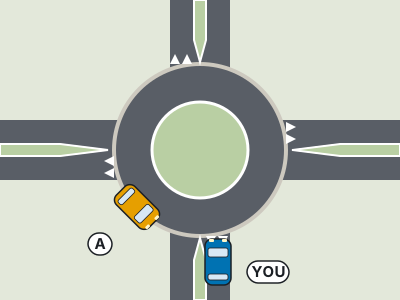
- Yield to traffic already in the roundabout and enter only with a safe gap
- Enter immediately because entering traffic has priority
- Stop inside the circle before choosing an exit
- Change lanes after entering to reach the desired exit
Show answer
Yield to traffic already in the roundabout and enter only with a safe gap. Traffic already circulating has priority, so an entering driver must yield and wait for a safe opening. Entering immediately can conflict with vehicles already in the circle. Stopping inside disrupts the flow, and changing lanes within a multi-lane roundabout is prohibited by the manual. Reduce speed on approach, select the appropriate lane before entry, and maintain awareness of pedestrians and bicyclists as you enter and leave.
Study this in the handbook: Traffic lights, arrows and roundabouts
4. How far from the nearest railroad rail may a Vermont driver not park?
- Within 10 feet
- Within 50 feet
- Within 25 feet
- Within 100 feet only when gates are present
Show answer
Within 50 feet. Vermont lists parking on railroad tracks or within 50 feet of the nearest rail of a railroad crossing among prohibited locations. The 10-foot and 25-foot choices understate that protected area, while the 100-foot answer adds a condition the rule does not require. A concrete cue is to treat the crossing as a wide no-parking zone, not merely the steel rails themselves. Keep the full 50-foot clearance whether or not the crossing has gates or flashing lights.
Study this in the handbook: Parking rules
5. How many questions must a Vermont applicant answer correctly to pass the online knowledge test?
- All 20
- At least 10 of 20
- At least 16 of 20
- At least 18 of 20
Show answer
At least 16 of 20. The Vermont online knowledge test has 20 questions, each with four answer options, and an applicant must answer at least 16 correctly to pass. Selecting all 20 sets a higher standard than the manual describes, while 10 or 18 changes the stated passing mark. The useful preparation cue is 16 out of 20, but passing the knowledge test alone does not complete every licensing requirement. Keep studying the road rules and required documents as well.
Study this in the handbook: Tests, renewals and license rules
6. Which violations do NOT add points to a Vermont driving record?
- Parking or defective equipment violations
- Texting while driving
- Speeding violations
- Failure to yield to a pedestrian
Show answer
Parking or defective equipment violations. Vermont does not assess points for parking or defective equipment violations. Speeding carries 2 to 8 points depending on how far over the limit, texting carries 2 to 5 points, and failing to yield to a pedestrian in a crosswalk carries 4 points. Points build toward the 10 point suspension notice, and the number received within 2 years sets how long the suspension lasts.
Study this in the handbook: Insurance, points and phone laws
7. How much clearance must a Vermont driver leave when passing a bicycle or another vehicle?
- At least two feet
- At least four feet
- At least three feet
- At least six feet
Show answer
At least four feet. Vermont tells drivers to pass vehicles and bicycles on the left and leave at least four feet of clearance between their vehicle and the vehicle or bicycle being passed. Two and three feet are less than Vermont's figure. Six feet is more than the stated minimum. The driver should then return right only after seeing the whole bicycle or vehicle in the inside mirror.
Study this in the handbook: Bicyclists, motorcycles, trucks and animals
8. From what distance must a Vermont rear license plate be readable by its light?
- At least 50 feet from the back of the vehicle
- At least 10 feet
- At least 100 feet
- At least 500 feet
Show answer
At least 50 feet from the back of the vehicle. The back license plate must be lighted so it can be seen and read at least 50 feet from the back of the vehicle. No portion of the plates should be covered or hidden, and they must be kept clean. Plates must also be properly affixed so they do not become loose, and the number plates issued may only be used on the vehicle they were issued for.
Study this in the handbook: Equipment, inspection and maintenance
9. What general message is usually conveyed by a yellow diamond-shaped Vermont warning sign?
- A mandatory instruction to stop at the sign
- A regulatory command listing a speed or turning requirement
- A service location such as fuel or food
- A warning about a hazard or condition ahead
Show answer
A warning about a hazard or condition ahead. Yellow or green diamond shapes are commonly used for warning signs. They alert drivers to hazards or roadway conditions such as sharp curves, unsafe intersections, dips, or crossings. A rectangular white sign carries regulatory directions, while service information is a different sign function. The diamond does not automatically require a stop. Its visual cue is advance preparation: reduce speed, read any supplemental message, and be ready for the specific condition that may affect the lane or roadway ahead.
Study this in the handbook: Road signs
10. If a solid line is in your lane and a broken line is in the other lane, what does Vermont's manual say?
- You must stop before the lines and wait for a green signal
- You may pass whenever your lane is moving slowly
- Both drivers may cross the lines without checking ahead
- You should not pass, but the vehicle in the other lane may pass
Show answer
You should not pass, but the vehicle in the other lane may pass. The line beside your lane controls your opportunity to pass. With a solid line in your lane and a broken line across the roadway, the manual says you should not pass, while the motor vehicle in the other lane may pass. Slow traffic does not override that marking, and neither driver may cross casually without checking conditions. This is not a traffic signal situation. Read the line from your own seat, then keep position unless the marking and surrounding conditions permit the movement.
Study this in the handbook: Turn signals and turning
11. After a Vermont crash with an injury or damage over $3,000, when must a written report reach the DMV?
- Within 10 days
- Within 72 hours
- Within 24 hours
- Within 30 days
Show answer
Within 72 hours. If any person has been injured, or if the damage is over $3,000, you must make a written report to the Department of Motor Vehicles within 72 hours. The manual notes that crash reports help the state improve roadways. Crash report forms are available at any Vermont police department, from the DMV in Montpelier, or online. You must also show your license to anyone injured or whose property was damaged.
Study this in the handbook: What to do after a crash
12. What does the Vermont manual say about mixing tires on a vehicle?
- Only the front tires must match
- Mixing is fine if the sizes match
- Never combine different types of tires on the same vehicle
- Snow tires may be mixed with summer tires
Show answer
Never combine different types of tires on the same vehicle. Never combine different types of tires on the same vehicle. Snow tires and summer tires are different types, so pairing them breaks the rule, and matching sizes alone does not make different types safe to combine. Vermont also requires at least 2/32 inch of tread depth. The manual adds that the safe choice is to have all good tires with the proper amount of tread.
Study this in the handbook: Floods, winter, skids and visibility
13. How many sides does a Vermont stop sign have?
- Eight
- Six
- Four
- Twelve
Show answer
Eight. The stop sign is an eight-sided shape. Its outline helps communicate the required action even if dirt, snow, or another obstruction makes the lettering hard to read. A six-sided sign, a rectangle, or a twelve-sided sign does not match the manual’s description. Shape recognition should lead to the full stop procedure: stop before the stop line, crosswalk, or intersecting road, whichever comes first, then scan and honor the right of way before moving.
Study this in the handbook: Road signs
14. What BAC level does Vermont identify as impaired for a general adult driver?
- 0.02 or above
- 0.04 or above
- 0.12 or above
- 0.08 or above
Show answer
0.08 or above. For the general adult rule described here, Vermont identifies a blood alcohol concentration of .08 or above as being under the influence or impaired. The lower .02 figure belongs to drivers under 21 and is a separate civil violation threshold, while .04 is not the general adult figure stated in this passage. A practical cue is to separate the adult impairment rule from the special under-21 rule instead of treating every driver category as identical.
Study this in the handbook: Alcohol, drugs and implied consent
15. What does the Vermont manual tell parents about supervised practice for a teen driver?
- Give the teen plenty of supervised practice, even more than the required 40 hours
- Practice only in daylight
- Stop at exactly 40 hours
- Let the teen practice alone after 10 hours
Show answer
Give the teen plenty of supervised practice, even more than the required 40 hours. The manual chapter for parents and guardians says motor vehicle crashes are the leading cause of death and injury for teenagers, and its first point is to assure your teen has plenty of chances to practice supervised driving, even more than the required 40 hours. The 40 hours is a minimum, not a stopping point. Parents are also urged to set a good example and to set family rules on known risk factors such as nighttime driving, speeding, and multiple teen passengers. Nothing in the manual limits practice to daylight or lets a permit holder drive alone.
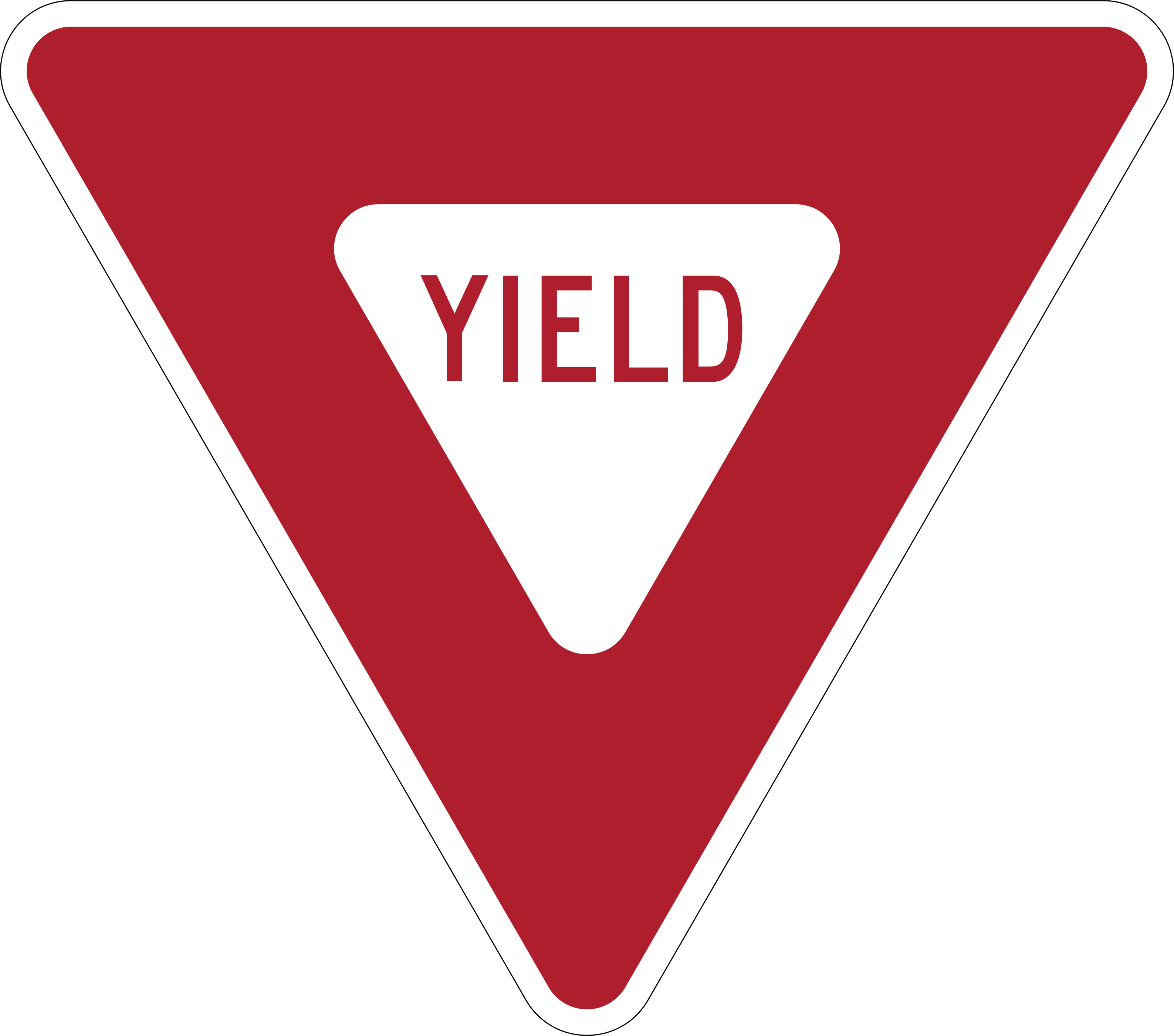
16. How can a driver identify the general meaning of a road sign when its wording is difficult to read?
- By the number of passengers
- By the vehicle’s fuel level
- By the time shown on the clock
- By its shape and color
Show answer
By its shape and color. Vermont explains that a driver can use a road sign’s shape and color, along with its wording, to understand its general meaning. This matters when dirt, snow, or another obstruction hides part of the message. It does not depend on the vehicle’s fuel, the time of day, or how many people are riding. Use the visible design to classify the sign as regulatory, warning, or information, then respond to the readable details and roadway conditions. The cue is to recognize the sign category before the full wording is clear.
Study this in the handbook: Traffic lights, arrows and roundabouts
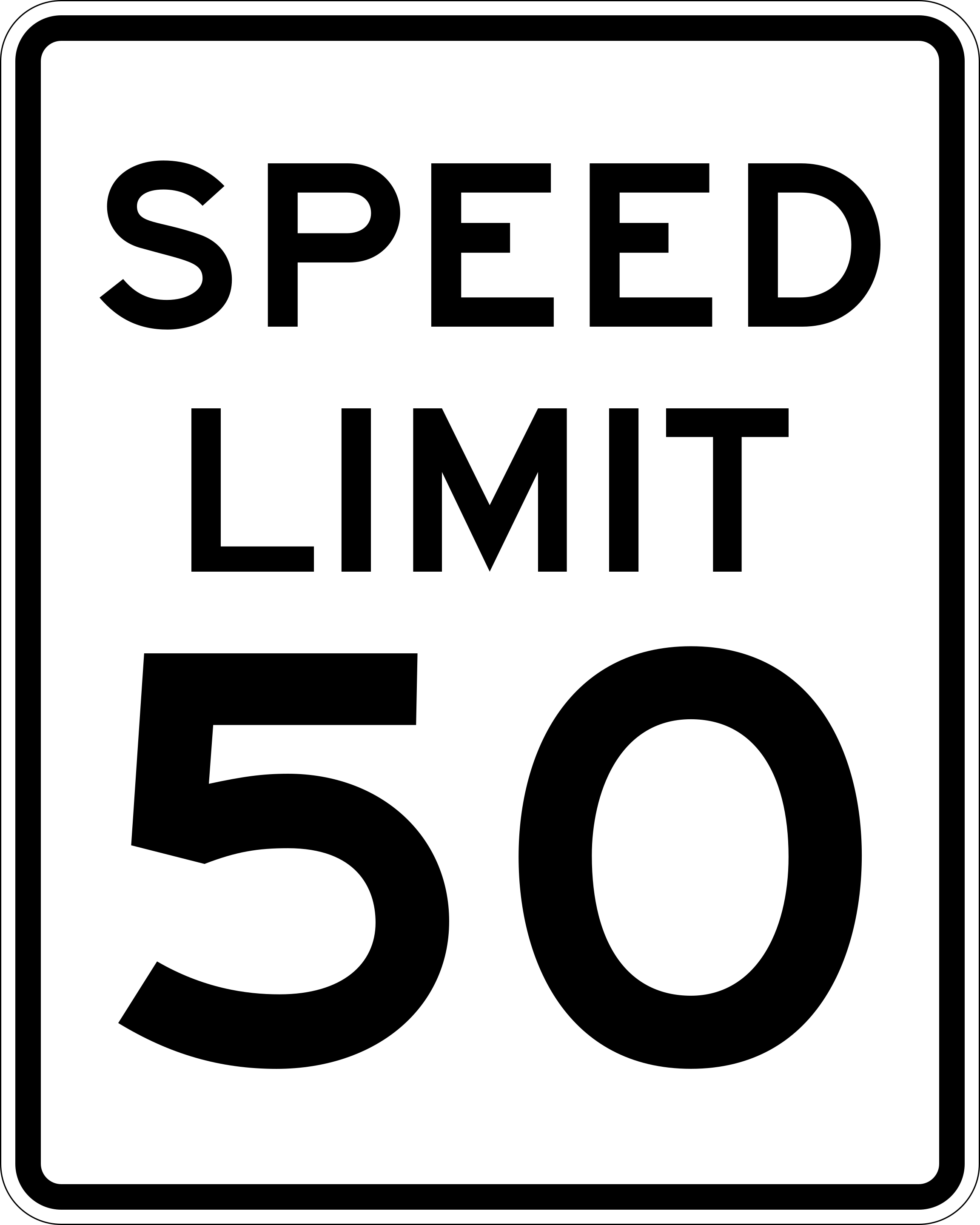
17. What kinds of rules may Vermont regulatory signs display?
- Only the names of nearby towns and rivers
- Speed limits, turning and passing laws, and other directions
- Only warnings about wildlife crossings
- Only the number of railroad tracks ahead
Show answer
Speed limits, turning and passing laws, and other directions. Vermont regulatory signs may display speed limits, turning and passing laws, and other directions. These signs tell drivers what is required or prohibited, so their messages control the maneuver rather than merely describing a possible hazard. Town names and rivers are information, wildlife warnings are a separate warning category, and track counts appear with railroad crossing information. Look for the rectangular white background and read the specific instruction before choosing speed, lane position, or passing behavior. The study cue is rule on the sign, action on the road.
Study this in the handbook: Turn signals and turning
18. A 16-year-old moves to Vermont holding another state's junior license for four months. Do Vermont's Graduated License rules apply?
- Yes, unless the other state's license had been held at least six months
- No, an out-of-state license is exempt
- Only the curfew applies
- Only if the teen fails the road test
Show answer
Yes, unless the other state's license had been held at least six months. An applicant with a junior license from another state must prove completion of an approved driver education course and pass eye, written, and road tests. The applicant is also subject to Vermont's Graduated License Law unless the other state's license was held for at least six months. Four months falls short, so the rules apply. An out-of-state license is not a blanket exemption, and the rule is not tied to a road test result.
Study this in the handbook: Junior license passenger rules and recalls
19. When preparing for a left turn, where should a Vermont driver position the vehicle before turning?
- Across the centerline before the turn
- Against the right curb
- Within one foot of the centerline, when safe
- In whichever lane has the most traffic
Show answer
Within one foot of the centerline, when safe. For a left turn, Vermont's manual directs the driver to position the vehicle within one foot of the centerline when it is safe to do so. The vehicle must still wait for oncoming traffic and keep its wheels straight until the turn begins. Moving against the right curb leaves the vehicle poorly positioned, and crossing the centerline early creates a conflict with opposing traffic. A good cue is position first, scan, then turn only through a clear path.
Study this in the handbook: Turn signals and turning
20. What may Vermont DMV provide when a disability significantly interferes with understanding permit or license information?
- A license issued without required documents
- A permanent exemption from every license test
- Reasonable accommodations for understanding the information
- A promise that no appointment will be needed
Show answer
Reasonable accommodations for understanding the information. Vermont DMV says reasonable accommodations may be available when a disability significantly interferes with understanding information for a Learner’s Permit or Driver’s License. That help concerns access to the information and process; it is not a blanket exemption from testing, identity documents, or appointments. The required response is to tell DMV about the barrier so the agency can address the need. The cue is the phrase significantly interferes, which points to accommodation rather than automatic waiver.
QualitySpace is expanding to Vermont
We are a California-based independent insurance brokerage working on licensing in more states. We cannot help with Vermont insurance yet. Leave your email and we will let you know when we can.
Every question is written from the official Vermont Driver's Manual. Need paper? Printable VT practice test with answer key.
Last verified 2026-10-05. How we check every question · Study all 200 as flashcards
Frequently asked questions
How many questions are on this Vermont practice test?
This fixed set has 20 questions. It is test 5 of 10 from the 200 question Vermont bank. The real VT exam asks 20 questions and you need 16 correct.
What is the passing score for the real Vermont test?
You must answer at least 16 questions correctly to pass the test (16 of 20) That figure comes from the official Vermont source cited on the DMV facts page.
How does this fixed test relate to the full Vermont bank?
Each numbered test is a fixed set of questions in a fixed order, so you can retake the same test later and compare. Every test mixes road signs and the other topics in about the same proportion as the full bank. Tests 1 to 10 together cover every question in the Vermont bank once. The full practice page mixes the whole bank at random.
Last verified 2026-10-05. See the Vermont DMV facts page for sourced state details.