
Test 8 of 10 · 20 questions · Free 2026
VT Permit Practice Test 8
Jump to the test ↓A fixed 20 question set from the Vermont bank with answers and plain English explanations. The real VT exam is 20 questions, 80 percent to pass; take the full length version on the main practice page.
Question 1 of 20 · 0 right so far
All 20 questions in test 8
Every question below comes from the Vermont question bank on this page. Open a question to see the correct answer and the explanation. Nothing here is hidden behind a signup.
1. What must a Vermont Junior Driver's License holder have to get a regular Driver's License?
- Be 17 and pay a fee
- Hold the junior license for three months
- Be 18 with no recalls, suspensions, or revocations in the previous six months
- Complete another driver education course
Show answer
Be 18 with no recalls, suspensions, or revocations in the previous six months. A Vermont junior license holder must be 18 and must not have any recalls, suspensions, or revocations during the previous six months to be eligible for a Driver's License. That six month period starts on the date of reinstatement if there was a suspension. Seventeen is too young, three months is only the first passenger stage, and no second driver education course is required.
Study this in the handbook: Junior license passenger rules and recalls
2. What happens in Vermont to a driver under 21 who operates a vehicle with a BAC of .02 or more?
- Nothing, because .02 is below the .08 limit
- A criminal felony charge
- A civil traffic violation, license suspension, and an alcohol and driving education program at the driver's expense
- A warning letter to the parents only
Show answer
A civil traffic violation, license suspension, and an alcohol and driving education program at the driver's expense. Drivers under 21 with an alcohol concentration of .02 or more can receive a civil traffic violation. The license will be suspended, and the driver must complete an alcohol and driving education program at their own expense. The .08 adult limit is not a safe harbor for young drivers. The under 21 offense is civil, not a felony, and it does more than notify parents.
Study this in the handbook: Highway markings and passing
3. What does Vermont law say about items hanging from the rearview mirror or sun visors?
- Nothing may hang from the rearview mirror or sun visors
- Only air fresheners are allowed
- Items are allowed if they do not block the windshield
- Small items are allowed
Show answer
Nothing may hang from the rearview mirror or sun visors. Vermont's manual says the law states there shall not be anything hanging from the rearview mirror or sun visors. The same passage says a driver has to be able to see clearly to the front and sides of the vehicle, so nothing should be in the way, and objects carried in the vehicle, passengers, or pets should not be in the driver's way. You must also have a rearview mirror and a horn. The rule has no exception for air fresheners or small items.
Study this in the handbook: Equipment, inspection and maintenance
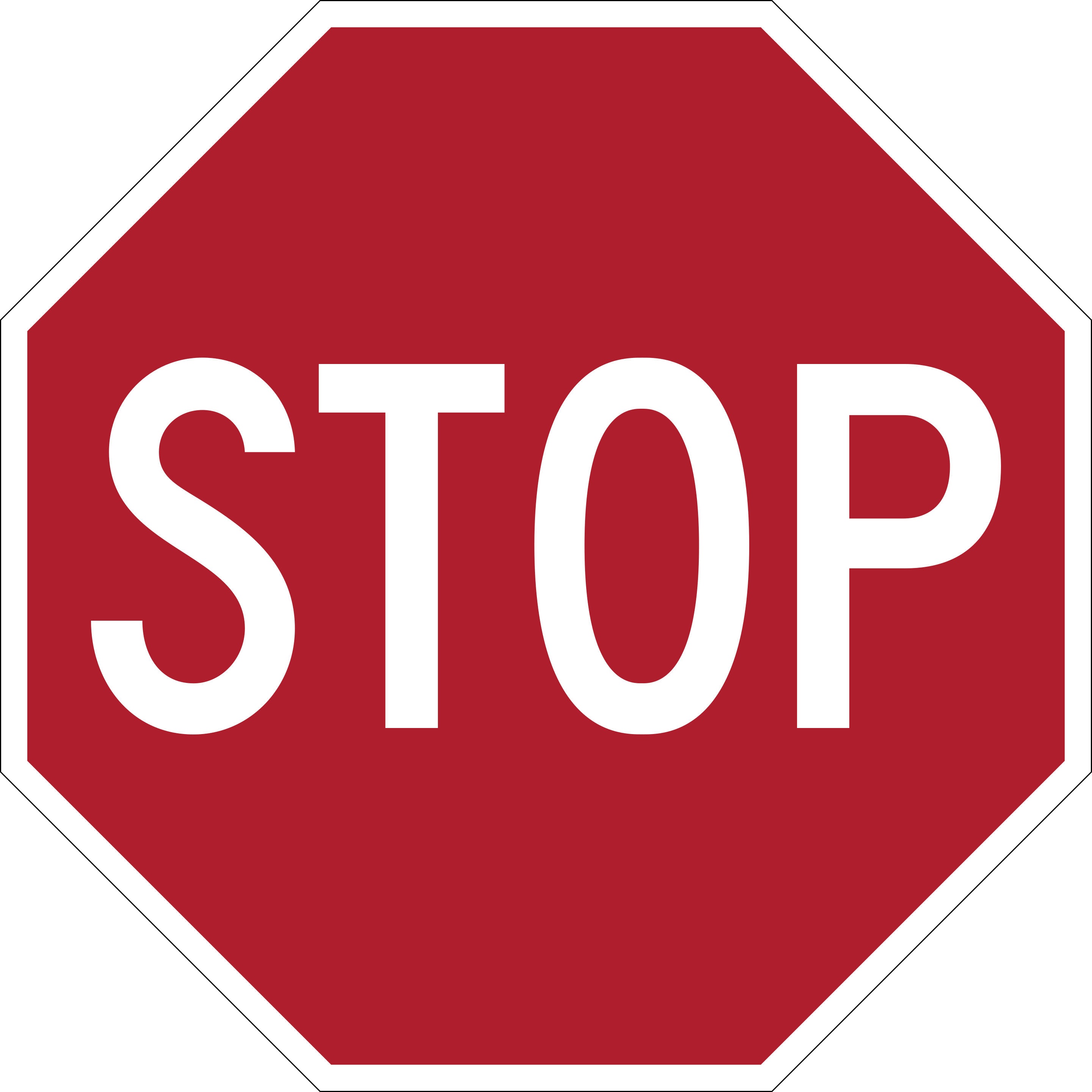
4. What does the eight-sided shape of a Vermont stop sign tell a driver?
- The sign indicates that the driver should yield without stopping
- The sign requires a complete stop
- The sign warns of a railroad crossing ahead
- The sign provides directions to nearby services
Show answer
The sign requires a complete stop. An eight-sided sign is the stop sign shape, so its shape communicates a stopping instruction even when wording is hard to read. Yield signs use an upside-down triangle, while railroad warnings use a circular design with an X and RR. The octagon does not provide service information. On seeing this shape, prepare to stop before the stop line, crosswalk, or intersecting road, whichever comes first. Then scan the intersection, honor the right of way, and proceed only when the route is safe.
Study this in the handbook: Traffic lights, arrows and roundabouts
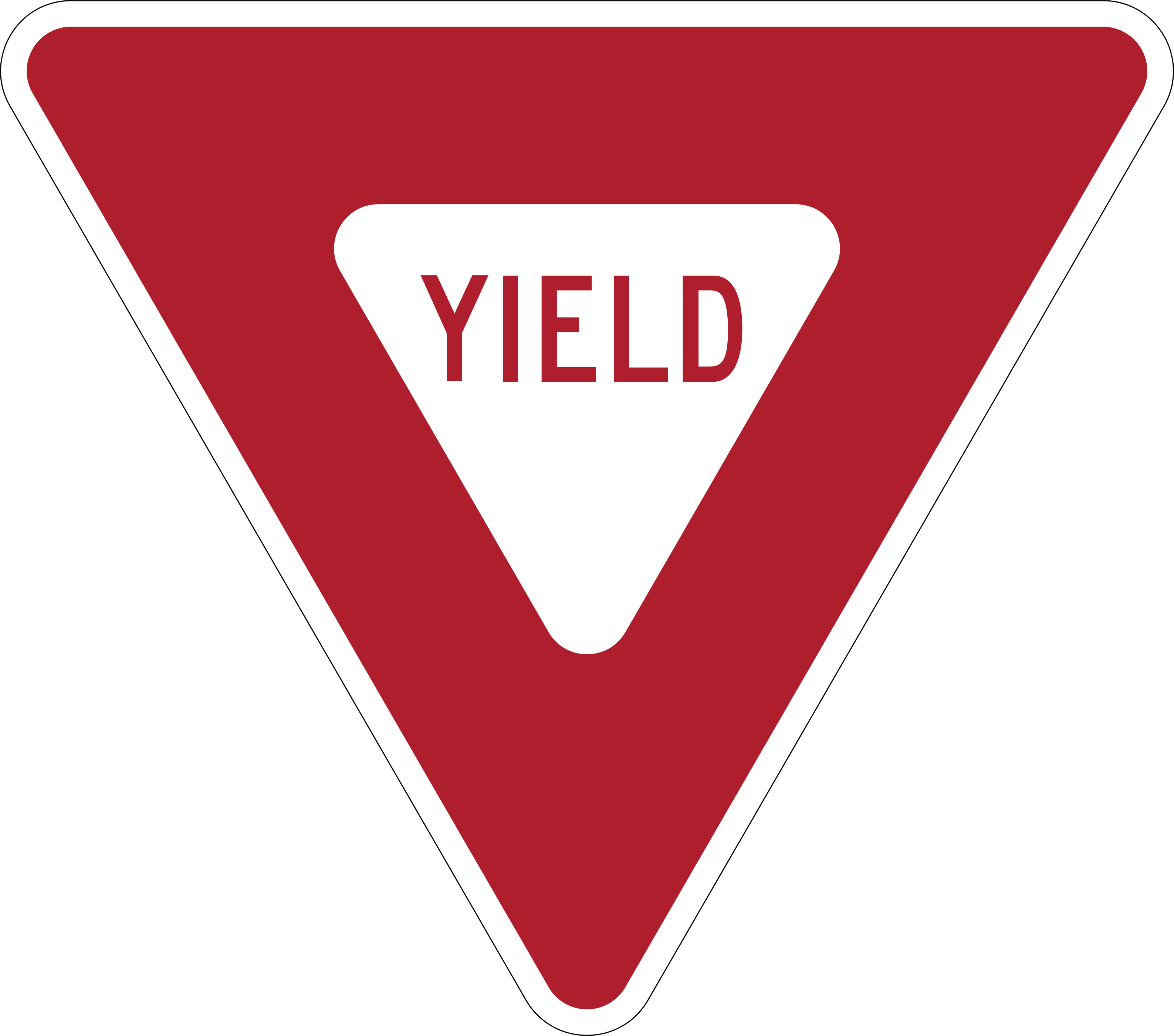
5. What action is associated with the inverted triangle yield sign?
- Stop at every yield sign even when the way is clear
- Accelerate to claim the intersection first
- Slow down, search, and enter only when the way is clear
- Ignore pedestrians if motor traffic has stopped
Show answer
Slow down, search, and enter only when the way is clear. Vermont describes the upside-down triangle as a yield right-of-way sign. It tells drivers to slow down, search, and enter only when pedestrians, bicyclists, and vehicles do not create a conflict. A full stop is not automatically required when the way is clear, although the driver must be ready to stop. Accelerating undermines the warning, and pedestrians cannot be ignored because another traffic stream has paused. Use the sign to make a careful gap check before entering.
Study this in the handbook: Traffic lights, arrows and roundabouts
6. What does Vermont's eight-sided stop sign require?
- Slow down and continue if no car is visible
- Stop, scan the intersection, honor right of way, and then proceed
- Stop only when a pedestrian is present
- Yield without stopping at a marked crosswalk
Show answer
Stop, scan the intersection, honor right of way, and then proceed. The octagonal stop sign requires a stop, an intersection scan, respect for right of way, and then a safe departure. Merely slowing does not satisfy the sign, even when the road appears empty. Waiting for a pedestrian is too narrow because vehicles and bicyclists also affect right of way. A yield sign has a different shape and does not replace the stop requirement. Treat the eight sides as an immediate visual cue to stop before the required line or crossing.
Study this in the handbook: Traffic lights, arrows and roundabouts
7. How long must an applicant under 18 have maintained a clean driving record before applying for a Vermont learner's permit?
- The previous one year
- The previous six months
- The previous two years
- The previous three years
Show answer
The previous two years. An applicant under 18 must have maintained a clean driving record during the previous two years before applying for a Vermont learner's permit. The six-month period is associated with a junior driver's license, so it is an attractive but mismatched choice. Recalls, suspensions, or revocations can create an additional waiting period, which is why an applicant should resolve those records with DMV before assuming eligibility. Think of the permit rule as a two-year lookback.
Study this in the handbook: Learner's Permit and Junior Driver's License
8. Under Vermont's implied consent law, what can happen if a driver refuses an officer's alcohol or drug test?
- The driver receives only a written warning
- The driver's license can be lost for at least six months
- The license is suspended for exactly 30 days
- The driver may refuse if no crash occurred
Show answer
The driver's license can be lost for at least six months. Getting a Vermont license means agreeing to take a test when a police officer believes alcohol or drugs may be affecting the driver. Refusal can cost the driver the license for at least six months, independent of whether a criminal DUI conviction follows. The 30-day option understates the minimum stated period, while a warning is not the administrative consequence described. The useful cue is the word refusal: the administrative suspension process can begin before a criminal case is resolved.
Study this in the handbook: Alcohol, drugs and implied consent
9. What must an applicant provide for the vehicle used in a Vermont road test?
- Only the vehicle title
- Only a current fuel receipt
- A rental agreement in every case
- Registration, inspection, and proof of insurance
Show answer
Registration, inspection, and proof of insurance. The road-test vehicle must be registered and inspected, and the applicant must have proof of insurance for that vehicle. A title or fuel receipt does not demonstrate all three conditions. Rental vehicles are not automatically acceptable either, because the rental company must provide a responsibility letter. Before the appointment, check the registration, inspection sticker, and insurance together. That simple three-part check prevents a mechanically usable vehicle from being rejected for missing paperwork.
Study this in the handbook: Tests, renewals and license rules
10. How far before a turn or lane change must a Vermont driver use a turn signal?
- Not less than 100 feet
- Not less than 25 feet
- Not less than 50 feet
- Not less than 200 feet
Show answer
Not less than 100 feet. Vermont requires a turn signal not less than 100 feet before making a turn or changing lanes. The manual notes that signaling three to five seconds before either action covers this requirement. The shorter distances in the other choices give following drivers less time to understand your plan, while 200 feet is not the stated minimum. Start the signal early, then confirm that the maneuver is safe before moving or turning.
Study this in the handbook: Turn signals and turning
11. A Vermont applicant's license is suspended in another state. What happens when the applicant applies in Vermont?
- The license is denied until proof of reinstatement or clearance in that state
- Vermont issues a Learner's Permit only
- Vermont issues the license anyway
- The applicant pays a double fee
Show answer
The license is denied until proof of reinstatement or clearance in that state. Every Vermont application triggers an inquiry of the national Problem Driver Pointer System. If it shows the applicant is suspended, revoked, denied, or canceled in another state, Vermont denies the Driver's License, Learner's Permit, or Junior Driver's License until proof arrives that the person has been reinstated or cleared there. The person may not even be tested. There is no permit-only or double-fee workaround.
Study this in the handbook: Tests, renewals and license rules
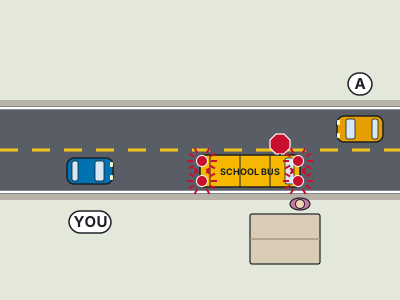
12. When a school bus activates its alternately flashing red warning lights, what must a driver do?
- Pass slowly if no children are visible
- Stop the vehicle and do not pass the bus
- Stop only when following the bus in the same direction
- Continue through a school yard if traveling below 15 mph
Show answer
Stop the vehicle and do not pass the bus. Alternately flashing red warning lights mean the stopped school bus is loading or unloading students, and vehicles must stop. Vermont says never to pass from any direction while those red lights are on, including in a school yard. The absence of visible children does not cancel the signal, and the rule is not limited to traffic behind the bus. Prepare to stop when yellow lights begin, then remain stopped until the red warning display has ended and it is safe to proceed.
Study this in the handbook: School buses and railroad crossings
13. When is a driver on a divided highway not required to stop for a school bus with red warning lights?
- When the driver is late for work
- When the bus is traveling in the opposite direction on the divided highway
- When the bus is stopped on any two-lane road
- When a driver sees no children outside the bus
Show answer
When the bus is traveling in the opposite direction on the divided highway. The manual gives a narrow exception: on a divided highway, a driver does not have to stop when the school bus is traveling in the opposite direction. A concrete barrier may separate the traffic streams. This does not excuse passing a stopped bus on an ordinary two-lane road, and the absence of visible children is not a legal test. Treat red warning lights as a stop command unless the divided-highway opposite-direction exception clearly applies.
Study this in the handbook: School buses and railroad crossings
14. What minimum liability coverage must a Vermont driver carry?
- $25,000 for one person, $50,000 for two or more, and $10,000 for property damage
- $15,000, $30,000, and $5,000
- $50,000, $100,000, and $25,000
- $10,000 for all claims combined
Show answer
$25,000 for one person, $50,000 for two or more, and $10,000 for property damage. The amount of coverage must be at least $25,000 for death or injury of one person, $50,000 for death or injury of two or more persons, and $10,000 for property damage. You must carry a card from your insurer in the vehicle showing the coverage, and you will have to show it if a police officer stops you or when you take a driving test. Driving without insurance and being stopped brings a ticket, a fine, and two points; driving uninsured and having a crash leads the Commissioner to take your license until you get insurance.
Study this in the handbook: Insurance, points and phone laws
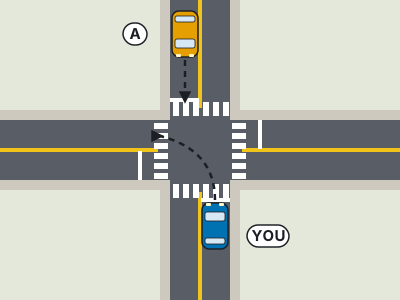
15. When turning left at an intersection, what traffic must the driver yield to?
- Only vehicles approaching from the right
- No traffic if the turn signal is on
- Only pedestrians in a marked crosswalk
- All oncoming traffic, including bicyclists
Show answer
All oncoming traffic, including bicyclists. A left-turning driver must wait for every oncoming road user described by the manual, including a motor vehicle or bicyclist. Activating a signal communicates the intention to turn but does not grant priority. Limiting the rule to traffic from the right or to marked crosswalk users overlooks the oncoming lane. A useful habit is to keep the wheels straight while waiting, then turn only after the opposing path is clear and pedestrians in the destination street have been considered.
Study this in the handbook: Right of way rules
16. An oncoming driver's bright lights are blinding you on a Vermont road. Where should you look?
- Directly at the lights so your eyes adjust
- Down at the dashboard
- At the center line
- Ahead toward the right edge of the highway until the lights have gone by
Show answer
Ahead toward the right edge of the highway until the lights have gone by. Vermont's manual says that if you look directly at oncoming lights, you could be blinded for several seconds. To avoid being temporarily blinded, look ahead toward the right edge of the highway until the bright lights have gone by and your vision has returned to normal. The manual adds that this practice also helps you detect bicyclists or pedestrians close to the edge of the road. The dashboard and the center line are not where the manual tells you to look.
Study this in the handbook: Floods, winter, skids and visibility
17. A continuous two-way left-turn lane in Vermont is intended for:
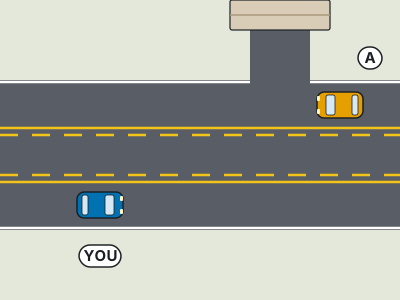
- Preparing for and making a left-hand turn
- Passing slower traffic in either direction
- Driving straight until the next traffic signal
- Parking while waiting for a passenger
Show answer
Preparing for and making a left-hand turn. A continuous two-way left-turn lane is for preparing to turn left, not for ordinary travel or passing. Traffic from both directions may need that lane for a left turn, so using it as a through lane creates conflicts. The manual advises signaling, moving into the lane carefully a short distance before the turn, and placing the whole vehicle in it so traffic is not blocked. The cue is turn-only space: enter briefly for the left turn, then leave it through the intended movement.
Study this in the handbook: Highway markings and passing
18. What is the purpose of yellow center lines on a Vermont highway?
- They mark the edge of a one-way roadway
- They separate lanes moving in the same direction
- They identify lanes reserved for parking
- They separate opposing directions of travel
Show answer
They separate opposing directions of travel. Yellow center lines divide traffic moving in opposite directions. They differ from broken white lines, which divide same-direction lanes. A center line does not identify a parking lane or prove that the roadway is one way. When reading pavement, determine whether the traffic on the other side is facing you. If it is, the yellow marking is performing its center line function. This distinction helps a driver interpret passing restrictions and position the vehicle safely before a maneuver.
Study this in the handbook: Turn signals and turning
19. Which vehicles require a commercial driver's license in Vermont?
- Any vehicle used for business
- Pickup trucks with trailers
- Any vehicle over 10,000 pounds
- Vehicles rated over 26,000 pounds, or carrying 16 or more passengers including the driver, or hazardous materials
Show answer
Vehicles rated over 26,000 pounds, or carrying 16 or more passengers including the driver, or hazardous materials. A commercial driver license is required for operators of vehicles rated in excess of 26,000 pounds, vehicles transporting 16 or more passengers including the driver, or vehicles carrying hazardous materials. Using a vehicle for business does not by itself trigger the requirement, and towing a trailer with a pickup matters only if the combination meets those thresholds. Vermont has three CDL classes: Class A for heavy combinations, Class B for heavy single vehicles, and Class C for lighter vehicles carrying placarded hazardous materials or 16 or more passengers.
20. What lane rights do motorcycles have on Vermont roads?
- They must ride on the shoulder
- They must share a lane with cars
- Motorcycles are entitled to a full lane
- They may use only the right third of the lane
Show answer
Motorcycles are entitled to a full lane. Motorcycles are entitled to a full lane. When passing a motorcycle, change lanes completely and never cut in too closely afterward. When following one, allow more than 4 seconds, since riders often slow by downshifting or rolling off the throttle without showing a brake light. Motorcyclists in turn must operate as responsible road users and not exploit the cycle's narrow silhouette to weave through traffic.
Study this in the handbook: Bicyclists, motorcycles, trucks and animals
QualitySpace is expanding to Vermont
We are a California-based independent insurance brokerage working on licensing in more states. We cannot help with Vermont insurance yet. Leave your email and we will let you know when we can.
Every question is written from the official Vermont Driver's Manual. Need paper? Printable VT practice test with answer key.
Last verified 2026-10-05. How we check every question · Study all 200 as flashcards
Frequently asked questions
How many questions are on this Vermont practice test?
This fixed set has 20 questions. It is test 8 of 10 from the 200 question Vermont bank. The real VT exam asks 20 questions and you need 16 correct.
What is the passing score for the real Vermont test?
You must answer at least 16 questions correctly to pass the test (16 of 20) That figure comes from the official Vermont source cited on the DMV facts page.
How does this fixed test relate to the full Vermont bank?
Each numbered test is a fixed set of questions in a fixed order, so you can retake the same test later and compare. Every test mixes road signs and the other topics in about the same proportion as the full bank. Tests 1 to 10 together cover every question in the Vermont bank once. The full practice page mixes the whole bank at random.
Last verified 2026-10-05. See the Vermont DMV facts page for sourced state details.