
Test 9 of 10 · 20 questions · Free 2026
VT Permit Practice Test 9
Jump to the test ↓A fixed 20 question set from the Vermont bank with answers and plain English explanations. The real VT exam is 20 questions, 80 percent to pass; take the full length version on the main practice page.
Question 1 of 20 · 0 right so far

All 20 questions in test 9
Every question below comes from the Vermont question bank on this page. Open a question to see the correct answer and the explanation. Nothing here is hidden behind a signup.
1. What does the circular RR warning sign indicate?
- A school crossing directly at the sign
- A lane ending on the right
- A railroad crossing ahead
- A required circular traffic movement
Show answer
A railroad crossing ahead. The circular RR sign is advance warning of a railroad crossing ahead. It does not mark a lane ending, identify a school crossing, or require a circular traffic movement. Because the crossing is ahead rather than necessarily at the sign, the driver should reduce speed and begin looking for the crossbuck, tracks, lights, gates, and other controls. The large X and RR lettering make this warning recognizable even before the crossing itself becomes visible.
Study this in the handbook: Traffic lights, arrows and roundabouts
2. How early should you signal before a turn or lane change to meet Vermont’s timing guidance?
- Only after entering the intersection
- Three to five seconds before the action
- One second before moving the wheel
- After the lane change is complete
Show answer
Three to five seconds before the action. The manual explains that signaling three to five seconds before a turn or lane change covers Vermont’s not-less-than-100-foot requirement. Signaling after entry or after the maneuver gives surrounding road users little useful warning, and one second may not provide enough notice at ordinary speed. Begin the signal early, confirm mirrors and blind spots, and keep watching traffic while preparing to turn or move over. The timing cue is a short count of several seconds before the maneuver begins.
Study this in the handbook: Stopping, braking and following distance
3. How much following distance should a Vermont driver keep behind a horse and rider or herded animals?
- At least a 4 second following distance
- At least 1 second
- At least 10 seconds
- No set distance, just a car length
Show answer
At least a 4 second following distance. When following a horse with a rider, a horse and wagon, or herded animals, leave at least a four second following distance. The manual asks drivers to reduce speed, and possibly stop, so the animals are not frightened. Never blow the horn or rev the engine near them, use the full traffic lane to pass completely, and never cut quickly back into your lane. Careless driving around such animals can bring a fine or imprisonment for negligent operation.
Study this in the handbook: Bicyclists, motorcycles, trucks and animals
4. Where should you stop when a police vehicle is stopping you?
- In the left lane beside the police vehicle
- In the center median of a divided highway
- In the intersection so the officer has a clear view
- As close as safely possible to the right side, outside an intersection
Show answer
As close as safely possible to the right side, outside an intersection. The police-stop procedure calls for moving as close as safely possible to the right side of the road. It also specifically says not to stop in an intersection or pull into the center median of a divided highway. Those locations can obstruct traffic or expose both vehicles to unnecessary danger. Choose a visible, safe position at the right edge, keep your belt fastened, limit movement, and wait for the officer’s instructions. The roadway position is part of handling the stop safely.
Study this in the handbook: Emergency vehicles, Move Over and police stops
5. Before entering an intersection, what must a Vermont driver do?
- Enter first whenever the vehicle is traveling on the wider road
- Search in all directions and make sure there is a clear path
- Look only left because traffic from the right must yield
- Accelerate through without checking if the signal is green
Show answer
Search in all directions and make sure there is a clear path. The manual calls for a complete visual search before entering any intersection and requires a clear path. A wider road does not automatically grant priority, and looking only one way can miss a vehicle, pedestrian, or bicyclist. Even a green signal does not remove the need to observe conditions before proceeding. Build the habit at every crossing: scan left, right, and ahead, verify that the intended path is open, and then move at a controlled speed. The all-directions check is the key safety cue.
Study this in the handbook: Stopping, braking and following distance
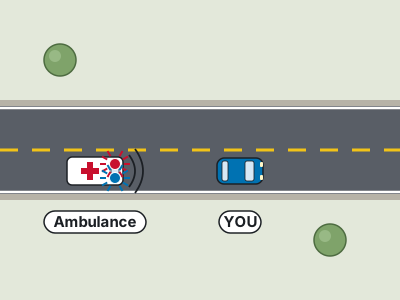
6. Where should you stop when an approaching emergency vehicle requires you to pull over?
- On the left shoulder even when the right side is clear
- In the center median of a divided highway
- Across the travel lane wherever the siren first becomes audible
- On the right side of the road, staying stopped until it has gone by
Show answer
On the right side of the road, staying stopped until it has gone by. Vermont law says that if you see or hear a vehicle with flashing blue or red lights or a siren approaching from any direction, you must pull over to the right side of the road and stop. You must remain stopped until the emergency or law enforcement vehicle has gone by. The left shoulder and the center median are not the side the law names, and stopping across a travel lane wherever you first hear the siren can block the very path the emergency vehicle needs. Check mirrors, move right when it is safe, and wait.
Study this in the handbook: Traffic lights, arrows and roundabouts
7. Where can a person take Vermont's learner permit test?
- Only at a DMV office
- Online through the DMV website
- Only through a private driving school
- At a town clerk's office
Show answer
Online through the DMV website. The learner permit test is administered online through Vermont DMV's website, so an applicant should plan for an online test rather than an office appointment for that step. A DMV office visit is not the route described for taking the permit test. The manual also distinguishes this test from the road test, which still involves an examiner and a vehicle. A useful planning cue is to review the online testing instructions at mydmv.vermont.gov before beginning the application process.
8. How many points does Vermont assess for failing to stop for a stop sign or red light?
- 8 points
- 4 points
- 5 points
- 2 points
Show answer
2 points. Vermont assesses 2 points for failure to stop for a stop sign or red light, the same as driving without a license. Four points is for failing to obey a police officer or to yield to a pedestrian in a crosswalk, and five points is for failing to yield to an emergency vehicle or failing to stop for a school bus. Eight points is the top of the speeding range.
Study this in the handbook: Insurance, points and phone laws
9. What should a Vermont driver do after recognizing a warning sign?

- Stop in every case before passing the sign
- Accelerate to clear the area before the hazard
- Slow down and prepare for the condition ahead
- Ignore it unless a police officer is present
Show answer
Slow down and prepare for the condition ahead. The manual tells drivers to slow down when warning signs identify danger. The sign does not always require a complete stop, and it certainly does not call for acceleration or waiting for an officer. Read any added safe-speed or distance information, look toward the roadway feature, and keep the vehicle under control as you approach. The useful habit is to treat the sign as advance notice: ease off the accelerator, increase observation, and prepare to respond to the hazard rather than reacting at the last moment.
Study this in the handbook: Road signs
10. A school bus with flashing red lights is stopped on the other side of a concrete barrier, traveling in the opposite direction. Must you stop?
- No, with a concrete barrier separating traffic you are not required to stop
- Yes, every driver in every direction must stop for the red lights
- Only if the bus is showing yellow lights instead of red
- Only if the bus driver does not wave you through
Show answer
No, with a concrete barrier separating traffic you are not required to stop. Vermont lists a few exceptions where a stop for a school bus is not necessary. You do not have to stop on a divided highway if the school bus is traveling in the opposite direction, and the manual adds that a concrete barrier may be used to separate traffic from the bus, in which case you are not required to stop. Outside these exceptions the rule is strict: once the red warning lights are on you must stop, and passing a stopped school bus brings a substantial fine and five points. Yellow lights mean prepare to stop, and a wave from the driver changes nothing.
Study this in the handbook: School buses and railroad crossings
11. A Vermont license has been expired for more than three years. What must the driver do to get a new one?
- Pay a late fee only
- Take the vision, written and road tests
- Take the written test only
- Renew online
Show answer
Take the vision, written and road tests. If your license has been expired for more than three years, or you do not have an out of state license, you will have to take the vision, written and road tests. The renewal section says the same thing for a Vermont license: once it has been expired more than three years, you must be tested again to obtain a new license. Separately, a Vermont license expired for more than 14 days is not valid for driving, so a lapsed driver should not get behind the wheel.
12. When may a driver enter a Vermont roundabout?
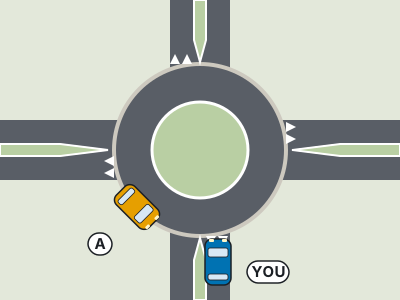
- When there is a safe gap in circulating traffic
- Only after stopping for every vehicle already inside
- Whenever the vehicle has reached the entrance line
- Only when a traffic signal gives permission
Show answer
When there is a safe gap in circulating traffic. Drivers must yield to traffic already in the roundabout and enter only when a safe gap exists. Reaching the entrance line is not automatic permission to go. The manual frames entry around yielding and finding a safe opening, not stopping for each vehicle inside. It does not describe a traffic signal granting entry; the safe gap is the cue. Slow before entering, scan for users inside, and signal when preparing to exit.
Study this in the handbook: Traffic lights, arrows and roundabouts
13. Before receiving a Vermont junior driver's license, how many classroom hours must an approved driver education course include?
- 40 hours
- 10 hours
- 20 hours
- 30 hours
Show answer
30 hours. Applicants who are 16 or 17 must complete an approved driver education course with 30 hours of classroom study, plus six hours behind the wheel and six hours of observation. The 40-hour figure belongs to additional driving practice, not classroom instruction. A study plan should keep those requirements separate because course hours do not replace the required practice log. The cue is the category attached to the number: classroom study is 30 hours, while practice behind the wheel is a different requirement.
Study this in the handbook: Learner's Permit and Junior Driver's License
14. What is the purpose of highway markings in Vermont?
- They help position vehicles, direct traffic, and show when passing is allowed
- They replace every traffic sign at an intersection
- They authorize drivers to ignore posted speed limits
- They identify only locations where emergency vehicles park
Show answer
They help position vehicles, direct traffic, and show when passing is allowed. Highway markings provide several kinds of guidance: they help position a vehicle, direct it through situations, show when passing is allowed, and warn of upcoming conditions. They do not replace every sign, cancel a posted limit, or serve only as emergency-vehicle parking markers. A concrete cue is to read pavement as traffic information. Check the color, whether a line is solid or broken, and which side of the marking you occupy before passing or changing lanes.
Study this in the handbook: Turn signals and turning
15. How often must a Vermont vehicle be inspected?
- Every six months
- Only when it changes owners
- Every two years
- Once a year
Show answer
Once a year. Vermont requires a vehicle inspection once a year. The inspection checks the vehicle at least annually, but the owner must continue keeping it in working condition between inspections. A two-year cycle or an ownership-only trigger would leave a vehicle unchecked for too long. The manual also provides a registration cue: motor vehicles must be inspected within 15 days of registration unless they already carry a valid Vermont inspection sticker.
Study this in the handbook: Equipment, inspection and maintenance
16. What does Vermont's implied consent law mean for a licensed driver?
- The driver may refuse every test if the vehicle is parked
- The driver agrees that a license can never be suspended for refusing a test
- The driver agrees to take an alcohol or drug test when an officer asks based on suspected impairment
- The driver must take a test only after a criminal conviction
Show answer
The driver agrees to take an alcohol or drug test when an officer asks based on suspected impairment. By accepting a license, a driver is treated as agreeing to say yes to a test when a police officer thinks alcohol or other drugs may be affecting driving. Refusal is not consequence-free: the manual says the license will be lost for at least six months. The rule does not wait for a criminal conviction, and it is not a general permission to refuse whenever a vehicle is stopped. The key cue is license possession carries this testing obligation.
Study this in the handbook: Alcohol, drugs and implied consent
17. How does a wet, icy, or gravel road affect a vehicle's braking distance?
- It makes the braking distance much longer
- It makes the braking distance shorter
- It has no effect if the tires are new
- It changes only the reaction distance
Show answer
It makes the braking distance much longer. The manual warns that on wet, icy, or gravel roads the braking distance will be much longer. Braking distance is the travel from the moment the brakes are applied until the vehicle stops, and it varies with road conditions. Reaction distance is the travel that happens before the brake is applied, and it grows with speed. New tires are not described as removing the effect of a slippery surface. When rain first starts, oil, rubber, dirt, and water combine to make roads especially slippery. Slow down early and leave extra room before a stop.
Study this in the handbook: Stopping, braking and following distance
18. During the first three months of a Vermont Junior Driver's License, the teen drives with a licensed, unimpaired 30-year-old in the front seat. How many passengers may ride?
- None besides the adult
- Only one
- No set number, but no more than there are safety belts
- Only immediate family
Show answer
No set number, but no more than there are safety belts. In the first three months, a junior operator is restricted to driving alone unless a qualified person rides in the front seat: a licensed unimpaired parent or guardian, a driver education instructor, or a licensed unimpaired person 25 or older. When one of them is in the vehicle, there is no restriction on the number of passengers, but the driver may not carry more passengers than there are safety belts. Family-only is the rule for the second three months.
Study this in the handbook: Junior license passenger rules and recalls
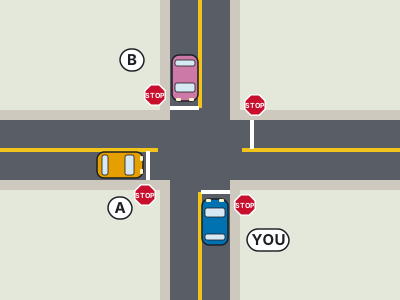
19. At a Vermont four-way stop, the first vehicle to arrive should have:
- Priority only after honking
- The duty to reverse before proceeding
- The right-of-way
- No priority unless a signal is green
Show answer
The right-of-way. At a four-way stop, the first vehicle to arrive should have the right-of-way. The reverse-before-proceeding and honking choices invent procedures that do not decide priority, while a green signal is not part of a four-way stop. If two vehicles arrive at approximately the same time from different directions, the driver on the left yields to the driver on the right. A concrete cue is arrival order first, right-side priority for a tie. Stop fully, observe the sequence, and let the rule settle the movement before entering.
Study this in the handbook: Right of way rules
20. Which example does Vermont give for a warning sign that includes a distance?
- “Stop here for 15 seconds”
- “Deer Crossing, next 3 miles”
- “Parking allowed for 2 hours”
- “Passing lane begins in 1 mile”
Show answer
“Deer Crossing, next 3 miles”. Vermont uses “Deer Crossing, next 3 miles” as an example of a warning sign that supplies distance information. The message tells the driver that the hazard may continue through the stated stretch, so attention and speed control should continue beyond the sign itself. The other phrases are not the example given in the manual and describe unrelated stopping, parking, or passing ideas. When a distance appears with a warning, keep scanning for the named condition for the full indicated area rather than assuming it ends at the sign.
Study this in the handbook: Road signs
QualitySpace is expanding to Vermont
We are a California-based independent insurance brokerage working on licensing in more states. We cannot help with Vermont insurance yet. Leave your email and we will let you know when we can.
Every question is written from the official Vermont Driver's Manual. Need paper? Printable VT practice test with answer key.
Last verified 2026-10-05. How we check every question · Study all 200 as flashcards
Frequently asked questions
How many questions are on this Vermont practice test?
This fixed set has 20 questions. It is test 9 of 10 from the 200 question Vermont bank. The real VT exam asks 20 questions and you need 16 correct.
What is the passing score for the real Vermont test?
You must answer at least 16 questions correctly to pass the test (16 of 20) That figure comes from the official Vermont source cited on the DMV facts page.
How does this fixed test relate to the full Vermont bank?
Each numbered test is a fixed set of questions in a fixed order, so you can retake the same test later and compare. Every test mixes road signs and the other topics in about the same proportion as the full bank. Tests 1 to 10 together cover every question in the Vermont bank once. The full practice page mixes the whole bank at random.
Last verified 2026-10-05. See the Vermont DMV facts page for sourced state details.