
Printable VT Permit Practice Test
20 questions in the real VT exam format, 80 percent (16 of 20) to pass. Answer key on the last page. Last verified 2026-09-05 against the official Vermont driver manual.
1. What must you do when approaching a stopped police or emergency vehicle with flashing lights if you cannot change lanes safely?
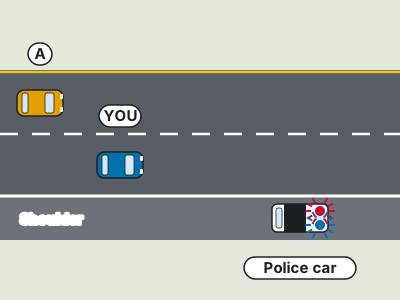
- Stop in the travel lane until the lights are turned off
- Maintain the posted speed because a lane change is impossible
- Slow down to 20 mph below the speed limit to go by
- Accelerate past before another vehicle reaches the scene
2. During the second three months of a Vermont junior license, which passengers may the driver begin transporting?
- Only a licensed adult supervisor
- Any passenger with a valid seat belt
- Immediate family members, specifically siblings and parents
- Passengers for hire if the trip is short
3. Under Vermont law, which drivers may not use a portable electronic device, such as a phone, while driving?
- Only junior operators
- Only drivers under 21
- Only commercial drivers
- Any person operating a motor vehicle
4. After a Vermont junior driver's license has been held for six months, what passenger limit remains?
- No passengers may ride until age 18
- Only one passenger may ride
- Only immediate family members may ride
- No numerical passenger restriction remains, but passengers may not exceed available safety belts
5. When making a right turn into a street with more than one lane in your direction, which lane should you enter?
- Either lane while crossing the other lane during the turn
- The farthest lane so the turn is completed quickly
- The nearest lane, then change lanes after completing the turn if needed
- The center lane regardless of the number of lanes
6. What do Vermont warning signs generally indicate about the roadway?

- A legal permission to pass at any speed
- A hazard such as a sharp curve, unsafe intersection, or dip
- A guaranteed stop at the next signal
- A parking area reserved for school buses
7. What does a Vermont crossbuck sign indicate?
- A school crossing with a required speed of 15 mph
- The beginning of a no-passing zone
- The location of railroad tracks
- A lane reserved for buses and bicycles
8. What must a Vermont Junior Driver's License holder have to get a regular Driver's License?
- Be 17 and pay a fee
- Hold the junior license for three months
- Be 18 with no recalls, suspensions, or revocations in the previous six months
- Complete another driver education course
9. What does the circular RR warning sign indicate?

- A school crossing directly at the sign
- A lane ending on the right
- A railroad crossing ahead
- A required circular traffic movement
10. A 16-year-old with a new Vermont Junior Driver's License is offered a pizza delivery job. When may the teen drive for work?
- Right away, if the employer approves
- After three months
- Only after age 21
- After one year with the junior license, or at 18, whichever comes first
11. How might a deer react to a vehicle's headlights, according to the Vermont manual?
- It always runs away from the road
- It may freeze in the light, or bound toward its habitat at up to 40 miles per hour
- It lies down until the vehicle passes
- It is unaffected by headlights
12. What does an upside-down triangle road sign mean in Vermont?
- Follow a route toward a hospital or other service
- Stop every time, even when no traffic is present
- Expect a railroad crossing immediately ahead
- Yield right of way after slowing and checking that the way is clear
13. Under Vermont law, how long is the license suspended for a first offense of driving under 21 with a BAC of 0.02 or more?
- 30 days
- 90 days, with automatic reinstatement after the period
- One year
- Until age 21
14. What extra information may some Vermont warning signs provide?

- A safe speed or a distance to the hazard
- The owner’s name and vehicle registration
- The exact fuel price at the next station
- A guarantee that the lane will remain open
15. If a traffic signal is dark because of a power failure, how should you treat the intersection?
- Use only the lane with the right-of-way arrow
- Treat it as a green light for the larger road
- Continue through without stopping if no signal is visible
- Stop as if there were stop signs in all directions
16. What should a driver do when a traffic light turns yellow?
- Accelerate so the vehicle reaches the intersection sooner
- Stop immediately in the middle of the intersection
- Prepare to stop, unless stopping safely is no longer possible
- Treat the light exactly like a green arrow
17. A Vermont driver should first practice with a Learner's Permit in:
- A busy downtown intersection during rush hour
- An empty parking lot or on roads with little traffic
- A highway entrance ramp at the posted speed
- A crowded parking garage with pedestrians moving nearby
18. What happens in Vermont to a driver under 21 who operates a vehicle with a BAC of .02 or more?
- Nothing, because .02 is below the .08 limit
- A criminal felony charge
- A civil traffic violation, license suspension, and an alcohol and driving education program at the driver's expense
- A warning letter to the parents only
19. How early should you signal before a turn or lane change to meet Vermont’s timing guidance?
- Only after entering the intersection
- Three to five seconds before the action
- One second before moving the wheel
- After the lane change is complete
20. What recall does Vermont impose on a junior operator caught texting while driving?
- A 90-day recall with no fine
- A 30-day recall, with a fine of at least $100 and at least two points
- A warning only
- A one-year revocation
Answer key
- 1. C
- 2. C
- 3. D
- 4. D
- 5. C
- 6. B
- 7. C
- 8. C
- 9. C
- 10. D
- 11. B
- 12. D
- 13. B
- 14. A
- 15. D
- 16. C
- 17. B
- 18. C
- 19. B
- 20. B