Every question below comes from the Iowa question bank on this page. Open a question to see the correct answer and the explanation. Nothing here is hidden behind a signup.
1. Why should loose objects be secured inside a vehicle?
- Loose objects become harmless once the vehicle exceeds 45 mph
- A 20-pound object can exert well over 1,000 pounds of force in a sudden stop at 60 mph
- Only objects heavier than 100 pounds can injure occupants
- Securing objects matters only when the vehicle is parked
Show answer
A 20-pound object can exert well over 1,000 pounds of force in a sudden stop at 60 mph. The manual warns that a loose object can become a serious projectile during a sudden stop. Full explanation in Test 1
2. Which visitor may drive in Iowa without an Iowa driver's license?
- A visitor carrying only a vehicle registration
- A visitor with a current license from their home state or country
- A visitor who has never been licensed anywhere
- A visitor using an expired license from another state
Show answer
A visitor with a current license from their home state or country. Iowa recognizes a current license from a visitor's home state or country. Full explanation in Test 2
3. Who must have an Iowa permit or driver's license when using public roads?
- Only Iowa residents who have lived there for one year
- Only people operating commercial trucks
- Anyone operating a motor vehicle, motorcycle, or moped
- Only drivers traveling outside city limits
Show answer
Anyone operating a motor vehicle, motorcycle, or moped. Iowa requires a permit or license for anyone operating a motor vehicle, motorcycle, or moped on public roads. Full explanation in Test 3
4. Which farm-equipment trip is listed as an Iowa driver's-license exemption?
- A daily commute in a passenger car owned by a farm
- Any farm trip across Iowa without a license
- Travel from a farm to any city beyond the county
- Travel between the home farm and nearby farmland within two miles
Show answer
Travel between the home farm and nearby farmland within two miles. The manual exempts driving farm equipment between the home farm and nearby farmland or a farm operation within two miles. Full explanation in Test 4
5. What does the Iowa manual recommend as a defense against other people's aggressive driving?
- Match their speed to keep pace
- Use the horn to warn them off
- Follow closely so they cannot cut in
- Avoid aggressive and inattentive tendencies yourself and leave plenty of space in front
Show answer
Avoid aggressive and inattentive tendencies yourself and leave plenty of space in front. Avoiding aggressive and inattentive driving tendencies yourself puts you in a stronger position to deal with other people's driving choices. Full explanation in Test 5
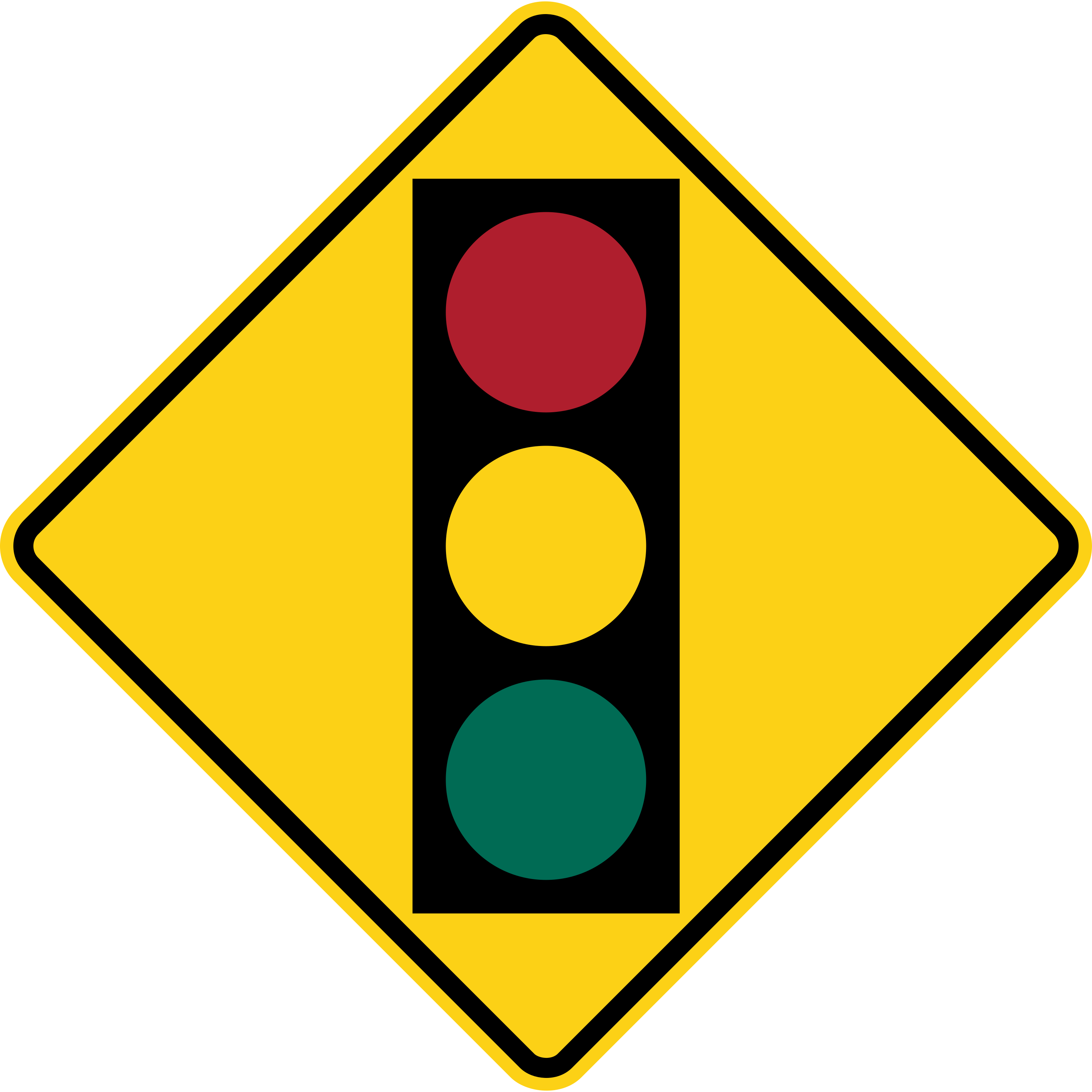
6. What is ahead when a signal-ahead warning is posted?
- A railroad crossing with no signal
- An intersection and a stop light
- A lane reserved for buses
- A road that ends without an intersection
Show answer
An intersection and a stop light. A signal-ahead warning tells you that an intersection and traffic light are coming. Full explanation in Test 6
7. From what distance must the red tail light on the back of a vehicle be visible under Iowa's equipment rules?
- At least 100 feet
- At least 200 feet
- At least 1,000 feet
- At least 500 feet
Show answer
At least 500 feet. Iowa requires at least one red light on the back of the vehicle, visible for at least 500 feet, plus two headlights and a white light for th Full explanation in Test 7
8. What should a driver expect when approaching a typical yellow, diamond-shaped warning sign?
- A special road hazard that calls for slower speed or extra caution
- A posted minimum speed that must be maintained
- A service such as fuel or lodging ahead
- A legal prohibition against entering the road
Show answer
A special road hazard that calls for slower speed or extra caution. Yellow diamond signs are warnings about a special situation or hazard ahead. Full explanation in Test 8
9. You stop at an Iowa railroad crossing. How much space should you leave between your vehicle and the nearest rail?
- At least 15 feet
- At least 3 feet
- At least 100 feet
- At least 50 feet
Show answer
At least 15 feet. When stopped at a crossing, leave at least 15 feet between the front and rear of your vehicle and the nearest rail, because trains are wider Full explanation in Test 9
10. What do Iowa right-of-way laws determine at an intersection?
- Which vehicle has priority regardless of circumstances
- Which driver may enter first without slowing
- Which driver is entitled to ignore other traffic
- Which driver must yield
Show answer
Which driver must yield. Iowa's intersection rules identify which road user must yield and who goes first in different traffic situations. Full explanation in Test 10
11. Your vehicle stalls in floodwater on an Iowa road. What does the manual say to do?
- Stay inside and wait for help
- Restart the engine and drive on
- Abandon the vehicle and move to higher ground
- Open the windows and wait
Show answer
Abandon the vehicle and move to higher ground. Do not stay in a flooded vehicle. If your vehicle is stalled in floodwater, abandon it and move to higher ground. Full explanation in Test 1
12. Which vehicles must have working turn signals under Iowa law?
- Only trucks over 10,000 pounds
- All cars, trucks, and trailers wider than 40 inches
- Only vehicles built after 2000
- Only vehicles used at night
Show answer
All cars, trucks, and trailers wider than 40 inches. Iowa requires turn signals on all cars, trucks, and trailers wider than 40 inches, and if a vehicle has turn signals they must work. Full explanation in Test 2
13. What do shared lane pavement markings, called sharrows, do on Iowa roads?
- Show where bicycles must ride on the sidewalk
- Reserve the lane for bicycles only
- Mark a no passing zone
- Alert motorists that bicyclists may be present and encourage safe passing, without reserving part of the road for bikes
Show answer
Alert motorists that bicyclists may be present and encourage safe passing, without reserving part of the road for bikes. Shared lane pavement markings, also called sharrows, alert motorists to the presence of bicyclists, encourage safe passing, and reduce wrong Full explanation in Test 3
14. When a driver illegally passes a stopped school bus, what license consequence may Iowa impose?
- A mandatory suspension of exactly 30 days
- A warning with no possible license action
- Permanent revocation for the first violation
- Suspension for up to 180 days
Show answer
Suspension for up to 180 days. Iowa says a school-bus passing violation may result in a driver's license being suspended for up to 180 days. Full explanation in Test 4
15. What roadway situation is identified by a pentagon-shaped sign?
- A railroad crossing ahead
- A school area or school crossing
- A no-passing zone
- A general service area
Show answer
A school area or school crossing. The five-sided pentagon marks a school area or school crossing. Full explanation in Test 5
16. What does an Iowa yield sign tell a driver to do?
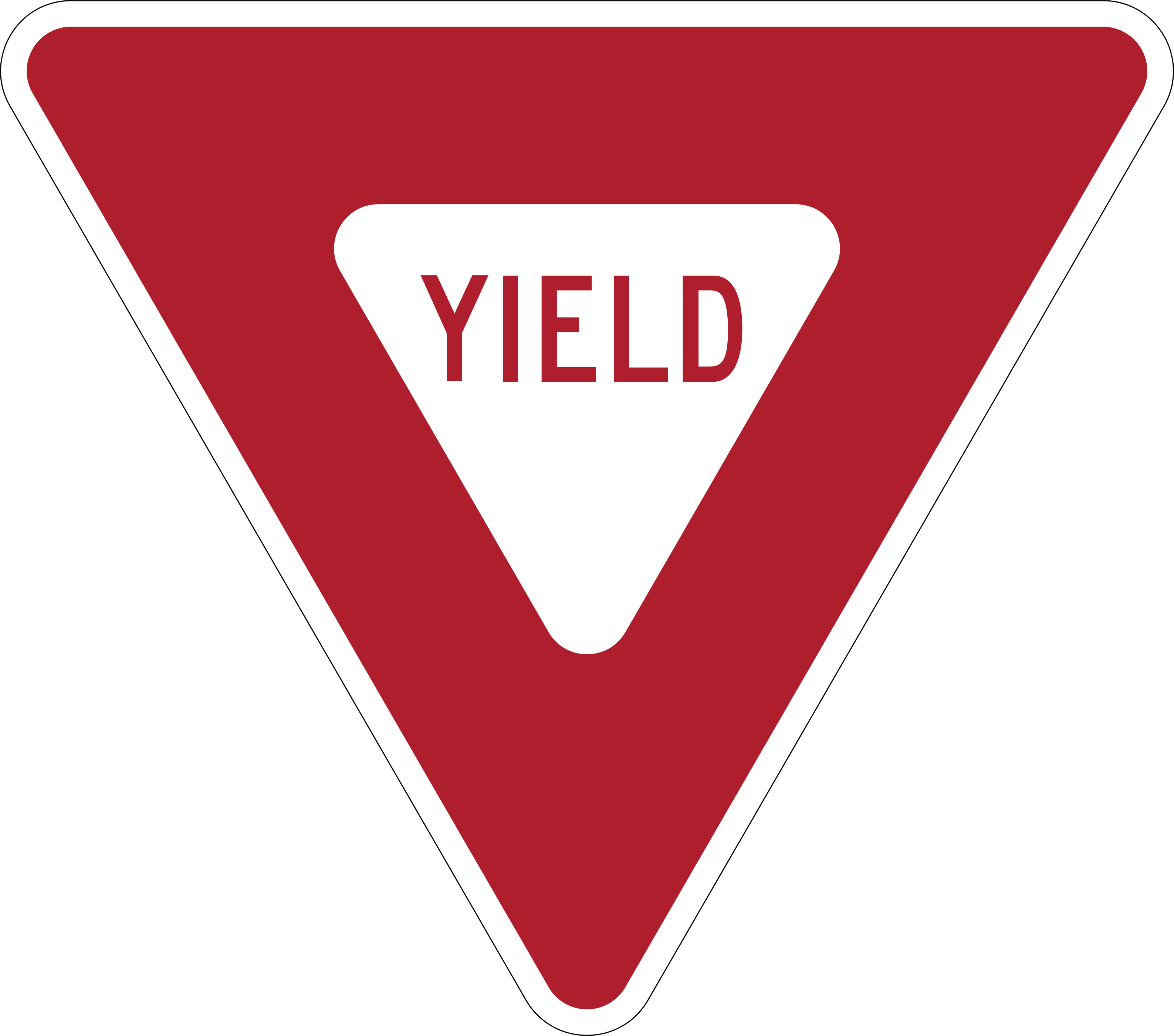
- Slow down and yield to traffic in the intersection or roadway being entered
- Stop at every yield sign even when no traffic is present
- Accelerate so cross traffic must wait
- Enter the roadway without checking for other users
Show answer
Slow down and yield to traffic in the intersection or roadway being entered. A yield sign directs the driver to slow down and yield the right of way to traffic in the intersection being crossed or the roadway being en Full explanation in Test 6
17. How close to an intersection may you pass another vehicle on an Iowa two-lane road?
- You may not pass within 100 feet of an intersection
- You may pass anywhere with a broken center line
- You may pass as close as 50 feet
- You may not pass within 500 feet
Show answer
You may not pass within 100 feet of an intersection. Iowa prohibits passing within 100 feet of an intersection, and also around a curve where your view is blocked. Full explanation in Test 7
18. Which following-distance rule is the safest and easiest way to judge space behind another vehicle?
- Keep one car length for every five mph
- Use the Three-Four Second Rule
- Stay exactly two seconds behind in all conditions
- Follow close enough to read the vehicle's plate
Show answer
Use the Three-Four Second Rule. The Iowa manual identifies the Three-Four Second Rule as the safest and easiest way to judge a following gap. Full explanation in Test 8
19. What does the Iowa manual say about hanging items from the rearview mirror?
- It is fine if the item is small
- Only air fresheners are allowed
- Do not hang things from the mirror or clutter the windshield with decals
- Items may hang below the dash line
Show answer
Do not hang things from the mirror or clutter the windshield with decals. Keep your view unobstructed. The manual says not to hang things from your rearview mirrors or clutter up the windshield with decals. Full explanation in Test 9
20. When is an Iowa driving test not required according to the manual?
- Whenever the applicant owns a vehicle
- When the applicant satisfies the driver education course requirement
- When the applicant passes the vision screening only
- Whenever the applicant has driven on private property
Show answer
When the applicant satisfies the driver education course requirement. The manual says a driving test is not required when the applicant satisfies the driver education course requirement. Full explanation in Test 10
21. What information does a white traffic sign generally provide in Iowa?
- General warnings about road hazards
- Enforceable laws and ordinances
- Directions to parks and historic sites
- Locations of traveler services
Show answer
Enforceable laws and ordinances. White is the standard color associated with regulatory signs in the Iowa manual. Full explanation in Test 1
22. At what speed do snowplows typically operate on Iowa roads?
- 55 to 65 mph
- 5 to 10 mph
- 25 to 35 mph
- 45 to 55 mph
Show answer
25 to 35 mph. Snowplows typically operate at 25 to 35 mph, and many drivers fail to realize how slowly they move and hit them from behind. Full explanation in Test 2
23. What should a driver do when approaching a farm vehicle traveling slowly on a rural road?
- Pass immediately because farm equipment must yield to every car
- Assume it will move onto the shoulder without signaling
- Identify it early, slow down, and use extreme caution before attempting to pass
- Follow closely so no other vehicle can enter the gap
Show answer
Identify it early, slow down, and use extreme caution before attempting to pass. Large farm equipment may be wider than the road, make wide turns at unmarked entrances, and have a turn signal that is difficult to detect. Full explanation in Test 3
24. What is a safe way to manage a vehicle that is following too closely behind you?
- Block the passing lane by accelerating hard
- Tap the brakes repeatedly to punish the driver
- Signal early and encourage the driver to pass
- Stop in the travel lane without warning
Show answer
Signal early and encourage the driver to pass. The manual recommends signaling early for turns, stops, or lane changes when you are being tailgated, and trying to slow down enough to enco Full explanation in Test 4
25. Under Iowa's Steer It Clear It law, what must you do after a crash with no injuries?
- Leave the vehicles where they stopped until police arrive
- Push the vehicles onto the median
- Drive away and report later
- Move an operable vehicle out of the driving lanes if it can be safely moved
Show answer
Move an operable vehicle out of the driving lanes if it can be safely moved. If you are involved in a crash with no injuries, Iowa law requires that you move your vehicle out of the driving lanes of traffic if the veh Full explanation in Test 5
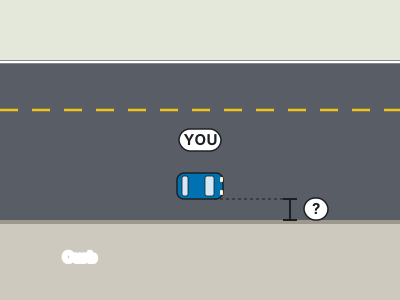
26. If parking beside a curb in Iowa, how close should the vehicle be?
- Within 3 feet of the curb
- Within 18 inches of the curb or closer
- At least 18 inches away from the curb
- With two wheels resting on the curb
Show answer
Within 18 inches of the curb or closer. When parking on a roadway beside a curb, Iowa's manual says to park within 18 inches of the curb or closer. Full explanation in Test 6
27. Besides fines, what can a distracted driving conviction cost an Iowa driver?
- Only higher insurance rates
- Suspension or revocation of the license or permit
- A mandatory new vision test
- Nothing more, since it is a minor offense
Show answer
Suspension or revocation of the license or permit. In addition to fines, a distracted driving conviction could result in your license or permit being suspended or revoked. Full explanation in Test 7
28. At a roundabout, what must approaching vehicles yield to?
- Pedestrians in the crosswalk and traffic already in the roundabout
- Only vehicles entering from the left
- Vehicles waiting behind the yield line
- No one when the driver signals a turn
Show answer
Pedestrians in the crosswalk and traffic already in the roundabout. At a roundabout, approaching vehicles must yield to pedestrians in the crosswalk and to traffic already circulating in the roundabout. Full explanation in Test 8
29. A police officer is directing traffic at an intersection where the signal is dark. Which instruction controls your movement?
- The lane marking nearest the intersection
- The usual meaning of the dark signal
- The direction of the largest group of vehicles
- The officer's direction
Show answer
The officer's direction. Iowa treats law enforcement, highway personnel, and school crossing guards as traffic-control authorities when they direct traffic. Full explanation in Test 9
30. When passing a large truck, when should the passing driver move back into the original lane?
- Immediately after pulling alongside the truck
- As soon as the passing vehicle's front bumper reaches the truck's cab
- Before the truck appears in the side mirror
- After seeing the front of the truck being passed in the rearview mirror and clearing it well
Show answer
After seeing the front of the truck being passed in the rearview mirror and clearing it well. The manual gives a visibility check for returning after a pass: see the front of the passed vehicle in the rearview mirror and make sure you Full explanation in Test 10
31. Under Iowa's Move Over or Slow Down Law, what must a driver do when approaching a stopped vehicle displaying flashing lights?
- Stop in the lane immediately beside the stopped vehicle
- Maintain speed because only emergency vehicles receive protection
- Change lanes when possible, or slow down and be prepared to stop if changing lanes is unsafe
- Pass on the shoulder to create more room
Show answer
Change lanes when possible, or slow down and be prepared to stop if changing lanes is unsafe. Iowa protects more than emergency vehicles under this rule, and it requires motorists to change lanes when approaching covered stopped vehic Full explanation in Test 1
32. What is Iowa's general speed limit on an unsurfaced (gravel) secondary road after sunset, when no limit is posted?
- 50 mph
- 35 mph
- 60 mph
- 25 mph
Show answer
50 mph. Iowa's general limit on unsurfaced secondary roads is 50 mph from sunset until sunrise, and trucks are held to 50 mph on secondary roads at Full explanation in Test 2
33. What can an Iowa driver face for causing a death while distracted?
- A $100 fine
- More than $1,000 in fines, license suspension, and possibly a vehicular homicide charge
- A warning letter
- Only civil liability
Show answer
More than $1,000 in fines, license suspension, and possibly a vehicular homicide charge. If you are distracted and cause the death of another person, the manual says you could face more than $1,000 in fines, have your license sus Full explanation in Test 3
34. Under Iowa's hands-free law, which phone activity is prohibited while driving?
- Manually scrolling or typing on the phone
- Using voice activation to place a call
- Listening through a hands-free system
- Receiving a safety-related traffic alert
Show answer
Manually scrolling or typing on the phone. The hands-free rules prohibit manually scrolling, typing, or interacting with a phone while driving. Full explanation in Test 4
35. What is the purpose of a solid green bicycle box at a signalized intersection?
- It provides bicyclists a safe way to turn
- It marks a lane where cars may park during a red light
- It identifies a pedestrian-only sidewalk
- It shows where motorcycles must stop behind trucks
Show answer
It provides bicyclists a safe way to turn. A bicycle box is a solid green pavement marking installed to give bicyclists a safe way to turn at a signalized intersection. Full explanation in Test 5
36. What education must an Iowa applicant under 18 show when applying for a license?
- Two years of unsupervised driving experience
- Completion of a college defensive-driving seminar
- A certificate from a vehicle repair school
- Successful completion of an Iowa-approved driver's education course
Show answer
Successful completion of an Iowa-approved driver's education course. Applicants under 18 must show successful completion of an Iowa-approved driver's education course. Full explanation in Test 6
37. What do Iowa guide signs show?
- The location of traveler services only
- A prohibition on entering a roadway
- A warning that workers are ahead
- Directions and distance to various locations
Show answer
Directions and distance to various locations. Iowa guide signs show directions and distance to locations such as cities, airports, state lines, national parks, historical areas, and muse Full explanation in Test 7
38. Why may a driver need to slow below the posted speed limit on a curve or in other difficult conditions?
- Posted limits are suggestions that apply only on sunny days
- Posted speed limits apply to ideal conditions, so the driver must match speed to conditions
- A driver may exceed the limit when a curve is clearly visible
- Every curve automatically has a separate lower legal limit
Show answer
Posted speed limits apply to ideal conditions, so the driver must match speed to conditions. Posted speed limits are established for ideal conditions, but a driver remains responsible for choosing a speed that fits the roadway and vi Full explanation in Test 8
39. Under Iowa's hands-free law, what must a driver do before reading or writing a text message?
- Slow to under 25 mph
- Bring the vehicle to a complete stop off the traveled portion of the roadway
- Stop at a red light
- Put the phone on speaker
Show answer
Bring the vehicle to a complete stop off the traveled portion of the roadway. Iowa prohibits using mobile phones and other hand held electronic devices to write, send or view an electronic message while driving. Full explanation in Test 9
40. What does a pennant-shaped traffic sign warn drivers about?
- A railroad crossing
- A no passing zone
- A school crossing
- A yield requirement
Show answer
A no passing zone. The pennant shape is reserved for a no passing warning, and the sign is placed on the left side of the road. Full explanation in Test 10
