
Test 10 of 10 · 20 questions · Free 2026
IA Permit Practice Test 10
Jump to the test ↓A fixed 20 question set from the Iowa bank with answers and plain English explanations.
Question 1 of 20 · 0 right so far
All 20 questions in test 10
Every question below comes from the Iowa question bank on this page. Open a question to see the correct answer and the explanation. Nothing here is hidden behind a signup.
1. What do Iowa right-of-way laws determine at an intersection?
- Which vehicle has priority regardless of circumstances
- Which driver may enter first without slowing
- Which driver is entitled to ignore other traffic
- Which driver must yield
Show answer
Which driver must yield. Iowa's intersection rules identify which road user must yield and who goes first in different traffic situations. They do not create permission to enter blindly or disregard a person already crossing. The option about entering first without slowing turns a priority rule into a guarantee, while the choices about ignoring traffic or having priority in every circumstance contradict the manual's emphasis on preventing collisions. Use right-of-way as a coordination rule: scan the intersection, reduce speed when needed, and yield whenever the situation calls for it, even if you think another driver should wait.
Study this in the handbook: Traffic Signals and Pedestrian Beacons
2. When is an Iowa driving test not required according to the manual?
- Whenever the applicant owns a vehicle
- When the applicant satisfies the driver education course requirement
- When the applicant passes the vision screening only
- Whenever the applicant has driven on private property
Show answer
When the applicant satisfies the driver education course requirement. The manual says a driving test is not required when the applicant satisfies the driver education course requirement. Owning a vehicle does not demonstrate the course completion Iowa identifies. A vision screening addresses eyesight, not driving skill, and private-property practice is not given as an exemption. Keep the distinction clear: the course requirement can affect whether the road test is needed, while the vision and knowledge steps remain separate parts of applying for a license.
Study this in the handbook: Who Needs a License and What to Carry
3. When passing a large truck, when should the passing driver move back into the original lane?
- Immediately after pulling alongside the truck
- As soon as the passing vehicle's front bumper reaches the truck's cab
- Before the truck appears in the side mirror
- After seeing the front of the truck being passed in the rearview mirror and clearing it well
Show answer
After seeing the front of the truck being passed in the rearview mirror and clearing it well. The manual gives a visibility check for returning after a pass: see the front of the passed vehicle in the rearview mirror and make sure your vehicle is well clear. That view indicates useful separation rather than merely being beside the truck. Moving over when the truck is still alongside can cut into its path, and an early return reduces the margin needed if the larger vehicle must brake. Finish the pass, confirm the truck's front is visible behind you, then signal and ease over.
Study this in the handbook: Trucks, Motorcycles, Bicyclists and Pedestrians
4. What does a pennant-shaped traffic sign warn drivers about?
- A railroad crossing
- A no passing zone
- A school crossing
- A yield requirement
Show answer
A no passing zone. The pennant shape is reserved for a no passing warning, and the sign is placed on the left side of the road. A railroad crossing uses a circle, a school crossing uses a pentagon, and a yield sign uses an inverted triangle. The manual says passing areas are based on how far you can see ahead. When the pennant appears, treat it as the beginning of a section where passing is prohibited, then remain alert for the related pavement markings and oncoming traffic.
Study this in the handbook: Sign Colors and Shapes
5. When all lights on a pedestrian hybrid beacon are dark, what may motorists do?
- Ignore pedestrians because the beacon is off
- Stop until a police officer waves them through
- Accelerate through the crosswalk
- Proceed with caution
Show answer
Proceed with caution. A pedestrian hybrid beacon with a dark display allows motorists to proceed with caution. That does not mean the crossing is free of people, so the driver still needs to watch for pedestrians and be ready to yield. Waiting for a police officer adds a condition the beacon does not require, and accelerating or ignoring pedestrians turns a permission to proceed into unsafe driving. Scan the crosswalk before entering it, then follow the beacon as it changes. The dark display is the cue to continue carefully, not a signal to stop watching the road.
Study this in the handbook: Traffic Signals and Pedestrian Beacons
6. Iowa dropped its separate phone rule for permit and intermediate license holders in 2025. When may any Iowa driver hold or manipulate a phone while driving?
- Whenever the call is shorter than one minute
- While stopped at a red light in the travel lane
- Only when the vehicle is at a complete stop off the traveled portion of the roadway
- Whenever a passenger is riding in the front seat
Show answer
Only when the vehicle is at a complete stop off the traveled portion of the roadway. Iowa Code section 321.276 now applies one rule to every driver: a person may not use an electronic device while driving unless the vehicle is at a complete stop off the traveled portion of the roadway. Use includes holding, viewing, or manipulating the device. Senate File 22, approved in 2025, struck the separate phone restriction for permit and intermediate license holders, so a teen may use a voice-activated or hands-free mode under the same rule as any other driver. A red light does not qualify, because the car is still in the traveled lane. Call length and the presence of a passenger make no difference. A violation is a moving violation with a $100 scheduled fine.
7. What should a driver do at a solid yellow traffic signal?
- Accelerate so the vehicle clears the intersection before red
- Avoid entering if able to stop safely, but continue cautiously if stopping safely is not possible
- Stop only if another vehicle is already crossing
- Treat it exactly like a flashing yellow signal
Show answer
Avoid entering if able to stop safely, but continue cautiously if stopping safely is not possible. A solid yellow means the driver should not enter the intersection when a safe stop is possible. If stopping would be unsafe because the vehicle is already too close, proceed through with caution. Accelerating to beat the red defeats the warning, and a flashing yellow has a different instruction to proceed cautiously while yielding. Look at your stopping distance and the space ahead, then choose a controlled stop or a careful continuation rather than making a sudden maneuver.
Study this in the handbook: Warning, Guide and Service Signs
8. How close may a vehicle be parked to a fire hydrant in Iowa?
- It may be directly beside the hydrant for loading
- It may be within one foot if hazard lights are on
- It may be within ten feet but not five feet
- It may not be closer than five feet
Show answer
It may not be closer than five feet. Iowa parking restrictions prohibit parking closer than five feet from a fire hydrant or in a designated hydrant red zone. Hazard lights do not create a parking exception, and the ten-foot choice reverses the actual minimum distance. Loading does not create an exception to the hydrant rule either. Look for the hydrant and any marked red area before leaving the vehicle, then choose a space that keeps the required buffer clear. The five-foot number applies even when the street otherwise appears open.
Study this in the handbook: Railroad Crossings and Rural Roads
9. An emergency vehicle with a siren approaches while you are already in an intersection. What should you do?
- Turn left and follow the emergency vehicle
- Stop immediately in the intersection
- Drive through the intersection, then pull over to the right
- Accelerate and remain in the lane
Show answer
Drive through the intersection, then pull over to the right. If an emergency vehicle approaches while you are in an intersection, Iowa directs you to clear that intersection before pulling over. Once clear, move to the right edge or as near to it as possible and stop. Stopping in the intersection can block the emergency route and create a collision point. Following the emergency vehicle or simply accelerating without yielding also fails to provide the required passage. Check mirrors, clear the conflict area, and stop on the right.
Study this in the handbook: Intersections and Right of Way
10. Where must an Iowa driver yield or stop for pedestrians?
- Only at traffic lights
- Only in painted crosswalks
- Only when a crossing guard is present
- In marked or unmarked crosswalks
Show answer
In marked or unmarked crosswalks. Iowa requires drivers to yield or stop for pedestrians in both marked and unmarked crosswalks. The painted-only choice misses crossings whose boundaries are not marked, while a crossing guard or traffic light is not required for the duty described here. Approach every intersection with enough control to stop, look for people on foot and pedestrian conveyances, and let them clear the path. A useful visual cue is that the absence of white paint does not mean the crossing is absent. The driver's obligation follows the pedestrian's crossing location, not the paint.
Study this in the handbook: Intersections and Right of Way
11. For an underage Iowa driver with a BAC from .02 through .079, what minimum revocation applies?
- 60 days
- 30 days
- 90 days
- 180 days
Show answer
60 days. An underage driver with a BAC at .02 or above but below .08 faces a minimum 60-day revocation under the manual. The 180-day figure applies when the underage BAC reaches .08 or more, so it should not be substituted for the lower range. Thirty and 90 days are not the stated minimums. Read the range carefully, including its upper boundary: .079 remains below .08. A good memory cue is lower underage range, 60 days; higher range beginning at .08, 180 days.
Study this in the handbook: Operating While Intoxicated (OWI)
12. When may an Iowa driver transport an open container of alcohol in a vehicle?
- When it is stored in the trunk
- When it is held by a passenger
- When the vehicle is on an interstate
- When the driver has not been drinking
Show answer
When it is stored in the trunk. Iowa permits an open alcohol container to be transported in the trunk of a vehicle, while the manual says transporting an open, unsealed container by a driver or passenger is otherwise illegal. A passenger holding it does not create the permitted location, and neither the road type nor the driver's sobriety changes the container rule. Place the container in the trunk before travel rather than in the passenger area. The concrete cue is location: trunk storage is the stated exception, not a person's role or the kind of road.
Study this in the handbook: Operating While Intoxicated (OWI)
13. An Iowa baby is 10 months old and weighs 18 pounds. How must the baby ride?
- In a forward-facing seat
- In a rear-facing child restraint system
- In a booster seat
- On a parent's lap with a seat belt
Show answer
In a rear-facing child restraint system. A child under one year old and weighing less than 20 pounds must be secured in a rear-facing child restraint system. A 10 month old at 18 pounds meets both conditions. A forward-facing seat or booster is not allowed for this child, and holding a baby on a lap, even with a belt, does not meet the law. Children under six must be in a child restraint system, not a seat belt alone.
Study this in the handbook: Vehicle Checks, Seat Belts and Child Restraints
14. Before turning across a bicycle lane, what must a motorist do?
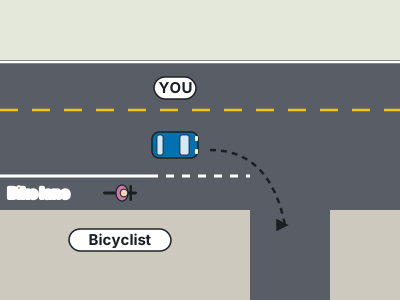
- Check carefully beside and behind the vehicle for bicyclists
- Stop in the bicycle lane and wait for a driver to wave through
- Use the lane as a passing lane before turning
- Turn without checking because bicycles must yield at driveways
Show answer
Check carefully beside and behind the vehicle for bicyclists. A motorist may enter a bicycle lane for a turning movement, but the lane is not a shortcut or passing lane. Before crossing it, check beside and behind the vehicle because a bicyclist may be traveling through the space. The choice “Stop in the bicycle lane and wait for a driver to wave through” creates a blockage, and the choice “Use the lane as a passing lane before turning” treats a lane reserved for bicycles as a place to overtake. A right turn should be made only after the cyclist's path is understood and the crossing can be completed carefully. The practical cue is mirror, shoulder, bicycle lane, then turn.
Study this in the handbook: Trucks, Motorcycles, Bicyclists and Pedestrians
15. What is one leading cause of crashes on Iowa roadways?
- Wildlife, typically deer
- Only parked delivery trucks
- Exclusively wet pavement
- Animals only inside city limits
Show answer
Wildlife, typically deer. Iowa identifies wildlife, especially deer, as one of the leading causes of roadway crashes. Deer can appear at any time, although October, November, and May are peak months for collisions. The choice limiting the risk to parked trucks changes the hazard entirely, while wet pavement and city limits are not the rule stated here. When driving near dawn, dusk, or through areas where animals are common, reduce speed and scan both shoulders. If an animal enters the roadway and there is not enough time to stop, avoid swerving, because a sudden veer can create a more severe crash.
Study this in the handbook: Trucks, Motorcycles, Bicyclists and Pedestrians
16. What is the safest response when water on the road causes your vehicle to hydroplane?
- Accelerate until the tires cut through the water
- Brake hard and turn sharply
- Slow down by easing off the accelerator
- Swerve onto the shoulder immediately
Show answer
Slow down by easing off the accelerator. Hydroplaning occurs when water deeper than the tire tread reduces friction and can cause loss of control. The manual's immediate instruction is to slow down, which supports easing off the accelerator while keeping steering smooth. Hard braking, a sharp turn, or an abrupt shoulder swerve can worsen the loss of grip. Accelerating adds speed without restoring traction. Watch for deep water, reflections on pavement, or a car ahead leaving no tracks. Those clues mean reduce speed early and avoid sudden inputs until the tires regain contact with the road.
Study this in the handbook: Night Driving, Bad Weather and Floods
17. What does an orange traffic sign normally warn drivers about?
- Traveler services such as fuel and lodging
- Road work, temporary traffic control, or maintenance
- Directions to a city or airport
- A recreation area or historical site
Show answer
Road work, temporary traffic control, or maintenance. Orange signs identify road work, temporary traffic control, and maintenance warnings. The service category uses blue, destinations and distances use green, and recreation or cultural points of interest use brown. Work zones can change speed limits, lane paths, and the location of workers, so an orange sign calls for active attention rather than routine travel. Reduce speed as directed, watch for cones or shifting lanes, and expect conditions to change after the first sign.
Study this in the handbook: Sign Colors and Shapes
18. What should a driver anticipate after seeing an advance railroad warning?

- A hospital entrance
- A bicycle lane beginning immediately
- Railroad tracks crossing the road ahead
- A mandatory U-turn
Show answer
Railroad tracks crossing the road ahead. The round railroad symbol gives advance notice that tracks cross the roadway ahead. It is not a bicycle, hospital, or turning instruction. Begin preparing early by reducing distractions, checking the crossing signals, and looking for a train before proceeding. The manual adds that trains cannot stop quickly and that you should never stop your vehicle on the tracks. Treat the sign as time to plan a safe approach, not as permission to accelerate through the tracks.
Study this in the handbook: Railroad Crossings and Rural Roads
19. Two opposing arrows on a warning sign indicate that the driver is:
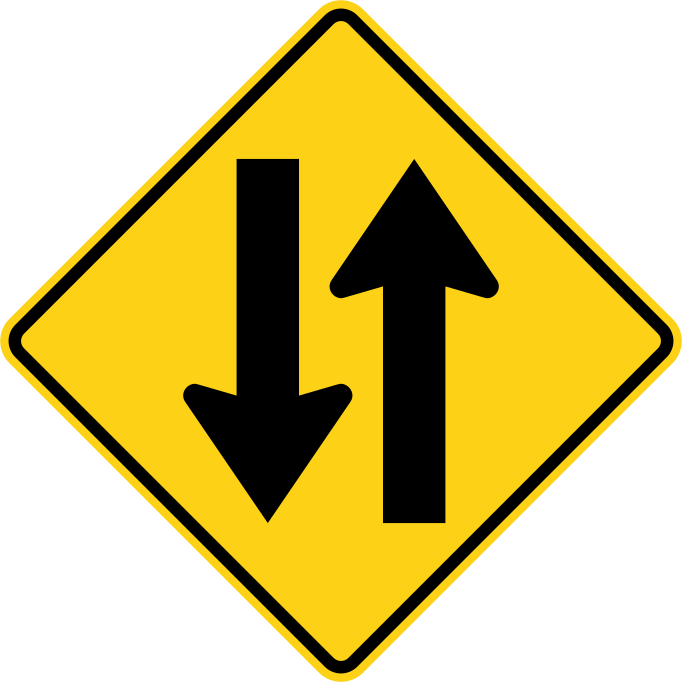
- Leaving a one-way road and entering a two-way road
- Entering a divided highway with no opposing traffic
- Approaching a road closed to all vehicles
- Allowed to pass on either shoulder
Show answer
Leaving a one-way road and entering a two-way road. The opposing arrows mark the transition from one-way travel to a two-way road. Keep to the right because vehicles may now approach from the opposite direction. The symbol does not describe a divided highway, a road closure, or permission to use a shoulder for passing. Recheck your lane position as the roadway changes and watch out for oncoming vehicles, since traffic no longer moves in only one direction.
Study this in the handbook: Warning, Guide and Service Signs
20. What do white lines on the roadway separate?
- Only vehicles traveling above the speed limit
- Traffic moving in opposite directions
- Traffic moving in the same direction
- Roads that are closed to all traffic
Show answer
Traffic moving in the same direction. Iowa uses white lines to separate traffic moving in the same direction, while yellow lines separate traffic moving in opposite directions. That color distinction helps a driver interpret the roadway before changing position. The opposite-direction option describes yellow markings, and the speed and closure choices are unrelated to pavement-line color. Do not infer passing permission from white alone: inspect whether the line is broken or solid and follow any nearby signs. Identify the direction of traffic first, then make lane decisions from the complete marking pattern.
Study this in the handbook: Pavement Markings and Lane Use
QualitySpace is expanding to Iowa
We are a California-based independent insurance brokerage working on licensing in more states. We cannot help with Iowa insurance yet. Leave your email and we will let you know when we can.
Every question is written from the official Iowa Driver's License Manual. Need paper? Printable IA practice test with answer key.
Last verified 2026-10-05. How we check every question · Study all 210 as flashcards
Frequently asked questions
How many questions are on this Iowa practice test?
This fixed set has 20 questions. It is test 10 of 10 from the 210 question Iowa bank.
How does this fixed test relate to the full Iowa bank?
Each numbered test is a fixed set of questions in a fixed order, so you can retake the same test later and compare. Every test mixes road signs and the other topics in about the same proportion as the full bank. Tests 1 to 10 together cover 200 of the 210 questions in the Iowa bank, each once. The full practice page mixes the whole bank at random.
Last verified 2026-10-05. See the Iowa DMV facts page for sourced state details.