
Test 9 of 10 · 20 questions · Free 2026
IA Permit Practice Test 9
Jump to the test ↓A fixed 20 question set from the Iowa bank with answers and plain English explanations.
Question 1 of 20 · 0 right so far
All 20 questions in test 9
Every question below comes from the Iowa question bank on this page. Open a question to see the correct answer and the explanation. Nothing here is hidden behind a signup.
1. You stop at an Iowa railroad crossing. How much space should you leave between your vehicle and the nearest rail?
- At least 15 feet
- At least 3 feet
- At least 100 feet
- At least 50 feet
Show answer
At least 15 feet. When stopped at a crossing, leave at least 15 feet between the front and rear of your vehicle and the nearest rail, because trains are wider than the tracks. Three feet is far too close. One hundred feet is the no passing distance near a crossing, and 50 feet is the upper limit of the 15 to 50 foot stopping zone for school buses and hazardous material vehicles, as well as the no parking distance.
Study this in the handbook: Railroad Crossings and Rural Roads
2. What does the Iowa manual say about hanging items from the rearview mirror?
- It is fine if the item is small
- Only air fresheners are allowed
- Do not hang things from the mirror or clutter the windshield with decals
- Items may hang below the dash line
Show answer
Do not hang things from the mirror or clutter the windshield with decals. Keep your view unobstructed. The manual says not to hang things from your rearview mirrors or clutter up the windshield with decals. Small items and air fresheners are not listed as exceptions. Window tint must also meet the state standards. Keep the windshield clean, because bright sun or headlights on a dirty windshield make it hard to see, and make sure the wipers, which are required, are in good working condition. Iowa has no medical exemption for tinted windows.
Study this in the handbook: Vehicle Checks, Seat Belts and Child Restraints
3. A police officer is directing traffic at an intersection where the signal is dark. Which instruction controls your movement?
- The lane marking nearest the intersection
- The usual meaning of the dark signal
- The direction of the largest group of vehicles
- The officer's direction
Show answer
The officer's direction. Iowa treats law enforcement, highway personnel, and school crossing guards as traffic-control authorities when they direct traffic. Their instruction governs the driver's movement, including at an intersection where an ordinary signal cannot provide guidance. The dark-signal choice assumes a rule that the manual does not give, and traffic volume or a lane stripe cannot replace an official command. Scan beyond the signal for a person controlling the intersection, then obey that person promptly and carefully.
Study this in the handbook: Warning, Guide and Service Signs
4. Under Iowa's hands-free law, what must a driver do before reading or writing a text message?
- Slow to under 25 mph
- Bring the vehicle to a complete stop off the traveled portion of the roadway
- Stop at a red light
- Put the phone on speaker
Show answer
Bring the vehicle to a complete stop off the traveled portion of the roadway. Iowa prohibits using mobile phones and other hand held electronic devices to write, send or view an electronic message while driving. Before writing, sending or reading a text, email or social media post, the vehicle must be brought to a complete stop off the traveled portion of the roadway. Stopping at a red light is still on the roadway, slowing does not qualify, and speaker mode does not allow reading a message.
Study this in the handbook: Iowa's Hands-Free Law and Distractions
5. Before turning on a flashing yellow arrow at an Iowa intersection, what must a driver do?
- Yield to oncoming traffic and pedestrians, then turn with caution
- Stop and wait for a solid green arrow
- Turn immediately because cross traffic must stop
- Treat the signal as a flashing red light
Show answer
Yield to oncoming traffic and pedestrians, then turn with caution. A flashing yellow arrow permits the indicated turn only after the driver yields to oncoming traffic and pedestrians. The signal does not give an unqualified right to turn, so the immediate-turn option is unsafe. It also is not a stop signal, which rules out waiting for a solid green arrow as a mandatory step and rules out treating it like flashing red. Scan the opposing lane and the crosswalk first, then complete the turn cautiously when the path is clear. The arrow describes permission with a yield condition attached.
Study this in the handbook: Traffic Signals and Pedestrian Beacons
6. What is the penalty for violating Iowa's open container law?
- A $50 fine for the driver only
- A simple misdemeanor with a $260 scheduled fine for each driver or passenger cited
- An automatic license revocation
- A felony charge
Show answer
A simple misdemeanor with a $260 scheduled fine for each driver or passenger cited. Iowa's open container rule covers both the driver, under Code section 321.284, and passengers, under section 321.284A. An open or unsealed alcoholic beverage may not be in the passenger area, which includes the glove compartment, although it may ride in the trunk. Each violation is a simple misdemeanor with a scheduled fine of $260 under section 805.8A, so every occupant holding an open container can be cited. The older $200 figure printed in some manuals is out of date. It is not a felony, and the open container charge alone does not revoke a license, although drinking and driving can bring separate OWI penalties.
7. Which vehicles must stop within 15 to 50 feet of Iowa railroad tracks even when no train is coming?
- All pickup trucks
- Motorcycles
- Vehicles towing trailers
- School buses and vehicles carrying hazardous materials
Show answer
School buses and vehicles carrying hazardous materials. School buses and vehicles carrying hazardous materials must stop within 15 to 50 feet of railroad tracks before crossing, unless a police officer or a highway traffic signal directs traffic to proceed or the crossing is marked as exempt. The same rule covers charter buses and drivers carrying passengers for hire, such as Uber or Lyft. Pickups, motorcycles and trailers have no such stopping duty unless a train is approaching.
Study this in the handbook: Railroad Crossings and Rural Roads
8. Can an Iowa driver under 18 receive a temporary restricted license during an OWI revocation?
- Yes, automatically after 10 days
- No, not while the license is revoked for OWI
- Yes, but only for school travel
- Yes, after paying the fine
Show answer
No, not while the license is revoked for OWI. The manual says offenders under age 18 are not eligible for a temporary restricted license while their license is revoked for OWI. The automatic, school-only, and fine-payment choices all add exceptions that the passage does not provide. This is an age-specific consequence layered on top of the revocation, so do not import rules that may apply to older drivers. On an exam item, identify both conditions: the driver is under 18 and the revocation is for OWI. Together they remove temporary restricted license eligibility during that period.
Study this in the handbook: Operating While Intoxicated (OWI)
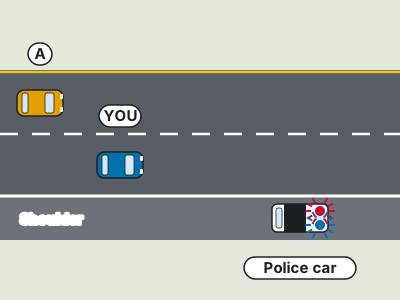
9. If a lane change around a stopped vehicle with flashing lights is unsafe, what must the driver do?
- Maintain the posted speed
- Slow down and be prepared to stop
- Pass on the shoulder
- Stop in the passing lane
Show answer
Slow down and be prepared to stop. Iowa's Move Over or Slow Down Law requires a driver to slow down and be prepared to stop when changing lanes is impossible, prohibited, or unsafe. Maintaining the posted speed fails to respond to the stopped vehicle, and using the shoulder creates a separate hazard rather than a safe workaround. Stopping in a passing lane can expose the vehicle to a rear-end crash. Watch for flashing lights early, signal only when a safe lane change exists, and otherwise reduce speed to something reasonable for the conditions while staying ready to stop.
Study this in the handbook: Emergency Vehicles and the Move Over Law
10. What do Iowa service signs show?
- Enforceable traffic laws and ordinances
- Directions to a city or state line
- Warnings about special road hazards
- The location of services such as rest areas, fuel stations, campgrounds, or hospitals
Show answer
The location of services such as rest areas, fuel stations, campgrounds, or hospitals. Iowa service signs identify locations of traveler services, including rest areas, fuel stations, campgrounds, and hospitals. Directions to cities or state lines belong to guide signs, hazard warnings use the warning-sign category, and enforceable laws are associated with regulatory signs. Use the service information to locate a needed facility without confusing it with a route direction or a mandatory rule. The examples in the manual are practical destinations, so a blue service sign should prompt a search for the listed facility rather than a change in lane use.
Study this in the handbook: Warning, Guide and Service Signs
11. If the yellow line on your side is broken and the line beside it is solid, what may you do?
- Drive between the two yellow lines
- Pass only by using the shoulder
- Never cross the broken line under any condition
- Pass when it is safe to do so
Show answer
Pass when it is safe to do so. A broken yellow line on your side indicates that passing may be permitted when the maneuver is safe. The solid line controls the traffic on the opposite side, so that direction may not cross it to pass. Using the shoulder is not a substitute for a legal passing lane, and driving between the lines is unsafe. Before moving left, check sight distance, opposing traffic, and other restrictions. The key is to identify which side has the broken line, then complete the pass only with adequate space.
Study this in the handbook: Pavement Markings and Lane Use
12. Which screening is required when an applicant applies for an Iowa license?
- A vision screening
- A hearing test by a private clinic
- A cholesterol screening
- A road test before any knowledge test
Show answer
A vision screening. The Iowa application process includes a vision screening. The manual lists that screening alongside the knowledge test and other possible licensing requirements. A private hearing examination and cholesterol check are not named as application steps. The road-test choice reverses the structure because the manual separately explains when a driving test is required or not required. On an exam question, focus on the exact health check identified by the state rather than assuming every common medical screening applies to licensing.
Study this in the handbook: Who Needs a License and What to Carry
13. What must a driver do at an octagonal stop sign?
- Yield without stopping when traveling straight
- Slow down only if another vehicle is visible
- Come to a full stop and wait until the crossing area is clear
- Stop after entering the intersection
Show answer
Come to a full stop and wait until the crossing area is clear. An octagonal sign is reserved for a stop sign, and the manual requires a full stop before the driver proceeds. The driver must also wait until crossing vehicles and the crosswalk are clear. Merely slowing down does not satisfy the sign, and entering the intersection before stopping reverses the required sequence. The straight-ahead option is not an exception. Look for the stop line, halt there when one is present, and then scan both the traffic path and crosswalk before moving. That pause creates room for people or vehicles that may still be crossing.
Study this in the handbook: Regulatory Signs
14. How close to a fire station entrance may you park in Iowa?
- No closer than 5 feet
- No closer than 20 feet
- No closer than 10 feet
- No closer than 50 feet
Show answer
No closer than 20 feet. Iowa prohibits parking closer than 20 feet from a fire station entrance. Five feet is the Iowa hydrant distance, 10 feet is the stop sign distance, and 50 feet is the railroad crossing distance. Those numbers are easy to mix up on the test. Also do not park on a crosswalk, in an intersection, in front of a public or private driveway, alongside another parked car, or in posted no parking zones.
Study this in the handbook: Railroad Crossings and Rural Roads
15. At an uncontrolled intersection, what is the basic responsibility of every driver?
- Assume the wider road has priority
- Accelerate to clear the crossing first
- Slow down and approach carefully
- Stop only when another driver honks
Show answer
Slow down and approach carefully. An uncontrolled intersection has no stop sign or traffic signal, so every driver must reduce speed and approach with care. The absence of a control device does not mean that the fastest vehicle, the vehicle on the wider road, or the driver who sounds a horn automatically gets priority. Iowa also says the ordinary yielding rules still apply, including yielding to traffic already on the main road and to pedestrians. Make the approach slowly enough to see a conflict and be prepared to stop rather than treating the crossing as automatically clear.
Study this in the handbook: Intersections and Right of Way
16. How far from railroad tracks must a vehicle carrying placarded hazardous materials stop before crossing, unless an exception applies?
- At least 100 feet
- Exactly 5 feet
- Between 15 and 50 feet
- No stop is required when no train is visible
Show answer
Between 15 and 50 feet. A vehicle required to display hazardous-material placards must stop within the 15-to-50-foot range before crossing railroad tracks. The rule is a stopping distance range, not a five-foot or 100-foot requirement, and the absence of a visible train does not erase it. A police officer, highway traffic signal, or an EXEMPT sign can direct traffic to proceed without that stop. Check the vehicle's placard status and the crossing instructions before moving across.
Study this in the handbook: Railroad Crossings and Rural Roads
17. When should an Iowa driver turn on both headlights because of visibility, even if it is not nighttime?
- Whenever visibility is 500 feet or less, such as in fog, heavy rain, or snow
- Only when visibility falls below 100 feet
- Only after another driver flashes headlights first
- Never during daylight hours
Show answer
Whenever visibility is 500 feet or less, such as in fog, heavy rain, or snow. Iowa requires both headlights from sunset to sunrise and whenever visibility is 500 feet or less. Fog, heavy rain, and snow are examples of conditions that can reach that threshold during daylight. The 100-foot choice sets an unsupported lower limit, while waiting for another driver gives up needed visibility. Daylight does not cancel the rule when the view is restricted. A practical reminder is to turn the headlights on whenever the windshield wipers are needed.
Study this in the handbook: Night Driving, Bad Weather and Floods
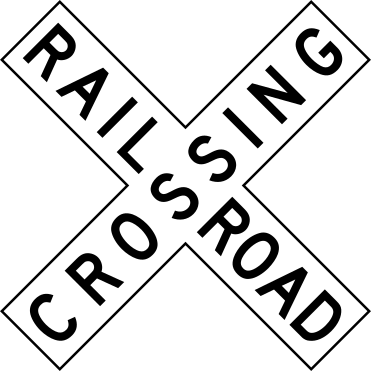
18. What does a crossbuck identify?
- A railroad crossing
- A school crossing
- A no-passing zone
- A divided highway
Show answer
A railroad crossing. The X-shaped crossbuck marks the railroad crossing itself. A pentagon is associated with school crossings, a pennant marks a no-passing zone, and a divided-highway sign describes roadway separation. At the tracks, slow down, look for a train, and obey any nearby stop or yield sign and active warning devices. Never assume the absence of a gate means the crossing is clear, because trains may approach on any track.
Study this in the handbook: Sign Colors and Shapes
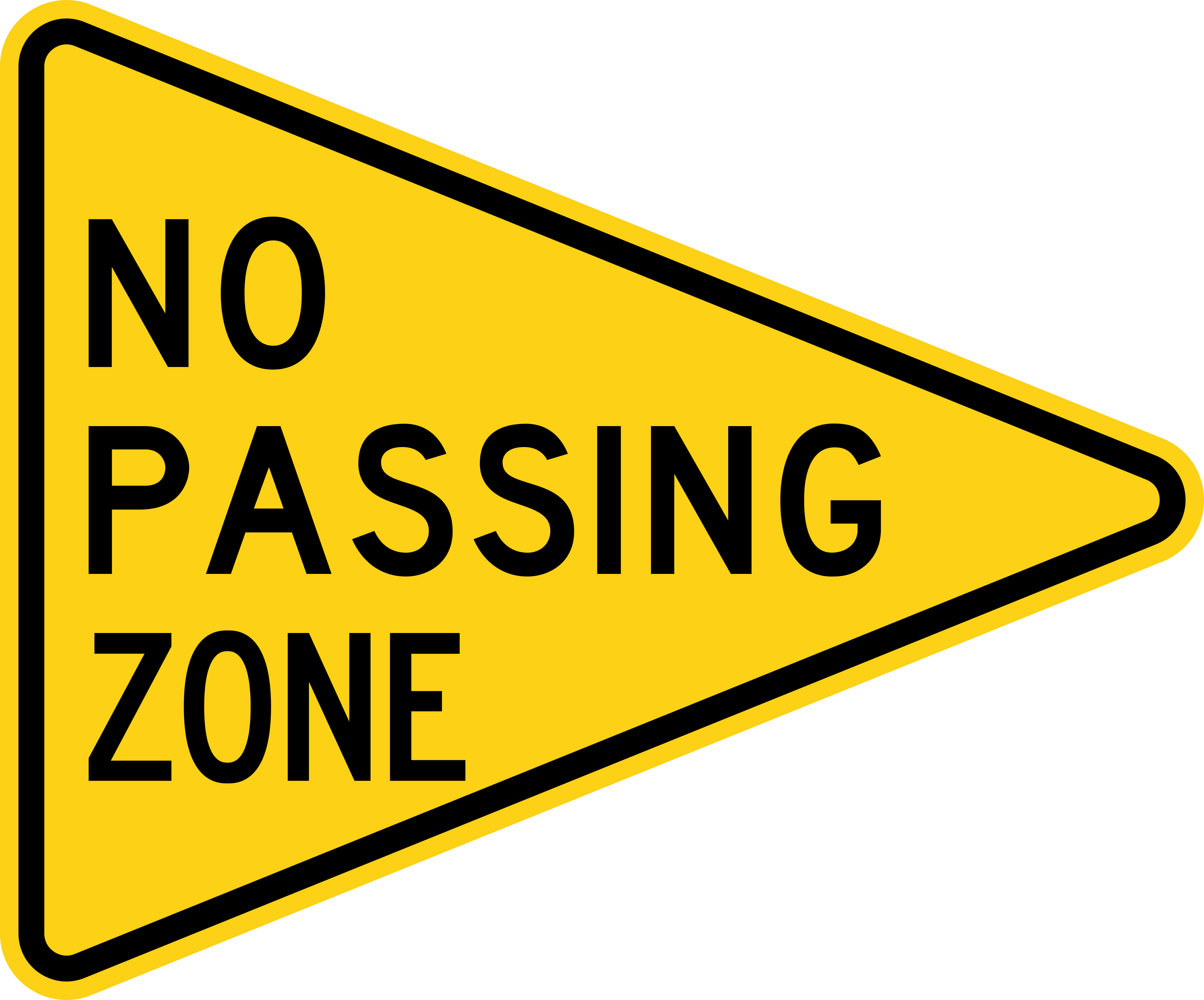
19. Where is a pennant-shaped no-passing sign placed?
- At the end of a divided highway
- On the right side after passing becomes legal
- Above every railroad crossing
- On the left side of the road at the beginning of the no-passing zone
Show answer
On the left side of the road at the beginning of the no-passing zone. The pennant is distinctive because it is placed on the left side of the road and marks the beginning of a no-passing zone. Passing is restricted there because the roadway ahead may not provide enough sight distance for a safe maneuver. The sign is not an end marker, a railroad sign, or a divided-highway notice. Stay in your lane and wait for a lawful passing area with enough visibility and space before overtaking another vehicle.
Study this in the handbook: Sign Colors and Shapes
20. When no sign changes the rule, what is Iowa's general speed limit in a residential district?
- 20 mph
- 25 mph
- 45 mph
- 50 mph
Show answer
25 mph. A residential district has a general unposted limit of 25 mph, and a school district uses that same figure. The 20 mph option belongs to a business district, while 45 mph describes a suburban district and 50 mph applies to an unsurfaced secondary road under stated conditions. Treat the listed number as a ceiling, not a target: the manual says a lower limit may be set, and weather or road conditions can require less speed. A useful cue is to pair neighborhood streets with 25 before checking for a posted sign.
Study this in the handbook: Iowa Speed Limits
QualitySpace is expanding to Iowa
We are a California-based independent insurance brokerage working on licensing in more states. We cannot help with Iowa insurance yet. Leave your email and we will let you know when we can.
Every question is written from the official Iowa Driver's License Manual. Need paper? Printable IA practice test with answer key.
Last verified 2026-10-05. How we check every question · Study all 210 as flashcards
Frequently asked questions
How many questions are on this Iowa practice test?
This fixed set has 20 questions. It is test 9 of 10 from the 210 question Iowa bank.
How does this fixed test relate to the full Iowa bank?
Each numbered test is a fixed set of questions in a fixed order, so you can retake the same test later and compare. Every test mixes road signs and the other topics in about the same proportion as the full bank. Tests 1 to 10 together cover 200 of the 210 questions in the Iowa bank, each once. The full practice page mixes the whole bank at random.
Last verified 2026-10-05. See the Iowa DMV facts page for sourced state details.