
Test 8 of 10 · 20 questions · Free 2026
IA Permit Practice Test 8
Jump to the test ↓A fixed 20 question set from the Iowa bank with answers and plain English explanations.
Question 1 of 20 · 0 right so far
All 20 questions in test 8
Every question below comes from the Iowa question bank on this page. Open a question to see the correct answer and the explanation. Nothing here is hidden behind a signup.
1. What should a driver expect when approaching a typical yellow, diamond-shaped warning sign?
- A special road hazard that calls for slower speed or extra caution
- A posted minimum speed that must be maintained
- A service such as fuel or lodging ahead
- A legal prohibition against entering the road
Show answer
A special road hazard that calls for slower speed or extra caution. Yellow diamond signs are warnings about a special situation or hazard ahead. Their message tells the driver why extra caution is needed, so reduce speed and be ready to stop if conditions require it. A warning sign does not post a minimum speed, identify traveler services, or automatically prohibit entry. The shape and color provide an early cue, but the symbol or words supply the specific meaning. Look beyond the sign, adjust control before reaching the hazard, and keep enough space to respond smoothly.
Study this in the handbook: Warning, Guide and Service Signs
2. Which following-distance rule is the safest and easiest way to judge space behind another vehicle?
- Keep one car length for every five mph
- Use the Three-Four Second Rule
- Stay exactly two seconds behind in all conditions
- Follow close enough to read the vehicle's plate
Show answer
Use the Three-Four Second Rule. The Iowa manual identifies the Three-Four Second Rule as the safest and easiest way to judge a following gap. It helps preserve enough room to stop if the vehicle ahead slows suddenly. A car length formula is not the method the manual names, and exactly two seconds is not suitable for every driver or condition. Reading a plate is a visual task, not a safety measure. Choose a stationary landmark, start counting when the lead vehicle passes it, and adjust farther back when weather or visibility reduces the margin.
Study this in the handbook: Following Distance and Stopping
3. At a roundabout, what must approaching vehicles yield to?
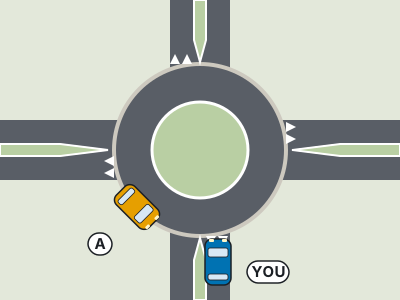
- Pedestrians in the crosswalk and traffic already in the roundabout
- Only vehicles entering from the left
- Vehicles waiting behind the yield line
- No one when the driver signals a turn
Show answer
Pedestrians in the crosswalk and traffic already in the roundabout. At a roundabout, approaching vehicles must yield to pedestrians in the crosswalk and to traffic already circulating in the roundabout. The choice “Only vehicles entering from the left” omits pedestrians and identifies only one approach direction. A vehicle waiting behind the yield line is not the traffic with priority, and a turn signal does not cancel the yield requirement. Slow before the entry, look left for circulating vehicles, and check the crosswalk before proceeding. Enter only when both the pedestrian path and the circulating lane provide a safe gap.
Study this in the handbook: Roundabouts and Uncontrolled Intersections
4. Some high-speed Iowa roads have a minimum speed limit. If that minimum is too fast for you, what should you do?
- Drive on the shoulder with your hazard lights on
- Use another route
- Drive below the minimum in the right lane
- Stay in the left lane so others can pass on the right
Show answer
Use another route. Speed limit signs can set a floor as well as a ceiling. On high-speed roads with a posted minimum, Iowa tells drivers who cannot keep up to choose a different road instead. Creeping along below the minimum in the right lane is still driving under the legal floor, so that choice fails. The shoulder is not a travel lane either: the handbook says never to drive on it unless a traffic control device or an official tells you to. Plan the trip so you can pick a slower road.
Study this in the handbook: Regulatory Signs
5. What does the Iowa manual identify as the number one cause of traffic-related fatalities in the state?
- Driving above the posted speed limit
- Failure to yield the right-of-way
- Driving while impaired by alcohol or drugs
- Using a handheld phone while driving
Show answer
Failure to yield the right-of-way. The manual names failure to yield the right-of-way as Iowa's number one cause of traffic-related fatalities. Speeding, impairment, and phone use can each create serious danger, but none is the statistic identified in this passage. The practical response is to watch for conflicts before they develop, especially at intersections where another driver, pedestrian, or bicyclist may be vulnerable. When a vehicle appears ready to enter your path, ease off and leave room rather than insisting on priority. A right-of-way rule organizes traffic, but it never makes a collision acceptable.
Study this in the handbook: Intersections and Right of Way
6. How much moving water can sweep away a vehicle, according to the Iowa manual?
- As little as 6 inches
- At least 3 feet
- At least 2 feet
- Only water over the roof
Show answer
As little as 6 inches. The Iowa manual warns that as little as 6 inches of water may sweep away a vehicle, including SUVs and pickups. Three feet, two feet, and water over the roof all overstate how much it takes; the manual says moving water is extremely powerful and very easy to underestimate. Almost half of flash flood deaths happen in vehicles. Never drive through a flooded road or bridge, since the road surface below may be washed out.
Study this in the handbook: Night Driving, Bad Weather and Floods
7. How much following distance does Iowa's manual recommend behind an emergency vehicle using lights and sirens?
- Exactly one car length
- At least 50 feet
- No more than 100 feet
- At least 500 feet
Show answer
At least 500 feet. The manual gives a minimum following distance of 500 feet behind an emergency vehicle using lights and sirens. Fifty feet and one car length are both far shorter than that minimum. The manual also does not frame the distance as a maximum of 100 feet. The rule sits with the other emergency vehicle steps: pull to the right edge when one approaches, and drive through an intersection before pulling over. Use the full figure when reviewing this rule.
Study this in the handbook: Intersections and Right of Way
8. Which of these parking spots is prohibited in Iowa?
- A bridge outside city limits
- A space 60 feet from a railroad crossing
- A curb space 12 inches from the curb
- A space 12 feet from a stop sign
Show answer
A bridge outside city limits. Iowa bans parking on any bridge outside city limits and in highway tunnels. A spot 60 feet from a railroad crossing is legal because the limit is 50 feet. Parking 12 inches from the curb is within the 18 inch rule, and 12 feet from a stop sign is outside the 10 foot limit. Other banned spots include a crosswalk, an intersection, a sidewalk, and anywhere within 20 feet of a fire station entrance.
Study this in the handbook: Railroad Crossings and Rural Roads
9. Under Iowa law, which adult passengers must wear a seat belt?
- Adults in every seat, front and back
- No adults, if the car has airbags
- Only the driver
- Adults 18 and older riding in the front seats
Show answer
Adults 18 and older riding in the front seats. Iowa requires adults 18 and older to wear a seat belt while riding in the front seats. The back seat belt requirement in Iowa law applies to passengers under 18. The driver is not the only one covered, and airbags do not replace belts. Not wearing a belt is a primary offense, so an officer may stop you for that reason alone, and Iowa Code section 805.8A sets the scheduled fine for a seat belt violation at $70.
Study this in the handbook: Vehicle Checks, Seat Belts and Child Restraints
10. For a driver age 21 or older operating a noncommercial vehicle in Iowa, what is the lowest BAC covered by the general alcohol per se threshold?
- .02 or higher
- .05 or higher
- .08 or higher
- .10 or higher
Show answer
.08 or higher. For the general adult OWI definition, Iowa uses a BAC of .08 or higher. The .02 figure belongs to the stricter underage rule, while .05 and .10 are not the threshold stated for this definition. The manual also explains that OWI can involve any amount of a controlled substance, so the BAC number is not the only route to the offense. Under 21 drivers face the stricter .02 rule, so the .08 figure applies only to the adult definition asked about here.
Study this in the handbook: Operating While Intoxicated (OWI)
11. What does this deer crossing sign tell you to do?

- Slow down and watch carefully, because deer may be trying to cross in the area
- Stop in your lane until a deer has crossed
- Use your horn the whole way through the area
- Drive faster to get past the area sooner
Show answer
Slow down and watch carefully, because deer may be trying to cross in the area. The deer crossing sign warns that there may be deer trying to cross the roadway in the area, and Iowa's instruction is to slow down and watch carefully. Wildlife, typically deer, is one of the leading causes of crashes on Iowa roads. Be most watchful at sunrise and sunset, and remember that deer travel in groups, so another may follow the first. If a deer appears and there is no time to stop, do not swerve or veer, because that will likely cause a more severe crash.
Study this in the handbook: Warning, Guide and Service Signs
12. What does a steady green arrow permit, and what must the driver still do?
- Wait until the arrow changes to flashing yellow
- Drive straight regardless of the arrow direction
- Turn without checking for anyone already in the intersection
- Make the arrow's turn, yielding to vehicles and pedestrians already in the intersection
Show answer
Make the arrow's turn, yielding to vehicles and pedestrians already in the intersection. A steady green arrow allows the movement shown, either a left or right turn, and directs the driver not to go straight. The signal does not erase the duty to yield to vehicles or pedestrians already in the intersection. The straight-ahead choice ignores the arrow's direction, while turning without checking could strike someone clearing the intersection. Waiting for a later signal is unnecessary. Follow the arrow, check the full intersection, and let existing traffic or pedestrians clear before beginning the turn.
Study this in the handbook: Warning, Guide and Service Signs
13. Under Iowa's hands-free law, which phone action is prohibited while driving?
- Using an approved hands-free call
- Using a voice command without holding the phone
- Listening to turn-by-turn directions without touching the phone
- Holding the phone in any way
Show answer
Holding the phone in any way. Iowa's hands-free rule means a driver cannot hold the phone in any way while driving. A voice command or hands-free call can be allowed when the device is not held and the other restrictions are followed. The important distinction is physical handling, not simply whether the driver is speaking. Holding the phone to read, call, or position it defeats the hands-free requirement. Set up navigation and communication before moving, then keep the device untouched while the vehicle is in motion.
Study this in the handbook: Iowa's Hands-Free Law and Distractions
14. You are driving when a tornado strikes and you cannot reach a sturdy building. What does Iowa advise if you stay in the vehicle?
- Drive fast in the opposite direction
- Park under a bridge or overpass
- Pull over, duck below the windows, keep your seat belt on, and cover your head
- Unbuckle so you can get out quickly
Show answer
Pull over, duck below the windows, keep your seat belt on, and cover your head. In a tornado, Iowa says the best course of action is to find a sturdy building for shelter. If you cannot make it to shelter, pull over, duck down below the windows, keep your seat belt fastened, and cover your head with your hands or something like a blanket or cushion. Bridges and overpasses are places the handbook specifically says to stay away from. If you can safely exit the vehicle, another option is a low-lying ditch or ravine while covering your head. A tornado warning means a tornado is imminent, so seek shelter immediately.
Study this in the handbook: Night Driving, Bad Weather and Floods
15. On a four-lane road, what school-bus rule applies to a driver approaching from the rear?
- The driver may pass if no children are visible
- The same rules as on a two- or three-lane road
- The driver must stop only when a police officer is present
- The driver may use the opposite lanes to pass
Show answer
The same rules as on a two- or three-lane road. Iowa states that when a driver approaches a school bus from the rear on a road with four or more lanes, the rules are the same as for a two- or three-lane road. The driver must prepare to stop, stop at least 15 feet behind the bus when its stop arm is extended, and wait until the arm retracts and the bus moves. No visible children or police officer is required. The opposite lanes exception applies only to traffic meeting the bus from the front.
Study this in the handbook: Stopping for School Buses
16. What do yellow lines separate on an Iowa roadway?
- Traffic traveling in the same direction
- Traffic traveling in different directions
- Only vehicles in a work zone
- Parking spaces from the curb
Show answer
Traffic traveling in different directions. Yellow lines separate traffic traveling in different directions. White lines separate traffic moving in the same direction, so the choice “Traffic traveling in the same direction” reverses the manual’s color rule. Work-zone markings and curbside parking are separate roadway functions, not the general meaning of a yellow center line. Before crossing a line to pass or turn, identify whether it divides opposing flows and check whether the line is solid or broken. The first visual cue is color, while the exact passing permission comes from the complete marking pattern and nearby signs.
Study this in the handbook: Turns, Lane Changes, Passing and Tailgaters
17. Which warning signs use a fluorescent yellow-green color in Iowa?
- Pedestrian, bicycle, and school warning signs
- Road work and maintenance signs
- Incident management signs for crash cleanup
- Railroad crossing signs
Show answer
Pedestrian, bicycle, and school warning signs. Iowa reserves fluorescent yellow-green for pedestrian, bicycle, and school warning signs. General warnings are plain yellow. Road work, temporary traffic control, and maintenance warnings are orange, and fluorescent pink marks incident management such as crash cleanup or debris removal. The advance school crossing sign is one example, though the handbook notes its color may also be yellow. When you see this bright color, look for people walking or riding near the road and be ready to slow down.
Study this in the handbook: Sign Colors and Shapes
18. An officer signals you to pull over on a busy Iowa street. What does the manual recommend?
- Stop immediately in your travel lane
- Keep driving to the nearest police station
- Get out and walk back to the patrol car
- Pull over to a clear area when safe, such as a parking lot or quieter side street
Show answer
Pull over to a clear area when safe, such as a parking lot or quieter side street. When an official law enforcement vehicle signals you to stop, Iowa says to pull over carefully to a clear area once it is safe, and not to stop in the travel lane. On busy streets or highways, a parking lot or a less busy side street may be the safest place. After stopping, turn off the vehicle, keep your hands visible, with the steering wheel recommended, stay calm, and follow the officer's instructions. Getting out of the car is not part of these steps, and neither is driving to a station.
19. In which direction may traffic travel on a one-way roadway?
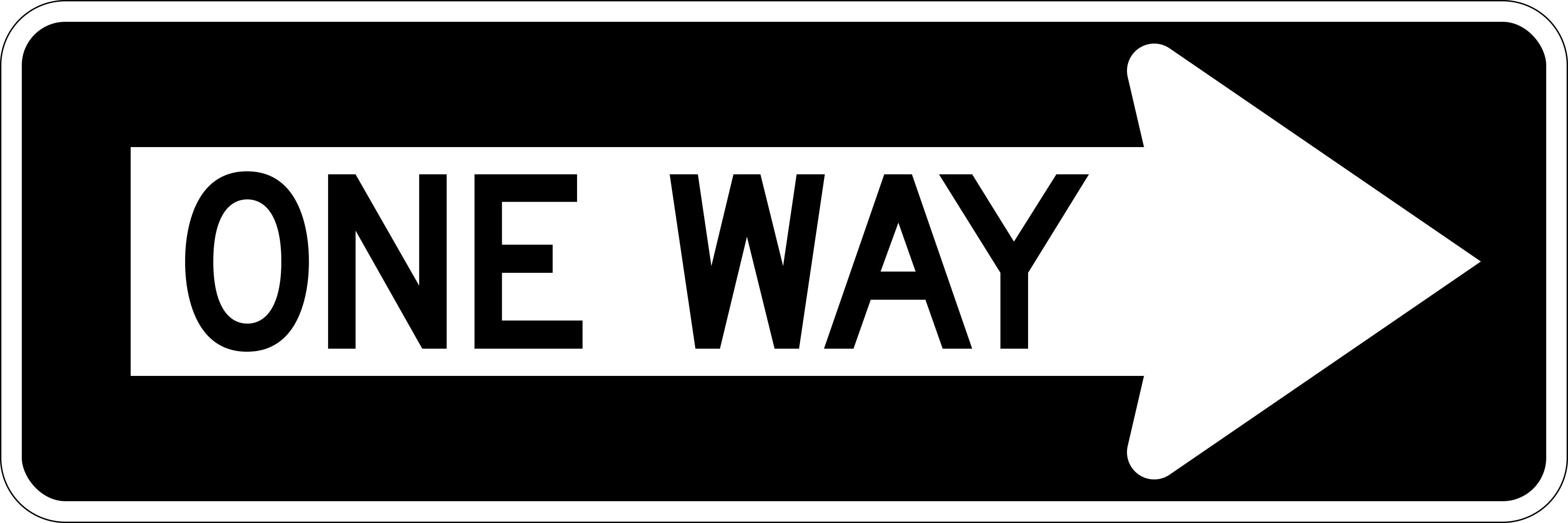
- Only toward the nearest intersection
- In either direction if the lane is empty
- Only in the direction shown by the arrow
- Opposite the arrow when turning around
Show answer
Only in the direction shown by the arrow. The Iowa manual defines a one-way sign as meaning traffic moves only in the direction of the arrow. An empty lane does not authorize opposing travel, and the nearest intersection does not change the sign's direction. Turning around against the arrow would also create a wrong-way conflict. Treat the arrow as a continuous direction for the roadway, not as a suggestion that applies only when other vehicles are visible. Check lane markings and signs before entering or turning onto that street.
Study this in the handbook: Regulatory Signs
20. Does refusing a breath test in Iowa prevent an OWI conviction?
- Yes, without a test there is no evidence
- Yes, if it is a first offense
- No, and the refusal still results in license revocation
- No, but the license is never revoked for a refusal
Show answer
No, and the refusal still results in license revocation. Refusing a breathalyzer test does not guarantee you will avoid an OWI conviction, and the refusal itself still results in license revocation. A refusal therefore does not shield the driver from conviction, and the manual gives no first offense exception to the revocation. The manual says refusing is treated more severely than failing a test, starting with an automatic one year revocation and a minimum $1,250 fine.
Study this in the handbook: Operating While Intoxicated (OWI)
Every question is written from the official Iowa Driver's License Manual. Need paper? Printable IA practice test with answer key.
Last verified 2026-10-05. How we check every question · Study all 210 as flashcards
Frequently asked questions
How many questions are on this Iowa practice test?
This fixed set has 20 questions. It is test 8 of 10 from the 210 question Iowa bank.
How does this fixed test relate to the full Iowa bank?
Each numbered test is a fixed set of questions in a fixed order, so you can retake the same test later and compare. Every test mixes road signs and the other topics in about the same proportion as the full bank. Tests 1 to 10 together cover 200 of the 210 questions in the Iowa bank, each once. The full practice page mixes the whole bank at random.
Last verified 2026-10-05. See the Iowa DMV facts page for sourced state details.