
Key points
When a school bus shows flashing red or amber lights, you may not pass it from behind and should be ready to stop.
Source: Handbook p. 20
“When you see flashing red or amber warning lights, you are not permitted to pass the school bus and should be prepared to stop.”
Iowa Driver's Manual, Handbook p. 20Stop no closer than 15 feet from the rear of the bus and stay stopped until the arm is retracted and the bus moves.
Source: Handbook p. 20
“Stop no closer than 15 feet from the rear of the bus, and remain stopped until the stop arm is retracted and the school bus starts moving again.”
Iowa Driver's Manual, Handbook p. 20Meeting a bus from the front with flashing amber lights, slow to no more than 20 mph and be ready to stop.
Source: Handbook p. 20
“When you see amber warning lights flashing, you must slow your vehicle to no more than 20 mph and be prepared to stop.”
Iowa Driver's Manual, Handbook p. 20On 3 lanes or fewer, all vehicles must stop for a bus with its stop arm out.
Source: Handbook p. 20
“3 lanes or fewer: all vehicles must stop”
Iowa Driver's Manual, Handbook p. 20On roads with four or more lanes, oncoming traffic in the opposite lanes need not stop.
Source: Handbook p. 20
“When meeting the bus in one of the opposite two lanes (or more), you do not need to stop, even if the bus has stopped with lights flashing and stop arm out.”
Iowa Driver's Manual, Handbook p. 20Illegally passing a school bus can mean a suspension of up to 180 days.
Source: Handbook p. 20
“Violating this law may result in your license being suspended for up to 180 days.”
Iowa Driver's Manual, Handbook p. 20
Numbers to know
| Number | What it means | Manual |
|---|---|---|
| 15 feet | minimum stopping distance behind a school bus | Handbook p. 20 |
| 20 mph | maximum speed when meeting a bus with amber lights | Handbook p. 20 |
| 3 lanes | roads on which all vehicles must stop (or fewer) | Handbook p. 20 |
| 4 lanes | roads where oncoming traffic need not stop (or more) | Handbook p. 20 |
| 180 days | maximum suspension for illegally passing a school bus | Handbook p. 20 |
Recognize these signs
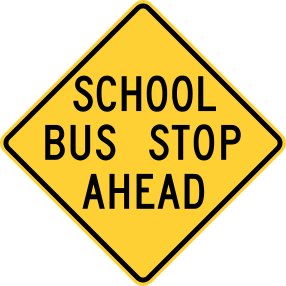
School bus stop ahead
3 questions from the Iowa practice test
1. How far from the rear of a stopped school bus must a driver stop?
- No closer than 5 feet
- No closer than 15 feet
- At least 50 feet away
- Only far enough to see the stop arm
Show answer
No closer than 15 feet. When the school bus stops with its stop arm extended, the driver behind it must stop no closer than 15 feet from the rear. Five feet leaves too little protection around children and the bus, while 50 feet is not the stated minimum. Visibility alone is not the measure because the manual specifies a distance. Remain stopped until the stop arm retracts and the bus starts moving again. The number to associate with the bus's rear is 15 feet, not the other distances in the choices.
2. When meeting a school bus from the front on a two or three lane road with amber lights flashing, what is required?
- Stop 100 feet before the bus even if it keeps moving
- Continue at the posted speed without watching the bus
- Slow to no more than 20 mph and be prepared to stop
- Pass on the shoulder before the stop arm extends
Show answer
Slow to no more than 20 mph and be prepared to stop. For a driver meeting the bus from the front in the described two or three lane setting, amber warning lights require slowing to no more than 20 mph and preparing to stop. Continuing at the posted speed ignores the warning, and the manual does not require an arbitrary 100-foot stop when the bus is still moving. Passing on the shoulder is never a safe substitute for following the bus procedure. The important combination is amber lights, a 20 mph ceiling, and readiness to stop.
3. When a driver illegally passes a stopped school bus, what license consequence may Iowa impose?
- A mandatory suspension of exactly 30 days
- A warning with no possible license action
- Permanent revocation for the first violation
- Suspension for up to 180 days
Show answer
Suspension for up to 180 days. Iowa says a school-bus passing violation may result in a driver's license being suspended for up to 180 days. The phrase up to sets a maximum period, not an automatic 30-day term, and the manual does not describe a permanent first-offense revocation here. A warning-only response understates the possible consequence. When a bus displays the relevant warning lights and stop arm, stop as required for the roadway scenario and remain stopped until the manual's release condition is met.
Practice this topic
Lock it in with safe driving questions from the free Iowa practice test. Every answer comes with a plain English explanation.
Source: the Iowa Driver's Manual, Chapter 2: School Buses. This lesson is a plain English summary, not the law itself; where it differs, the manual and the statute govern. Last checked 2026-09-27.