
Key points
Never stop on the railroad tracks; trains cannot stop quickly.
Source: Handbook p. 12
“Use extra caution at railroad crossings and never stop your vehicle on the railroad tracks. Trains cannot stop quickly.”
Iowa Driver's Manual, Handbook p. 12When stopped, leave at least 15 feet between your vehicle and the nearest rail.
Source: Handbook p. 12
“When stopped, leave at least 15 feet between the front and rear of your vehicle and the nearest rail.”
Iowa Driver's Manual, Handbook p. 12Drivers carrying passengers for hire and placarded hazmat vehicles, among others, must stop 15 to 50 feet from the tracks.
Source: Handbook p. 12
“carrying passengers for hire (such as Uber or Lyft), and all vehicles required to be placarded for hazardous materials, must stop within 15 to 50 feet of railroad tracks before crossing.”
Iowa Driver's Manual, Handbook p. 12If stalled with a train coming, get everyone out and move away at a 45 degree angle toward the train.
Source: Handbook p. 12
“Get everyone out of the car IMMEDIATELY, move away from the tracks at a 45-degree angle, in the direction of the approaching train”
Iowa Driver's Manual, Handbook p. 12Call the number on the blue ENS sign, or 911 if there is none.
Source: Handbook p. 12
“Call the number on the blue and white Emergency Notification System (ENS) sign. Share the crossing ID number with the dispatcher. • If there is no sign, call 911.”
Iowa Driver's Manual, Handbook p. 12Do not park closer than 50 feet from a railroad crossing.
Source: Handbook p. 21
“Closer than 50 feet from a railroad crossing.”
Iowa Driver's Manual, Handbook p. 21On gravel, slow down, avoid sudden turns and increase your following distance.
Source: Handbook p. 55
“Slow down, avoid sudden turning, accelerate and brake slowly, and increase your following distance.”
Iowa Driver's Manual, Handbook p. 55Use low beam headlights in extremely dusty conditions.
Source: Handbook p. 55
“Use low beam headlights to make your vehicle more visible to others during extremely dusty conditions”
Iowa Driver's Manual, Handbook p. 55
Numbers to know
| Number | What it means | Manual |
|---|---|---|
| 15 feet | minimum gap to the nearest rail when stopped | Handbook p. 12 |
| 15 to 50 feet | required stop zone for buses and hazmat vehicles | Handbook p. 12 |
| 45 degree | angle to move away from the tracks | Handbook p. 12 |
| 50 feet | no parking distance from a railroad crossing | Handbook p. 21 |
| 911 | number to call if there is no ENS sign | Handbook p. 12 |
Recognize these signs

Railroad crossing ahead 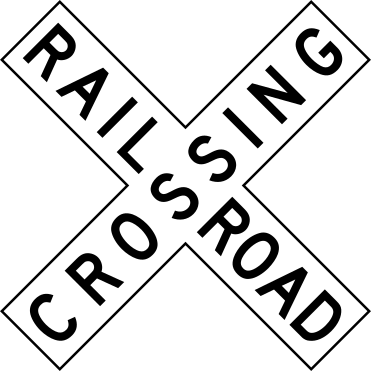
Railroad crossbuck
3 questions from the Iowa practice test
1. How far from railroad tracks must a vehicle carrying placarded hazardous materials stop before crossing, unless an exception applies?
- At least 100 feet
- Exactly 5 feet
- Between 15 and 50 feet
- No stop is required when no train is visible
Show answer
Between 15 and 50 feet. A vehicle required to display hazardous-material placards must stop within the 15-to-50-foot range before crossing railroad tracks. The rule is a stopping distance range, not a five-foot or 100-foot requirement, and the absence of a visible train does not erase it. A police officer, highway traffic signal, or an EXEMPT sign can direct traffic to proceed without that stop. Check the vehicle's placard status and the crossing instructions before moving across.
2. How close to a railroad crossing is parking prohibited in Iowa?
- Within 20 feet
- Within 5 feet
- Within 10 feet
- Within 50 feet
Show answer
Within 50 feet. Iowa prohibits parking closer than 50 feet from a railroad crossing. The shorter distances in the choices are easy to confuse with other parking restrictions in the same section, including the five-foot fire-hydrant rule and the ten-foot stop-sign rule. Twenty feet is also used for a fire-station entrance, not the crossing. Separate the locations before recalling the number: railroad crossing means 50 feet. The same list also bans parking on any bridge outside city limits and in highway tunnels.
3. During extremely dusty conditions on a rural road, which lights should make the vehicle more visible?
- No lights until the dust clears
- High beams only
- Parking lights only
- Low-beam headlights
Show answer
Low-beam headlights. The manual directs drivers to use low-beam headlights during extremely dusty conditions so other road users can see the vehicle. High beams are not the instruction given for this situation; the manual names low beams. Parking lights provide less useful visibility, and waiting for the dust to clear removes an important warning to approaching traffic. The light choice does not replace slower, alert driving. Reduce speed, expect limited sight distance, look for vehicles entering from the side, and keep enough space to stop if the dust hides a hazard.
Practice this topic
Lock it in with emergencies questions from the free Iowa practice test. Every answer comes with a plain English explanation.
Source: the Iowa Driver's Manual, Chapters 2 and 5: Railroad Crossings and Rural Roads. This lesson is a plain English summary, not the law itself; where it differs, the manual and the statute govern. Last checked 2026-09-27.