Every question below comes from the Wisconsin question bank on this page. Open a question to see the correct answer and the explanation. Nothing here is hidden behind a signup.
1. When should a driver return from high beams to low beams?
- Only after entering a construction area
- Whenever the road has a center line
- When a vehicle comes toward you
- When following a vehicle at any distance
Show answer
When a vehicle comes toward you. Wisconsin directs drivers to return to low beams when a vehicle is coming toward them. Full explanation in Test 1
2. What roadway feature does a Keep Right sign indicate ahead?
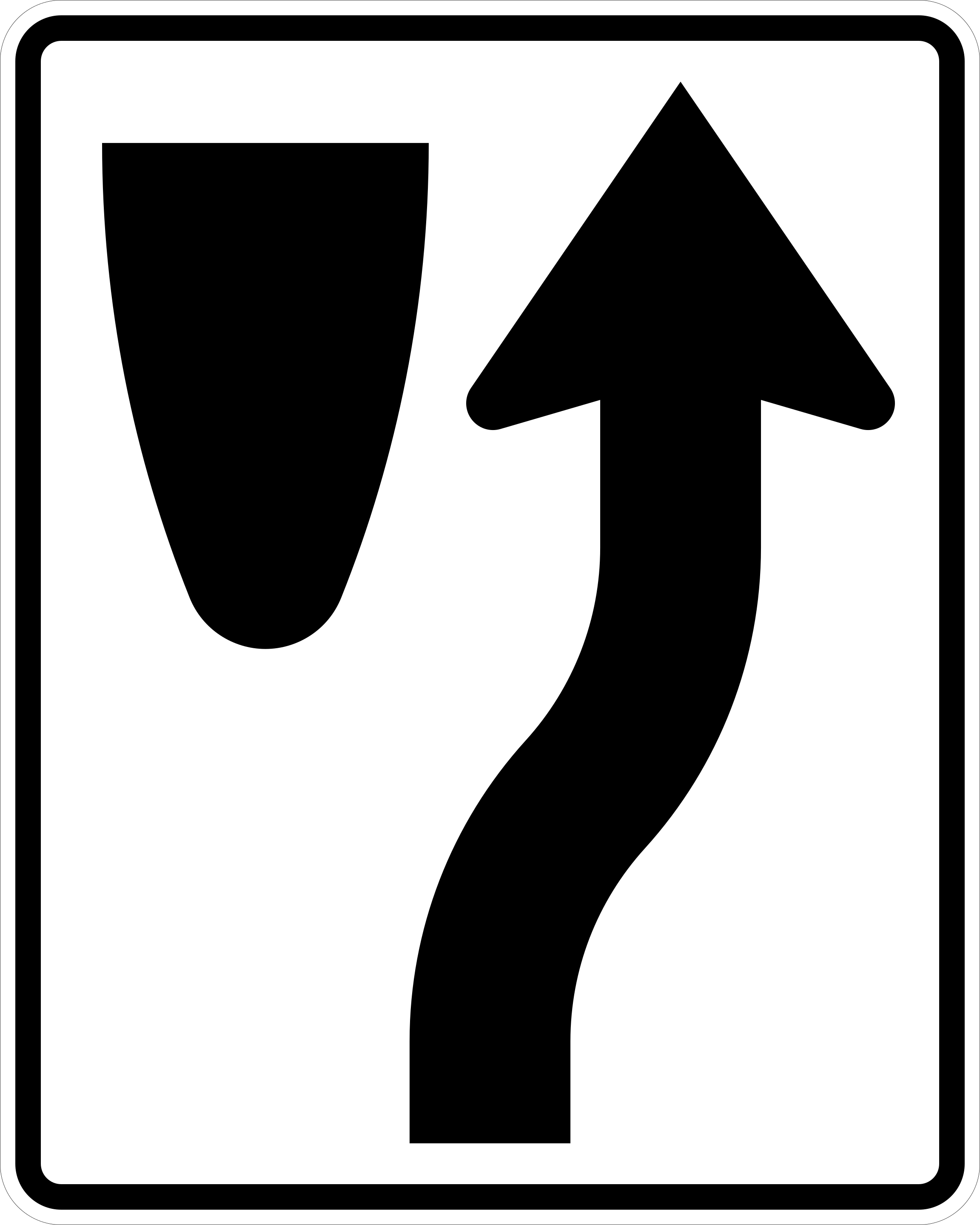
- A traffic island or obstacle divides the road
- The right lane is reserved for passing
- A one-way roadway requires every turn to be right
- A railroad gate blocks the left shoulder
Show answer
A traffic island or obstacle divides the road. The Keep Right sign warns that a traffic island or other obstacle divides the road ahead. Full explanation in Test 2
3. If a Wisconsin driver refuses a requested PAC test, what minimum driving privilege consequence does the handbook describe?
- Loss of driving privileges for at least one year
- A warning with no license consequence
- A three-month suspension only
- A requirement to retake the signs test
Show answer
Loss of driving privileges for at least one year. Wisconsin's implied consent rule requires a driver to agree to a prohibited alcohol concentration test when an officer asks. Full explanation in Test 3
4. What does an intersection or cross-road warning sign identify?

- A road that permits traffic in one direction only
- A lane reserved for turning vehicles only
- A railroad track that is no longer in use
- A place where two or more roads cross
Show answer
A place where two or more roads cross. The intersection or cross-road warning identifies a location where roads meet or cross, alerting the driver to watch for traffic entering th Full explanation in Test 4
5. Until what age must children generally use a child safety seat in Wisconsin?
- Until they reach age eight
- Until they reach age two
- Until they reach age four
- Until they reach age twelve
Show answer
Until they reach age four. Wisconsin generally requires a child safety seat until a child reaches age four. Full explanation in Test 5
6. Why might a driver encounter this sign on an exit ramp?
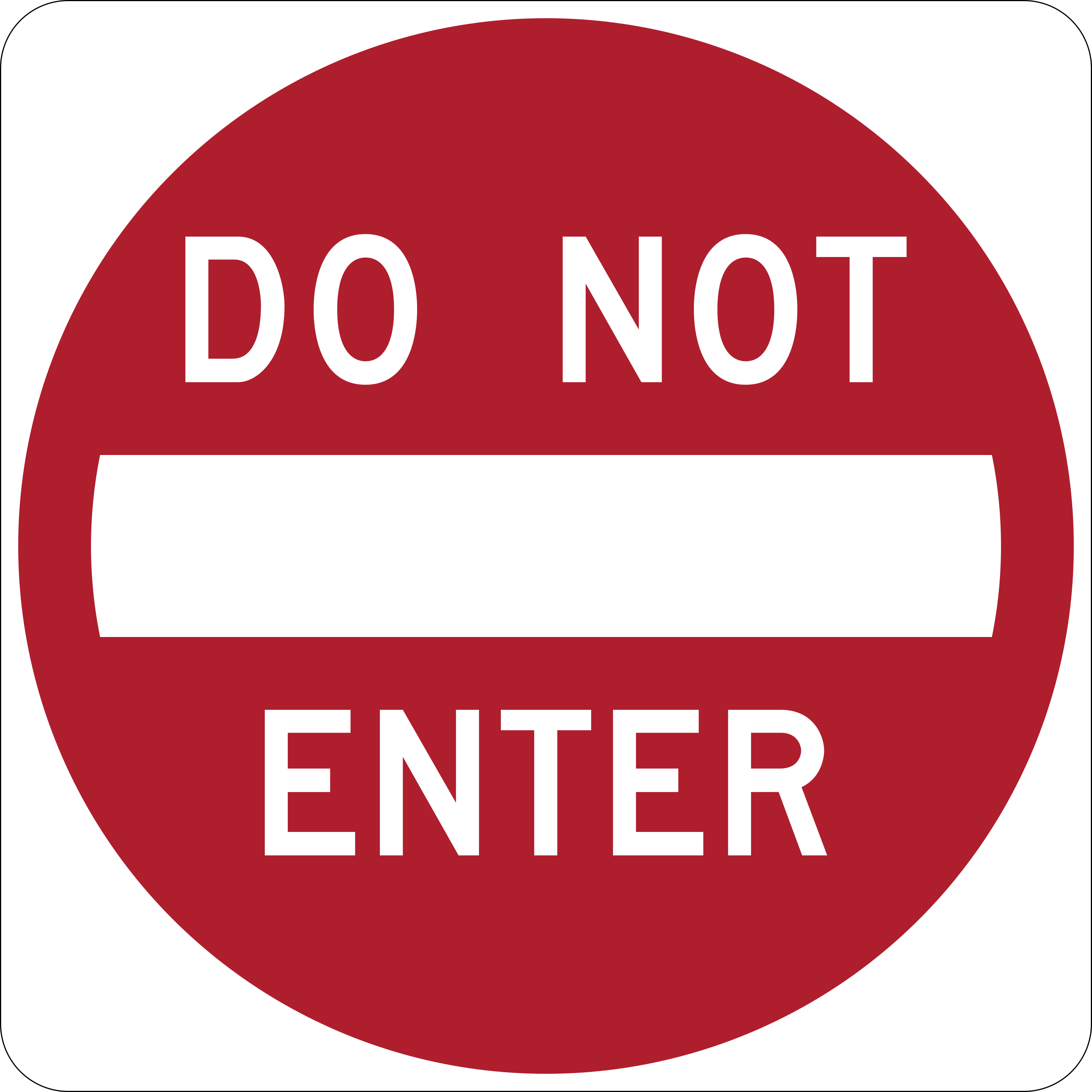
- The ramp is reserved for emergency vehicles
- The ramp leads in the wrong direction
- The ramp is a legal passing lane
- The ramp ends at a railroad signal
Show answer
The ramp leads in the wrong direction. Wisconsin uses the Do Not Enter sign on exit ramps when a driver could go the wrong direction. Full explanation in Test 6
7. Where does the Wisconsin handbook say parking is not allowed?
- Only on the left side of a one-way street
- On yellow curb markings or in front of fire hydrants
- Anywhere within one block of a business
- On every road with a paved shoulder
Show answer
On yellow curb markings or in front of fire hydrants. The handbook identifies yellow curb markings and areas in front of fire hydrants as places where parking is not allowed. Full explanation in Test 7
8. What following gap does Wisconsin recommend as a normal starting point?
- Ten feet behind the vehicle ahead
- One car length at every speed
- Two seconds only when roads are icy
- Four seconds from a stationary reference point
Show answer
Four seconds from a stationary reference point. Wisconsin teaches the Four Second Following Distance Rule. Full explanation in Test 8
9. What does a dashed yellow center line allow when it is safe?
- Parking in the center of the roadway
- Passing other vehicles
- Turning only at a traffic signal
- Driving against traffic without checking
Show answer
Passing other vehicles. A dashed yellow line separates opposing traffic but indicates that passing may be allowed when it is safe to do so. Full explanation in Test 9
10. How often must a Wisconsin driver license be renewed?
- Every eight years
- Every four years
- Every two years
- Every twelve years
Show answer
Every eight years. Wisconsin sets the renewal cycle at eight years. Full explanation in Test 10
11. A school bus displays flashing red lights on the opposite side of an undivided road. What must you do?
- Stop only if the bus driver gestures
- Continue if you are traveling in the opposite direction
- Pass slowly after checking for children
- Stop at least 20 feet from the bus
Show answer
Stop at least 20 feet from the bus. A school bus with flashing red lights requires a stop at least 20 feet away. Full explanation in Test 1
12. On a Wisconsin railroad crossbuck assembly, what may a sign below the X-shaped Railroad Crossing sign tell you?
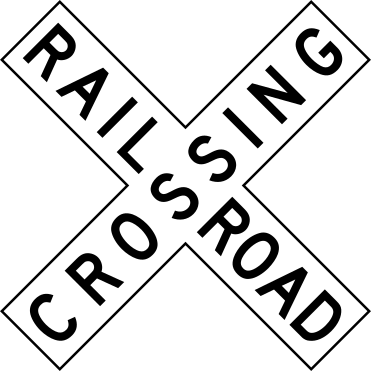
- The speed limit for the next town
- The train's exact arrival time
- The number of tracks at the crossing
- The distance to the nearest hospital
Show answer
The number of tracks at the crossing. A Wisconsin railroad crossbuck assembly may include a separate sign listing how many tracks must be crossed. Full explanation in Test 2
13. When may a driver cross a dashed yellow centerline to pass?
- When the vehicle ahead is farm equipment
- Whenever the driver wants to save time
- Only after sounding the horn twice
- When passing is safe and the way is clear
Show answer
When passing is safe and the way is clear. A dashed yellow line indicates that passing may be permitted, but the maneuver still depends on safety. Full explanation in Test 3
14. What should a driver do after seeing a curved-road warning sign?

- Move immediately onto the shoulder
- Accelerate before the road changes direction
- Stop in the travel lane until the curve ends
- Slow down if needed to drive safely through the curve
Show answer
Slow down if needed to drive safely through the curve. A curved-road warning means the roadway will gradually move right or left, so the driver should reduce speed when conditions require it. Full explanation in Test 4
15. Before crossing railroad tracks, what should a Wisconsin driver do even if warning signs are not flashing?
- Stop on the tracks to check for traffic
- Shift gears while crossing to gain speed
- Look both ways and listen for a train
- Cross quickly without checking if the gate is raised
Show answer
Look both ways and listen for a train. The handbook calls for checking both directions before crossing railroad tracks, even when the warning devices are not flashing. Full explanation in Test 5
16. What guidance does the Wisconsin handbook give regular license holders about cell phone use while driving?
- Use a phone only for navigation, with no other restriction
- Use a handheld phone freely when traffic is moving slowly
- Avoid using a cell phone and try the vehicle’s hands-free option if use is necessary
- Turn the phone off by law in every situation
Show answer
Avoid using a cell phone and try the vehicle’s hands-free option if use is necessary. For regular license holders, the handbook says to avoid using a cell phone while driving and, if use is necessary, try the vehicle’s hands-f Full explanation in Test 6
17. A school bus has flashing red lights on the other side of a divided highway. What is the rule for you?
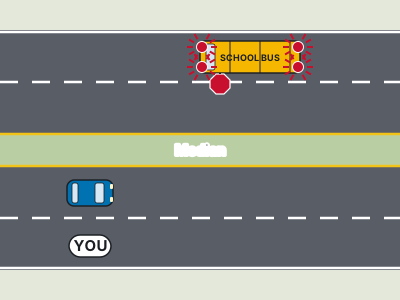
- You must stop unless the highway has four lanes
- You must stop at least 20 feet away every time
- You may pass only after the bus driver waves you through
- You do not have to stop when you are on the opposite side of the divided roadway
Show answer
You do not have to stop when you are on the opposite side of the divided roadway. The handbook makes an exception for a divided highway or roadway when you are on the side opposite the stopped school bus. Full explanation in Test 7
18. What score is required to pass Wisconsin's separate Highway Signs test?
- 10 correct out of 15
- 12 correct out of 15
- 13 correct out of 20
- 8 correct out of 10
Show answer
12 correct out of 15. The separate Highway Signs test contains 15 questions, and an applicant must answer 12 correctly. That is an 80 percent passing score. Full explanation in Test 8
19. For how long are Wisconsin graduated driver license restrictions required for a driver under 18, unless the driver turns 18 sooner?
- The first three months
- The first six months
- The first nine months
- Until the driver turns 21
Show answer
The first nine months. Wisconsin keeps the graduated driver license restrictions in place for the first nine months unless the young driver reaches age 18 before t Full explanation in Test 9
20. How long are Wisconsin GDL restrictions extended if the teen breaks one of them?
- Thirty days
- Six months
- One year
- Until age 21
Show answer
Six months. The graduated driver license restrictions are extended six months if the driver is convicted of a moving traffic violation, violates any of Full explanation in Test 10
21. Which action is prohibited when crossing railroad tracks?
- Waiting for a clear path on the other side
- Looking both ways before crossing
- Stopping on the tracks
- Checking for a train even when warning signs are dark
Show answer
Stopping on the tracks. Never stop on railroad tracks. A stopped vehicle can be trapped in the path of a train, and the handbook also warns drivers not to enter unl Full explanation in Test 1
22. What happens to points on second or future convictions under Wisconsin GDL restrictions?
- They apply only after age 21
- They are erased
- They convert to driving hours
- They double
Show answer
They double. Wisconsin applies a stricter point consequence to second and later convictions while graduated driver license restrictions are in effect. Full explanation in Test 2
23. How should you approach an intersection when trees, buildings, or parked vehicles block your view?
- Rely on the vehicle ahead without looking
- Accelerate so you clear the obstruction quickly
- Stop in the middle of the cross street
- Approach at a slow pace
Show answer
Approach at a slow pace. A blocked intersection requires a slow approach because the obstruction can hide a vehicle, cyclist, or pedestrian. Full explanation in Test 3
24. What must a driver do when a railroad crossing gate is lowering?
- Cross after the gate reaches halfway down
- Drive around it if no train is visible
- Wait and do not drive around the gate
- Stop under the gate until the bell ends
Show answer
Wait and do not drive around the gate. A lowering railroad gate means the crossing is closing for a train, so wait and never drive around or under the gate. Full explanation in Test 4
25. What is the purpose of Wisconsin warning signs?
- To authorize parking in any nearby lane
- To list the driver's license renewal date
- To identify only services such as hospitals
- To alert drivers to a special situation or hazard ahead
Show answer
To alert drivers to a special situation or hazard ahead. Warning signs communicate that a special situation or hazard is ahead. Full explanation in Test 5
26. A pedestrian with a guide dog or white cane is near the roadway. How far away should a driver stop until that person is clear?
- Only at the edge of a marked crosswalk
- At least 3 feet
- At least 20 feet
- At least 10 feet
Show answer
At least 10 feet. The handbook gives special protection to a pedestrian using a guide dog or carrying a white cane. Full explanation in Test 6
27. What does Wisconsin’s handbook say about assuming that the vehicle on the right always goes first?
- Do not make that assumption because each situation can differ
- Make that assumption at every intersection
- Use it only at four-way stops
- Ignore it whenever the road is wet
Show answer
Do not make that assumption because each situation can differ. Wisconsin’s handbook cautions that a vehicle on the right is not automatically first in every encounter. Full explanation in Test 7
28. On a road with more than one lane in your direction, how should you pass a stopped emergency vehicle with flashing lights?
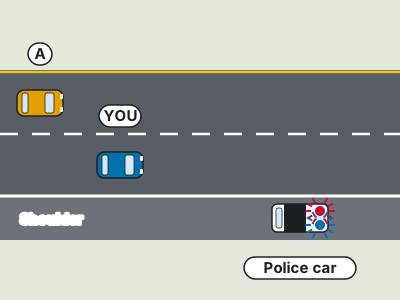
- Drive on the shoulder beside it
- Stop in the lane nearest the vehicle
- Move into the lane farthest from the stopped vehicle
- Turn around before reaching it
Show answer
Move into the lane farthest from the stopped vehicle. Approaching a stopped emergency vehicle with its lights flashing requires moving into the lane not nearest the stopped vehicle, then staying Full explanation in Test 8
29. Which steering response is recommended while a vehicle is hydroplaning?
- Hold the wheel straight until the tires grip again
- Swerve toward the nearest open lane
- Use repeated hard braking to force traction
- Turn toward the vehicle behind you
Show answer
Hold the wheel straight until the tires grip again. When water lifts the tires from the pavement, steering inputs can become unpredictable. Full explanation in Test 9
30. In which situation does the Wisconsin handbook recommend using low beam headlights?
- Only when parked and idling
- When using windshield wipers
- Only when driving on a divided highway
- When no vehicle has a license plate
Show answer
When using windshield wipers. The handbook recommends using low beam headlights when you are using your windshield wipers, as well as when it is rainy, snowy, or foggy. Full explanation in Test 10
31. What must Wisconsin drivers always do to avoid hitting pedestrians, bicyclists, or other vehicles?
- Yield when needed
- Assume pedestrians will stop
- Proceed first after sounding the horn
- Yield only when a police officer is present
Show answer
Yield when needed. Wisconsin's right-of-way section puts safety ahead of claiming priority: drivers must yield when needed to avoid hitting pedestrians, bicycl Full explanation in Test 1
32. In a Wisconsin construction zone, when may you hold and use your cellphone while driving?
- Whenever you are below the posted speed limit
- Whenever traffic is stopped
- Only to report an emergency
- Only if you are 18 or older
Show answer
Only to report an emergency. Construction zones in Wisconsin carry two special rules: traffic fines double, and the handbook says a driver may use a cellphone there only Full explanation in Test 2
33. What must a driver do when a police car is stopped on the roadside with lights and sirens on?
- Move over or slow down to give it room
- Stop directly behind the police car
- Pass without changing speed if the lane is open
- Turn around before reaching the stopped vehicle
Show answer
Move over or slow down to give it room. Wisconsin’s roadside rule protects officers and other emergency personnel working near traffic. Full explanation in Test 3
34. When are Wisconsin drivers required to use low-beam headlights?
- Only when driving on an interstate highway
- From a half hour after sunset until a half hour before sunrise
- Only during rain, snow, or fog
- Whenever the vehicle is parked and idling
Show answer
From a half hour after sunset until a half hour before sunrise. The handbook requires low beams during the period beginning one-half hour after sunset and ending one-half hour before sunrise. Full explanation in Test 4
35. What should you turn on during a roadside emergency in Wisconsin?
- Emergency flashers
- High beams only
- The parking brake warning light
- Interior dome lights only
Show answer
Emergency flashers. For roadside emergencies, Wisconsin tells drivers to turn on emergency flashers. Full explanation in Test 5
36. Before receiving a probationary license, an applicant under 18 must hold the instruction permit for at least how long?
- One year
- Three months
- Nine months
- Six months
Show answer
Six months. An applicant under 18 needs to hold the instruction permit for at least six months before moving to a probationary license. Full explanation in Test 6
37. What cell phone use is permitted for a Wisconsin instruction permit or probationary license holder while driving?
- Using any hands-free feature whenever desired
- Using the phone only to report an emergency
- Making personal calls if traffic is light
- Using the phone only while stopped at a red light
Show answer
Using the phone only to report an emergency. Instruction permit and probationary license holders have a narrow handbook allowance: they may use a cell phone while driving only to report Full explanation in Test 7
38. When may a driver travel briefly in a Wisconsin reserved lane that is marked for special vehicles?
- Whenever traffic in regular lanes is slow
- When turning across it in the next half of a block
- Only to pass a bicyclist at full speed
- Anytime the lane has a white diamond
Show answer
When turning across it in the next half of a block. Reserved lanes are for special vehicles, but Wisconsin allows a driver to travel in one when a turn across that lane is needed in the next h Full explanation in Test 8
39. What do two solid yellow lines mean for passing?
- Passing is allowed for both directions
- No lane of travel can pass
- Only trucks may cross to pass
- Passing is required before the next curve
Show answer
No lane of travel can pass. Two solid yellow lines mean that no lane of travel can pass. Full explanation in Test 9
40. When making a left turn, what must you leave room for?
- No traffic once your signal is on
- Only vehicles parked behind you
- A vehicle to pass on the shoulder
- Oncoming traffic to turn in front of you
Show answer
Oncoming traffic to turn in front of you. A left-turning driver must leave room for oncoming traffic to turn in front of the waiting vehicle. Full explanation in Test 10
41. What headphone use does Wisconsin warn drivers not to do?
- Drive with headsets or headphones covering or in both ears
- Use one earbud for a navigation prompt
- Keep the vehicle radio at low volume
- Listen for emergency vehicles while driving
Show answer
Drive with headsets or headphones covering or in both ears. Wisconsin tells drivers not to drive with headsets or headphones that cover or go in both ears. Full explanation in Test 1
42. What does Wisconsin require to reinstate a revoked license once the revocation period is over?
- Only a new vision test
- A letter from the arresting officer
- Proof of identity, a reinstatement fee, and possibly proof of financial responsibility
- Nothing, because it restores itself
Show answer
Proof of identity, a reinstatement fee, and possibly proof of financial responsibility. A revoked Wisconsin license can be reinstated only after the revocation period is over. Full explanation in Test 2
43. On a two lane road, what does a solid yellow line beside a dashed yellow line indicate?
- The road is changing to one way traffic
- Passing is forbidden for vehicles on both sides
- Passing is allowed from the solid side only
- Passing is allowed from the dashed side but not the solid side
Show answer
Passing is allowed from the dashed side but not the solid side. A mixed yellow centerline assigns different passing permissions to the two directions. Full explanation in Test 3
44. What does Wisconsin say about exceeding the speed limit to pass another vehicle?
- It is allowed only on two-lane rural highways
- It is allowed for less than one mile
- It is not allowed
- It is required when traffic is backed up
Show answer
It is not allowed. Passing does not give a Wisconsin driver permission to exceed the posted limit. Full explanation in Test 4
45. When parallel parking in Wisconsin, how long should the parking space be compared with your vehicle?
- Exactly the same length
- About 10 to 15 feet longer
- At least twice as long
- About 3 to 6 feet longer
Show answer
About 3 to 6 feet longer. The handbook's parallel parking steps start with finding a space about 3 to 6 feet longer than your vehicle. Full explanation in Test 5
46. Why might Wisconsin’s safe driving speed be lower than the posted maximum?
- Visibility and road conditions may require a slower speed
- A driver may exceed the maximum when visibility is poor
- The posted number applies only when traffic is heavy
- A driver should always travel exactly at the posted number
Show answer
Visibility and road conditions may require a slower speed. Wisconsin describes a speed limit as the maximum, not a target that must be reached in every condition. Full explanation in Test 6
47. At a steady green light, what must you remember before making a left turn?
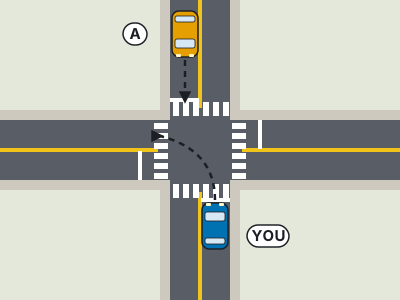
- Oncoming traffic has the right of way, so turn only when safe
- The green light gives an unconditional left turn
- You must wait for a red light before turning
- Vehicles behind you have priority over oncoming traffic
Show answer
Oncoming traffic has the right of way, so turn only when safe. A steady green light permits movement, but it does not give a left turning driver priority over approaching traffic. Full explanation in Test 7
48. What does a slow moving vehicle sign identify in Wisconsin?

- A vehicle carrying hazardous cargo only
- A vehicle that must travel at least 55 mph
- A road closed to farm equipment
- A vehicle that could travel at 25 mph or less
Show answer
A vehicle that could travel at 25 mph or less. Wisconsin describes the slow moving vehicle sign as a triangle with reflective orange markings and says the vehicle could travel at 25 mph o Full explanation in Test 8
49. A Wisconsin driver is asked to take a prohibited alcohol concentration test and refuses. What consequence does the handbook describe?
- The driver may refuse if no crash occurred
- The driver receives only a written warning for a first refusal
- The refusal changes the charge to a parking violation
- The officer must arrest the driver, and driving privileges are lost for at least one year
Show answer
The officer must arrest the driver, and driving privileges are lost for at least one year. Wisconsin treats refusal of a requested prohibited alcohol concentration test as a violation of the Implied Consent Law. Full explanation in Test 9
50. If a Wisconsin crash has no injuries and the vehicle can move, what should the driver do when safe?
- Leave it blocking traffic until a tow truck arrives
- Move the vehicle off the road
- Drive away without exchanging information
- Stop in the middle of the road to take photos first
Show answer
Move the vehicle off the road. When there are no injuries and the vehicle can be moved, Wisconsin tells the driver to move it off the road when safe. Full explanation in Test 10
51. What should a driver do when the tires begin sliding on top of water?
- Press the brake pedal firmly and turn toward the shoulder
- Ease off the gas, keep the wheel straight, and wait for grip
- Accelerate until the tires cut through the water
- Turn sharply before the vehicle reaches the road edge
Show answer
Ease off the gas, keep the wheel straight, and wait for grip. When a vehicle hydroplanes, the tires are riding on water instead of gripping the pavement. Full explanation in Test 1
52. How far away should you stop for a pedestrian using a guide dog or white cane?
- Within one foot of the crosswalk
- At least ten feet away
- Twenty feet away in every situation
- Only after the pedestrian reaches the center line
Show answer
At least ten feet away. Wisconsin gives special protection to pedestrians using a guide dog or carrying a white cane. Full explanation in Test 2
53. How much room must you give a bicyclist when passing in Wisconsin?
- At least one foot
- At least three feet
- At least ten feet
- Half a lane width
Show answer
At least three feet. Wisconsin tells drivers to give bicyclists at least three feet of room when passing, and to wait for oncoming traffic to clear before passin Full explanation in Test 3
54. What must a driver do when an emergency vehicle approaches with lights and sirens?
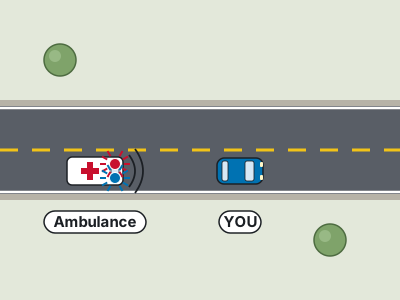
- Stop in the middle of the intersection
- Pull to the side and stop until it has passed
- Follow the emergency vehicle closely through traffic
- Remain in the nearest lane and continue normally
Show answer
Pull to the side and stop until it has passed. Flashing emergency lights and sirens signal the driver to move toward the side of the road and stop. Full explanation in Test 4
55. Which of these people may supervise a Wisconsin instruction permit holder from the front passenger seat, if licensed at least two years?
- A parent age 19 or older
- A friend age 20
- A sibling age 18
- An uncle age 20
Show answer
A parent age 19 or older. The accompanying driver must be a qualified instructor age 19 or older, a parent, guardian or spouse age 19 or older, or any person 21 or ol Full explanation in Test 5
56. Who is a habitual traffic offender in Wisconsin?
- Someone with two speeding tickets in one year
- Someone convicted of four or more major or 12 or more minor violations within five years
- Someone who reaches 6 points in 12 months
- Someone with one OWI conviction
Show answer
Someone convicted of four or more major or 12 or more minor violations within five years. A habitual traffic offender is someone convicted of four or more major traffic violations, or 12 or more minor violations, within five years Full explanation in Test 6
57. What special rule applies to traffic fines in construction areas?
- Fines double only after sunset
- Traffic fines are waived when workers are present
- Only parking fines double there
- Traffic fines double in these areas
Show answer
Traffic fines double in these areas. Wisconsin warns that traffic fines double in construction areas. Full explanation in Test 7
58. Where should your front wheels stop when approaching a crosswalk?
- Just before the solid white line
- On top of the crosswalk
- Past the crosswalk near the opposite curb
- At least one car length beyond the intersection
Show answer
Just before the solid white line. At a crosswalk, stop with the front wheels just before the solid white line. Full explanation in Test 8
59. What does a Wisconsin Signal Ahead sign warn a driver about?
- A railroad crossing is immediately behind the sign
- Stop lights are ahead, so be ready to slow and stop
- The road becomes one-way with no signal
- A lane ends and must be changed immediately
Show answer
Stop lights are ahead, so be ready to slow and stop. A Signal Ahead sign warns that stop lights are coming and tells the driver to prepare for slowing or stopping. Full explanation in Test 9
60. What does a single dashed yellow line between opposing traffic lanes mean?
- Traffic travels in the same direction
- No vehicle may cross the line
- You may pass when it is safe
- The road is approaching a railroad crossing
Show answer
You may pass when it is safe. A single dashed yellow line separates traffic moving in opposite directions and permits passing when conditions make that maneuver safe. Full explanation in Test 10
61. What roadway change does this Merge warning describe?

- A stop sign replaces every traffic signal ahead
- A right or left lane merges into the next lane
- The road becomes a one-way street with no opposing traffic
- A railroad track divides the roadway into three paths
Show answer
A right or left lane merges into the next lane. The Merge warning can show either a right or left lane merging. Full explanation in Test 1
62. If the gas pedal sticks, which step does the Wisconsin handbook tell you to take with the car?
- Turn the ignition off while steering at speed
- Switch the car to neutral
- Pump the accelerator until it releases
- Shift into reverse to slow the car
Show answer
Switch the car to neutral. A stuck accelerator calls for switching the vehicle to neutral, then pulling off safely when possible and turning off the engine. Full explanation in Test 2
63. How much room should you give a snowplow in Wisconsin when its lights are flashing?
- At least 200 feet
- At least 20 feet
- At least 50 feet
- At least 1,000 feet
Show answer
At least 200 feet. Wisconsin's winter driving tips tell drivers to give snowplows at least 200 feet of room when their lights are flashing red, amber or green. Full explanation in Test 3
64. When may you turn right at a steady red light in Wisconsin?
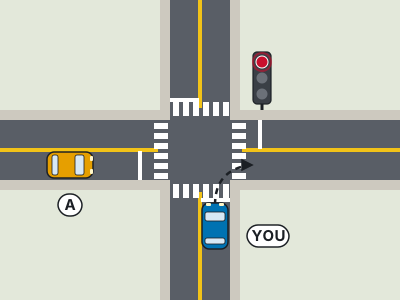
- Immediately, without stopping if the road is empty
- After stopping first, yielding to all traffic, and confirming it is safe with no prohibiting sign
- Only after the light turns green
- Whenever a vehicle behind you honks
Show answer
After stopping first, yielding to all traffic, and confirming it is safe with no prohibiting sign. A right turn on steady red requires a full stop first. Full explanation in Test 4
65. A Wisconsin driver is declared a habitual traffic offender. How long is driving revoked, and when might an occupational license be possible?
- One year, with an occupational license right away
- Ten years, with no occupational license
- Six months, with a probationary license after
- Five years, with an occupational license possible after a two-year wait
Show answer
Five years, with an occupational license possible after a two-year wait. A habitual traffic offender cannot drive for five years because the driving privilege is revoked. Full explanation in Test 5
