
Test 9 of 10 · 20 questions · Free 2026
WI Permit Practice Test 9
Jump to the test ↓A fixed 20 question set from the Wisconsin bank with answers and plain English explanations. The real WI exam has a 15 question road sign section with 12 correct to pass, plus 50 knowledge questions with 40 correct to pass; take the full length version on the main practice page.
Question 1 of 20 · 0 right so far
All 20 questions in test 9
Every question below comes from the Wisconsin question bank on this page. Open a question to see the correct answer and the explanation. Nothing here is hidden behind a signup.
1. What does a dashed yellow center line allow when it is safe?
- Parking in the center of the roadway
- Passing other vehicles
- Turning only at a traffic signal
- Driving against traffic without checking
Show answer
Passing other vehicles. A dashed yellow line separates opposing traffic but indicates that passing may be allowed when it is safe to do so. Before passing, check for approaching vehicles, adequate sight distance, and a clear return path. The marking does not create a parking area or limit turns to signalized intersections. It also never excuses driving against traffic without checking. The word dashed is the cue: unlike two solid yellow lines, it can identify a passing opportunity when conditions support it.
Study this in the handbook: Lane lines, crosswalks and special lanes
2. For how long are Wisconsin graduated driver license restrictions required for a driver under 18, unless the driver turns 18 sooner?
- The first three months
- The first six months
- The first nine months
- Until the driver turns 21
Show answer
The first nine months. Wisconsin keeps the graduated driver license restrictions in place for the first nine months unless the young driver reaches age 18 before that period ends. The rules limit late night driving and the number and type of passengers, which helps a new driver gain experience with fewer distractions. Six months is not the standard restriction period; six months is the extension that can follow a moving violation, a restriction violation, or a suspension or revocation. A useful study cue is to separate the normal nine month period from the possible six month extension.
Study this in the handbook: Sponsors and the instruction permit
3. Which steering response is recommended while a vehicle is hydroplaning?
- Hold the wheel straight until the tires grip again
- Swerve toward the nearest open lane
- Use repeated hard braking to force traction
- Turn toward the vehicle behind you
Show answer
Hold the wheel straight until the tires grip again. When water lifts the tires from the pavement, steering inputs can become unpredictable. Wisconsin advises keeping the wheel straight while easing off the accelerator and avoiding a stop or turn until grip returns. Swerve maneuvers and hard braking can turn a temporary loss of traction into a spin or lane departure. The vehicle behind you does not determine where to steer. Remember the sequence as release, stabilize, and wait: remove gas, maintain a straight path, then respond after the tires reconnect with the road.
Study this in the handbook: Bad weather, skids, winter and rural roads
4. What do two solid yellow lines mean for passing?
- Passing is allowed for both directions
- No lane of travel can pass
- Only trucks may cross to pass
- Passing is required before the next curve
Show answer
No lane of travel can pass. Two solid yellow lines mean that no lane of travel can pass. They separate traffic moving in opposite directions and signal that the center line is not a normal passing route. The handbook lists limited exceptions, including crossing to turn into a driveway when safe, and passing a vehicle traveling below half the speed limit when safe, except farm equipment. Those exceptions do not turn the marking into a general passing zone. See two solid lines and plan to remain behind the vehicle ahead.
Study this in the handbook: Lane lines, crosswalks and special lanes
5. A Wisconsin driver is asked to take a prohibited alcohol concentration test and refuses. What consequence does the handbook describe?
- The driver may refuse if no crash occurred
- The driver receives only a written warning for a first refusal
- The refusal changes the charge to a parking violation
- The officer must arrest the driver, and driving privileges are lost for at least one year
Show answer
The officer must arrest the driver, and driving privileges are lost for at least one year. Wisconsin treats refusal of a requested prohibited alcohol concentration test as a violation of the Implied Consent Law. The officer must arrest the person, and the handbook says driving privileges will be lost for at least one year, with additional consequences possible. A warning is not the described outcome, and neither the absence of a crash nor a different traffic charge creates an exception. When an officer lawfully requests the test, remember that refusal itself triggers the arrest and revocation consequences. The key cue is the phrase prohibited alcohol concentration test, not a voluntary roadside conversation.
Study this in the handbook: Alcohol, drugs and implied consent
6. What does a Wisconsin Signal Ahead sign warn a driver about?
- A railroad crossing is immediately behind the sign
- Stop lights are ahead, so be ready to slow and stop
- The road becomes one-way with no signal
- A lane ends and must be changed immediately
Show answer
Stop lights are ahead, so be ready to slow and stop. A Signal Ahead sign warns that stop lights are coming and tells the driver to prepare for slowing or stopping. It does not identify a railroad crossing, declare that the road becomes one-way, or force an immediate lane change. The warning is advance information, so scan for the signal, manage speed early, and be prepared to stop at the intersection. Treat the sign as a prompt to look farther ahead, not as permission to accelerate before the light appears.
Study this in the handbook: Warning and construction signs
7. If another driver is following too closely, what adjustment can create more safety?
- Move onto the sidewalk
- Brake sharply to punish the driver
- Accelerate until you lose sight of the vehicle
- Slowly reduce your speed to encourage the driver to pass
Show answer
Slowly reduce your speed to encourage the driver to pass. When someone is tailgating, slowly reduce speed so the following driver has an opportunity to drive around you. This is a gradual adjustment, not a brake check. Sharp braking could cause a rear-end crash, while accelerating can increase the consequences if traffic ahead changes. A sidewalk is not a lawful escape route and can endanger pedestrians. Keep your steering steady, watch the space ahead, and use the extra time created by a calmer pace to respond to traffic conditions.
Study this in the handbook: The four second rule and space around you
8. What movement is prohibited by this regulatory sign?
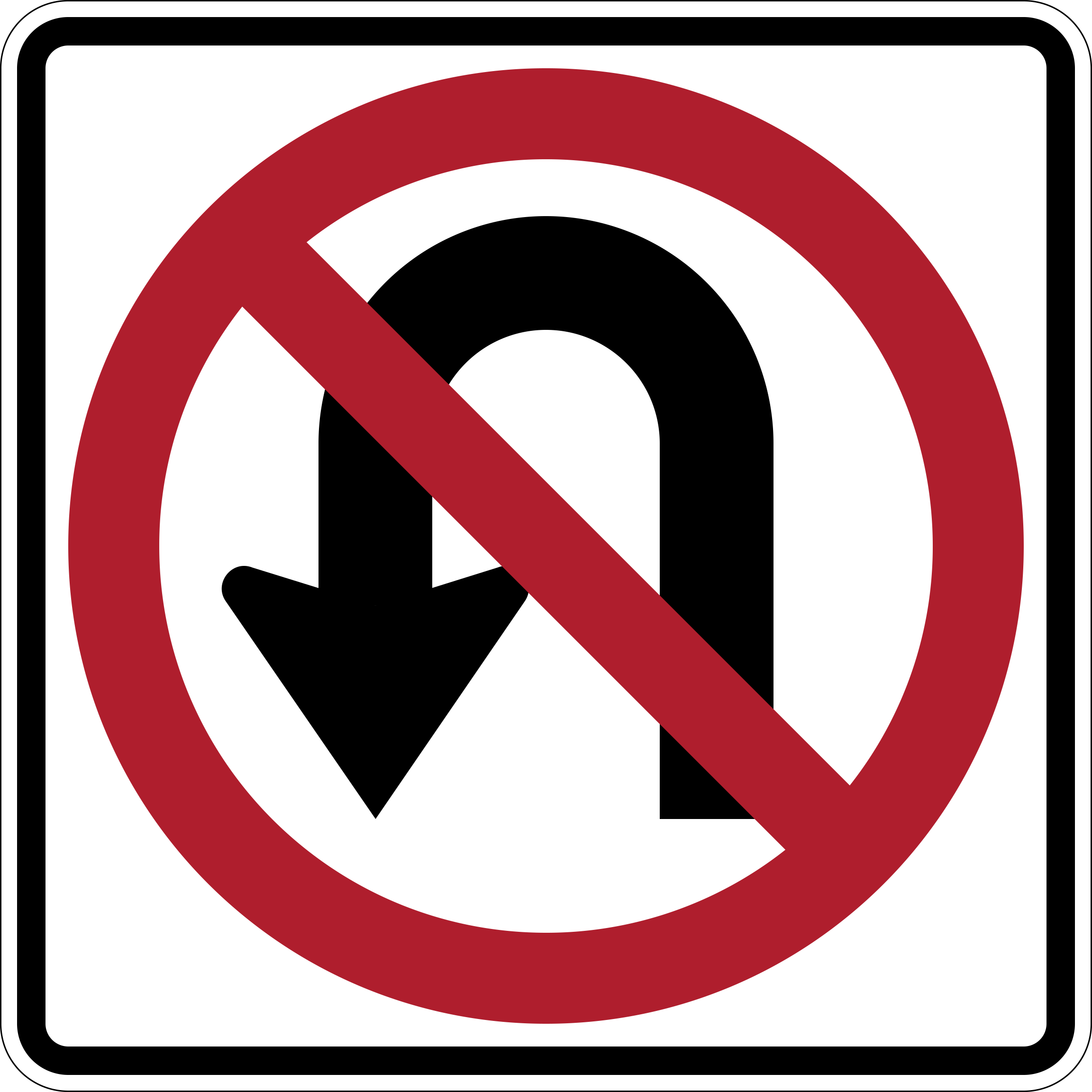
- Changing speed before a curve
- Turning into a driveway
- Moving from a one-way road to a two-way road
- Making a U-turn
Show answer
Making a U-turn. The pictured regulatory sign is the Wisconsin No U-turn sign, so it prohibits making a U-turn at that location. A driveway turn is a separate movement and is not what this symbol names. Moving between one way and two way roads describes a roadway arrangement rather than the banned maneuver. Changing speed before a curve concerns vehicle control, not this sign. When the sign appears, continue in an allowed direction and look for a later location where turning around is permitted. The most reliable clue is the curved U shaped arrow crossed by the red slash.
Study this in the handbook: Turns, passing, backing and parking
9. What does this Divided Highway warning tell you about traffic ahead?

- Opposing traffic will be separated by a physical barrier
- The roadway will become a single lane in each direction without separation
- All vehicles must make a U-turn at the next opening
- A railroad crossing has more than one track
Show answer
Opposing traffic will be separated by a physical barrier. A divided highway has two lanes carrying traffic in opposite directions, with a physical barrier such as a guardrail ahead. The choice “Opposing traffic will be separated by a physical barrier” includes both the separation and the barrier described by Wisconsin. The choice “The roadway will become a single lane in each direction without separation” removes the defining feature, while the U-turn and railroad choices concern different roadway conditions. Watch for the barrier as you approach and remain on the proper side of it. Do not cross through the divided area simply to reach a turn or respond to congestion.
Study this in the handbook: Warning and construction signs
10. During the first nine months of Wisconsin GDL restrictions, when may a teen drive alone?
- From 10 p.m. to 6 a.m., anywhere
- From midnight to 5 a.m., anywhere
- From 5 a.m. to midnight, anywhere
- Only during daylight hours
Show answer
From 5 a.m. to midnight, anywhere. The handbook allows a teen to drive alone and go anywhere between 5 a.m. and 12 a.m. During the midnight to 5 a.m. period, driving alone is limited to travel between home, school, and work. The overnight unrestricted choice therefore reverses the rule, and the 10 p.m. to 6 a.m. window is not Wisconsin's stated schedule. A daylight-only answer is too narrow because the allowed period extends through late evening. Use the clock boundary of midnight, not sunset, as the cue.
Study this in the handbook: The probationary license and GDL restrictions
11. What does a posted speed limit represent in Wisconsin?
- The minimum speed required on every road
- A suggested speed that may always be exceeded while passing
- The fastest speed allowed in that area
- A speed applying only when no other vehicles are present
Show answer
The fastest speed allowed in that area. A posted speed limit is the fastest speed permitted for the area under ordinary good conditions. It is not a suggestion that can be exceeded to pass, and it is not a minimum that every driver must maintain. The rule still does not authorize extra speed merely because the road is empty. Visibility, traffic, rain, snow, or ice may require a slower pace. Use the sign as an upper boundary, then select a speed that leaves enough distance to stop safely.
Study this in the handbook: Speed limits and the sight distance rule
12. What should a Wisconsin driver remember when turning on a steady green arrow?
- Oncoming traffic always has a green light too
- Watch for pedestrians
- Stop until the arrow changes to yellow
- Cross traffic may ignore the signal
Show answer
Watch for pedestrians. A steady green arrow lets a Wisconsin driver turn in the arrow's direction, but the handbook adds a pedestrian warning. Oncoming or crossing traffic should not be moving while the arrow is green, so saying oncoming traffic always has green reverses the signal design. Waiting for yellow is unnecessary when the path is clear, and assuming cross traffic may ignore signals is not the instruction. The cue is a protected arrow with a crosswalk nearby: turn, but keep scanning for people walking.
Study this in the handbook: Traffic lights and arrows
13. Where should you not stop when yielding to an approaching emergency vehicle?
- In a legal parking area
- On the side of the road
- In the middle of an intersection
- Behind the stop line
Show answer
In the middle of an intersection. A driver yielding to an approaching emergency vehicle must not stop in the middle of an intersection. That position can block the responder’s route and create a conflict with cross traffic. Pull toward the side of the road and stop until the emergency vehicle has passed, while avoiding sudden movements. The side of the road, a legal parking area, or a position behind the stop line can be appropriate depending on the roadway. The key cue is to clear the intersection before stopping.
Study this in the handbook: Pedestrians, emergency vehicles and school buses
14. At a four-way stop, two drivers arrive simultaneously. Which driver proceeds first?
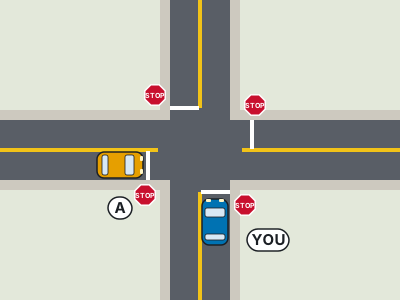
- The driver with the larger vehicle
- The driver on the left
- The driver going straight
- The driver on the right
Show answer
The driver on the right. When drivers reach a four-way stop at the same time, Wisconsin gives priority to the driver on the right. This resolves the tie without relying on vehicle size, intended direction, or a gesture from another motorist. If one driver arrived earlier, that arrival order controls instead. The left-side option reverses the handbook's tie rule, and a straight-moving vehicle does not automatically outrank a turning vehicle at this specific stop. Slow down, confirm who arrived first, then apply the right-side rule only when arrival is simultaneous.
Study this in the handbook: Right of way
15. Who may operate a farm tractor or self-propelled farm machinery on Wisconsin highways?
- A person who is at least 16 years old
- Anyone at least 14 years old
- Only a person at least 18 years old
- Any child if accompanied by an adult
Show answer
A person who is at least 16 years old. Wisconsin prohibits anyone under 16 from operating a farm tractor or self-propelled farm machinery on highways. Therefore, the handbook's age cutoff is at least 16, not 14 or 18. Adult accompaniment does not create an exception to the stated prohibition. This rule belongs to rural driving safety, where large equipment may move slowly and have limited visibility or signaling. When sharing the road, expect farm machinery and give it patience, space, and the right-of-way when required.
Study this in the handbook: Bad weather, skids, winter and rural roads
16. How many questions does the Wisconsin knowledge test include, and how many must an applicant answer correctly to pass?
- 60 questions, with 48 correct required
- 40 questions, with 32 correct required
- 50 questions, with 40 correct required
- 30 questions, with 24 correct required
Show answer
50 questions, with 40 correct required. The Wisconsin knowledge test includes 50 questions, and an applicant must answer 40 correctly to pass. The handbook identifies that threshold as 80 percent. The other pairs preserve an 80 percent pattern but use the wrong test size, so calculating a percentage alone is not enough. Memorize both figures together: 50 total and 40 correct. The test takes about 45 minutes, but that timing detail does not change the number of questions or the passing requirement.
Study this in the handbook: The vision, signs, knowledge and skills tests
17. A Wisconsin applicant under 18 has no living parent. What may the applicant file instead of having a sponsor?
- A school report card
- A signed statement from a teacher
- A second vision test
- Proof of insurance
Show answer
Proof of insurance. Wisconsin lets certain minors file proof of insurance instead of having a sponsor. The list includes applicants under 18 who do not have a living parent, who do not live with their parents and are full-time students or earning a living, who are wards placed in foster care, or who are married to a spouse under 18. A report card, a teacher's statement or an extra vision test is not a filing the handbook names; for these applicants it lists proof of insurance in place of a sponsor.
18. How much driving does a Wisconsin occupational license allow?
- Up to 12 hours a day and up to 60 hours a week, for listed purposes
- Unlimited driving during daylight
- Up to 8 hours a day and 40 hours a week, anywhere
- Only one round trip to work per day
Show answer
Up to 12 hours a day and up to 60 hours a week, for listed purposes. An occupational license lets a driver who lost the privilege drive up to 12 hours a day and up to 60 hours a week to and from work, school, and places needed to maintain the household, such as a grocery store, medical appointments, and the agency handling the Intoxicated Driver Program assessment and Driver Safety Plan. Unlimited daylight driving and driving anywhere are too broad. One trip to work per day is narrower than the stated purposes. The applicant also needs proof of financial responsibility.
Study this in the handbook: Points, seat belts, child seats and insurance
19. When must you yield to an emergency vehicle entering a roundabout?
- When it enters with its siren on
- Only when it has no warning lights
- Only after it stops in the roundabout
- Never, because circulating traffic has priority
Show answer
When it enters with its siren on. A driver must yield when an emergency vehicle enters a roundabout with its siren on. This emergency response rule overrides the ordinary priority given to traffic already circulating. If you have not entered, pull over and let the vehicle pass; if you are already inside, exit safely at the next right and then pull over. Do not stop in the roundabout, because blocking the circle can delay the emergency vehicle and create another hazard.
Study this in the handbook: Roundabouts, metered ramps and funeral processions
20. What does a yellow pennant-shaped no-passing sign mean?
- A school crossing begins ahead
- Passing is prohibited in that zone
- The roadway is open only to buses
- A railroad crossing is immediately ahead
Show answer
Passing is prohibited in that zone. The yellow pennant identifies a no-passing zone, so you may not pass another vehicle there. The school, bus, and railroad choices describe unrelated warnings or restrictions. Treat the pennant as a direct restriction on passing, not merely as a suggestion to be cautious. Scan for the pavement markings and keep your vehicle in its lane until the no-passing restriction ends and a legal, visible opportunity appears.
Study this in the handbook: Regulatory, destination and service signs
QualitySpace is expanding to Wisconsin
We are a California-based independent insurance brokerage working on licensing in more states. We cannot help with Wisconsin insurance yet. Leave your email and we will let you know when we can.
Every question is written from the official Wisconsin Motorists' Handbook. Need paper? Printable WI practice test with answer key.
Last verified 2026-10-05. How we check every question · Study all 200 as flashcards
Frequently asked questions
How many questions are on this Wisconsin practice test?
This fixed set has 20 questions. It is test 9 of 10 from the 200 question Wisconsin bank. The real WI exam has a 15 question road sign section with 12 correct to pass, plus 50 knowledge questions with 40 correct to pass.
What is the passing score for the real Wisconsin test?
40 questions (80%) correctly to pass That figure comes from the official Wisconsin source cited on the DMV facts page.
How does this fixed test relate to the full Wisconsin bank?
Each numbered test is a fixed set of questions in a fixed order, so you can retake the same test later and compare. Every test mixes road signs and the other topics in about the same proportion as the full bank. Tests 1 to 10 together cover every question in the Wisconsin bank once. The full practice page mixes the whole bank at random.
Last verified 2026-10-05. See the Wisconsin DMV facts page for sourced state details.
Return to the full Wisconsin practice test · Study road signs