
Test 12 of 25 · 20 questions · Free 2026
WI Permit Practice Test 12
Jump to the test ↓A fixed 20 question set from the Wisconsin bank with answers and plain English explanations. The real WI exam has a 15 question road sign section with 12 correct to pass, plus 50 knowledge questions with 40 correct to pass; take the full length version on the main practice page.
Question 1 of 20 · 0 right so far
All 20 questions in test 12
Every question below comes from the Wisconsin question bank on this page. Open a question to see the correct answer and the explanation. Nothing here is hidden behind a signup.
1. In Wisconsin, a flashing yellow arrow appears for your left turn. What must you do before turning?
- Turn immediately, because the arrow gives you the right of way
- Yield first, then turn with caution when clear
- Stop for a full minute, then turn without yielding
- Turn only after the arrow becomes a steady red light
Show answer
Yield first, then turn with caution when clear. Before turning at a flashing yellow arrow, yield first, then turn with caution. The flashing arrow permits the turn but does not protect it, so oncoming traffic and pedestrians keep their priority. Turning at once, waiting through a timed stop, or holding for a red arrow all miss that yield-then-turn sequence. Creep forward, judge the oncoming gap honestly, and complete the turn only when it clears everyone already moving.
Study this in the handbook: Traffic lights and arrows
2. In Wisconsin, you may travel briefly in a reserved lane marked for special vehicles only in which situation?
- When the general lanes are crowded at rush hour today
- When following a bus that is using the reserved lane
- When your trip in the lane stays under five minutes
- When turning across it in the next half of a block
Show answer
When turning across it in the next half of a block. A driver may travel briefly in a reserved lane marked for special vehicles when turning across it in the next half of a block. Rush hour crowding, following a bus, or keeping the trip short does not create that permission. Enter the lane only to complete the turn, check for the special vehicles and bicyclists the lane serves, and leave it as soon as the turn is done rather than continuing in it.
Study this in the handbook: Lane lines, crosswalks and special lanes
3. In Wisconsin, a driver is very angry after an argument. What does the handbook advise about driving?
- Drive faster to work off the angry feeling quickly
- Not while very worried, excited, afraid, angry or depressed
- Drive only on familiar streets while feeling upset
- Drive with the radio loud to change your mood
Show answer
Not while very worried, excited, afraid, angry or depressed. Emotions strongly affect safe driving, so do not drive if you are very worried, excited, afraid, angry or depressed. Speeding to burn off anger, sticking to familiar streets, or blasting the radio does not restore judgment. Pull over, breathe, call someone, or let another person drive. Twenty minutes of cooling down protects you, your passengers, and strangers who never saw the argument.
Study this in the handbook: The horn, headlights and turn signals
4. In Wisconsin, fog makes it hard to see the road ahead. What combined response is required?
- Keep the posted speed and drive on parking lights
- Speed up briefly to exit the fog bank sooner
- Slow down, stay ready to stop, and drive with headlights on
- Follow the car ahead as closely as possible
Show answer
Slow down, stay ready to stop, and drive with headlights on. Fog, rain and other low visibility conditions require a lower speed, readiness to stop, and headlights to see better. The posted limit may be far too fast for what you can see, parking lights are too dim for driving, and close following removes your only margin. Slow until you can stop inside the distance you actually see, and let impatient drivers pass where it is safe.
Study this in the handbook: Bad weather, skids, winter and rural roads
5. In Wisconsin, where is the blue railroad problem report sign posted?
- At every crossing, with a phone number for reporting problems
- Only at crossings equipped with gates and bells
- Only at crossings located on interstate highways
- Only at crossings built near a police station
Show answer
At every crossing, with a phone number for reporting problems. The blue sign with white lettering that lists a phone number for unsafe conditions is posted at every highway-railroad crossing, not only at gated or interstate crossings. Keeping it universal means any driver can report a stalled vehicle or a broken warning light. If you see a hazard on the tracks, move to a safe place and call the number on that blue sign.
Study this in the handbook: Railroad crossing signs and rules
6. In Wisconsin, a crossing has no number-of-tracks sign. What should a driver still do?
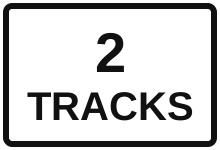
- Assume there is only one track and cross quickly
- Stop on the first track to look both ways
- Check for more than one track before crossing
- Cross slowly while shifting gears to listen
Show answer
Check for more than one track before crossing. Not every crossing with several tracks posts a number-of-tracks sign, so the absence of that sign proves nothing. Always check for more than one track before crossing, because a second train can follow the first. Never stop on a track to look, and never shift gears while crossing. Wait until you can see that every track is clear and that there is room beyond the last rail.
Study this in the handbook: Railroad crossing signs and rules
7. In Wisconsin, a white arrow is painted in a lane ahead of a driver. What does that arrow show?
- How many seconds the green light will last
- What direction the driver needs to go in that lane
- Where the nearest crosswalk will appear
- Which side of the road parking is allowed
Show answer
What direction the driver needs to go in that lane. A white arrow painted in a lane shows what direction you need to go in that lane, such as straight or turning. It does not time the signal, place the next crosswalk, or assign parking sides. Read the arrow early enough to be in the proper lane before the intersection. Changing lanes at the last second over solid markings risks cutting off drivers beside you.
Study this in the handbook: Lane lines, crosswalks and special lanes
8. In Wisconsin, which drivers face greater risk of drowsy related crashes?
- Drivers over sixty with morning jobs
- Teen and young adult drivers
- Drivers who only drive at noon
- Drivers with passengers who stay awake
Show answer
Teen and young adult drivers. Teen and young adult drivers are at greater risk of drowsy related crashes. Drowsy driving follows little sleep, and it can also follow an untreated sleep disorder or a long shift at work. Getting enough sleep the night before you drive matters. Pull over and rest if you are yawning or blinking a lot, drifting from your lane, or hitting the rumble strip on the side of the road.
Study this in the handbook: Distracted and drowsy driving
9. In Wisconsin, why must drivers be careful around farm equipment on the road?
- Farmers may miss traffic, and gear may lack brake or turn lights
- Farm equipment always travels at highway speed
- Farmers can stop equipment instantly any time
- Equipment always displays full car lighting
Show answer
Farmers may miss traffic, and gear may lack brake or turn lights. Be careful around farm equipment because farmers may have difficulty seeing or hearing other traffic over machine noise, and their equipment may not have brake lights or turn signals. A tractor will not match highway speed or stop instantly. Do not assume a slowdown or turn will be signaled. Hang back, pass only with generous clear space, and expect wide turns into field drives.
Study this in the handbook: Bad weather, skids, winter and rural roads
10. In Wisconsin, how can a driver make routine stops safer for everyone in line?
- Brake late so traffic behind stays close
- Coast in neutral to every stop sign
- Slow down earlier to make a gradual and safer stop
- Stop suddenly, then wave traffic around
Show answer
Slow down earlier to make a gradual and safer stop. Slowing down earlier makes a gradual and safer stop, giving the driver behind time to match your pace. Braking late compresses the whole line, coasting in neutral removes engine control, and sudden stops with a wave confuse following drivers. Watch far ahead, lift off the gas when a stop is likely, and press the brake smoothly. Early, gentle stops also save wear on your brakes.
Study this in the handbook: Speed limits and the sight distance rule
11. In Wisconsin, why can passing another vehicle on the right be especially risky?
- Right passes are risky only in rainy weather
- The other driver might not be able to see you there
- Right side passes always take longer than passing on the left
- The right lane always ends without warning
Show answer
The other driver might not be able to see you there. Passing on the right is risky because the driver you pass might not be able to see you in that position, since drivers watch their left side for passing traffic. Weather, pass length, and lane endings are not the core danger. Prefer passing on the left where you are expected. If a right pass is lawful and needed, allow extra room and expect the other car to drift right.
12. In Wisconsin, a driver approaches a stretch of curved road over hills. What speed change is needed?
- Slow down to navigate the curves and hills safely
- Speed up to keep momentum over the hills
- Hold your speed, because curves only matter at night
- Coast in neutral down each hill to save fuel
Show answer
Slow down to navigate the curves and hills safely. Slow down for curved roads and hills, where sight distance shortens and the car needs extra room to change direction. Speeding for momentum, treating curves as a night-only concern, or coasting in neutral all reduce control. Enter curves at a speed that lets you stop for a stalled car or deer just beyond the crest, and keep the car in gear for steady control.
Study this in the handbook: Right of way
13. In Wisconsin, what parking responsibility does the driver hold for the parked vehicle?
- Keeping the parked vehicle from becoming a hazard and clear of traffic
- Park as close to travel lanes as the car fits
- Leave hazards acceptable if flashers are on
- Let the following drivers judge whether the parked position is safe for traffic
Show answer
Keeping the parked vehicle from becoming a hazard and clear of traffic. You are responsible for making sure your vehicle is not a hazard when parked, parked far enough from any travel lane to avoid interfering with traffic, normally on the far right side of the road. Flashers do not excuse a blocking position, and other drivers cannot ratify your choice. Check mirrors before opening doors, confirm the car clears the lane fully, and reposition if it does not.
Study this in the handbook: Turns, passing, backing and parking
14. In Wisconsin, two drivers arrive at a four-way stop at the same moment, one on your right. Which driver proceeds first?
- The driver on the left proceeds first at a tie
- Whoever accelerates first claims the intersection
- Both drivers proceed together through the middle
- The driver on the right proceeds first
Show answer
The driver on the right proceeds first. At a four-way stop where two drivers arrive simultaneously, the driver on the right proceeds first. The driver on the left yields in that tie, and racing or entering together does not settle the conflict safely. If you are the driver on the left, wait and wave nothing ambiguous; let the right side driver go, then take your turn when the intersection is clear and your stop is complete.
Study this in the handbook: Right of way
15. In Wisconsin, the gas pedal sticks and the car keeps accelerating. What is the final step described?
- Turn off the engine first while still at full speed in traffic
- Press the gas harder to free the pedal while steering
- Shift to reverse to cancel the acceleration
- Pull off the road safely in neutral and turn off the engine
Show answer
Pull off the road safely in neutral and turn off the engine. With a stuck gas pedal, keep your eyes on the road, shift to neutral, pull off the road when safe, and turn off the engine as the final step. Killing the engine at speed in traffic removes steering assist while the car still rolls fast, stomping the pedal may not free it, and reverse would wreck the driveline. Neutral disconnects the power so brakes can win.
Study this in the handbook: Avoiding crashes, crash duties and roadside emergencies
16. In Wisconsin, a driver who has been drinking asks what will sober them up before driving home. What is the answer?
- Coffee and fresh air will sober a driver up quickly
- A large meal will sober a driver up within an hour
- Only time will sober a driver up
- Cold water and exercise will sober a driver up fast
Show answer
Only time will sober a driver up. The only thing that will sober a driver up is time. Coffee, fresh air, meals, cold water, and exercise can make a person feel more alert while alcohol remains active. That false alertness is dangerous because judgment and reaction stay impaired. A driver who has been drinking should not drive at all; wait with a sober driver or arrange another ride home.
Study this in the handbook: Alcohol, drugs and implied consent
17. In Wisconsin, a friend insists the vehicle on the right always goes first at every intersection. What does the guidance say?
- The vehicle on the right always goes first without exception
- The vehicle on the left always goes first at intersections
- The faster vehicle always goes first at every crossing
- Do not assume that, because each situation can differ
Show answer
Do not assume that, because each situation can differ. Do not assume the vehicle on the right always goes first, because each situation can differ. Signals, signs, pedestrians, and vehicles already inside an intersection can all change who yields. Replacing the saying with a left-side or faster-vehicle rule keeps the same mistake in a new form. Read the actual controls and traffic at each intersection, yield as they require, and proceed only when your movement is clearly lawful and safe.
Study this in the handbook: Right of way
18. In Wisconsin, what shapes do regulatory signs take at the roadside?
- Always round and yellow with black symbols
- Always triangular and orange with black symbols
- Square, rectangle or a special shape, often white or red
- Always diamond shaped and blue with white symbols
Show answer
Square, rectangle or a special shape, often white or red. Regulatory signs are square, rectangular, or a special shape such as the octagon or triangle, and they can be white or red with black, red, white or green lettering. Round yellow belongs to railroad warnings, orange triangles to slow moving vehicles, and blue diamonds are not a standard family. Reading shape and color together tells you a rule applies before you can read the words.
Study this in the handbook: Regulatory, destination and service signs
19. In Wisconsin, an emergency vehicle with flashing lights and a siren approaches behind you on a two-lane road. What must you do?
- Stop immediately in your travel lane so it can pass around you
- Speed up to stay ahead of it until your exit arrives
- Follow it closely after it passes to use its clear path
- Pull to the side of the road and stop until it has passed
Show answer
Pull to the side of the road and stop until it has passed. When an emergency vehicle approaches with lights and sirens, pull to the side of the road and stop until the emergency vehicle has passed. Stopping in your lane, outrunning it to your exit, or drafting behind it afterward all obstruct or misuse the response. If you are inside an intersection, clear it safely first, then pull aside. Stay stopped until the vehicle is fully past before reentering traffic.
Study this in the handbook: Pedestrians, emergency vehicles and school buses
20. In Wisconsin, at a three-lane roundabout approach, which lane is used to go straight?
- The middle lane is used to go straight
- The left lane is used to go straight through
- The right lane is used for U-turns
- Any lane may be used to go straight
Show answer
The middle lane is used to go straight. At a roundabout approach, the left lane is generally marked for turning left, the right lane for the next right turn, and the middle lane to go straight. Using the left lane straight or inventing U-turns from the right crosses the paths painted for others. Read the signs above you early, because lane choice must be settled before the yield line, not inside the circle.
Study this in the handbook: Roundabouts, metered ramps and funeral processions
Every question is written from the official Wisconsin Motorists' Handbook. Need paper? Printable WI practice test with answer key.
Last verified 2026-10-05. How we check every question · Study all 500 as flashcards
Frequently asked questions
How many questions are on this Wisconsin practice test?
This fixed set has 20 questions. It is test 12 of 25 from the 500 question Wisconsin bank. The real WI exam has a 15 question road sign section with 12 correct to pass, plus 50 knowledge questions with 40 correct to pass.
What is the passing score for the real Wisconsin test?
40 questions (80%) correctly to pass That figure comes from the official Wisconsin source cited on the DMV facts page.
How does this fixed test relate to the full Wisconsin bank?
Each numbered test is a fixed set of questions in a fixed order, so you can retake the same test later and compare. Every test mixes road signs and the other topics in about the same proportion as the full bank. Tests 1 to 25 together cover every question in the Wisconsin bank once. The full practice page mixes the whole bank at random.
Last verified 2026-10-05. See the Wisconsin DMV facts page for sourced state details.
Return to the full Wisconsin practice test · Study road signs